
BuddhistCatholicContemplativeEvangelicalGeneral ChristianHinduJewishLatter-day SaintMuslimNew VisionsProgressive Christian
Beliefs
- Buddhist
- Catholic
- Contemplative
- Evangelical
- General Christian
- Hindu
- Jewish
- Latter-day Saint
- More Voices
- Muslim
- New Visions
- Pagan
- Progressive Christian
Topics
- Religion News
- Food and Religion
- Sports and Religion
- Religious Art
- Religious Music and Entertainment
- Religious Events
- History and Religion
- Style and Religion
- Politics and Religion
- Women in Religion
- Recreation Outdoors and Religion
- Business Finance and Religion
- Careers Workplace and Religion
- Education and Religion
- Family Parenting and Religion
- Health Fitness and Religion
- Home and Religion
- Relationships and Religion
- Technology and Religion
- Travel and Religion
Columnists
- Buddhist Columnists
- Business Finance and Religion Columnists
- Careers Workplace and Religion Columnists
- Catholic Columnists
- Contemplative Columnists
- Education and Religion Columnists
- Evangelists Columnists
- Family Parenting and Religion Columnists
- General Christian Columnists
- Health Fitness and Religion Columnists
- Hindu Columnists
- History and Religion Columnists
- Home and Religion Columnists
- Jewish Columnists
- More Voices Columnists
- Latter Day Columnists
- Muslim Columnists
- New Visions Columnists
- Nonreligious Columnists
- Pagan Columnists
- Politics and Religion Columnists
- Progressive Columnists
- Recreation Outdoors and Religion Columnists
- Relationships and Religion Columnists
- Religion News Columnists
- Religious Art Columnists
- Religious Events Columnists
- Religious Music and Entertainment Columnists
- Sports and Religion Columnists
- Style and Religion Columnists
- Technology and Religion Columnists
- Travel and Religion Columnists
- Women in Religion Columnists
Resource Library
- 2026 Calendar
- Library of World Religions
- The 100 Most Holy Places on Earth
- Patheos Answers
- Podcasts
- Videos
- Faith Leaders Database
- Anglican Episcopalian
- Bahai
- Baptist
- Buddhism
- Christianity
- Confucianism
- Eastern Orthodoxy
- Hinduism
- Holiness and Pentecostal
- ISKCON
- Islam
- Judaism
- Lutheran
- Methodist
- The Church of Jesus Christ of Latter-day Saints
- New Age
- Paganism
- Presbytarian and Reformed
- Protestantism
- Religion Behind the Scenes
- Roman Catholic
- Scientology
- Shia Islam
- Sikhism
- Sufism
- Sunni Islam
- Taoism
- Zen
- See all religions
Research Tools
 Ad-Free & Subscriber Log-In Subscription Support
Ad-Free & Subscriber Log-In Subscription Support
Follow Patheos 

- Trending:
- Forgiveness
- |
- Marriage
- |
- Consciousness
- |
- Death Penalty
- |
- Election
- |
- Halloween
 Cosmos The In Lost
- Home
- Catholic
- G. Wolfe: Eat (Cath-L)it Already!
G. Wolfe: Eat (Cath-L)it Already!
Last updated on: January 19, 2015 at 10:22 pm by Artur Rosman
G. Wolfe: Eat (Cath-L)it Already! 2015-01-19T22:22:53-07:00 Artur Rosman
Patheos Explore the world's faith through different perspectives on religion and spirituality! Patheos has the views of the prevalent religions and spiritualities of the world.
I’ve done a fair share of writing on the fiction of a Catholic/Christian/Religious/(Whatever, so long as we manufacture something to regret) literary crisis here, here, and here.

I pity the amount of reading you have left if you think all the great Catholic lit appeared during the 50’s and 60’s.
Dana Gioia recently joined the chorus of Cassandras such as Elie and Boyagoda. I’ve been trying to wrap my head around the Gioia article for a while. To my tastes it piles on too many stereotypes about religious writing without actually gathering them into a comprehensible whole. Maybe I’ll come back to it sometime, meanwhile, here’s what Gregory Wolfe has to say about in a First Things essay “Cultural Anorexia: Doubting the Decline of Faith in Fiction.”
I think he’s right on when he suggests there might be an element of laziness involved in the latest round of narratives of decline. Wolfe says:
“So here’s my counter-thesis: The loss of a Catholic presence in mainstream literary culture is not because we are suffering from a dearth of gifted Catholic writers but because ideological blinders have prevented religious and secular people alike from perceiving and engaging the work that is out there.
In other words, we suffer from a type of spiritual and cultural anorexia: What would feed and nourish us is before us, but we will not eat.”
He continues with, “The weakest part of ‘The Catholic Writer Today‘ is its assertion that we have fallen away from a high point of Catholic literary activity in the mid-twentieth century. In the spirit of Gioia’s essay—with its insistence of grounding arguments in fact—I decided to test his narrative of decline.”
I’ll spare you Gioia’s list of late-greats, because you’re familiar with them, because not all of them were that great, because in his hurry to Jeremiad Gioia didn’t seem to notice how many of them were nominally Catholic.
I’ll leave you with a clickable version of Wolfe’s list of contemporary writers. Each link leads to a representative work by the author. It’s up to you to get off your lazy… and tolle lege.
“They included established fiction writers—Ron Hansen, Alice McDermott, Cormac McCarthy, Tobias Wolff, Robert Clark, Stuart Dybek, Oscar Hijuelos, Louise Erdrich, David Plante, Ann Patchett, Mary Gordon, Robert Girardi, and the late Andre Dubus. . . . There were also science-fiction and detective writers such as Gene Wolfe, Dennis Lehane, Dean Koontz, and the late Tony Hillerman. There was an equally strong Catholic presence in American poetry, which included Marie Howe, Franz Wright, Paul Mariani, Mary Karr, Carolyn Forché, Kevin Hart, Dana Gioia, Martha Serpas, Orlando Ricardo Menes, Janet McCann, Bruce Bond, Lise Goett, Jerry Harp, Madeleine DeFrees, and Timothy Murphy. Moreover, given the rise of memoir as a literary genre in recent decades, I would see Gioia’s list and raise him a series of nonfiction writers whose work is shot through with a profoundly Catholic sensibility—writers like Richard Rodriguez, Annie Dillard, Patricia Hampl, Thomas Lynch, and Barry Lopez.”
That, my friends, is a lot of links. Don’t miss the rest of Wolfe’s essay, especially where he details how the tone of contemporary literature is appropriate for our time.
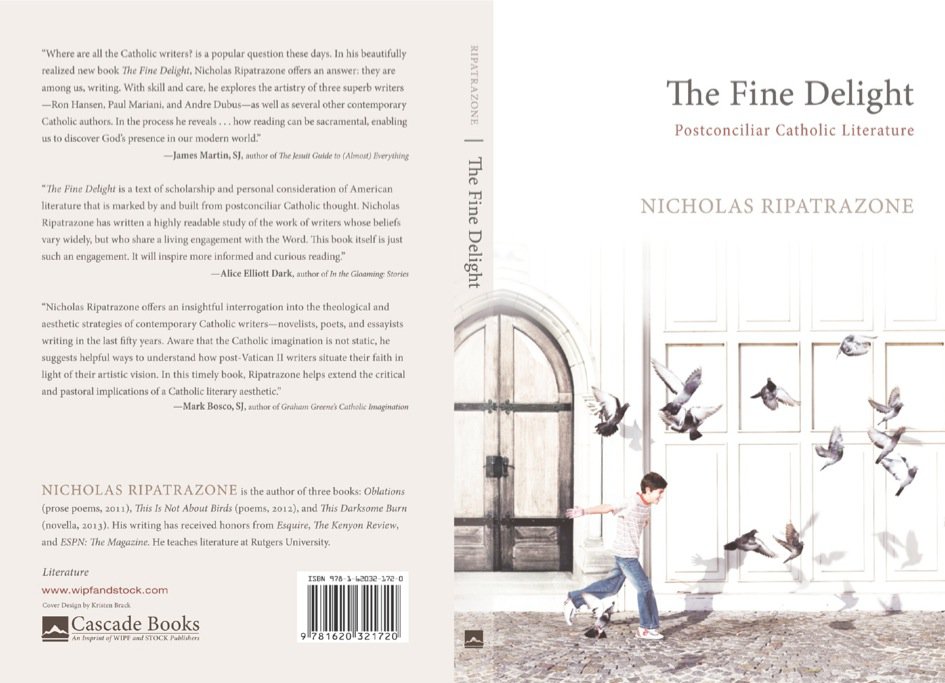
Ripatrazone’s postconciliar Catholic delights.
If you want a book-length account of trends in contemporary Catholic literature, you should take a look at Nick Ripatrazone’s The Fine Delight: Postconciliar Catholic Literature. Don’t miss his fine blog which takes its title from the book (and includes an interview with yours truly).
Tolle lege, indeed and…
http://www.youtube.com/watch?v=ZcJjMnHoIBI
Previous Post

December 21, 2013
Christmas Carols from the DSM-5
Next Post
December 25, 2013 TOP10: A Christmas Gift for Catholics from Wipf & Stock
Browse Our Archives
Select a Category #WhyRemainCatholic Abortion Advent Anti-Catholicism Arts Atheism Beauty Benedict XVI Bible Book Review Catholic Cinema Comedy Cosmos: A Space-Time Odyssey Czesław Miłosz Dariusz Karłowicz Devil Easter Eastern Orthodoxy Economics Environment Family Famous Atheists Who Weren't Atheists Guest Post Hans Urs von Balthasar HHS Mandate History Imagination Interview Islam Jean-Luc Marion John Paul II Judaism Just War Lent Literature Little Sisters of the Poor Liturgy Martyrdom Music News Paganism Patristics Phenomenology Philosophy Pierre Hadot Poetry Poland Pop Culture Pope Francis Poverty Prayer Protestantism Rabelais Race Remi Brague Rene Girard Russia Sam Rocha Science & Religion SCOTUS Secularization Sexual Abuse Sexuality Silence Solidarity Stratford Caldecott Synod14 Terrorism Top 10 Uncategorized Walker Percy War Weakened Edition World War II World Youth Day WYD Krakow
Select a Month July 2017 June 2017 May 2017 April 2017 March 2017 February 2017 January 2017 December 2016 October 2016 September 2016 August 2016 July 2016 June 2016 May 2016 April 2016 March 2016 February 2016 January 2016 December 2015 November 2015 October 2015 September 2015 August 2015 July 2015 June 2015 May 2015 April 2015 March 2015 February 2015 January 2015 December 2014 November 2014 October 2014 September 2014 August 2014 July 2014 May 2014 April 2014 March 2014 February 2014 January 2014 December 2013 November 2013 October 2013 September 2013 August 2013 July 2013 June 2013 May 2013
Follow Us!
TAKE THE
Religious Wisdom Quiz
Dry bones in a valley came together, received sinews and flesh, then breath entered them. What did this valley represent?
Select your answer to see how you score.
The dead The house of Israel God's army The resurrection
Related posts from Cosmos The In Lost

The Surprising Anti-Capitalist Logic Behind the Catholic Church's...

How is Classical Philosophy is Like War?

Why Does the World's Leading Philosopher Remain a...
It's a Good Friday to Leave Calypso's Island
TRENDING AT PATHEOS Catholic

Rejecting Doom: Christian Hope And Human Action
Christianity is a religion of hope. We are to have hope and...

It’s What Comes From Within Which Matters
One of the most difficult things for us to understand is why...

Why I Choose the Eucharist Over the Sermon
Choose the Eucharist, Not the Sermon What are we supposed to get...

5 Design Elements Found in Spiritually Rooted Homes
Putting Spirituality Into Home Decor Our homes are more than our living...

Credo: A Story of God Told with the...
About 10 years ago, I began to imagine a personal "Credo" that...

The Anatomy of Divine Revelation in Catholic Thought
The claim that God has made Himself known to human beings is...
view all Catholic blogs
Ad-Free & Subscriber Log-In Subscription Support
- About Us
- 2026 Calendar
- Videos
- Podcasts
- Library of World Religions
- Faith In Media Tracker
- Advertise With Us
- Write for Us
- Privacy Policy
- Terms of Service
- Do Not Sell My Data
- Contact Us
- Radiant Digital
- Manage Newsletter Subscriptions
- Unsubscribe From Notifications
- Sitemap
Copyright 2008-2026, Patheos. All rights reserved.
Subscription Support Ad-Free & Subscriber Log-In
Follow Patheos