
BuddhistCatholicContemplativeEvangelicalGeneral ChristianHinduJewishLatter-day SaintMuslimNew VisionsProgressive Christian
Beliefs
- Buddhist
- Catholic
- Contemplative
- Evangelical
- General Christian
- Hindu
- Jewish
- Latter-day Saint
- More Voices
- Muslim
- New Visions
- Pagan
- Progressive Christian
Topics
- Religion News
- Food and Religion
- Sports and Religion
- Religious Art
- Religious Music and Entertainment
- Religious Events
- History and Religion
- Style and Religion
- Politics and Religion
- Women in Religion
- Recreation Outdoors and Religion
- Business Finance and Religion
- Careers Workplace and Religion
- Education and Religion
- Family Parenting and Religion
- Health Fitness and Religion
- Home and Religion
- Relationships and Religion
- Technology and Religion
- Travel and Religion
Columnists
- Buddhist Columnists
- Business Finance and Religion Columnists
- Careers Workplace and Religion Columnists
- Catholic Columnists
- Contemplative Columnists
- Education and Religion Columnists
- Evangelists Columnists
- Family Parenting and Religion Columnists
- General Christian Columnists
- Health Fitness and Religion Columnists
- Hindu Columnists
- History and Religion Columnists
- Home and Religion Columnists
- Jewish Columnists
- More Voices Columnists
- Latter Day Columnists
- Muslim Columnists
- New Visions Columnists
- Nonreligious Columnists
- Pagan Columnists
- Politics and Religion Columnists
- Progressive Columnists
- Recreation Outdoors and Religion Columnists
- Relationships and Religion Columnists
- Religion News Columnists
- Religious Art Columnists
- Religious Events Columnists
- Religious Music and Entertainment Columnists
- Sports and Religion Columnists
- Style and Religion Columnists
- Technology and Religion Columnists
- Travel and Religion Columnists
- Women in Religion Columnists
Resource Library
- 2026 Calendar
- Library of World Religions
- The 100 Most Holy Places on Earth
- Patheos Answers
- Podcasts
- Videos
- Faith Leaders Database
- Anglican Episcopalian
- Bahai
- Baptist
- Buddhism
- Christianity
- Confucianism
- Eastern Orthodoxy
- Hinduism
- Holiness and Pentecostal
- ISKCON
- Islam
- Judaism
- Lutheran
- Methodist
- The Church of Jesus Christ of Latter-day Saints
- New Age
- Paganism
- Presbytarian and Reformed
- Protestantism
- Religion Behind the Scenes
- Roman Catholic
- Scientology
- Shia Islam
- Sikhism
- Sufism
- Sunni Islam
- Taoism
- Zen
- See all religions
Research Tools
 Ad-Free & Subscriber Log-In Subscription Support
Ad-Free & Subscriber Log-In Subscription Support
Follow Patheos 

- Trending:
- Forgiveness
- |
- Marriage
- |
- Consciousness
- |
- Death Penalty
- |
- Election
- |
- Halloween
 Cosmos The In Lost
- Home
- Catholic
- Thanksgiving Special: Eating, Theology, Philosophy, and the Hungry Soul
Thanksgiving Special: Eating, Theology, Philosophy, and the Hungry Soul
Last updated on: February 10, 2015 at 9:53 am by Artur Rosman
Thanksgiving Special: Eating, Theology, Philosophy, and the Hungry Soul 2015-02-10T09:53:06-07:00 Artur Rosman
Patheos Explore the world's faith through different perspectives on religion and spirituality! Patheos has the views of the prevalent religions and spiritualities of the world.
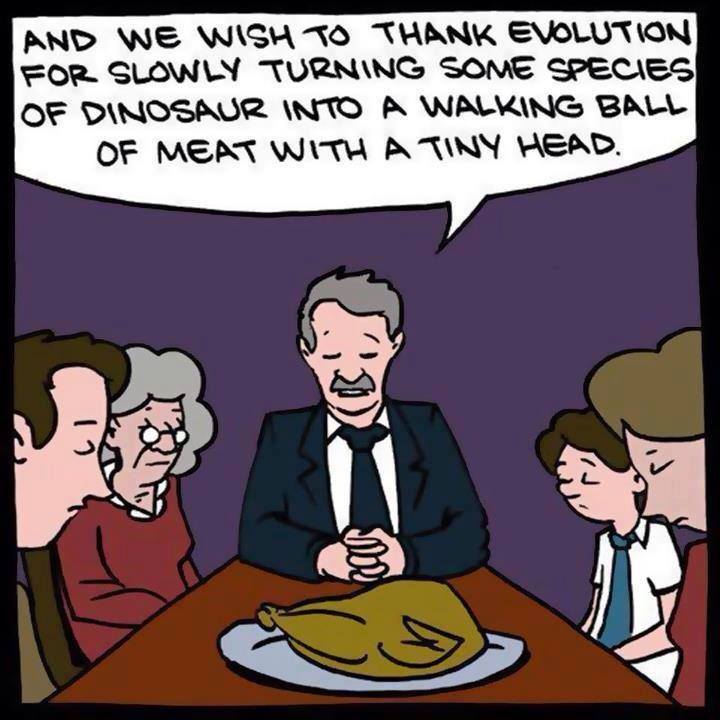
The books in the Cosmos TOP 10 Science and Religion list explore why we don’t talk this way.
Today is a busy day, so I’ll have to confine myself to some quick remarks. While I’m not theologically set against evolution in a way that the topic of my dissertation (Czeslaw Milosz) was, I am fascinated by books that deal with the unique problems of conceptualization and language that it poses for theology. The books in the Cosmos TOP 10 Science and Religion list have helped me think some of these things through.
But we won’t be talking about that today. Even though eating is a frequent activity–more frequent for some of us than others–it garners precious little attention from philosophers and theologians. Perhaps eating is so ubiquitous that it escapes intellectual attention? Or maybe intellectual work is somehow in competition with eating? But then we talk about devouring books. I’m puzzled.
The most widely circulated books on the topic like Levi-Strauss’ The Raw and the Cooked, Michel de Certeau’s The Practice of Everyday Life, Vol. 2: Living and Cooking and the incommparable classic Eat, Pray, Love have been gobbled up by many of you by now. So what else is there? Take a look and these books and their blurbs.
What follows is a reduced TOP 10 list (poke around in the TOP 10 archives here). I hope the self-control I exhibit by limiting myself to only five books will help to encourage you to moderate your eating habits over the next few days. Such a transformation of your habits could leave more money for books, or the collection plate.

I’m too much of an idiot to figure out how the title of this book might require a reworking of Dostoevsky’s dictum “Beauty will save the world.”
“The enigmatic link between the natural and artistic beauty that is to be contemplated but not eaten, on the one hand, and the eucharistic beauty that is both seen (with the eyes of faith) and eaten, on the other, intrigues me and inspires this book. One cannot ask theo-aesthetic questions about the Eucharist without engaging fundamental questions about the relationship between beauty, art (broadly defined), and eating.”—from Eating Beauty
In a remarkable book that is at once learned, startlingly original, and highly personal, Ann W. Astell explores the ambiguity of the phrase “eating beauty.” The phrase evokes the destruction of beauty, the devouring mouth of the grave, the mouth of hell. To eat beauty is to destroy it. Yet in the case of the Eucharist the person of faith who eats the Host is transformed into beauty itself, literally incorporated into Christ. In this sense, Astell explains, the Eucharist was “productive of an entire ‘way’ of life, a virtuous life-form, an artwork, with Christ himself as the principal artist.”
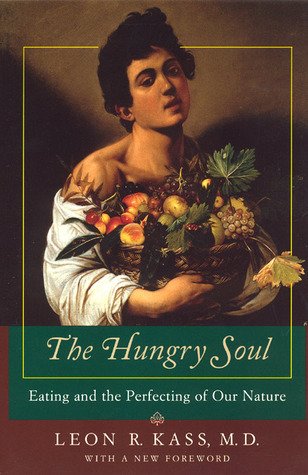
Looking a bit pale. Give that hungry soul some vodka.
Eating, observes Kass, a physician and biochemist who teaches literature and philosophy at the University of Chicago, is a “great paradox.” To preserve life, individuals necessarily destroy life. Yet, he argues, if this urgent, most basic animal necessity is humanized through table manners, hospitality, sharing, good conversation and ritual, eating becomes a means to celebrate and broaden human community, friendship and values. This stimulating, original philosophical inquiry views eating among humans as a key to our place in the natural order and as a manifestation of the “hungry soul” that seeks satisfaction in activities motivated by ambition, curiosity, affection and awe. Kass concludes by arguing that Jewish dietary laws are one example of a code that embodies an understanding of the ethics of eating and a reverence for life.

Stone and Dung, Oil and Spit, or: What Jesus Ate and What He Did Afterwards
In Stone and Dung, Oil and Spit Jodi Magness unearths “footprints” buried in both archaeological and literary evidence to shed new light on Jewish daily life in Palestine from the mid-first century b.c.e. to 70 c.e. — the time and place of Jesus’ life and ministry.
Magness analyzes recent archaeological discoveries from such sites as Qumran and Masada together with a host of period texts, including the New Testament, the works of Josephus, and rabbinic teachings. Layering all these sources together, she reconstructs in detail a fascinating variety of everyday activities — dining customs, Sabbath observance, fasting, toilet habits, burial customs, and more.
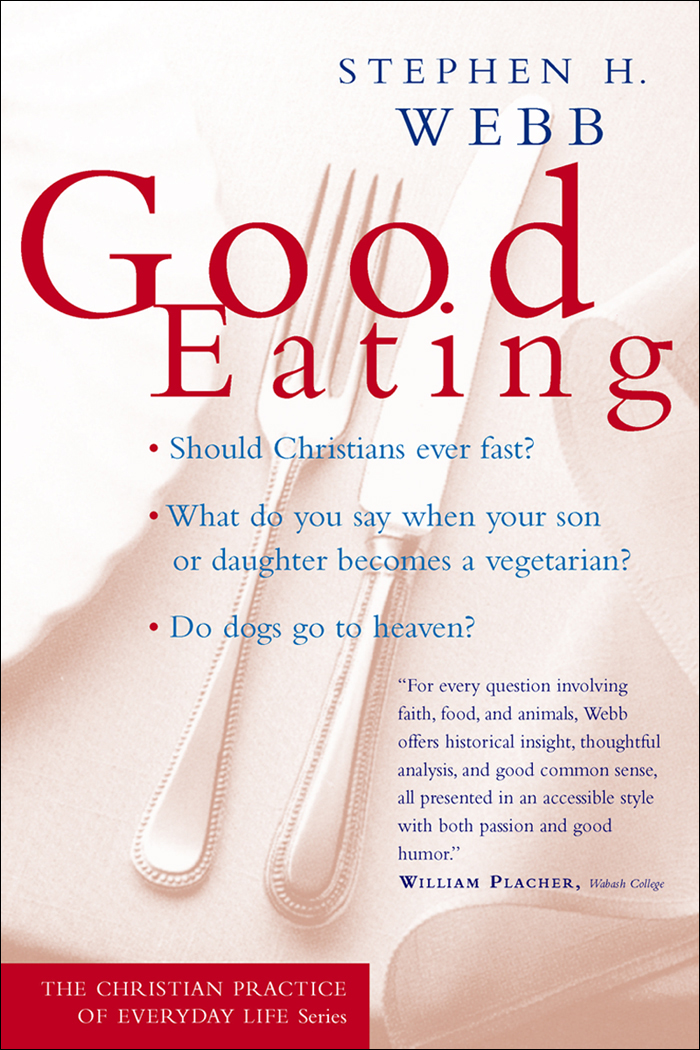
What is the early Christian theology of Good Eating?
In the diet-obsessed U.S., a book beginning with the claim that “the unexamined meal is not worth eating” really should find an audience, especially given the worldwide significance of food-related issues and the fact that Christianity is defined by a meal. In Good Eating Webb proposes a biblical alternative to the animal-rights movement, which he sees as largely anti-Christian. He articulates a biblical understanding of human-animal relationships by, he insists, sharpening the distinction between humans and animals rather than blurring it. He constructs his critique within a theology of diet, thereby taking up a long-neglected tradition that was influential in early Christianity and addressing historic questions about food and animals in relation to John the Baptist, Jesus, and the early church. Food, he notes, is essential in rituals that define us: we are what and how and with whom we eat. Hence, Webb writes near the end of the book, we need animal rites rather than animal rights. Even readers inclined to say that we need both will find the book fascinating.

My own informal research at our Dominican parish confirms that it’s somehow appropriate that an OP would write THE Theology of Food
The links between religion and food have been known for centuries, and yet we rarely examine or understand the nature of the relationship between food and spirituality, or food and sin. Drawing on literature, politics, and philosophy as well as theology, The Theology of Food unlocks the role food has played within religious tradition.
- A fascinating book tracing the centuries-old links between theology and food, showing religion in a new and intriguing light
- Draws on examples from different religions: the significance of the apple in the Christian Bible and the eating of bread as the body of Christ; the eating and fasting around Ramadan for Muslims; and how the dietary laws of Judaism are designed to create an awareness of living in the time and space of the Torah
- Explores ideas from the fields of literature, politics, and philosophy, as well as theology
- Takes seriously the idea that food matters, and that the many aspects of eating – table fellowship, culinary traditions, the aesthetic, ethical and political dimensions of food – are important and complex, and throw light on both religion and our relationship to food
Previous Post

November 25, 2013
Two La Farges and One Hidden Encyclical
Next Post
November 28, 2013 Thanksgiving Borne of Vexation and Humility
Browse Our Archives
Select a Category #WhyRemainCatholic Abortion Advent Anti-Catholicism Arts Atheism Beauty Benedict XVI Bible Book Review Catholic Cinema Comedy Cosmos: A Space-Time Odyssey Czesław Miłosz Dariusz Karłowicz Devil Easter Eastern Orthodoxy Economics Environment Family Famous Atheists Who Weren't Atheists Guest Post Hans Urs von Balthasar HHS Mandate History Imagination Interview Islam Jean-Luc Marion John Paul II Judaism Just War Lent Literature Little Sisters of the Poor Liturgy Martyrdom Music News Paganism Patristics Phenomenology Philosophy Pierre Hadot Poetry Poland Pop Culture Pope Francis Poverty Prayer Protestantism Rabelais Race Remi Brague Rene Girard Russia Sam Rocha Science & Religion SCOTUS Secularization Sexual Abuse Sexuality Silence Solidarity Stratford Caldecott Synod14 Terrorism Top 10 Uncategorized Walker Percy War Weakened Edition World War II World Youth Day WYD Krakow
Select a Month July 2017 June 2017 May 2017 April 2017 March 2017 February 2017 January 2017 December 2016 October 2016 September 2016 August 2016 July 2016 June 2016 May 2016 April 2016 March 2016 February 2016 January 2016 December 2015 November 2015 October 2015 September 2015 August 2015 July 2015 June 2015 May 2015 April 2015 March 2015 February 2015 January 2015 December 2014 November 2014 October 2014 September 2014 August 2014 July 2014 May 2014 April 2014 March 2014 February 2014 January 2014 December 2013 November 2013 October 2013 September 2013 August 2013 July 2013 June 2013 May 2013
Follow Us!
TAKE THE
Religious Wisdom Quiz
According to Colossians, in whom are hidden all the treasures of wisdom and knowledge?
Select your answer to see how you score.
Christ The Scriptures The Holy Spirit God the Father
Related posts from Cosmos The In Lost

The Surprising Anti-Capitalist Logic Behind the Catholic Church's...

How is Classical Philosophy is Like War?

Why Does the World's Leading Philosopher Remain a...

It's a Good Friday to Leave Calypso's Island
TRENDING AT PATHEOS Catholic

Creation, Preservation, and Teleology in Catholic Theology
As I write this, it is very early Monday morning. Like millions...

The Parable Of The Sower And The Word...
One of Christ’s most famous parables is that of the sower who...

Rejecting Doom: Christian Hope And Human Action
Christianity is a religion of hope. We are to have hope and...

Why I Choose the Eucharist Over the Sermon
Choose the Eucharist, Not the Sermon What are we supposed to get...

5 Design Elements Found in Spiritually Rooted Homes
Putting Spirituality Into Home Decor Our homes are more than our living...

Credo: A Story of God Told with the...
About 10 years ago, I began to imagine a personal "Credo" that...
view all Catholic blogs
Ad-Free & Subscriber Log-In Subscription Support
- About Us
- 2026 Calendar
- Videos
- Podcasts
- Library of World Religions
- Faith In Media Tracker
- Advertise With Us
- Write for Us
- Privacy Policy
- Terms of Service
- Do Not Sell My Data
- Contact Us
- Radiant Digital
- Manage Newsletter Subscriptions
- Unsubscribe From Notifications
- Sitemap
Copyright 2008-2026, Patheos. All rights reserved.
Subscription Support Ad-Free & Subscriber Log-In
Follow Patheos