
BuddhistCatholicContemplativeEvangelicalGeneral ChristianHinduJewishLatter-day SaintMuslimNew VisionsProgressive Christian
Beliefs
- Buddhist
- Catholic
- Contemplative
- Evangelical
- General Christian
- Hindu
- Jewish
- Latter-day Saint
- More Voices
- Muslim
- New Visions
- Pagan
- Progressive Christian
Topics
- Religion News
- Food and Religion
- Sports and Religion
- Religious Art
- Religious Music and Entertainment
- Religious Events
- History and Religion
- Style and Religion
- Politics and Religion
- Women in Religion
- Recreation Outdoors and Religion
- Business Finance and Religion
- Careers Workplace and Religion
- Education and Religion
- Family Parenting and Religion
- Health Fitness and Religion
- Home and Religion
- Relationships and Religion
- Technology and Religion
- Travel and Religion
Columnists
- Buddhist Columnists
- Business Finance and Religion Columnists
- Careers Workplace and Religion Columnists
- Catholic Columnists
- Contemplative Columnists
- Education and Religion Columnists
- Evangelists Columnists
- Family Parenting and Religion Columnists
- General Christian Columnists
- Health Fitness and Religion Columnists
- Hindu Columnists
- History and Religion Columnists
- Home and Religion Columnists
- Jewish Columnists
- More Voices Columnists
- Latter Day Columnists
- Muslim Columnists
- New Visions Columnists
- Nonreligious Columnists
- Pagan Columnists
- Politics and Religion Columnists
- Progressive Columnists
- Recreation Outdoors and Religion Columnists
- Relationships and Religion Columnists
- Religion News Columnists
- Religious Art Columnists
- Religious Events Columnists
- Religious Music and Entertainment Columnists
- Sports and Religion Columnists
- Style and Religion Columnists
- Technology and Religion Columnists
- Travel and Religion Columnists
- Women in Religion Columnists
Resource Library
- 2026 Calendar
- Library of World Religions
- The 100 Most Holy Places on Earth
- Patheos Answers
- Podcasts
- Videos
- Faith Leaders Database
- Anglican Episcopalian
- Bahai
- Baptist
- Buddhism
- Christianity
- Confucianism
- Eastern Orthodoxy
- Hinduism
- Holiness and Pentecostal
- ISKCON
- Islam
- Judaism
- Lutheran
- Methodist
- The Church of Jesus Christ of Latter-day Saints
- New Age
- Paganism
- Presbytarian and Reformed
- Protestantism
- Religion Behind the Scenes
- Roman Catholic
- Scientology
- Shia Islam
- Sikhism
- Sufism
- Sunni Islam
- Taoism
- Zen
- See all religions
Research Tools
 Ad-Free & Subscriber Log-In Subscription Support
Ad-Free & Subscriber Log-In Subscription Support
Follow Patheos 

- Trending:
- Forgiveness
- |
- Marriage
- |
- Consciousness
- |
- Death Penalty
- |
- Election
- |
- Halloween
 Cosmos The In Lost
- Home
- Catholic
- Famous Atheists Who Weren’t Atheists 6: The Catholic Demarcations of Wallace Stevens
Famous Atheists Who Weren’t Atheists 6: The Catholic Demarcations of Wallace Stevens
Last updated on: March 16, 2017 at 10:16 am by Artur Rosman
Famous Atheists Who Weren’t Atheists 6: The Catholic Demarcations of Wallace Stevens 2017-03-16T10:16:52-07:00 Artur Rosman
Patheos Explore the world's faith through different perspectives on religion and spirituality! Patheos has the views of the prevalent religions and spiritualities of the world.
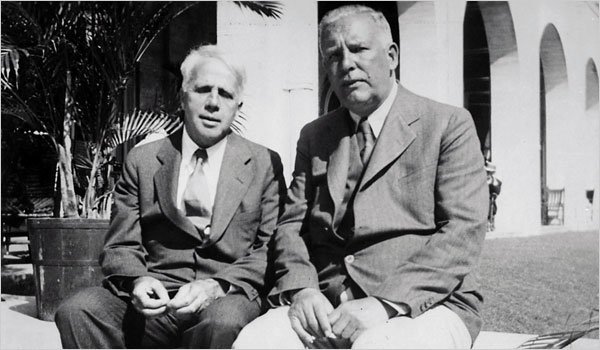
The reality of Robert Frost at Key West. Wallace Stevens (R)
[Read about Sartre, Camus, Warhol, Hitchcock, and Heidegger in the “Famous Atheists Who Weren’t Atheists” archive.]
David Tracy’s Blessed Rage for Order introduced me to what would subsequently become one of my very favorite poems:
“The Idea of Order at Key West”
[Listen to Stevens reading it here]
She sang beyond the genius of the sea.
The water never formed to mind or voice,
Like a body wholly body, fluttering
Its empty sleeves; and yet its mimic motion
Made constant cry, caused constantly a cry,
That was not ours although we understood,
Inhuman, of the veritable ocean.The sea was not a mask. No more was she.
The song and water were not medleyed sound
Even if what she sang was what she heard.
Since what she sang was uttered word by word.
It may be that in all her phrases stirred
The grinding water and the gasping wind;
But it was she and not the sea we heard.For she was the maker of the song she sang.
The ever-hooded, tragic-gestured sea
Was merely a place by which she walked to sing.
Whose spirit is this? we said, because we knew
It was the spirit that we sought and knew
That we should ask this often as she sang.If it was only the dark voice of the sea
That rose, or even colored by many waves;
If it was only the outer voice of sky
And cloud, of the sunken coral water-walled,
However clear, it would have been deep air,
The heaving speech of air, a summer sound
Repeated in a summer without end
And sound alone. But it was more than that,
More even than her voice, and ours, among
The meaningless plungings of water and the wind,
Theatrical distances, bronze shadows heaped
On high horizons, mountainous atmospheres
Of sky and sea.It was her voice that made
The sky acutest at its vanishing.
She measured to the hour its solitude.
She was the single artificer of the world
In which she sang. And when she sang, the sea,
Whatever self it had, became the self
That was her song, for she was the maker. Then we,
As we beheld her striding there alone,
Knew that there never was a world for her
Except the one she sang and, singing, made.Ramon Fernandez, tell me, if you know,
Why, when the singing ended and we turned
Toward the town, tell why the glassy lights,
The lights in the fishing boats at anchor there,
As night descended, tilting in the air,
Mastered the night and portioned out the sea,
Fixing emblazoned zones and fiery poles,
Arranging, deepening, enchanting night.Oh! Blessed rage for order, pale Ramon,
The maker’s rage to order words of the sea,
Words of the fragrant portals, dimly-starred,
And of ourselves and of our origins,
In ghostlier demarcations, keener sounds.
Stevens is considered among the greatest of Modernist poets. Like most of his contemporaries he experienced a deep crisis of faith. His Presbyterian upbringing didn’t stand up to the double-challenge of post-Kantian philosophy and Darwinism. Like in the poem above the rest of his work is marked with a vague nostalgia for “more than that.”
But the story doesn’t end there. There’s a last minute Hail Mary. You can read one version of the story here and Dana Gioia’s version toward the end of this article.
Helen Vendler, herself a lapsed Catholic besides being a widely published academic popularizer who’s written several books on Stevens (see: Words Chosen Out of Desire), has led the charge denying the conversion. That’s understandable, because it’s difficult to reconcile the image of a modernist iconoclast with the picture of a dying man who wanted to write a poem about a pope whose heart broke at his failure to stop World War I.
But the veritable ocean of the internet has turned up this response to Vendler’s questioning of the episode:
Dear Helen Vendler, I didn’t expect you to agree with everything I put down in my letter to you. It is disturbing, however, when you ignore the testimony of Dr. Edward Sennett (in charge of the Radiology Dept. at St. Francis Hospital when Stevens was admitted both times [1955]) and the Sisters with whom I talked in 1977 (and later) who believed Fr. Hanley’s account. They never spoke of any kind of forgetfulness or memory loss on Fr. Hanley’s part, whether noble (when one intentionally does not remember injuries, mischief, etc.) or unmeant (when one unintentionally cannot remember things owing to trauma, confusion or some other mental impairment). What provoked me NOT to visit Fr. Hanley in 1977 was their testimony that his account in 1955 was credible and that they believed Stevens was baptized. The Sisters had no reason to doubt Hanley’s word, one of whom worked with him and knew him quite well. You seem to want to ignore that. Do you really believe they were ALL taken in by Fr. Hanley’s ‘forgetfulness,’ by his ‘mental impairment,’ in 1977, when he was alive, retired, and in touch with them? (He lived only a half hour away from them!) Dr. Sennett was too sharp a person and knew the Sisters too well to believe they were being deluded and misled owing to Fr. Hanley’s ‘memory loss.’ Also, in your response, you ignore the fact that a number of priests in the past refrained from recording (in nearby parishes and hospitals) the baptisms of certain dying people. I myself, for example, remember baptizing two people and leaving their baptisms unrecorded on two different occasions. That is, I baptized two people (unconditionally and absolutely), gave them Communion, and didn’t record their baptisms in a nearby parish or at the hospital – for many reasons, not the least being that the dying person wanted no Catholic funeral and preferred that his/her ‘reception’ remain private (i.e., between himself/herself and God). I mentioned this in my first letter. Such private baptisms did occur in New England and elsewhere! (Today, of course, federal law and new legislation requires that some sort of record of a person’s baptism be kept in the hospital as part of the deceased person’s medical history. But that was not always the case in the past. And it is anyone’s guess as to whether priests abide by those rules today; they pick and chose so freely.) Finally, to assume that because ‘nothing in his [Stevens’] poetry or prose suggests any wish to be a member of any church’ he therefore could never have requested a private baptism flies in the face of so many ‘hour of death’ accounts of the dying, many of whose private testimonies, disclosures, groundless terrors contradict the reckonings and calculations erected or founded on their earlier lives (and, in this case, the person’s writings). The dying often believe for themselves; not for another person or for the sake of some book they wrote. Any person who has witnessed the dying also knows that they ‘say’ and disclose their sentiments (in words and gestures) better than the witnesses or those around them can, foolish cliches and all. In conclusion, I don’t think this response to your letter will dissuade you from holding your own belief that Fr. Hanley was forgetful, etc. Indeed, reasoning further against your opinion in this matter would be like fighting against a shadow – all-consuming, exhausting without affecting the shadow. I also sincerely believe you can’t change. As a critic, you have too much invested in your opinion. (One of my colleagues lent me her THE MUSIC OF WHAT HAPPENS to read. In that book you are quite adamant about Hanley on page 80.) However, based on Dr. Sennett’s and the Sisters’ propriety of feeling for Fr. Hanley and their belief that he was telling the truth in 1977 as he was in 1955, I do believe Stevens was baptized privately (though in academic journals his baptism will always be lightly condemned, censured, or laid aside as ‘inconsistent’ with his writings). I also believe that the baptism should never have been made public. Stevens was a great ‘unnamer,’ to quote Harold Bloom, and Fr. Hanley should have left his baptism unnamed, as it were, anonymous, like a ‘blindness cleaned.’ Sincerely, (Fr.) James Chichetto, C.S.C.

The selected poems in The Palm at the End of the Mind is the best place to dive into Stevens. It was edited by his daughter Holly, also a conversion denier.
I’ll leave you with a poem whose lines furnished the title of the above collection.
“Of Mere Being”
The palm at the end of the mind,
Beyond the last thought, rises
In the bronze decor,A gold-feathered bird
Sings in the palm, without human meaning,
Without human feeling, a foreign song.You know then that it is not the reason
That makes us happy or unhappy.
The bird sings. Its feathers shine.The palm stands on the edge of space.
The wind moves slowly in the branches.
The bird’s fire-fangled feathers dangle down.
Even just from what you’ve read of Stevens in this post, doesn’t it seem appropriate that his Catholic demarcations remained ghostly? How ironic that the skeptics among us would have to fabricate comforting stories (a favorite Stevens theme) in order to make our skepticism more certain!
And even if Stevens remained an atheist, the following passage from Simone Weil’s Gravity and Grace is an interpretation of skepticism that is much more skeptical than Vendler’s comfortable reassurances:
“Religion in so far as it is a source of consolation is a hindrance to true faith; and in this sense atheism is a purification. I have to be an atheist with that part of myself which is not made for God. Among those in whom the supernatural part of themselves has not been awakened, the atheists are right and the believers wrong.”
Fides confusa is a concept that would have tickled the author of supreme fictions with its ambiguity.
Famous Atheists Who Weren't Atheists
Next Post

November 22, 2013 Something Fleshy and Earthly: A Phenomenology of Christian Life
Browse Our Archives
Select a Category #WhyRemainCatholic Abortion Advent Anti-Catholicism Arts Atheism Beauty Benedict XVI Bible Book Review Catholic Cinema Comedy Cosmos: A Space-Time Odyssey Czesław Miłosz Dariusz Karłowicz Devil Easter Eastern Orthodoxy Economics Environment Family Famous Atheists Who Weren't Atheists Guest Post Hans Urs von Balthasar HHS Mandate History Imagination Interview Islam Jean-Luc Marion John Paul II Judaism Just War Lent Literature Little Sisters of the Poor Liturgy Martyrdom Music News Paganism Patristics Phenomenology Philosophy Pierre Hadot Poetry Poland Pop Culture Pope Francis Poverty Prayer Protestantism Rabelais Race Remi Brague Rene Girard Russia Sam Rocha Science & Religion SCOTUS Secularization Sexual Abuse Sexuality Silence Solidarity Stratford Caldecott Synod14 Terrorism Top 10 Uncategorized Walker Percy War Weakened Edition World War II World Youth Day WYD Krakow
Select a Month July 2017 June 2017 May 2017 April 2017 March 2017 February 2017 January 2017 December 2016 October 2016 September 2016 August 2016 July 2016 June 2016 May 2016 April 2016 March 2016 February 2016 January 2016 December 2015 November 2015 October 2015 September 2015 August 2015 July 2015 June 2015 May 2015 April 2015 March 2015 February 2015 January 2015 December 2014 November 2014 October 2014 September 2014 August 2014 July 2014 May 2014 April 2014 March 2014 February 2014 January 2014 December 2013 November 2013 October 2013 September 2013 August 2013 July 2013 June 2013 May 2013
Follow Us!
TAKE THE
Religious Wisdom Quiz
Who is known for his wisdom and built a temple?
Select your answer to see how you score.
David Paul Moses Solomon
Related posts from Cosmos The In Lost

The Surprising Anti-Capitalist Logic Behind the Catholic Church's...

Where Does the Body of Christ Go After...

How is Classical Philosophy is Like War?

Why Does the World's Leading Philosopher Remain a...
TRENDING AT PATHEOS Catholic

The Parable Of The Sower And The Word...
One of Christ’s most famous parables is that of the sower who...

Rejecting Doom: Christian Hope And Human Action
Christianity is a religion of hope. We are to have hope and...

Why I Choose the Eucharist Over the Sermon
Choose the Eucharist, Not the Sermon What are we supposed to get...

5 Design Elements Found in Spiritually Rooted Homes
Putting Spirituality Into Home Decor Our homes are more than our living...

Credo: A Story of God Told with the...
About 10 years ago, I began to imagine a personal "Credo" that...

The Anatomy of Divine Revelation in Catholic Thought
The claim that God has made Himself known to human beings is...
view all Catholic blogs
Ad-Free & Subscriber Log-In Subscription Support
- About Us
- 2026 Calendar
- Videos
- Podcasts
- Library of World Religions
- Faith In Media Tracker
- Advertise With Us
- Write for Us
- Privacy Policy
- Terms of Service
- Do Not Sell My Data
- Contact Us
- Radiant Digital
- Manage Newsletter Subscriptions
- Unsubscribe From Notifications
- Sitemap
Copyright 2008-2026, Patheos. All rights reserved.
Subscription Support Ad-Free & Subscriber Log-In
Follow Patheos