
BuddhistCatholicContemplativeEvangelicalGeneral ChristianHinduJewishLatter-day SaintMuslimNew VisionsProgressive Christian
Beliefs
- Buddhist
- Catholic
- Contemplative
- Evangelical
- General Christian
- Hindu
- Jewish
- Latter-day Saint
- More Voices
- Muslim
- New Visions
- Pagan
- Progressive Christian
Topics
- Religion News
- Food and Religion
- Sports and Religion
- Religious Art
- Religious Music and Entertainment
- Religious Events
- History and Religion
- Style and Religion
- Politics and Religion
- Women in Religion
- Recreation Outdoors and Religion
- Business Finance and Religion
- Careers Workplace and Religion
- Education and Religion
- Family Parenting and Religion
- Health Fitness and Religion
- Home and Religion
- Relationships and Religion
- Technology and Religion
- Travel and Religion
Columnists
- Buddhist Columnists
- Business Finance and Religion Columnists
- Careers Workplace and Religion Columnists
- Catholic Columnists
- Contemplative Columnists
- Education and Religion Columnists
- Evangelists Columnists
- Family Parenting and Religion Columnists
- General Christian Columnists
- Health Fitness and Religion Columnists
- Hindu Columnists
- History and Religion Columnists
- Home and Religion Columnists
- Jewish Columnists
- More Voices Columnists
- Latter Day Columnists
- Muslim Columnists
- New Visions Columnists
- Nonreligious Columnists
- Pagan Columnists
- Politics and Religion Columnists
- Progressive Columnists
- Recreation Outdoors and Religion Columnists
- Relationships and Religion Columnists
- Religion News Columnists
- Religious Art Columnists
- Religious Events Columnists
- Religious Music and Entertainment Columnists
- Sports and Religion Columnists
- Style and Religion Columnists
- Technology and Religion Columnists
- Travel and Religion Columnists
- Women in Religion Columnists
Resource Library
- 2026 Calendar
- Library of World Religions
- The 100 Most Holy Places on Earth
- Patheos Answers
- Podcasts
- Videos
- Faith Leaders Database
- Anglican Episcopalian
- Bahai
- Baptist
- Buddhism
- Christianity
- Confucianism
- Eastern Orthodoxy
- Hinduism
- Holiness and Pentecostal
- ISKCON
- Islam
- Judaism
- Lutheran
- Methodist
- The Church of Jesus Christ of Latter-day Saints
- New Age
- Paganism
- Presbytarian and Reformed
- Protestantism
- Religion Behind the Scenes
- Roman Catholic
- Scientology
- Shia Islam
- Sikhism
- Sufism
- Sunni Islam
- Taoism
- Zen
- See all religions
Research Tools
 Ad-Free & Subscriber Log-In Subscription Support
Ad-Free & Subscriber Log-In Subscription Support
Follow Patheos 

- Trending:
- Forgiveness
- |
- Marriage
- |
- Consciousness
- |
- Death Penalty
- |
- Election
- |
- Halloween
 Cosmos The In Lost
- Home
- Catholic
- The Catholic Imagination and the Age of Czeslaw Milosz
The Catholic Imagination and the Age of Czeslaw Milosz
Last updated on: October 29, 2013 at 8:46 am by Artur Rosman
The Catholic Imagination and the Age of Czeslaw Milosz 2013-10-29T08:46:59-07:00 Artur Rosman
Patheos Explore the world's faith through different perspectives on religion and spirituality! Patheos has the views of the prevalent religions and spiritualities of the world.
Dissertation writing is a long process of accumulating knowledge, scrapping it, finding surprising connections, resurrecting what seemed to be dead ends, and then miraculously stumbling upon an insight that weaves as much as possible of the previous research into an intelligible pattern. I wouldn’t recommend it for the sane.
Nearly all my intellectual interests are dictated by a chance encounter with one poem by Czeslaw Milosz in a high school anthology of American poetry. All these year later I’ve earned degrees in history, comparative religion, and comparative literature pretty much trying to figure out what’s going on in his poems and why they’ve captured my imagination. I’ve finally reached the point where I see a pattern I can write about without end.
Idle curiosity led me to rummage around Amazon to see whether there is anything new going on in Milosz studies. The nine years since his death have been surprisingly fallow for scholars. Maybe they’re also having some of the same issues as myself?
Sometimes I wonder whether Milosz was so controlling about interpreting his poetry through his essay collections (such as Native Realm, Visions from San Francisco Bay, Land of Ulro, and Beginning With My Streets) that he didn’t bother to cultivate a generation of Miloszologists.
For a while there were rumors of a Clare Cavanaugh biography of Milosz, but the project seems to be on hold. A few studies of Milosz’s poetry do exist English (Poet’s Work, The Eternal Moment, Fellowship of Poets, and, actually, that’s it besides scattered essay collections). The Polish output is about three or four times that–not much for a poet of such stature.
This was the state of things until I ran across the work Irresolute Heresiarch. To my eyes the publisher’s description suggests the book is on the right track:
“In the midst of a multi-national comparative study of modern Catholic poets, Charles S. Kraszewski was more than a little surprised at the difficulty he encountered in finding a representative poet from that ostensibly most Catholic of European nations, Poland. With but two guiding criteria in mind the poet had to be possessed of a Catholic world view and have a significant impact on the development of modern poetry it seemed that Polish poets were either very good . . . or Catholic. Then, in 2004, during the funeral of the Nobel Prize winning poet Czeslaw Milosz, it was revealed that the poet had written a recent letter to the Pope, declaring his intent, in his later writings, to express a Catholic viewpoint. This was a surprising admission, given the rather heterodox reputation that characterized the poet during his long lifetime. Irresolute Heresiarch: Catholicism, Gnosticism and Paganism in the Poetry of Czeslaw Milosz is the fruit of Kraszewski’s research into the religious themes expressed in the poetry of the great bard.”
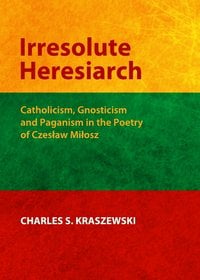
The cover suggests Kraszewski highlights Milosz’s Lithuanian background in Irresolute Heresiarch.
I’m pretty much on board with all this. I am looking forward to reading the book, because I wonder whether Kraszewski comes to the same conclusion as I do: Milosz was a cafetria Manichean and cafeteria Pagan who used those traditions, as Catholics have for ages, in service of a Catholic imagination.
It’s affirming to see someone else has been mining some of the same territories as I have in my dissertation. It means I’m not entirely a madman for following what Milosz says about Catholicism in his writings. It’s also a little frightening, because there is always the danger that someone else has written your dissertation already! I frantically searched through Kraszewski’s book and found no traces of Andrew Greeley and David Tracy, plus only a few mentions of the imagination and the liturgy. These are the main hubs of my analysis, which should be completed sometime early next year. Phew.
By the way, if you’re still suffering from a Milosz deficit the video at the top of this post is the trailer for a recently released documentary of the poet entitled The Age of Czeslaw Milosz. The trailer starts out by addressing the state of the religious imagination as Milosz did in Roadside Dog (and pretty much everything else he wrote), which means they’re probably onto the right path (I’ll see, the DVD is in the mail):
“Instead of leaving to theologians their worries, I have constantly meditated on religion [in my poetry]. Why? Simply because someone had to do this [in literature or otherwise]… I lived in a time when a huge change in the contents of the human imagination was occurring. In my lifetime Heaven and Hell disappeared, the belief in life after death was considerably weakened [and so on]… After two thousand years in which a huge edifice of creeds and dogmas has been erected, from Origen and Saint Augustine to Thomas Aquinas and Cardinal Newman, when every work of the human mind and of human hands was created within a system of reference, the age of homelessness has dawned. How could I not think of this?”

I don’t want to leave you with a sense of despair, so here’s how Czeslaw Milosz imagined the Catholic imagination in Visions From San Francisco Bay:
“There is the warm, human presence of a God who took on flesh in order to experience our hunger and our pain, so we would not be doomed to strain our eyes upward but could be nourished by words spoken by lips like our own. And the God-man is not one of us in our moments of pride and glory but one of us in misfortune, in slavery, and in the fear of death. The hour when he agreed to accept suffering conquers time; centuries of change and passing civilizations are insignificant and short-lived, and no wasteland of cement, glass, and metal will make man different from those men Christ addressed in Galilee…
Catholicism is the most anthropocentric of religions and, in some sense, through its own excess of divine humanity, it resists the exact sciences which annihilate the individual. Thus, paradoxically, it is less susceptible than other religions to the disintegrative influence of science and technology. In Catholicism, even Heaven and Earth, the Descent and the Ascension of God are not like relations between worlds but like those between human forms.”
Previous Post

October 11, 2013
Ingmar Bergman on the Apologetic Value of Human Holiness
Next Post
October 30, 2013 Books I've Cheated On: Non-Fiction
Browse Our Archives
Select a Category #WhyRemainCatholic Abortion Advent Anti-Catholicism Arts Atheism Beauty Benedict XVI Bible Book Review Catholic Cinema Comedy Cosmos: A Space-Time Odyssey Czesław Miłosz Dariusz Karłowicz Devil Easter Eastern Orthodoxy Economics Environment Family Famous Atheists Who Weren't Atheists Guest Post Hans Urs von Balthasar HHS Mandate History Imagination Interview Islam Jean-Luc Marion John Paul II Judaism Just War Lent Literature Little Sisters of the Poor Liturgy Martyrdom Music News Paganism Patristics Phenomenology Philosophy Pierre Hadot Poetry Poland Pop Culture Pope Francis Poverty Prayer Protestantism Rabelais Race Remi Brague Rene Girard Russia Sam Rocha Science & Religion SCOTUS Secularization Sexual Abuse Sexuality Silence Solidarity Stratford Caldecott Synod14 Terrorism Top 10 Uncategorized Walker Percy War Weakened Edition World War II World Youth Day WYD Krakow
Select a Month July 2017 June 2017 May 2017 April 2017 March 2017 February 2017 January 2017 December 2016 October 2016 September 2016 August 2016 July 2016 June 2016 May 2016 April 2016 March 2016 February 2016 January 2016 December 2015 November 2015 October 2015 September 2015 August 2015 July 2015 June 2015 May 2015 April 2015 March 2015 February 2015 January 2015 December 2014 November 2014 October 2014 September 2014 August 2014 July 2014 May 2014 April 2014 March 2014 February 2014 January 2014 December 2013 November 2013 October 2013 September 2013 August 2013 July 2013 June 2013 May 2013
Follow Us!
TAKE THE
Religious Wisdom Quiz
Which Orthodox celebration marks the resurrection of Christ?
Select your answer to see how you score.
Pentecost Pascha Epiphany Transfiguration
Related posts from Cosmos The In Lost

Where Does the Body of Christ Go After...

Why Does the World's Leading Philosopher Remain a...

Leading Historian Made the Analogy Between the Refugee...

Holocaust Remembrance Day: The Memory of the Holocaust...
TRENDING AT PATHEOS Catholic

Rejecting Doom: Christian Hope And Human Action
Christianity is a religion of hope. We are to have hope and...

It’s What Comes From Within Which Matters
One of the most difficult things for us to understand is why...

Why I Choose the Eucharist Over the Sermon
Choose the Eucharist, Not the Sermon What are we supposed to get...

5 Design Elements Found in Spiritually Rooted Homes
Putting Spirituality Into Home Decor Our homes are more than our living...

Credo: A Story of God Told with the...
About 10 years ago, I began to imagine a personal "Credo" that...

The Anatomy of Divine Revelation in Catholic Thought
The claim that God has made Himself known to human beings is...
view all Catholic blogs
Ad-Free & Subscriber Log-In Subscription Support
- About Us
- 2026 Calendar
- Videos
- Podcasts
- Library of World Religions
- Faith In Media Tracker
- Advertise With Us
- Write for Us
- Privacy Policy
- Terms of Service
- Do Not Sell My Data
- Contact Us
- Radiant Digital
- Manage Newsletter Subscriptions
- Unsubscribe From Notifications
- Sitemap
Copyright 2008-2026, Patheos. All rights reserved.
Subscription Support Ad-Free & Subscriber Log-In
Follow Patheos