
BuddhistCatholicContemplativeEvangelicalGeneral ChristianHinduJewishLatter-day SaintMuslimNew VisionsProgressive Christian
Beliefs
- Buddhist
- Catholic
- Contemplative
- Evangelical
- General Christian
- Hindu
- Jewish
- Latter-day Saint
- More Voices
- Muslim
- New Visions
- Pagan
- Progressive Christian
Topics
- Religion News
- Food and Religion
- Sports and Religion
- Religious Art
- Religious Music and Entertainment
- Religious Events
- History and Religion
- Style and Religion
- Politics and Religion
- Women in Religion
- Recreation Outdoors and Religion
- Business Finance and Religion
- Careers Workplace and Religion
- Education and Religion
- Family Parenting and Religion
- Health Fitness and Religion
- Home and Religion
- Relationships and Religion
- Technology and Religion
- Travel and Religion
Columnists
- Buddhist Columnists
- Business Finance and Religion Columnists
- Careers Workplace and Religion Columnists
- Catholic Columnists
- Contemplative Columnists
- Education and Religion Columnists
- Evangelists Columnists
- Family Parenting and Religion Columnists
- General Christian Columnists
- Health Fitness and Religion Columnists
- Hindu Columnists
- History and Religion Columnists
- Home and Religion Columnists
- Jewish Columnists
- More Voices Columnists
- Latter Day Columnists
- Muslim Columnists
- New Visions Columnists
- Nonreligious Columnists
- Pagan Columnists
- Politics and Religion Columnists
- Progressive Columnists
- Recreation Outdoors and Religion Columnists
- Relationships and Religion Columnists
- Religion News Columnists
- Religious Art Columnists
- Religious Events Columnists
- Religious Music and Entertainment Columnists
- Sports and Religion Columnists
- Style and Religion Columnists
- Technology and Religion Columnists
- Travel and Religion Columnists
- Women in Religion Columnists
Resource Library
- 2026 Calendar
- Library of World Religions
- The 100 Most Holy Places on Earth
- Patheos Answers
- Podcasts
- Videos
- Faith Leaders Database
- Anglican Episcopalian
- Bahai
- Baptist
- Buddhism
- Christianity
- Confucianism
- Eastern Orthodoxy
- Hinduism
- Holiness and Pentecostal
- ISKCON
- Islam
- Judaism
- Lutheran
- Methodist
- The Church of Jesus Christ of Latter-day Saints
- New Age
- Paganism
- Presbytarian and Reformed
- Protestantism
- Religion Behind the Scenes
- Roman Catholic
- Scientology
- Shia Islam
- Sikhism
- Sufism
- Sunni Islam
- Taoism
- Zen
- See all religions
Research Tools
 Ad-Free & Subscriber Log-In Subscription Support
Ad-Free & Subscriber Log-In Subscription Support
Follow Patheos 

- Trending:
- Forgiveness
- |
- Marriage
- |
- Consciousness
- |
- Death Penalty
- |
- Election
- |
- Halloween
 Cosmos The In Lost
- Home
- Catholic
- The Eviscerated Public Square
The Eviscerated Public Square
Last updated on: October 2, 2013 at 6:47 am by Artur Rosman
The Eviscerated Public Square 2013-10-02T06:47:37-07:00 Artur Rosman
Patheos Explore the world's faith through different perspectives on religion and spirituality! Patheos has the views of the prevalent religions and spiritualities of the world.
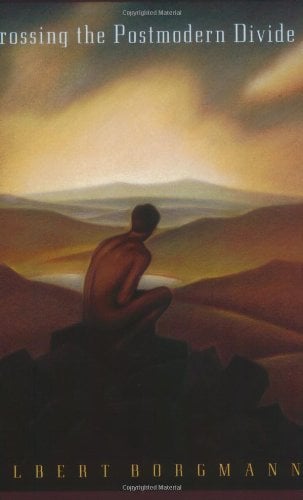
“We live in self-imposed exile from communal conversation and action. The public square is naked. American politics has lost its soul,” says Borgmann.
When you accumulate books there is always that one which you’ve meant to read for the longest time. For whatever reason, call it grace or luck, you pick it up one day and spend the rest of the week (month, year) kicking yourself for not reading it earlier.
I’m presently kicking myself for not picking up Albert Borgmann’s Crossing the Posmodern Divide before Monday (even though I’m quite satisfied with my readings of great books by D.B. Hart, Norman Davies, and A.D. Nock).
Crossing the Postmodern Divide was the first thing to come to mind (dunno why… I’m weird?) just as news of the government “shutdown” reached me.
Then yesterday’s withering critique of classical liberalism in the most recent pope Francis interview only confirmed the timeliness of Bogrmann’s book.
“Personally I think so-called unrestrained liberalism only makes the strong stronger and the weak weaker and excludes the most excluded. We need great freedom, no discrimination, no demagoguery and a lot of love. We need rules of conduct and also, if necessary, direct intervention from the state to correct the more intolerable inequalities.”
The perversity of what Francis describes is indicative of an eviscerated public square. Forget Nehaus’s naked public square when both parties are tearing at the flesh, cleaning out the innards, of the body politic.
Borgmann is just as relentless in his analysis of the political gridlock of the 90’s. What he says, unfortunately, sounds like it could have been written yesterday:
“There is a rising sentiment that we are coming to the close not only of a century and a millennium but of an era, too [written in 1992]. The sentiment has not quite become universal, but the indications of closure and transition are manifold. One indication is the difficulty we have in finding the kind of discourse that would help us to chart the passage from the present to the future. The idiom we have favored since the beginning of the modern era fails to inspire conviction or yield insight; the language of those who are proclaiming a new epoch seems merely deconstructive or endlessly prefatory.
The distinctive discourse of modernity is one of prediction and control. In the teeth of severe cultural and moral crises, we continue to use it as if it were the sole alternative to sullen silence. Ironically, there is a profound helplessness in surrendering the future to prediction and control, and there would be even if we could predict and control things at will.
We predict the weather and try to control inflation because we are not the weather and not inflation. They are objects other than ourselves, objects we want to subject to ourselves. Strictly speaking, I do not predict or control myself or my behavior. I promise or decide to do a certain thing; I pledge myself to do it. I do not manipulate or arrange my behavior so that it proceeds to the desired outcome. I either do or fail to do what I set out to do.
Nor would I think of predicting and controlling others to whom I am bound by ties of respect and affection. It would not occur to me to assimilate them to the weather and inflation. Yet the dominant discourse about the future of our society is composed of the vocables of prognoses, projections, extrapolations, scenarios, models, programs, simulations, and incentives. It is as though we had taken ourselves out of reality and had left only objectified and disavowed versions of ourselves in the universe [Sounds a lot like Walker Percy in Lost in the Cosmos, doesn’t it?] we are trying to understand and shape. We vacate our first-person place and presence in the world just when we mean to take responsibility for its destiny. Surely there is deprivation and helplessness in this.
Liberals have been most determined collectively to plan and engineer society for the better. They, accordingly, have been associated most closely with the obstreperous problems of social policy and the vacancy of public discourse. To conservative minds, the sensible alternative to misguided liberal ambitions is a healthy respect for the natural order of things. We can affect the large design of society only in a negative manner. All we can do positively and collectively is step aside and allow the native ambitions of individuals and the spontaneous dynamics of small groups to take their beneficial course.
But there is helplessness in this position, too, for it views social reality as a natural fact like the seasons and the weather, and urges us to make peace with it. Like liberals, conservatives feel bound to consider society objectively and prospectively, to determine the best future outcome given our present conditions. Here, too, the collective future is something that happens to people.
In bringing out the predictive and controlling intentions of modern discourse about the future I am not concerned with highlighting the limits of social science or the seriousness of social and environmental problems. These are real enough. But even if we could overcome these obstacles, the crucial debility of the rule of prediction and control would remain, namely, the expatriate quality of public life. We live in self-imposed exile from communal conversation and action. The public square is naked. American politics has lost its soul. The republic has become procedural, and we have become unencumbered selves. Individualism has become cancerous. We live in an age of narcissism and pursue loneliness. These expressions are alarming not because they predict the ruin of the state; prediction and control, for all their liabilities, will continue to provide comfort and stability. Rather, these expressions of distress should disquiet us because they indicate that we have no common life, what what hold us all together is a cold and impersonal design.”
It appears that the striptease didn’t end with the naked public square. Our politics are stripping away living flesh, ripping out vital organs. There’s also some indication here that some horrible theology is behind it all. Heresy, it’s been said, kills.
All this reminds me I should at least page through my notes in Simone Weil’s The Need for Roots. There is much weariness in connections between readings and the end of the world almost seems like a relief…
http://www.dailymotion.com/video/xqxm9i_czeslaw-milosz-a-song-on-the-end-of-the-world_creation
Previous Post

September 30, 2013
Science & Religion: Beyond the Ham-Nye Rye Sandwich
Next Post
October 5, 2013 Apart From... What Has Christianity Ever Done for Us?
Browse Our Archives
Select a Category #WhyRemainCatholic Abortion Advent Anti-Catholicism Arts Atheism Beauty Benedict XVI Bible Book Review Catholic Cinema Comedy Cosmos: A Space-Time Odyssey Czesław Miłosz Dariusz Karłowicz Devil Easter Eastern Orthodoxy Economics Environment Family Famous Atheists Who Weren't Atheists Guest Post Hans Urs von Balthasar HHS Mandate History Imagination Interview Islam Jean-Luc Marion John Paul II Judaism Just War Lent Literature Little Sisters of the Poor Liturgy Martyrdom Music News Paganism Patristics Phenomenology Philosophy Pierre Hadot Poetry Poland Pop Culture Pope Francis Poverty Prayer Protestantism Rabelais Race Remi Brague Rene Girard Russia Sam Rocha Science & Religion SCOTUS Secularization Sexual Abuse Sexuality Silence Solidarity Stratford Caldecott Synod14 Terrorism Top 10 Uncategorized Walker Percy War Weakened Edition World War II World Youth Day WYD Krakow
Select a Month July 2017 June 2017 May 2017 April 2017 March 2017 February 2017 January 2017 December 2016 October 2016 September 2016 August 2016 July 2016 June 2016 May 2016 April 2016 March 2016 February 2016 January 2016 December 2015 November 2015 October 2015 September 2015 August 2015 July 2015 June 2015 May 2015 April 2015 March 2015 February 2015 January 2015 December 2014 November 2014 October 2014 September 2014 August 2014 July 2014 May 2014 April 2014 March 2014 February 2014 January 2014 December 2013 November 2013 October 2013 September 2013 August 2013 July 2013 June 2013 May 2013
Follow Us!
TAKE THE
Religious Wisdom Quiz
Who was the first king of Israel?
Select your answer to see how you score.
Saul Josiah David Solomon
Related posts from Cosmos The In Lost

The Surprising Anti-Capitalist Logic Behind the Catholic Church's...

Where Does the Body of Christ Go After...

How is Classical Philosophy is Like War?

Why Does the World's Leading Philosopher Remain a...
TRENDING AT PATHEOS Catholic

Rejecting Doom: Christian Hope And Human Action
Christianity is a religion of hope. We are to have hope and...

It’s What Comes From Within Which Matters
One of the most difficult things for us to understand is why...

Why I Choose the Eucharist Over the Sermon
Choose the Eucharist, Not the Sermon What are we supposed to get...

5 Design Elements Found in Spiritually Rooted Homes
Putting Spirituality Into Home Decor Our homes are more than our living...

Credo: A Story of God Told with the...
About 10 years ago, I began to imagine a personal "Credo" that...

The Anatomy of Divine Revelation in Catholic Thought
The claim that God has made Himself known to human beings is...
view all Catholic blogs
Ad-Free & Subscriber Log-In Subscription Support
- About Us
- 2026 Calendar
- Videos
- Podcasts
- Library of World Religions
- Faith In Media Tracker
- Advertise With Us
- Write for Us
- Privacy Policy
- Terms of Service
- Do Not Sell My Data
- Contact Us
- Radiant Digital
- Manage Newsletter Subscriptions
- Unsubscribe From Notifications
- Sitemap
Copyright 2008-2026, Patheos. All rights reserved.
Subscription Support Ad-Free & Subscriber Log-In
Follow Patheos