
BuddhistCatholicContemplativeEvangelicalGeneral ChristianHinduJewishLatter-day SaintMuslimNew VisionsProgressive Christian
Beliefs
- Buddhist
- Catholic
- Contemplative
- Evangelical
- General Christian
- Hindu
- Jewish
- Latter-day Saint
- More Voices
- Muslim
- New Visions
- Pagan
- Progressive Christian
Topics
- Religion News
- Food and Religion
- Sports and Religion
- Religious Art
- Religious Music and Entertainment
- Religious Events
- History and Religion
- Style and Religion
- Politics and Religion
- Women in Religion
- Recreation Outdoors and Religion
- Business Finance and Religion
- Careers Workplace and Religion
- Education and Religion
- Family Parenting and Religion
- Health Fitness and Religion
- Home and Religion
- Relationships and Religion
- Technology and Religion
- Travel and Religion
Columnists
- Buddhist Columnists
- Business Finance and Religion Columnists
- Careers Workplace and Religion Columnists
- Catholic Columnists
- Contemplative Columnists
- Education and Religion Columnists
- Evangelists Columnists
- Family Parenting and Religion Columnists
- General Christian Columnists
- Health Fitness and Religion Columnists
- Hindu Columnists
- History and Religion Columnists
- Home and Religion Columnists
- Jewish Columnists
- More Voices Columnists
- Latter Day Columnists
- Muslim Columnists
- New Visions Columnists
- Nonreligious Columnists
- Pagan Columnists
- Politics and Religion Columnists
- Progressive Columnists
- Recreation Outdoors and Religion Columnists
- Relationships and Religion Columnists
- Religion News Columnists
- Religious Art Columnists
- Religious Events Columnists
- Religious Music and Entertainment Columnists
- Sports and Religion Columnists
- Style and Religion Columnists
- Technology and Religion Columnists
- Travel and Religion Columnists
- Women in Religion Columnists
Resource Library
- 2026 Calendar
- Library of World Religions
- The 100 Most Holy Places on Earth
- Patheos Answers
- Podcasts
- Videos
- Faith Leaders Database
- Anglican Episcopalian
- Bahai
- Baptist
- Buddhism
- Christianity
- Confucianism
- Eastern Orthodoxy
- Hinduism
- Holiness and Pentecostal
- ISKCON
- Islam
- Judaism
- Lutheran
- Methodist
- The Church of Jesus Christ of Latter-day Saints
- New Age
- Paganism
- Presbytarian and Reformed
- Protestantism
- Religion Behind the Scenes
- Roman Catholic
- Scientology
- Shia Islam
- Sikhism
- Sufism
- Sunni Islam
- Taoism
- Zen
- See all religions
Research Tools
 Ad-Free & Subscriber Log-In Subscription Support
Ad-Free & Subscriber Log-In Subscription Support
Follow Patheos 

- Trending:
- Forgiveness
- |
- Marriage
- |
- Consciousness
- |
- Death Penalty
- |
- Election
- |
- Halloween
 Cosmos The In Lost
- Home
- Catholic
- A Fish Rots from the Head Down (On Paul Elie and Secularization in the Arts)
A Fish Rots from the Head Down (On Paul Elie and Secularization in the Arts)
Last updated on: January 19, 2015 at 4:58 pm by Artur Rosman
A Fish Rots from the Head Down (On Paul Elie and Secularization in the Arts) 2015-01-19T16:58:42-07:00 Artur Rosman
Patheos Explore the world's faith through different perspectives on religion and spirituality! Patheos has the views of the prevalent religions and spiritualities of the world.

The head of a rotting fish would be too much for even the most devoted readers; so instead here’s a shark eating a shark.
The Polish poet Czesław Miłosz (1911-2004) is widely read in American poetry circles. It wouldn’t be much of a stretch to say that many Americans almost think of him as one of their own (Cynthia Haven even documents his worldwide influence here).
Now Milosz’s poetry appeals to me because he interprets his experience of late modern America and early 20th century totalitarianism with a finely honed Catholic theological imagination. Don’t take my word for it. There’s plenty of evidence for my judgment here, here, here, here, and here.
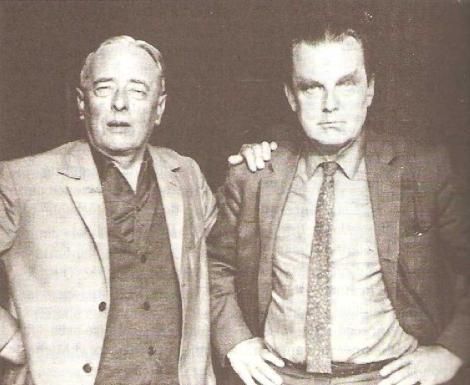
Czeslaw Milosz (right) with friend and literary rival Gombrowicz (mentioned later in post).
Czesław Miłosz, as we’ll see, appears to be in agreement with Paul Elie who recently pronounced the death of the religious novel along with plans to resurrect the genre single-handedly with a novel-in-progress. Elie proudly announced in a New York Times article, “Now I am writing a novel with matters of belief at its core. Now I have skin in the game. Now I am trying to answer the question: Where has the novel of belief gone?” The article in question, “Has Fiction Lost Its Faith?,” expands upon these questions with the following answer:
“The obvious answer is that it has gone where belief itself has gone. In America today Christianity is highly visible in public life but marginal or of no consequence in a great many individual lives. For the first time in our history it is possible to speak of Christianity matter-of-factly as one religion among many; for the first time it is possible to leave it out of the conversation altogether. This development places the believer on a frontier again, at the beginning of a new adventure; it means that the Christian who was born here is a stranger in a strange land no less than the Sikhs, Muslims, Hindus, Buddhists, Soviet Jews and Spanish-speaking Catholics who have arrived from elsewhere. But few people see it that way. People of faith see decline and fall. Their detractors see a people threatening rear-guard political action, or a people left behind.”
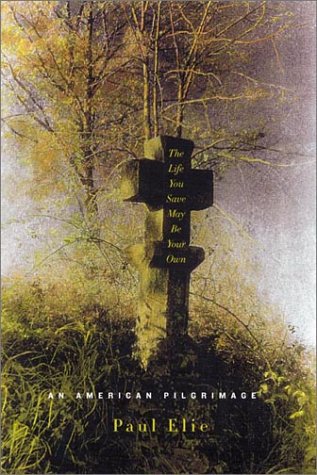
“We come to life in the middle of stories that are not ours,” says Paul Elie in The Life You Save...
Czesław Miłosz tells the story of literary secularization within a much longer and damning historical arc than Elie, author of the study The Life You Save Maybe Your Own. In that fat tome (eminently readable and well-researched) Elie presents the work of Merton, Flannery O’Connor, Dorothy Day, and Walker Percy as a literary-religious triumph. Milosz viewed the literary victories of the last few centuries within a much more Pyrrhic frame. The Nobelist saw modern literature, which is not to say all of it, as the culmination of the process of European secularization:
“The fact of Europe’s dechrstianization is indubitable and depressing. It can also be translated into numbers of victims. If a half-Christian Europe could not prevent the First World War and its massacres in the trenches, then two totalitarianisms, which exterminated millions in concentration camps, were the product of leaders who were entirely godless.However, the ties between religion and society are too complicated to draw up a clear boundary between Christian and post-Christian countries. A fish rots from the head down, and what we call the erosion of the religious imagination began with the philosophers of the 18th century, only to progress through the whole of the next century, receiving its lasting expression, above all, in literature and art…”
Now consider this statement in the context of what Nietzsche, Flaubert, Ibsen, Andre Gide, Sartre, and Gombrowicz wrote. Then you’ll get the picture.
Even this may be true it still doesn’t take away from the achievements of poets and novelists of both past and present who are legion. In the piece “Whispers of Faith in a Postmodern World” Gregory Wolfe argues the myth of rampant secularization in the arts is precisely that: a myth. Here’s how he puts it:
“In The New Republic in 2008, Ruth Franklin noted that ‘the absence of God from our literature feels so normal, so self-evident, that one realizes with shock how complete it is.’ Last month in a New York Times Sunday Book Review essay entitled ‘Has Fiction Lost Its Faith?, Paul Elie suggested that ‘if any patch of our culture can be said to be post-Christian, it is literature.’
Really? From where I stand, things don’t look that way. That is in large part because for the past 24 years I have edited Image, a journal that publishes literature and art concerned with the faith traditions of the West. Our instinct when launching the publication was that the narrative of decline was misguided, but we honestly didn’t know if we could fill more than a few issues.
Sometimes when you look, you find. Over the years Image has featured many believing writers, including Annie Dillard, Elie Wiesel, Christian Wiman, Marilynne Robinson and Mark Helprin. But these writers of religious faith and others are not hard to find elsewhere. Several prominent American authors—Franz Wright, Mary Karr and Robert Clark—are Catholic converts. Nathan Englander and Jonathan Safran Foer last year published ‘New American Haggadah,’ a contemporary take on the ritual book used by Jews on Passover.”
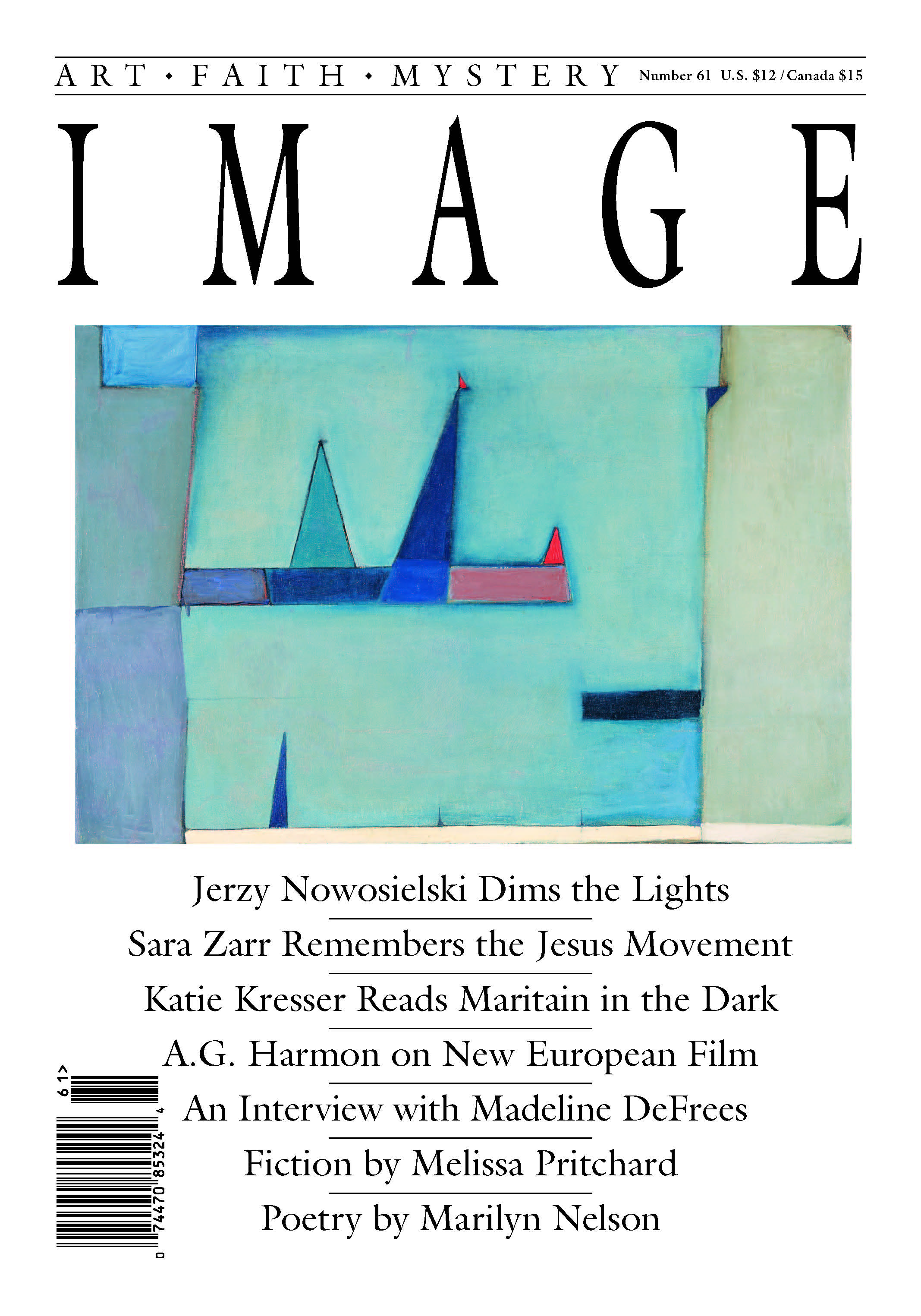
You can read my own contribution to IMAGE here. You can subscribe to IMAGE here.
Perhaps the fish isn’t all that rotten? At least not in the head? Over the next few days I plan on compiling some Top 10 lists of contemporary poets (Now available!) and novelists who write from within a theological imagination.
I don’t think the task will be as tough as Elie makes it out to be. The toughest task will be keeping the lists down to only ten authors each!
The follow up posts are now up. They are “Fresh Caught Fish: Top 10 Living Religious Poets” and “Fresh Caught Fish II: Top 10 Living Religious Novelists.”
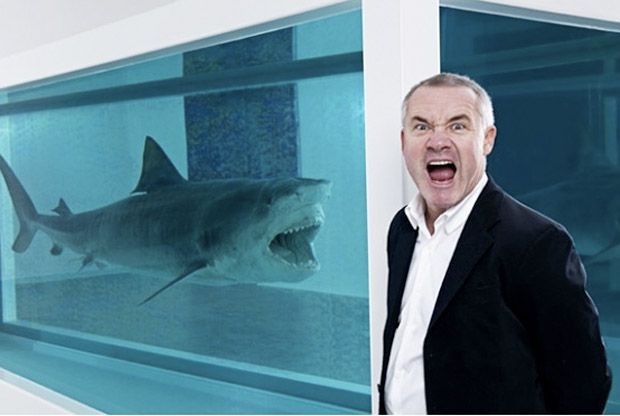
Rotting heads: did you know one of these Damien Hirst sharks (pictured left) rotted in a gallery and had to be replaced?
Previous Post

August 10, 2013
Confession: How I Lost My Faith After Reading Rachel Held Evans
Next Post
August 13, 2013 Attn: University of Notre Dame Press Overstock Sale!
Browse Our Archives
Select a Category #WhyRemainCatholic Abortion Advent Anti-Catholicism Arts Atheism Beauty Benedict XVI Bible Book Review Catholic Cinema Comedy Cosmos: A Space-Time Odyssey Czesław Miłosz Dariusz Karłowicz Devil Easter Eastern Orthodoxy Economics Environment Family Famous Atheists Who Weren't Atheists Guest Post Hans Urs von Balthasar HHS Mandate History Imagination Interview Islam Jean-Luc Marion John Paul II Judaism Just War Lent Literature Little Sisters of the Poor Liturgy Martyrdom Music News Paganism Patristics Phenomenology Philosophy Pierre Hadot Poetry Poland Pop Culture Pope Francis Poverty Prayer Protestantism Rabelais Race Remi Brague Rene Girard Russia Sam Rocha Science & Religion SCOTUS Secularization Sexual Abuse Sexuality Silence Solidarity Stratford Caldecott Synod14 Terrorism Top 10 Uncategorized Walker Percy War Weakened Edition World War II World Youth Day WYD Krakow
Select a Month July 2017 June 2017 May 2017 April 2017 March 2017 February 2017 January 2017 December 2016 October 2016 September 2016 August 2016 July 2016 June 2016 May 2016 April 2016 March 2016 February 2016 January 2016 December 2015 November 2015 October 2015 September 2015 August 2015 July 2015 June 2015 May 2015 April 2015 March 2015 February 2015 January 2015 December 2014 November 2014 October 2014 September 2014 August 2014 July 2014 May 2014 April 2014 March 2014 February 2014 January 2014 December 2013 November 2013 October 2013 September 2013 August 2013 July 2013 June 2013 May 2013
Follow Us!
TAKE THE
Religious Wisdom Quiz
Who is the "friend at midnight" in one of Jesus' parables?
Select your answer to see how you score.
A fisherman A neighbor seeking bread A soldier An angel
Related posts from Cosmos The In Lost

The Surprising Anti-Capitalist Logic Behind the Catholic Church's...

How is Classical Philosophy is Like War?

Why Does the World's Leading Philosopher Remain a...

Atheists Have "National Day of Reason," But American...
TRENDING AT PATHEOS Catholic

Creation, Preservation, and Teleology in Catholic Theology
As I write this, it is very early Monday morning. Like millions...

The Parable Of The Sower And The Word...
One of Christ’s most famous parables is that of the sower who...

Rejecting Doom: Christian Hope And Human Action
Christianity is a religion of hope. We are to have hope and...

Why I Choose the Eucharist Over the Sermon
Choose the Eucharist, Not the Sermon What are we supposed to get...

5 Design Elements Found in Spiritually Rooted Homes
Putting Spirituality Into Home Decor Our homes are more than our living...

Credo: A Story of God Told with the...
About 10 years ago, I began to imagine a personal "Credo" that...
view all Catholic blogs
Ad-Free & Subscriber Log-In Subscription Support
- About Us
- 2026 Calendar
- Videos
- Podcasts
- Library of World Religions
- Faith In Media Tracker
- Advertise With Us
- Write for Us
- Privacy Policy
- Terms of Service
- Do Not Sell My Data
- Contact Us
- Radiant Digital
- Manage Newsletter Subscriptions
- Unsubscribe From Notifications
- Sitemap
Copyright 2008-2026, Patheos. All rights reserved.
Subscription Support Ad-Free & Subscriber Log-In
Follow Patheos