
BuddhistCatholicContemplativeEvangelicalGeneral ChristianHinduJewishLatter-day SaintMuslimNew VisionsProgressive Christian
Beliefs
- Buddhist
- Catholic
- Contemplative
- Evangelical
- General Christian
- Hindu
- Jewish
- Latter-day Saint
- More Voices
- Muslim
- New Visions
- Pagan
- Progressive Christian
Topics
- Religion News
- Food and Religion
- Sports and Religion
- Religious Art
- Religious Music and Entertainment
- Religious Events
- History and Religion
- Style and Religion
- Politics and Religion
- Women in Religion
- Recreation Outdoors and Religion
- Business Finance and Religion
- Careers Workplace and Religion
- Education and Religion
- Family Parenting and Religion
- Health Fitness and Religion
- Home and Religion
- Relationships and Religion
- Technology and Religion
- Travel and Religion
Columnists
- Buddhist Columnists
- Business Finance and Religion Columnists
- Careers Workplace and Religion Columnists
- Catholic Columnists
- Contemplative Columnists
- Education and Religion Columnists
- Evangelists Columnists
- Family Parenting and Religion Columnists
- General Christian Columnists
- Health Fitness and Religion Columnists
- Hindu Columnists
- History and Religion Columnists
- Home and Religion Columnists
- Jewish Columnists
- More Voices Columnists
- Latter Day Columnists
- Muslim Columnists
- New Visions Columnists
- Nonreligious Columnists
- Pagan Columnists
- Politics and Religion Columnists
- Progressive Columnists
- Recreation Outdoors and Religion Columnists
- Relationships and Religion Columnists
- Religion News Columnists
- Religious Art Columnists
- Religious Events Columnists
- Religious Music and Entertainment Columnists
- Sports and Religion Columnists
- Style and Religion Columnists
- Technology and Religion Columnists
- Travel and Religion Columnists
- Women in Religion Columnists
Resource Library
- 2026 Calendar
- Library of World Religions
- The 100 Most Holy Places on Earth
- Patheos Answers
- Podcasts
- Videos
- Faith Leaders Database
- Anglican Episcopalian
- Bahai
- Baptist
- Buddhism
- Christianity
- Confucianism
- Eastern Orthodoxy
- Hinduism
- Holiness and Pentecostal
- ISKCON
- Islam
- Judaism
- Lutheran
- Methodist
- The Church of Jesus Christ of Latter-day Saints
- New Age
- Paganism
- Presbytarian and Reformed
- Protestantism
- Religion Behind the Scenes
- Roman Catholic
- Scientology
- Shia Islam
- Sikhism
- Sufism
- Sunni Islam
- Taoism
- Zen
- See all religions
Research Tools
 Ad-Free & Subscriber Log-In Subscription Support
Ad-Free & Subscriber Log-In Subscription Support
Follow Patheos 

- Trending:
- Forgiveness
- |
- Marriage
- |
- Consciousness
- |
- Death Penalty
- |
- Election
- |
- Halloween
 Cosmos The In Lost
- Home
- Catholic
- Disconsolate Karłowicz & Dostoevsky Tarry with Theological Corpses
Disconsolate Karłowicz & Dostoevsky Tarry with Theological Corpses
Last updated on: July 9, 2013 at 12:04 pm by Artur Rosman
Disconsolate Karłowicz & Dostoevsky Tarry with Theological Corpses 2013-07-09T12:04:43-07:00 Artur Rosman
Patheos Explore the world's faith through different perspectives on religion and spirituality! Patheos has the views of the prevalent religions and spiritualities of the world.
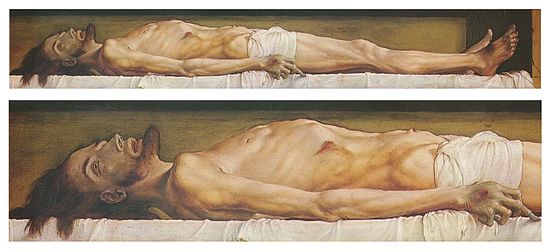
Hans Holbein, Dead Christ, 1522. Dostoevsky’s inspiration in the Idiot.
One of my readers has (rightfully?) chided me about my obsession with the negative aspects of life.
“Why not look at a happy integrated family, or the beauty of God’s creation?,” he asks. “Why think about violence, death, and perversion instead?,” he wants to know.
I confess to being drawn toward the latter. For example, I have written about Nowosielski’s dark iconic vision here, or Kristeva’s obsession with the sickly Baroque here, or dirty, gritty Rabelaisian Catholicism here and here.****
I talk abut these things because they are aspects of my own experience that need to be integrated through grace. You should also remember that I come from a country, Poland (a.k.a. Catholiclandia), that lost roughly one-sixth of its population during World War II.
Below you will find a florilegium that will hopefully suggest that Manichean tendencies aren’t the only driving force behind these posts.
“‘The thought steps in, whether one likes it or no, that death is so terrible and so powerful, that even He who conquered it in His miracles during life was unable to triumph over it at the last. He who called to Lazarus, ‘Lazarus, come forth!’ and the dead man lived—He was now Himself a prey to nature and death. Nature appears to one, looking at this picture, as some huge, implacable, dumb monster; or still better—a stranger simile—some enormous mechanical engine of modern days which has seized and crushed and swallowed up a great and invaluable Being, a Being worth nature and all her laws, worth the whole earth, which was perhaps created merely for the sake of the advent of that Being.
‘This blind, dumb, implacable, eternal, unreasoning force is well shown in the picture, and the absolute subordination of all men and things to it is so well expressed that the idea unconsciously arises in the mind of anyone who looks at it. All those faithful people who were gazing at the cross and its mutilated occupant must have suffered agony of mind that evening; for they must have felt that all their hopes and almost all their faith had been shattered at a blow. They must have separated in terror and dread that night, though each perhaps carried away with him one great thought which was never eradicated from his mind for ever afterwards. If this great Teacher of theirs could have seen Himself after the Crucifixion, how could He have consented to mount the Cross and to die as He did? This thought also comes into the mind of the man who gazes at this picture. I thought of all this by snatches probably between my attacks of delirium—for an hour and a half or so before Colia’s departure.
‘Can there be an appearance of that which has no form? And yet it seemed to me, at certain moments, that I beheld in some strange and impossible form, that dark, dumb, irresistibly powerful, eternal force.'”
—Dostoevsky, The Idiot

Mantegna, Lamentation of Christ, c. 1480.
“Holy Saturday. The drama of Holy Week dies down for a moment. However, our thoughts race ahead, because they are hesitant about stopping near scenes of mourning, at physically repelling pietas, or by the corpse of Christ that has turned blue (as Mantegna saw it during a moment of religious dread). It is difficult to stay with a dead God, if only because his very death negates the logic of all consolations—doubt strikes not only the object of hope, but also its very possibility. We run away. Even though the tortured body of Christ rests in its grave, we live in the inevitable arrival of Sunday. The encouraging signs: rolled away stone, empty grave, angels, glory! It’s as if the final battle with the gates of hell is already behind us. But why does God wait nonetheless? Why does he leave us at the grave? Why is the One who is capable of rebuilding the temple in three days incapable of rebuilding it immediately?
The temptation to run away from the silence of Holy Saturday is not new. These same waters—disgust with the foolishness of an actual incarnation and an actual sacrifice—water the Docetist heresy. In the apocryphal Gospel of Bartholomew (dated back to the third century) the harrowing of hell occurs already on Friday, even before the deposition from the cross. However this only makes Christ’s tomb into a mere theatrical decoration, and Saturday a problem of rhetoric not philosophy. I believe that Irenaeus of Lyons, who thought the Savior was in hell from his death until his resurrection, has the backing of some weighty theological reasons.”
—Dariusz Karlowicz, Koniec snu Konstantyna [The End of Constantine’s Dream], my own translation.
Previous Post

July 8, 2013
Hannah Arendt: Any Anthropology is Always-Already a Theology
Next Post
July 10, 2013 The Wild & Wooly von Balthasar
Browse Our Archives
Select a Category #WhyRemainCatholic Abortion Advent Anti-Catholicism Arts Atheism Beauty Benedict XVI Bible Book Review Catholic Cinema Comedy Cosmos: A Space-Time Odyssey Czesław Miłosz Dariusz Karłowicz Devil Easter Eastern Orthodoxy Economics Environment Family Famous Atheists Who Weren't Atheists Guest Post Hans Urs von Balthasar HHS Mandate History Imagination Interview Islam Jean-Luc Marion John Paul II Judaism Just War Lent Literature Little Sisters of the Poor Liturgy Martyrdom Music News Paganism Patristics Phenomenology Philosophy Pierre Hadot Poetry Poland Pop Culture Pope Francis Poverty Prayer Protestantism Rabelais Race Remi Brague Rene Girard Russia Sam Rocha Science & Religion SCOTUS Secularization Sexual Abuse Sexuality Silence Solidarity Stratford Caldecott Synod14 Terrorism Top 10 Uncategorized Walker Percy War Weakened Edition World War II World Youth Day WYD Krakow
Select a Month July 2017 June 2017 May 2017 April 2017 March 2017 February 2017 January 2017 December 2016 October 2016 September 2016 August 2016 July 2016 June 2016 May 2016 April 2016 March 2016 February 2016 January 2016 December 2015 November 2015 October 2015 September 2015 August 2015 July 2015 June 2015 May 2015 April 2015 March 2015 February 2015 January 2015 December 2014 November 2014 October 2014 September 2014 August 2014 July 2014 May 2014 April 2014 March 2014 February 2014 January 2014 December 2013 November 2013 October 2013 September 2013 August 2013 July 2013 June 2013 May 2013
Follow Us!
TAKE THE
Religious Wisdom Quiz
Which Christian denomination was founded by John and Charles Wesley?
Select your answer to see how you score.
Baptist Presbyterian Methodist Catholic
Related posts from Cosmos The In Lost

Where Does the Body of Christ Go After...

Holocaust Remembrance Day: The Memory of the Holocaust...
How Did the Resurrection Historically Affect Reason?
Liberal Theologian's Lenient Easter Sermon Makes a Mockery...
TRENDING AT PATHEOS Catholic

Creation, Preservation, and Teleology in Catholic Theology
As I write this, it is very early Monday morning. Like millions...

The Parable Of The Sower And The Word...
One of Christ’s most famous parables is that of the sower who...

Rejecting Doom: Christian Hope And Human Action
Christianity is a religion of hope. We are to have hope and...

Why I Choose the Eucharist Over the Sermon
Choose the Eucharist, Not the Sermon What are we supposed to get...

5 Design Elements Found in Spiritually Rooted Homes
Putting Spirituality Into Home Decor Our homes are more than our living...

Credo: A Story of God Told with the...
About 10 years ago, I began to imagine a personal "Credo" that...
view all Catholic blogs
Ad-Free & Subscriber Log-In Subscription Support
- About Us
- 2026 Calendar
- Videos
- Podcasts
- Library of World Religions
- Faith In Media Tracker
- Advertise With Us
- Write for Us
- Privacy Policy
- Terms of Service
- Do Not Sell My Data
- Contact Us
- Radiant Digital
- Manage Newsletter Subscriptions
- Unsubscribe From Notifications
- Sitemap
Copyright 2008-2026, Patheos. All rights reserved.
Subscription Support Ad-Free & Subscriber Log-In
Follow Patheos