
BuddhistCatholicContemplativeEvangelicalGeneral ChristianHinduJewishLatter-day SaintMuslimNew VisionsProgressive Christian
Beliefs
- Buddhist
- Catholic
- Contemplative
- Evangelical
- General Christian
- Hindu
- Jewish
- Latter-day Saint
- More Voices
- Muslim
- New Visions
- Pagan
- Progressive Christian
Topics
- Religion News
- Food and Religion
- Sports and Religion
- Religious Art
- Religious Music and Entertainment
- Religious Events
- History and Religion
- Style and Religion
- Politics and Religion
- Women in Religion
- Recreation Outdoors and Religion
- Business Finance and Religion
- Careers Workplace and Religion
- Education and Religion
- Family Parenting and Religion
- Health Fitness and Religion
- Home and Religion
- Relationships and Religion
- Technology and Religion
- Travel and Religion
Columnists
- Buddhist Columnists
- Business Finance and Religion Columnists
- Careers Workplace and Religion Columnists
- Catholic Columnists
- Contemplative Columnists
- Education and Religion Columnists
- Evangelists Columnists
- Family Parenting and Religion Columnists
- General Christian Columnists
- Health Fitness and Religion Columnists
- Hindu Columnists
- History and Religion Columnists
- Home and Religion Columnists
- Jewish Columnists
- More Voices Columnists
- Latter Day Columnists
- Muslim Columnists
- New Visions Columnists
- Nonreligious Columnists
- Pagan Columnists
- Politics and Religion Columnists
- Progressive Columnists
- Recreation Outdoors and Religion Columnists
- Relationships and Religion Columnists
- Religion News Columnists
- Religious Art Columnists
- Religious Events Columnists
- Religious Music and Entertainment Columnists
- Sports and Religion Columnists
- Style and Religion Columnists
- Technology and Religion Columnists
- Travel and Religion Columnists
- Women in Religion Columnists
Resource Library
- 2026 Calendar
- Library of World Religions
- The 100 Most Holy Places on Earth
- Patheos Answers
- Podcasts
- Videos
- Faith Leaders Database
- Anglican Episcopalian
- Bahai
- Baptist
- Buddhism
- Christianity
- Confucianism
- Eastern Orthodoxy
- Hinduism
- Holiness and Pentecostal
- ISKCON
- Islam
- Judaism
- Lutheran
- Methodist
- The Church of Jesus Christ of Latter-day Saints
- New Age
- Paganism
- Presbytarian and Reformed
- Protestantism
- Religion Behind the Scenes
- Roman Catholic
- Scientology
- Shia Islam
- Sikhism
- Sufism
- Sunni Islam
- Taoism
- Zen
- See all religions
Research Tools
 Ad-Free & Subscriber Log-In Subscription Support
Ad-Free & Subscriber Log-In Subscription Support
Follow Patheos 

- Trending:
- Forgiveness
- |
- Marriage
- |
- Consciousness
- |
- Death Penalty
- |
- Election
- |
- Halloween
 Convivium Salon
- Home
- Catholic
- The Same Thing
The Same Thing
Last updated on: July 6, 2019 at 8:39 am by Suzanne M. Lewis
The Same Thing 2019-07-06T08:39:15-05:00 Suzanne M. Lewis
Patheos Explore the world's faith through different perspectives on religion and spirituality! Patheos has the views of the prevalent religions and spiritualities of the world.
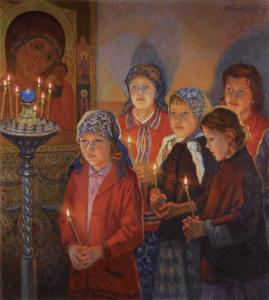
Nikolay Bogdanov Belsky
“About Jesus and the Church, I simply know they’re just one thing, and we shouldn’t complicate the matter.”
~ St. Joan of Arc from the transcripts of her trial.
Christ so identifies himself with his people, the Church, that when he confronts Paul on the road to Damascus, he asks, “Why are you persecuting me?” Many passages in St. Paul’s letters help to develop the implications of this radical incarnation of Christ present in the flesh and faces of his new Mystical Body: “For we are members of his body, of his flesh, and of his bones” (Ephesians 5:30) and “Now you are the body of Christ and individually members of it” (1 Corinthians 12:27).
In 1 Corinthians 13, Paul reminds us of the three essentials we require in order to remain in Christ’s body (see John 15): faith, hope, and love; then he launches into some of the most beautiful poetry in the Bible, the Canticle of Love. This supernatural Love provides the “glue” that gives Christ’s new body life, integrity, and unity.
Christ also left us a method, or a structuring principle, in the (messy, impulsive, and even sinful) person of Peter, who embodies Christ, specifically his divine authority to teach and to minister the Eucharist and other sacraments, “vicariously.” Peter, the apostles, and later the bishops all ensure that these two key divine functions remain present in our own flesh.
A body part cannot be “fired” or “voted out of office.” Only by incurring great pain and permanent loss of function could a body sustain the loss of a limb. But a body cannot survive the loss of its central nervous system or heart, and neither can Christ’s body on earth sustain the loss of its embodied teaching authority or the lifeblood of the sacraments. While the brain and heart can sustain the loss of a hand, a hand dies if it loses contact with its brain or heart.
The extent to which it makes us uncomfortable to think about interpersonal relationships in such visceral terms can give us insights into how distant we are from faith, which does not involve assent to abstract principles but rather demands we enter into relationship with the divine through tangible, concrete matter.
One can disagree with the bishops (and even the Pope!) without damaging the loving unity upon which Christ’s current incarnation depends. But a baptized person who disavows or attacks the person of a bishop either engages in self-mutilation and a hatred for Christ or betrays a depth of ignorance that points to a severe crisis in education (it works the other way around, too: bishops who do violence to the baptized injure the person of Jesus and commit a form of suicide by dismemberment).
Catechesis of the Good Shepherd
Previous Post

July 6, 2019
Is there anything more urgent?
Browse Our Archives
Select a Category Academic Freedom Catechesis of the Good Shepherd Enormous Room Eucharist Music School of Community songs Uncategorized Vitamin Drops Way of the Cross
Select a Month July 2019 April 2019 March 2019 February 2019 January 2019 December 2018
Follow Us!
TAKE THE
Religious Wisdom Quiz
My child died, but a prophet stretched himself upon him three times and life returned. Who am I?
Select your answer to see how you score.
The widow of Zarephath Ruth The Shunammite woman Hannah
Related posts from Convivium Salon
Is there anything more urgent?
On Using Cliches to Shed Light on Cliches
Holy Saturday Catechesis: Liturgy of Light
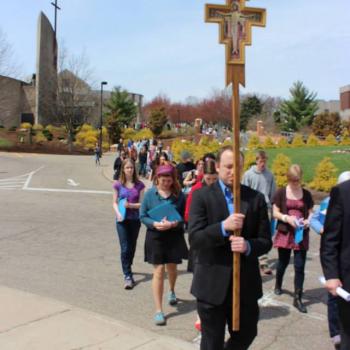
Way of the Cross at Franciscan University (2019)
TRENDING AT PATHEOS Catholic

Rejecting Doom: Christian Hope And Human Action
Christianity is a religion of hope. We are to have hope and...

It’s What Comes From Within Which Matters
One of the most difficult things for us to understand is why...

Why I Choose the Eucharist Over the Sermon
Choose the Eucharist, Not the Sermon What are we supposed to get...

5 Design Elements Found in Spiritually Rooted Homes
Putting Spirituality Into Home Decor Our homes are more than our living...

Credo: A Story of God Told with the...
About 10 years ago, I began to imagine a personal "Credo" that...

The Anatomy of Divine Revelation in Catholic Thought
The claim that God has made Himself known to human beings is...
view all Catholic blogs
Ad-Free & Subscriber Log-In Subscription Support
- About Us
- 2026 Calendar
- Videos
- Podcasts
- Library of World Religions
- Faith In Media Tracker
- Advertise With Us
- Write for Us
- Privacy Policy
- Terms of Service
- Do Not Sell My Data
- Contact Us
- Radiant Digital
- Manage Newsletter Subscriptions
- Unsubscribe From Notifications
- Sitemap
Copyright 2008-2026, Patheos. All rights reserved.
Subscription Support Ad-Free & Subscriber Log-In
Follow Patheos