
BuddhistCatholicContemplativeEvangelicalGeneral ChristianHinduJewishLatter-day SaintMuslimNew VisionsProgressive Christian
Beliefs
- Buddhist
- Catholic
- Contemplative
- Evangelical
- General Christian
- Hindu
- Jewish
- Latter-day Saint
- More Voices
- Muslim
- New Visions
- Pagan
- Progressive Christian
Topics
- Religion News
- Food and Religion
- Sports and Religion
- Religious Art
- Religious Music and Entertainment
- Religious Events
- History and Religion
- Style and Religion
- Politics and Religion
- Women in Religion
- Recreation Outdoors and Religion
- Business Finance and Religion
- Careers Workplace and Religion
- Education and Religion
- Family Parenting and Religion
- Health Fitness and Religion
- Home and Religion
- Relationships and Religion
- Technology and Religion
- Travel and Religion
Columnists
- Buddhist Columnists
- Business Finance and Religion Columnists
- Careers Workplace and Religion Columnists
- Catholic Columnists
- Contemplative Columnists
- Education and Religion Columnists
- Evangelists Columnists
- Family Parenting and Religion Columnists
- General Christian Columnists
- Health Fitness and Religion Columnists
- Hindu Columnists
- History and Religion Columnists
- Home and Religion Columnists
- Jewish Columnists
- More Voices Columnists
- Latter Day Columnists
- Muslim Columnists
- New Visions Columnists
- Nonreligious Columnists
- Pagan Columnists
- Politics and Religion Columnists
- Progressive Columnists
- Recreation Outdoors and Religion Columnists
- Relationships and Religion Columnists
- Religion News Columnists
- Religious Art Columnists
- Religious Events Columnists
- Religious Music and Entertainment Columnists
- Sports and Religion Columnists
- Style and Religion Columnists
- Technology and Religion Columnists
- Travel and Religion Columnists
- Women in Religion Columnists
Resource Library
- 2026 Calendar
- Library of World Religions
- The 100 Most Holy Places on Earth
- Patheos Answers
- Podcasts
- Videos
- Faith Leaders Database
- Anglican Episcopalian
- Bahai
- Baptist
- Buddhism
- Christianity
- Confucianism
- Eastern Orthodoxy
- Hinduism
- Holiness and Pentecostal
- ISKCON
- Islam
- Judaism
- Lutheran
- Methodist
- The Church of Jesus Christ of Latter-day Saints
- New Age
- Paganism
- Presbytarian and Reformed
- Protestantism
- Religion Behind the Scenes
- Roman Catholic
- Scientology
- Shia Islam
- Sikhism
- Sufism
- Sunni Islam
- Taoism
- Zen
- See all religions
Research Tools
 Ad-Free & Subscriber Log-In Subscription Support
Ad-Free & Subscriber Log-In Subscription Support
Follow Patheos 

- Trending:
- Forgiveness
- |
- Marriage
- |
- Consciousness
- |
- Death Penalty
- |
- Election
- |
- Halloween
 Convivium Salon
- Home
- Catholic
- Open door(s)
Open door(s)
Last updated on: February 9, 2019 at 12:00 am by Guest Contributor
Open door(s) 2019-02-09T00:00:14-05:00 Guest Contributor
Patheos Explore the world's faith through different perspectives on religion and spirituality! Patheos has the views of the prevalent religions and spiritualities of the world.
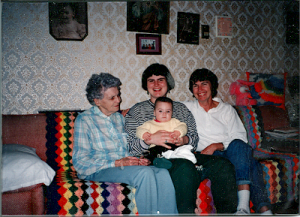
“Lena, Suzanne, Judy, and Sweetpea“
Lena Dougherty spent most of her adult life in Bulpitt, Illinois, where she raised five children. Her husband, Andy – his friends called him ‘Sad Eyes’, though I only ever heard her refer to him as ‘Bello’ – descended underground each day to manually remove coal in the nearby mine. Lena’s education had ended in the 8th grade, when her family hired her out as a farm laborer, for which she earned a dollar a day to work from before sunup to well after sundown.
Lena has fifteen grandchildren, of whom I am the twelfth. Numbers 1-11 all grew up relatively nearby – some within walking distance of Bulpitt, others were a short drive away – while my three younger sisters and I traveled the globe with my parents, whose work (we vaguely understood) involved something to do with saving the Free World from Immanent Destruction. Every two, or four, or five years, my dad caught a break from thwarting bad guys and we got to visit “home,” the little gray house in Bulpitt, a far more exotic place to us than the Snake Temple in Bayan Lepas or the Tiger Balm Gardens in Hong Kong.
In Bulpitt, all the important rules of etiquette were bewilderingly reversed: my cousins laughed when I ate French fries with a fork, and they expressed great suspicion when, after drinking, I failed to leave a Kool-Aid mustache encircling my lips. Despite the fact that my Grandma shared daily life with my other cousins, she evidenced no distance or awkwardness with me or with my sisters when she’d see us again after years apart. She looked at me with exactly the same frank gaze of affectionate familiarity that she used with all my other cousins. She clung to memories of our times together and brought out these stories, to chuckle endlessly over them when we would return to her kitchen table; for example: “Remember that time you were frying eggs, Suzy, and one slipped over the lip of the pan below the burner of my stove?!” Then she mimicked the sound that an escaping egg might make: “Fwwiipppp! How I laughed when I pulled out the drawer to clean and discovered that one perfect egg, all shiny – and – UNBROKEN!” And she’d dissolve into more gales of laughter. Though I had failed to report the egg’s fall to her, she did not view this as a mark against me, or worthy of any reproach.
Once, on a school trip to the Museum of American History, in Washington, DC, I turned a corner, and there behind a wall of glass, I confronted my Grandma’s kitchen. I was dumbstruck by the white gas stove, identical to Grandma D’s, down to the iron claw burners with a cavity below, where a perfect, unbroken egg could hide until someone slid open the tray to clean it. Enthroned in the center of the display, I saw a close replica of Grandma’s kitchen table, with hollow stainless tubes for legs and the tabletop covered in faux marble contact paper. Three objects were arrayed on the table: a pink glass sugar bowl in the shape of a faceted ice cream cone and filled with teaspoons; a set of rectangular, white milk glass salt and pepper shakers; and an antique black metal pasta machine, an exact duplicate of the one my Grandma used to roll out paper-thin strips of tortellini dough. The exhibit included other eerily familiar items, for example, the same framed images on the walls and the almost identical china pattern on the gravy boat. In that instant, I felt I could smell the unique aroma that belonged to her kitchen: a mix of browned hamburger beef and garlic, Romano cheese, roasted onions, cornmeal mush, basil, crispy ham and the starchy smell of pale cannellini. This smell brought back hours of unself-conscious laughter – a symphony of hooting and cackling and little-girl giggles – and the hungry way that she’d look at me, as if she could never get enough of my face, my eyes, my voice.
I pressed up close to the glass, stunned that what I thought had been the unique, exotic experience of standing in her home, carried cultural weight: enough weight to be museum-worthy. Many others must have had the experience I thought had been mine alone. To underline this extraordinary fact, the museum curators had placed a sign on the glass: Italian Immigrant’s Kitchen.
…But did all those other Grandmas explain to all those other grandkids, as they cranked the wooden handles on their pasta rollers, the precise tongue shape the dough had to form before they could feed it into their machines? Did they hold the rolled dough up to the light so their granddaughters could gauge its translucence? Did they demonstrate the way to lift a pea-sized morsel of meat filling onto the end of a spoon, then use the back of another spoon to roll it into shape and deposit it on the cut squares? Maybe. But did they also regale their grandkids with stories about the three or four or five children they sponsored in Guatemala, and Nigeria, and Haiti and all the letters they’d received from these kids living thousands of miles away? Had they sung, By the light/ of the silvery moon/ I’d like to swoon/ while to my honey I croon love tunes… and then add, “I sang that to Bello on our honeymoon, but I won’t tell you about the other songs we used to sing together!” and then wink, and dissolve into another fit of laughter? Had any of those grandmas walked in, unexpectedly, when their granddaughters were stress dancing, without an ounce of reserve, to Donna Summer, and then exclaim, “How beautiful that you can be so free and dance like that, with all your heart!”?
I didn’t think so.
Quidquid recipitur ad modum recipientis recipitur
Whatever is received is received according to the mode of the receiver. This Latin phrase, originally from Thomas Aquinas, expresses the observation that whatever we perceive reveals more about who we are than it discloses about the thing we are beholding. Aquinas’ insight also elucidates the psychological concepts of transference and of projection, but it expands these premises to characterize all human perceptions of reality. Thus the figurative language in any great work of literature reflects something of the psyche and experience of its narrator, as in David Foster Wallace’s Infinite Jest, when his main character, Don Gately, a recovering addict, observes that “the sky outside the window was gorgeous, Dilaudid-colored.”
In the first part of this essay, I wrote:
Without hearing a “yes” from someone who is not me, I am unable to give myself permission, even to live. The word “yes” represents an invitation. When we hear the word, “yes,” we also experience radical hospitality. To be met with “yes” means to receive acknowledgment, to be ratified as one who exists. “Yes” tells us that we belong, that we matter, and even that the other perceives us as something good.
Nonetheless, during my early adulthood, my Grandma’s “yes” to my existence did not count for much with me. Instead, I gave a heft, a significance, and a mission to each “no”: the daily hours of tennis that did not help me to rise above a certain level of play; a dear friend who had misunderstood me and then blamed me for a hurt I’d received; the novel that no publisher would take and that, in any case, disappointed me. A friend once told me, “You’re so burdened by your memories; you’re like a homeless person who has to wear her entire suffocating wardrobe when it’s hot out because she has nowhere to put everything.” Each item of clothing represented another “no.” Later I would have to retrace my steps and pick up each “yes” that I’d discarded along the way, but in my early twenties, I didn’t value them.
I was the man from the country; the gatekeeper of Kafka’s parable represented reality for me.
How many more pages of life experience would Kafka have needed to write for that man from the country, in order to somehow help his character develop the strength to turn away from the impassible gate, with its implacable gatekeeper, so that he could discover a new entryway to the Law, one with a gatekeeper whose collar was free from fleas, and who said, “yes”?
The answer to that last question is: many. Many, many, many. And it would take far too many words for me to describe the path that brought me from a fixation on the gatekeeper’s “no” to an active search for other openings, where those entrusted with entrance to the Law of existence say, “yes.”
Boiling all those words down to their essence, though, Kafka’s parable needs only one additional sentence in order to become the story of my own life:
After staring at the gatekeeper all that time, one day the man from the country turned his head and looked in a new direction.
My Grandma’s love determined who I am. But only after I began to say “yes” to it.
This piece is a continuation of a previous essay, Parable of the door(s)
Previous Post
January 13, 2019
Parable of the door(s)
Next Post

January 16, 2019 Seeing Inside a Mystery
Browse Our Archives
Select a Category Academic Freedom Catechesis of the Good Shepherd Enormous Room Eucharist Music School of Community songs Uncategorized Vitamin Drops Way of the Cross
Select a Month July 2019 April 2019 March 2019 February 2019 January 2019 December 2018
Follow Us!
TAKE THE
Religious Wisdom Quiz
What Christian group is known for their "Circuit Riders" in history?
Select your answer to see how you score.
Anglicans Lutherans Methodists Baptists
Related posts from Convivium Salon
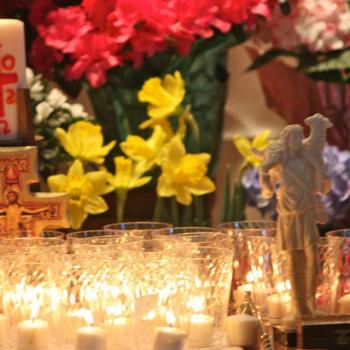
Holy Saturday Catechesis: Liturgy of Light
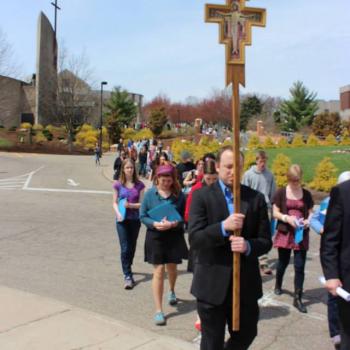
Way of the Cross at Franciscan University (2019)
Good Friday Catechesis: The City of Jerusalem
Holy Thursday Catechesis: The Cenacle
TRENDING AT PATHEOS Catholic

Rejecting Doom: Christian Hope And Human Action
Christianity is a religion of hope. We are to have hope and...

It’s What Comes From Within Which Matters
One of the most difficult things for us to understand is why...

Why I Choose the Eucharist Over the Sermon
Choose the Eucharist, Not the Sermon What are we supposed to get...

5 Design Elements Found in Spiritually Rooted Homes
Putting Spirituality Into Home Decor Our homes are more than our living...

Credo: A Story of God Told with the...
About 10 years ago, I began to imagine a personal "Credo" that...

The Anatomy of Divine Revelation in Catholic Thought
The claim that God has made Himself known to human beings is...
view all Catholic blogs
Ad-Free & Subscriber Log-In Subscription Support
- About Us
- 2026 Calendar
- Videos
- Podcasts
- Library of World Religions
- Faith In Media Tracker
- Advertise With Us
- Write for Us
- Privacy Policy
- Terms of Service
- Do Not Sell My Data
- Contact Us
- Radiant Digital
- Manage Newsletter Subscriptions
- Unsubscribe From Notifications
- Sitemap
Copyright 2008-2026, Patheos. All rights reserved.
Subscription Support Ad-Free & Subscriber Log-In
Follow Patheos