
BuddhistCatholicContemplativeEvangelicalGeneral ChristianHinduJewishLatter-day SaintMuslimNew VisionsProgressive Christian
Beliefs
- Buddhist
- Catholic
- Contemplative
- Evangelical
- General Christian
- Hindu
- Jewish
- Latter-day Saint
- More Voices
- Muslim
- New Visions
- Pagan
- Progressive Christian
Topics
- Religion News
- Food and Religion
- Sports and Religion
- Religious Art
- Religious Music and Entertainment
- Religious Events
- History and Religion
- Style and Religion
- Politics and Religion
- Women in Religion
- Recreation Outdoors and Religion
- Business Finance and Religion
- Careers Workplace and Religion
- Education and Religion
- Family Parenting and Religion
- Health Fitness and Religion
- Home and Religion
- Relationships and Religion
- Technology and Religion
- Travel and Religion
Columnists
- Buddhist Columnists
- Business Finance and Religion Columnists
- Careers Workplace and Religion Columnists
- Catholic Columnists
- Contemplative Columnists
- Education and Religion Columnists
- Evangelists Columnists
- Family Parenting and Religion Columnists
- General Christian Columnists
- Health Fitness and Religion Columnists
- Hindu Columnists
- History and Religion Columnists
- Home and Religion Columnists
- Jewish Columnists
- More Voices Columnists
- Latter Day Columnists
- Muslim Columnists
- New Visions Columnists
- Nonreligious Columnists
- Pagan Columnists
- Politics and Religion Columnists
- Progressive Columnists
- Recreation Outdoors and Religion Columnists
- Relationships and Religion Columnists
- Religion News Columnists
- Religious Art Columnists
- Religious Events Columnists
- Religious Music and Entertainment Columnists
- Sports and Religion Columnists
- Style and Religion Columnists
- Technology and Religion Columnists
- Travel and Religion Columnists
- Women in Religion Columnists
Resource Library
- 2026 Calendar
- Library of World Religions
- The 100 Most Holy Places on Earth
- Patheos Answers
- Podcasts
- Videos
- Faith Leaders Database
- Anglican Episcopalian
- Bahai
- Baptist
- Buddhism
- Christianity
- Confucianism
- Eastern Orthodoxy
- Hinduism
- Holiness and Pentecostal
- ISKCON
- Islam
- Judaism
- Lutheran
- Methodist
- The Church of Jesus Christ of Latter-day Saints
- New Age
- Paganism
- Presbytarian and Reformed
- Protestantism
- Religion Behind the Scenes
- Roman Catholic
- Scientology
- Shia Islam
- Sikhism
- Sufism
- Sunni Islam
- Taoism
- Zen
- See all religions
Research Tools
 Ad-Free & Subscriber Log-In Subscription Support
Ad-Free & Subscriber Log-In Subscription Support
Follow Patheos 

- Trending:
- Forgiveness
- |
- Marriage
- |
- Consciousness
- |
- Death Penalty
- |
- Election
- |
- Halloween
 Contemplatio Culture
- Home
- Catholic
- History and Religion
- Pius X- August 21 (Everyday Saints Series)
Pius X- August 21 (Everyday Saints Series)
Last updated on: August 21, 2020 at 6:00 am by Theresa Zoe Williams
Pius X- August 21 (Everyday Saints Series) 2020-08-14T11:15:54-07:00 Theresa Zoe Williams
Patheos Explore the world's faith through different perspectives on religion and spirituality! Patheos has the views of the prevalent religions and spiritualities of the world.
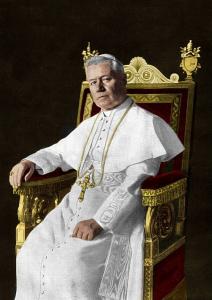
Pius X might be most well-known as the namesake of the Society of Saint Pius X, a semi-schismatic fraternity of priests (they currently have no canonical standing). The Vatican and the SSPX are currently at an impasse. It is unfortunate that this saint’s name is wound up in this mess, as he was an incredible person.
Pius X was born as Giuseppe Melchiorre Sarto on June 2, 1835 in Riesi, Italy (then part of the Austrian Empire). He was the second of ten children, eight of whom survived into adulthood. His family was poor, as his father was the postman. However, his parents valued education almost as highly as they valued the faith and so they sent him to school, though he had to walk almost four miles each way.
To attend seminary, Pius X was granted a scholarship. While there, he excelled at classics, philosophy, and theology. He was then ordained a priest and further studied St. Thomas Aquinas and canon law. He restored the church at Salzano and expanded the hospital by begging for the funds and also laboring to make the money. He assisted the sick during the cholera plague that swept northern Italy in the early 1870s. Pius X was made chancellor of the Diocese of Treviso and used his position to make it possible for public school students to receive religious instruction. One of his great struggles was in getting religious instruction to rural and urban youth who could not attend Catholic schools. But, he persisted in this and made some headway.
Pius X was the last pope (before Pope Francis) who did not have a doctorate.
His papal motto was Instaurare Omnia in Christo, “to restore all things in Christ.” Pius X made reforms in liturgy and church law. He took his origins and the poverty of the Gospel to heart, cutting down on papal ceremonies, wearing simpler sacramentals, and inviting friends to dine with him rather than dining alone. At the time, it was also a custom for the pope to make his siblings papal counts and countesses. He refused to do this for his peasant sisters, saying, “I have made them sisters of the Pope; what more can I do for them?” acknowledging that money and status was not the highest temporal goods. He did, though, make sure his family was cared for.
Pius X placed special care and importance in children. He carried candy in his pockets for the children of Mantua and Venice and also taught them catechism. During papal audiences, he would gather children around him and talk to them about things that interested them. His weekly catechism lessons included a special place for children, too. Pius X’s decision to require the Confraternity of Christian Doctrine in every parish was motivated by a desire to spare children from religious ignorance. Also, he restored the habit of frequent reception of communion from childhood!
In 1913, Pius X suffered a heart attack. On the Feast of the Assumption in 1914, he fell ill again and did not recover. He died five days later. His last will and testament include the sentence: “I was born poor, I have lived in poverty, and I wish to die poor.” Following this, he had prohibited any of his organs to be removed for aid in the embalming process; successive popes have continued this as tradition. Pius X was buried in an unadorned tomb in the crypt below St. Peter’s Basilica.
His simplicity, humility, and poverty of spirit allowed him to rule and guide the Church with wisdom and love.
Image courtesy of https://commons.wikimedia.org/wiki/File:Portrait_of_Pope_St._Pius_X_(Colored).jpg
Previous Post
August 20, 2020
Bernard of Clairvaux- August 20 (Everyday Saints Series)
Next Post

August 22, 2020 Andrew the Scot - August 22 (Everyday Saints Series)
Browse Our Archives
Select a Category Daily Saints Fairytales Uncategorized
Select a Month August 2020 July 2020 June 2020 May 2020 April 2020 December 2019 July 2019 May 2019 April 2019 March 2019 February 2019 January 2019 December 2018
Follow Us!
TAKE THE
Religious Wisdom Quiz
What does Hebrews say Jesus learned through what he suffered?
Select your answer to see how you score.
Humility Mercy Compassion Obedience
Support this
Column


Related posts from Contemplatio Culture
Andrew the Scot - August 22 (Everyday Saints...
Bernard of Clairvaux- August 20 (Everyday Saints Series)
Emily Bicchieri- August 19 (Everyday Saints Series)
Alberto Hurtado Cruchaga- August 18 (Everyday Saints Series)
TRENDING AT PATHEOS Catholic

Rejecting Doom: Christian Hope And Human Action
Christianity is a religion of hope. We are to have hope and...

It’s What Comes From Within Which Matters
One of the most difficult things for us to understand is why...

Why I Choose the Eucharist Over the Sermon
Choose the Eucharist, Not the Sermon What are we supposed to get...

5 Design Elements Found in Spiritually Rooted Homes
Putting Spirituality Into Home Decor Our homes are more than our living...

Credo: A Story of God Told with the...
About 10 years ago, I began to imagine a personal "Credo" that...

The Anatomy of Divine Revelation in Catholic Thought
The claim that God has made Himself known to human beings is...
view all Catholic blogs
Ad-Free & Subscriber Log-In Subscription Support
- About Us
- 2026 Calendar
- Videos
- Podcasts
- Library of World Religions
- Faith In Media Tracker
- Advertise With Us
- Write for Us
- Privacy Policy
- Terms of Service
- Do Not Sell My Data
- Contact Us
- Radiant Digital
- Manage Newsletter Subscriptions
- Unsubscribe From Notifications
- Sitemap
Copyright 2008-2026, Patheos. All rights reserved.
Subscription Support Ad-Free & Subscriber Log-In
Follow Patheos