
BuddhistCatholicContemplativeEvangelicalGeneral ChristianHinduJewishLatter-day SaintMuslimNew VisionsProgressive Christian
Beliefs
- Buddhist
- Catholic
- Contemplative
- Evangelical
- General Christian
- Hindu
- Jewish
- Latter-day Saint
- More Voices
- Muslim
- New Visions
- Pagan
- Progressive Christian
Topics
- Religion News
- Food and Religion
- Sports and Religion
- Religious Art
- Religious Music and Entertainment
- Religious Events
- History and Religion
- Style and Religion
- Politics and Religion
- Women in Religion
- Recreation Outdoors and Religion
- Business Finance and Religion
- Careers Workplace and Religion
- Education and Religion
- Family Parenting and Religion
- Health Fitness and Religion
- Home and Religion
- Relationships and Religion
- Technology and Religion
- Travel and Religion
Columnists
- Buddhist Columnists
- Business Finance and Religion Columnists
- Careers Workplace and Religion Columnists
- Catholic Columnists
- Contemplative Columnists
- Education and Religion Columnists
- Evangelists Columnists
- Family Parenting and Religion Columnists
- General Christian Columnists
- Health Fitness and Religion Columnists
- Hindu Columnists
- History and Religion Columnists
- Home and Religion Columnists
- Jewish Columnists
- More Voices Columnists
- Latter Day Columnists
- Muslim Columnists
- New Visions Columnists
- Nonreligious Columnists
- Pagan Columnists
- Politics and Religion Columnists
- Progressive Columnists
- Recreation Outdoors and Religion Columnists
- Relationships and Religion Columnists
- Religion News Columnists
- Religious Art Columnists
- Religious Events Columnists
- Religious Music and Entertainment Columnists
- Sports and Religion Columnists
- Style and Religion Columnists
- Technology and Religion Columnists
- Travel and Religion Columnists
- Women in Religion Columnists
Resource Library
- 2026 Calendar
- Library of World Religions
- The 100 Most Holy Places on Earth
- Patheos Answers
- Podcasts
- Videos
- Faith Leaders Database
- Anglican Episcopalian
- Bahai
- Baptist
- Buddhism
- Christianity
- Confucianism
- Eastern Orthodoxy
- Hinduism
- Holiness and Pentecostal
- ISKCON
- Islam
- Judaism
- Lutheran
- Methodist
- The Church of Jesus Christ of Latter-day Saints
- New Age
- Paganism
- Presbytarian and Reformed
- Protestantism
- Religion Behind the Scenes
- Roman Catholic
- Scientology
- Shia Islam
- Sikhism
- Sufism
- Sunni Islam
- Taoism
- Zen
- See all religions
Research Tools
 Ad-Free & Subscriber Log-In Subscription Support
Ad-Free & Subscriber Log-In Subscription Support
Follow Patheos 

- Trending:
- Forgiveness
- |
- Marriage
- |
- Consciousness
- |
- Death Penalty
- |
- Election
- |
- Halloween
 Contemplatio Culture
- Home
- Catholic
- History and Religion
- Alberto Hurtado Cruchaga- August 18 (Everyday Saints Series)
Alberto Hurtado Cruchaga- August 18 (Everyday Saints Series)
Last updated on: August 18, 2020 at 6:00 am by Theresa Zoe Williams
Alberto Hurtado Cruchaga- August 18 (Everyday Saints Series) 2020-08-12T10:34:14-07:00 Theresa Zoe Williams
Patheos Explore the world's faith through different perspectives on religion and spirituality! Patheos has the views of the prevalent religions and spiritualities of the world.
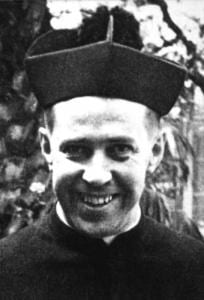
Luis Alberto Hurtado Cruchaga
Alberto Hurtado Cruchaga was born in Viña del Mar, Chile on January 22, 1901 to an aristocratic family. His father died when he was only four years old, his mother decided to sell their large estate. Unfortunately, she was defrauded. This impoverished their family, leading them to live with a string of relatives over the years.
Now without money or a home, Alberto was forced to understand life in poverty. He was only able to attend the all-boys Jesuit school of St. Ignacio, Santiago, Chile due to being granted a scholarship. While there, he volunteered in the office and library of a Catholic parish and school in a poor neighborhood.
Later, Alberto studied law at the Pontificia Universidad Cátolica de Chile and wrote his thesis on labor law. Once he earned his degree, he entered the Jesuit novitiate. He was sent to Argentina, Spain, and Belgium to continue his studies in humanities, philosophy, theology. Eventually, he obtained his doctorate in pedagogy and psychology.
Alberto returned to Chile in 1936. There he was appointed professor of religion at Colegio San Ignacio and of pedagogy at the Catholic University of Santiago. He involved his students with his catechesis of the poor practically from the very beginning. This was an offshoot of his criticism of the catechetical teachings to the poor in Chile and the refusal of the hierarchy there to stay in line with the pope.
Because of his early life, Alberto was heavily involved in social movements.
He founded homes for children in need of shelter and food, Hogar de Cristo. The shelters spread throughout Chile. It’s estimated that between the years of 1945 and 1951, more than 850,000 children received help from his movement. He would also monitor the streets at night to find people in need and help them as he could.
The locals called Alberto “Padre Hurtado” as a sign of affection and his solidarity with them.
Alberto also wrote prolifically on the Church’s social teaching. He questioned whether or not the government and hierarchy of Chile were living up to that. He received much criticism for this, especially from more conservative Catholics. Sometimes he was even written off as or accused of being a Communist. Sounds familiar in our day and age.
But the left also attacked him, calling him “the last prophet of the bourgeoisie”. None of these things mattered to Alberto; he was only concerned with keeping the Faith and helping the poor and the workers.
He died after a short illness.
One day in 1952, Alberto was rushed to the hospital with a terrible pain. There, he was diagnosed with pancreatic cancer. The media kept a constant vigil, updating the country on his health at all times. Alberto had become a national hero! The illness was intense, however, and after a brief battle with it, Alberto died in Santiago on August 18, 1952.
Alberto was one of the first people to be canonized during Pope Emeritus Benedict XVI’s papacy, on October 23, 2005. He is also the second Chilean to be canonized, after St. Teresa of Los Andes. At his canonization, a large group of Chileans gathered in St. Peter’s Square, lead by Chilean President Ricardo Lagos and other high-ranking politicians. Some of these men had been Alberto’s students during his time as a time.
Alberto’s legacy, faith, and good works live on today.
The way that he would be most proud of is that Hogar de Cristo still exists. Today it is one of the biggest charitable groups in all of Chile. There is also an award named for him presented to people for service through journalism.
“I hold that every poor man, every vagrant, every beggar is Christ carrying his cross. And as Christ, we must love and help him. We must treat him as a brother, a human being like ourselves. If we were to start a campaign of love for the poor and homeless, we would, in a short time, do away with depressing scenes of begging, children sleeping in doorways and women with babies in their arms fainting in our streets.” -St. Alberto Hurtado, S.J.
Image courtesy of https://es.wikipedia.org/wiki/Archivo:Padre_Alberto_Hurtado_en_el_noviciado_de_Chillán,_ca._1923.jpg
Previous Post
August 17, 2020
Jeanne Delanoue- August 17 (Everyday Saints Series)
Next Post
August 19, 2020 Emily Bicchieri- August 19 (Everyday Saints Series)
Browse Our Archives
Select a Category Daily Saints Fairytales Uncategorized
Select a Month August 2020 July 2020 June 2020 May 2020 April 2020 December 2019 July 2019 May 2019 April 2019 March 2019 February 2019 January 2019 December 2018
Follow Us!
TAKE THE
Religious Wisdom Quiz
Which parable illustrates God's joy over one sinner who repents?
Select your answer to see how you score.
The Sower The Ten Virgins The Two Sons The Lost Sheep
Support this
Column


Related posts from Contemplatio Culture
Andrew the Scot - August 22 (Everyday Saints...
Pius X- August 21 (Everyday Saints Series)
Bernard of Clairvaux- August 20 (Everyday Saints Series)
Emily Bicchieri- August 19 (Everyday Saints Series)
TRENDING AT PATHEOS Catholic

The Parable Of The Sower And The Word...
One of Christ’s most famous parables is that of the sower who...

Rejecting Doom: Christian Hope And Human Action
Christianity is a religion of hope. We are to have hope and...

Why I Choose the Eucharist Over the Sermon
Choose the Eucharist, Not the Sermon What are we supposed to get...

5 Design Elements Found in Spiritually Rooted Homes
Putting Spirituality Into Home Decor Our homes are more than our living...

Credo: A Story of God Told with the...
About 10 years ago, I began to imagine a personal "Credo" that...

The Anatomy of Divine Revelation in Catholic Thought
The claim that God has made Himself known to human beings is...
view all Catholic blogs
Ad-Free & Subscriber Log-In Subscription Support
- About Us
- 2026 Calendar
- Videos
- Podcasts
- Library of World Religions
- Faith In Media Tracker
- Advertise With Us
- Write for Us
- Privacy Policy
- Terms of Service
- Do Not Sell My Data
- Contact Us
- Radiant Digital
- Manage Newsletter Subscriptions
- Unsubscribe From Notifications
- Sitemap
Copyright 2008-2026, Patheos. All rights reserved.
Subscription Support Ad-Free & Subscriber Log-In
Follow Patheos