
BuddhistCatholicContemplativeEvangelicalGeneral ChristianHinduJewishLatter-day SaintMuslimNew VisionsProgressive Christian
Beliefs
- Buddhist
- Catholic
- Contemplative
- Evangelical
- General Christian
- Hindu
- Jewish
- Latter-day Saint
- More Voices
- Muslim
- New Visions
- Pagan
- Progressive Christian
Topics
- Religion News
- Food and Religion
- Sports and Religion
- Religious Art
- Religious Music and Entertainment
- Religious Events
- History and Religion
- Style and Religion
- Politics and Religion
- Women in Religion
- Recreation Outdoors and Religion
- Business Finance and Religion
- Careers Workplace and Religion
- Education and Religion
- Family Parenting and Religion
- Health Fitness and Religion
- Home and Religion
- Relationships and Religion
- Technology and Religion
- Travel and Religion
Columnists
- Buddhist Columnists
- Business Finance and Religion Columnists
- Careers Workplace and Religion Columnists
- Catholic Columnists
- Contemplative Columnists
- Education and Religion Columnists
- Evangelists Columnists
- Family Parenting and Religion Columnists
- General Christian Columnists
- Health Fitness and Religion Columnists
- Hindu Columnists
- History and Religion Columnists
- Home and Religion Columnists
- Jewish Columnists
- More Voices Columnists
- Latter Day Columnists
- Muslim Columnists
- New Visions Columnists
- Nonreligious Columnists
- Pagan Columnists
- Politics and Religion Columnists
- Progressive Columnists
- Recreation Outdoors and Religion Columnists
- Relationships and Religion Columnists
- Religion News Columnists
- Religious Art Columnists
- Religious Events Columnists
- Religious Music and Entertainment Columnists
- Sports and Religion Columnists
- Style and Religion Columnists
- Technology and Religion Columnists
- Travel and Religion Columnists
- Women in Religion Columnists
Resource Library
- 2026 Calendar
- Library of World Religions
- The 100 Most Holy Places on Earth
- Patheos Answers
- Podcasts
- Videos
- Faith Leaders Database
- Anglican Episcopalian
- Bahai
- Baptist
- Buddhism
- Christianity
- Confucianism
- Eastern Orthodoxy
- Hinduism
- Holiness and Pentecostal
- ISKCON
- Islam
- Judaism
- Lutheran
- Methodist
- The Church of Jesus Christ of Latter-day Saints
- New Age
- Paganism
- Presbytarian and Reformed
- Protestantism
- Religion Behind the Scenes
- Roman Catholic
- Scientology
- Shia Islam
- Sikhism
- Sufism
- Sunni Islam
- Taoism
- Zen
- See all religions
Research Tools
 Ad-Free & Subscriber Log-In Subscription Support
Ad-Free & Subscriber Log-In Subscription Support
Follow Patheos 

- Trending:
- Forgiveness
- |
- Marriage
- |
- Consciousness
- |
- Death Penalty
- |
- Election
- |
- Halloween
 Confessions
- Home
- Catholic
- Busy Lives & Restless Souls: A Practical Approach to Ignatian Spirituality
Busy Lives & Restless Souls: A Practical Approach to Ignatian Spirituality
Last updated on: March 27, 2017 at 11:53 am by Cynthia Dagnal-Myron
Busy Lives & Restless Souls: A Practical Approach to Ignatian Spirituality 2017-03-27T11:53:06-07:00 Cynthia Dagnal-Myron
Patheos Explore the world's faith through different perspectives on religion and spirituality! Patheos has the views of the prevalent religions and spiritualities of the world.
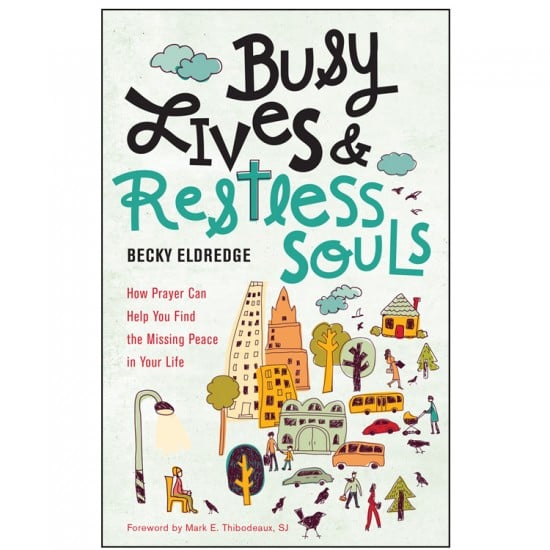
In the “Foreword” to Busy Lives & Restless Souls, Fr. Mark Thibodeaux, makes a bold statement:
“For too long the written explications of Ignatian Spirituality have been the exclusive work of Jesuit priests.”
A Jesuit priest himself, Thibodeaux offers an enthusiastic endorsement of Becky Eldredge’s approach to Ignatian Spirituality. He knows firsthand the power of the practice.
But he acknowledges that it is one thing to practice Ignatian meditation “in my quiet little bedroom in a house full of priests,” and quite another to attempt to do the same, only to be interrupted by “pajama-wearing, sweet, squealing little kids jumping on my bed.”
Eldredge’s book makes the case that Ignatian Spirituality can be just as transformative for those of us who must live in the real, workaday world. She believes that St. Ignatius wanted us all to become “contemplatives in action,” by discerning and then using our own unique gifts for the good of the world.
To that end, each chapter discusses how Eldredge herself learned to use several of the most familiar of St. Ignatius’ practices, like The Examen, the Colloquy, Ignatian contemplation and more as a very busy wife and mother. The exercises at the end of each lesson allow readers to contemplate and then practice what they’ve learned.
She reveals, quite candidly, her moments of doubt and disappointment. But she also assures us that the Holy Spirit removes all obstacles “so that the soul goes forward in doing good.” And the “quick tips” culled from her own journey are designed to encourage and inspire.
The latter sets her book apart from the more daunting scholarly texts and workbooks. The language and tone are reassuring and personable, as if a good friend, heart afire, had stopped by to share the Good News.
Louisiana born, she even likens God’s mercy to, say, cooking a pot of red beans and rice, as He constantly stirs and checks that pot, turning the heat up or down as necessary.
“First of all, we need to know that we can access God at any time and in any place” she explains.
“God is a friend we can talk to throughout the day as we wake, a we cook, as we eat, as we drive/commute to work, as we play and hang out with our friends. God is available to talk to us as we do laundry, change diapers…Everything is holy.”
Her spiritual “recipes” are indeed inviting and user-friendly. But one might ask if the Spiritual Exercises actually lend themselves to the “shake and bake” approach. St. Ignatius’ original process is meant to be spread out over at least 30 days of quiet contemplation.
Yes, it’s difficult for most of us to find that time. But perhaps making the time is part of the process. A very important part.
To skeptics I would say this book is a timely and worthy introduction to the practices—an “amuse bouche” to whet the appetite.
For, “Jesus calls us now, as we are” Eldredge insists. “Jesus is not waiting for us to be completely healed or whole or to reach some point in our faith journey that magically qualifies us for discipleship. No, Jesus calls us now. Right now.”
Busy Lives & Restless Souls will help you heed that call.
Previous Post
March 20, 2017
Do You Love Me? Feed My Sheep
Next Post

April 10, 2017 Farewell, My Beautiful Eliza--A Lenten Lesson
Browse Our Archives
Select a Category Uncategorized
Select a Month May 2017 April 2017 March 2017 February 2017 January 2017 December 2016 November 2016 October 2016 September 2016 August 2016 July 2016 June 2016
Follow Us!
TAKE THE
Religious Wisdom Quiz
In Colossians, Paul says that Christ is the head of what?
Select your answer to see how you score.
The body, the church The apostles All creation The believers
Related posts from Confessions

The Mysteries of Faith: Saving Chauncey The Shelter...
Farewell, My Beautiful Eliza--A Lenten Lesson

Hopi Lessons: What Trump's Election Says About All...
TRENDING AT PATHEOS Catholic

Rejecting Doom: Christian Hope And Human Action
Christianity is a religion of hope. We are to have hope and...

It’s What Comes From Within Which Matters
One of the most difficult things for us to understand is why...

Why I Choose the Eucharist Over the Sermon
Choose the Eucharist, Not the Sermon What are we supposed to get...

5 Design Elements Found in Spiritually Rooted Homes
Putting Spirituality Into Home Decor Our homes are more than our living...

Credo: A Story of God Told with the...
About 10 years ago, I began to imagine a personal "Credo" that...

The Anatomy of Divine Revelation in Catholic Thought
The claim that God has made Himself known to human beings is...
view all Catholic blogs
Ad-Free & Subscriber Log-In Subscription Support
- About Us
- 2026 Calendar
- Videos
- Podcasts
- Library of World Religions
- Faith In Media Tracker
- Advertise With Us
- Write for Us
- Privacy Policy
- Terms of Service
- Do Not Sell My Data
- Contact Us
- Radiant Digital
- Manage Newsletter Subscriptions
- Unsubscribe From Notifications
- Sitemap
Copyright 2008-2026, Patheos. All rights reserved.
Subscription Support Ad-Free & Subscriber Log-In
Follow Patheos