
BuddhistCatholicContemplativeEvangelicalGeneral ChristianHinduJewishLatter-day SaintMuslimNew VisionsProgressive Christian
Beliefs
- Buddhist
- Catholic
- Contemplative
- Evangelical
- General Christian
- Hindu
- Jewish
- Latter-day Saint
- More Voices
- Muslim
- New Visions
- Pagan
- Progressive Christian
Topics
- Religion News
- Food and Religion
- Sports and Religion
- Religious Art
- Religious Music and Entertainment
- Religious Events
- History and Religion
- Style and Religion
- Politics and Religion
- Women in Religion
- Recreation Outdoors and Religion
- Business Finance and Religion
- Careers Workplace and Religion
- Education and Religion
- Family Parenting and Religion
- Health Fitness and Religion
- Home and Religion
- Relationships and Religion
- Technology and Religion
- Travel and Religion
Columnists
- Buddhist Columnists
- Business Finance and Religion Columnists
- Careers Workplace and Religion Columnists
- Catholic Columnists
- Contemplative Columnists
- Education and Religion Columnists
- Evangelists Columnists
- Family Parenting and Religion Columnists
- General Christian Columnists
- Health Fitness and Religion Columnists
- Hindu Columnists
- History and Religion Columnists
- Home and Religion Columnists
- Jewish Columnists
- More Voices Columnists
- Latter Day Columnists
- Muslim Columnists
- New Visions Columnists
- Nonreligious Columnists
- Pagan Columnists
- Politics and Religion Columnists
- Progressive Columnists
- Recreation Outdoors and Religion Columnists
- Relationships and Religion Columnists
- Religion News Columnists
- Religious Art Columnists
- Religious Events Columnists
- Religious Music and Entertainment Columnists
- Sports and Religion Columnists
- Style and Religion Columnists
- Technology and Religion Columnists
- Travel and Religion Columnists
- Women in Religion Columnists
Resource Library
- 2026 Calendar
- Library of World Religions
- The 100 Most Holy Places on Earth
- Patheos Answers
- Podcasts
- Videos
- Faith Leaders Database
- Anglican Episcopalian
- Bahai
- Baptist
- Buddhism
- Christianity
- Confucianism
- Eastern Orthodoxy
- Hinduism
- Holiness and Pentecostal
- ISKCON
- Islam
- Judaism
- Lutheran
- Methodist
- The Church of Jesus Christ of Latter-day Saints
- New Age
- Paganism
- Presbytarian and Reformed
- Protestantism
- Religion Behind the Scenes
- Roman Catholic
- Scientology
- Shia Islam
- Sikhism
- Sufism
- Sunni Islam
- Taoism
- Zen
- See all religions
Research Tools
 Ad-Free & Subscriber Log-In Subscription Support
Ad-Free & Subscriber Log-In Subscription Support
Follow Patheos 

- Trending:
- Forgiveness
- |
- Marriage
- |
- Consciousness
- |
- Death Penalty
- |
- Election
- |
- Halloween
 Confessions
- Home
- Catholic
- How NOT to Evangelize—From a New Catholic Convert, With Love and Hope
How NOT to Evangelize—From a New Catholic Convert, With Love and Hope
Last updated on: August 2, 2016 at 9:10 am by Cynthia Dagnal-Myron
How NOT to Evangelize—From a New Catholic Convert, With Love and Hope 2016-08-02T09:10:33-07:00 Cynthia Dagnal-Myron
Patheos Explore the world's faith through different perspectives on religion and spirituality! Patheos has the views of the prevalent religions and spiritualities of the world.
Well, it was inevitable. The baptismal love haze lifted. The rose colored glasses finally fell off.
But I’m still here. In fact, my faith is stronger than ever, not in spite of but because of being forced into battle not only with non-Catholics but also with a few Catholics, too.
Jesus started it. On purpose. I’m sure of it.
“Do you love me?” He was asking, over and over again. The way did with Peter that day, after Peter had forsaken Him three times in one night.
And like Peter, I can say, “Yes,” without hesitation. Because if I didn’t, the past two weeks would’ve ended our relationship for sure.
Some of you may already have read the heated exchange in the comments of one of my Patheos pieces, Confession Conundrum. That wasn’t much of a test. We’ve all heard those anti-Catholic arguments before, even newbies like me. They never go anywhere. They’re not meant to.
The biggest tests came from fellow Catholics. Warnings I received against reading certain authors (too New Age), visiting certain sites (dens of dissidents), even thinking certain thoughts (slippery slopes).
There were television shows, podcasts and videos for and by Catholics that stunned me with ferocious—and sometimes contradictory–denunciations and declarations on everything from politics to parenting.
One channel seems to be choosing Trump based solely on his questionable pledges of allegiance to the pro-life and pro-religious freedom movements, while ignoring his racist rhetoric and vitriolic attacks on women and almost anyone else who disagrees with his views, entirely.
A host on the same channel repeatedly reminded an African American guest that we didn’t have “all the facts” about the shootings of two African American men by policemen that week, which was true. But the relentless repetition of that assertion as his guest patiently agreed while trying to offer the insights she’d been invited to provide hurt my heart.
I’m constantly asked why there aren’t more Black Catholics. Imagine how a Black non-Catholic viewer who happened upon that exchange would answer that question.
As I reeled from all the rancor, two passages from “Amoris Laetitia” finally floated up from the depths of my memory:
“Unity of teaching and practice is certainly necessary in the Church, but this does not preclude various ways of interpreting some aspects of that teaching or drawing certain consequences from it. This will always be the case as the Spirit guides us towards the entire truth…until he leads us fully into the mystery of Christ and enables us to see all things as he does. Each country or region, moreover, can seek solutions better suited to its culture and sensitive to its traditions and local needs. For ‘cultures are in fact quite diverse and every general principle… needs to be inculturated, if it is to be respected and applied’” (p. 4)
“We also need to be humble and realistic, acknowledging that at times the way we present our Christian beliefs and treat other people has helped contribute to today’s problematic situation. We need a healthy dose of self-criticism.”(p. 26)
Can I get an “Amen?”
You see, here’s the thing. For non-cradle Catholic converts, not to mention the entirely non-religious, the discourse patterns and opinions of long time Catholics can be rather…well, disconcerting. We don’t know the lingo. We didn’t grow up immersed in the Catholic world view.
So what seems “New Agey” or “fringe” to you may just seem reassuringly familiar to us. In fact, my first foray into Catholicism was an earnest attempt to complete an online retreat on the Creighton University site because it reminded me of the other religions and disciplines I knew more about. It was, therefore, more approachable, and an enticing introduction to the Faith I would finally and wholeheartedly join.
Likewise, some of our political views may seem very “worldly” and wrong-headed to Catholics, and our cultures frighteningly foreign. But when you stiffen and stifle, we feel rebuked. Disrespected. And there is no hope of conversion.
Jesus reached out to some pretty “interesting” people, even when His disciples and the Pharisees were scandalized. He even changed His mind sometimes. Gasp.
Remember the Caananite woman (Matthew 15:21) who asked Him to save her daughter? He rebuffed her with a line that still makes me wince whenever I read it.
“It is not right to take the food of the children and throw it to the dogs,” He told her, because she was not Jewish.
But she persisted, begging, “Please, Lord, for even the dogs eat the scraps that fall from the table of their masters.”
And Jesus heard her. And healed her child.
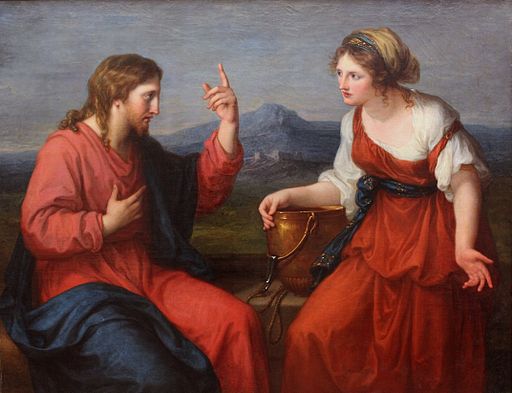
Some of us non-cradle Catholic converts, especially those who’ve had little or no other religious training, are still a bit like her. And the Samaritan woman at the well and that adulteress he saved from being stoned to death and those tax collectors and the Roman centurion who asked Him to heal his servant.
We’re from a different world, still getting acclimated to yours. Sometimes we look for something familiar from our old worlds to hold onto while we make the crossing. And sometimes Jesus tells us not to let go of those things entirely, because He thinks you need them as much as we do.
Something I always try to remember, when talking to my still very stunned friends and family, is that I am the only Catholic some of them have ever met up close and personal. But over the past few months I’ve learned that Catholicism has, even for many who have no faith at all, a kind of inherent authority that no other faith can match.
Watch non-Catholic visitors enter the nave sometime. Watch their faces, their body language. God touches them. Something softens, even as they hesitate by the font, trying to figure out what to do.
Even the least “Catholic curious” among my friends admit that Catholic churches “feel different.” One Protestant friend goes to Mass to be blessed even though he cannot accept the body and blood as we do. It “cleanses” him, renews his faith.
So they “get it” sometimes, even if they’re not ready to give in to it. And if you really want to help them take that first step, meet them where they are. Find common ground first and be patient with the ideas that set your teeth on edge.
Once someone is really ready, those scary ideas will begin to magically mesh and morph. Trust me, I know. But they may also have some ideas that fit better than you think.
Philippians 2:4 advises us to “humbly regard others as more important than yourselves, each looking out not for his own interests, but [also] everyone for those of others.”
Tall order. But we’ve got the best Teacher ever, right?
Photo credit: Angelica Kauffman [Public domain], via Wikimedia Commons
Previous Post
July 26, 2016
The Problem With Prayer
Next Post

August 8, 2016 What Mike Pence Missed: Jesus "Speaks" to Catholics, Too
Browse Our Archives
Select a Category Uncategorized
Select a Month May 2017 April 2017 March 2017 February 2017 January 2017 December 2016 November 2016 October 2016 September 2016 August 2016 July 2016 June 2016
Follow Us!
TAKE THE
Religious Wisdom Quiz
We are two prophets who speak for 1,260 days with great power. Fire comes from our mouths to devour enemies. Who are we?
Select your answer to see how you score.
The two witnesses Enoch and Elijah Peter and Paul Moses and Elijah
Related posts from Confessions

The Mysteries of Faith: Saving Chauncey The Shelter...

Farewell, My Beautiful Eliza--A Lenten Lesson
Busy Lives & Restless Souls: A Practical Approach...
TRENDING AT PATHEOS Catholic

Rejecting Doom: Christian Hope And Human Action
Christianity is a religion of hope. We are to have hope and...

It’s What Comes From Within Which Matters
One of the most difficult things for us to understand is why...

Why I Choose the Eucharist Over the Sermon
Choose the Eucharist, Not the Sermon What are we supposed to get...

5 Design Elements Found in Spiritually Rooted Homes
Putting Spirituality Into Home Decor Our homes are more than our living...

Credo: A Story of God Told with the...
About 10 years ago, I began to imagine a personal "Credo" that...

The Anatomy of Divine Revelation in Catholic Thought
The claim that God has made Himself known to human beings is...
view all Catholic blogs
Ad-Free & Subscriber Log-In Subscription Support
- About Us
- 2026 Calendar
- Videos
- Podcasts
- Library of World Religions
- Faith In Media Tracker
- Advertise With Us
- Write for Us
- Privacy Policy
- Terms of Service
- Do Not Sell My Data
- Contact Us
- Radiant Digital
- Manage Newsletter Subscriptions
- Unsubscribe From Notifications
- Sitemap
Copyright 2008-2026, Patheos. All rights reserved.
Subscription Support Ad-Free & Subscriber Log-In
Follow Patheos