
BuddhistCatholicContemplativeEvangelicalGeneral ChristianHinduJewishLatter-day SaintMuslimNew VisionsProgressive Christian
Beliefs
- Buddhist
- Catholic
- Contemplative
- Evangelical
- General Christian
- Hindu
- Jewish
- Latter-day Saint
- More Voices
- Muslim
- New Visions
- Pagan
- Progressive Christian
Topics
- Religion News
- Food and Religion
- Sports and Religion
- Religious Art
- Religious Music and Entertainment
- Religious Events
- History and Religion
- Style and Religion
- Politics and Religion
- Women in Religion
- Recreation Outdoors and Religion
- Business Finance and Religion
- Careers Workplace and Religion
- Education and Religion
- Family Parenting and Religion
- Health Fitness and Religion
- Home and Religion
- Relationships and Religion
- Technology and Religion
- Travel and Religion
Columnists
- Buddhist Columnists
- Business Finance and Religion Columnists
- Careers Workplace and Religion Columnists
- Catholic Columnists
- Contemplative Columnists
- Education and Religion Columnists
- Evangelists Columnists
- Family Parenting and Religion Columnists
- General Christian Columnists
- Health Fitness and Religion Columnists
- Hindu Columnists
- History and Religion Columnists
- Home and Religion Columnists
- Jewish Columnists
- More Voices Columnists
- Latter Day Columnists
- Muslim Columnists
- New Visions Columnists
- Nonreligious Columnists
- Pagan Columnists
- Politics and Religion Columnists
- Progressive Columnists
- Recreation Outdoors and Religion Columnists
- Relationships and Religion Columnists
- Religion News Columnists
- Religious Art Columnists
- Religious Events Columnists
- Religious Music and Entertainment Columnists
- Sports and Religion Columnists
- Style and Religion Columnists
- Technology and Religion Columnists
- Travel and Religion Columnists
- Women in Religion Columnists
Resource Library
- 2026 Calendar
- Library of World Religions
- The 100 Most Holy Places on Earth
- Patheos Answers
- Podcasts
- Videos
- Faith Leaders Database
- Anglican Episcopalian
- Bahai
- Baptist
- Buddhism
- Christianity
- Confucianism
- Eastern Orthodoxy
- Hinduism
- Holiness and Pentecostal
- ISKCON
- Islam
- Judaism
- Lutheran
- Methodist
- The Church of Jesus Christ of Latter-day Saints
- New Age
- Paganism
- Presbytarian and Reformed
- Protestantism
- Religion Behind the Scenes
- Roman Catholic
- Scientology
- Shia Islam
- Sikhism
- Sufism
- Sunni Islam
- Taoism
- Zen
- See all religions
Research Tools
 Ad-Free & Subscriber Log-In Subscription Support
Ad-Free & Subscriber Log-In Subscription Support
Follow Patheos 

- Trending:
- Forgiveness
- |
- Marriage
- |
- Consciousness
- |
- Death Penalty
- |
- Election
- |
- Halloween
 Confessions
- Home
- Catholic
- The Problem With Prayer
The Problem With Prayer
Last updated on: July 26, 2016 at 9:24 am by Cynthia Dagnal-Myron
The Problem With Prayer 2016-07-26T09:24:18-07:00 Cynthia Dagnal-Myron
Patheos Explore the world's faith through different perspectives on religion and spirituality! Patheos has the views of the prevalent religions and spiritualities of the world.
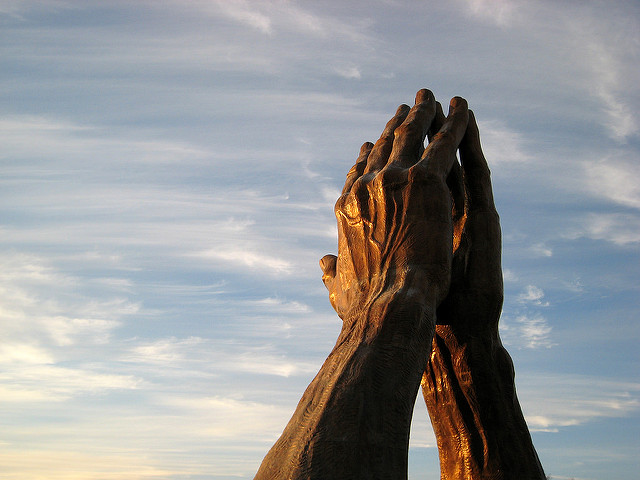
What is prayer?
In Everything Belongs, Richard Rohr says, “Prayer is being loved at a deep, sweet level.”
And it seemed just that simple when I was a child. It was those magic words you said before you ate and before you got into bed at night. I pictured some sort of Godman in the sky, looking down, nodding appreciatively whenever I remembered to say them. The way my mother did.
Over the years, prayer, for me, became far more complex. While trying on various disciplines from Buddhism to Baha’i, I discovered that prayer was “used” in myriad ways. To center, to calm, to contemplate, to commune. Or as a cry for help, a cry of gratitude and praise.
The most moving recent example of both the latter I’ve heard was the final prayer uttered by a group of 21 Coptic Christian martyrs, as they were being beheaded one by one, by Isis assassins on a beach in Libya. The Christian Post reported that:
“In the moment of their barbaric execution, some of the Christians were mouthing the words ‘Lord, Jesus Christ.'”
As a convert to Catholicism, I have reveled in the joy of reciting and receiving prayer communally during Mass, realizing that all my brothers and sisters all over the world are saying the same words and hearing the same readings that I have.
Likewise, I’ve begun to learn the Rosary, and the many novenas and chaplets and more well-known prayers and to choose, for daily prayers, the ones that resonate most. The first day prayer from the Padre Pio Novena is my “go to.” Especially as recited via the Web site Discerning Hearts.
I am always deeply moved by the tearful “catch” in the reader’s voice as he recites the final verses:
Stay with me, Lord, for it is You alone I look for,
Your love, Your grace, Your will, Your heart, Your spirit,
Because I love You
And ask no other reward but to love You more and more.
With a firm love, I will love You with all my heart while on earth and continue to love You perfectly during all eternity.
But recently, I’ve been struggling with a question many newbies probably come to sooner or later.
I have always prayed in some form or another, for all the reasons mentioned. But I’ve found it difficult to stay focused as I recited the longer and more repetitive prayers I was learning. They were not my words. And in some cases, they were archaic words that did not resonate with or speak to the feelings in my heart.
And while the repetition and rhythm sometimes calmed me, and I was always glad I’d fought my way through for love, I had begun to feel that they almost distanced me from the One I wanted so desperately to reach. As if He could not get a word in edgewise, through the torrent of words.
I decided to investigate “contemplative” prayer at the Benedictine monastery here in Tucson, which reminds me of some of the disciplines I’d studied previously and seems to “open the door” for more fervent and focused prayer after each session of stillness. And our parish just announced the formation of a “Charismatic Prayer Group,” which I will probably investigate as well.
But what does God want, I wondered? Besides the prayer we were taught by His Son?
And as always happens, I began to receive answers to that question, one after the other. One night, choosing a random passage from my audio New American Bible, I heard this:
“In praying, do not babble like the pagans, who think that they will be heard because of their many words.” Matthew 6:7
A day or two later, while reading He And I, the remarkable Gabrielle Bossis journal full of heart lifting messages ostensibly from Jesus to the author, I read:
• “When you say, ‘Sacred heart of Jesus, have mercy on us,’ with love, I grant more grace than for a long, drawn out prayer that you repeat mechanically.”
• “Don’t let praying tire you. Why do you give yourself so much trouble? Let it be simple and heart warming. A family chat.”
• “Don’t aim at saying an exact number of wordy prayers. Just love Me simply.”
He also teaches her, throughout, a number of tiny prayers which He asks her to repeat often, out of true love, instead of the obligatory ones she recites in church.
“…say, ‘My Jesus, I love You,’” He suggests. “And put your heart into it.”
The Bible, too, in 1 Thessalonians 5:16-18, (NAB) commands that we:
“Rejoice always; pray without ceasing. In all circumstances give thanks, for this is the will of God for you in Christ Jesus.”
And of course, the easiest way to do this is, as the the Bossis messages suggest, in short, fervent phrases spoken when the soul moves.
I have, thus far, decided not to choose only one mode of prayer. Each has its own merits, and I seem to know what’s needed, instinctively.
Sometimes it’s the little kiss and caress I plant on one of the statues in the house. Sometimes it’s a full on novena, litany, chaplet or Rosary–I tell non-Catholic friends we do the latter to ask Mary to “holla at Your Boy for me” from time to time.
They have so much trouble with Mary, my Protestant friends. One even said the repetition of the “Hail Mary” by a group on nuns on TV sounded “satanic.” Wow.
In the end, as I continue this journey, I am sure I will make my peace with prayer. An apt turn of phrase, since that is what prayer does for me, even now, when I focus and really feel it. It makes peace. It sends and surrounds me with love.
And so I leave you with the little one I say most often, which is also the one that gets those Divine messages flowing when I need them most:
“Thy Will, be done, Lord. Thy will be done.”
Photo credit: By C Jill Reed, Attribution-ShareAlike 2.0 Generic (CC BY-SA 2.0)
Previous Post

July 21, 2016
Defending Your Faith: "It's the Spirituality, Stupid!"
Next Post

August 2, 2016 How NOT to Evangelize—From a New Catholic Convert, With Love and Hope
Browse Our Archives
Select a Category Uncategorized
Select a Month May 2017 April 2017 March 2017 February 2017 January 2017 December 2016 November 2016 October 2016 September 2016 August 2016 July 2016 June 2016
Follow Us!
TAKE THE
Religious Wisdom Quiz
Which two apostles went up to the temple at the "hour of prayer" and healed a lame man in Acts 3?
Select your answer to see how you score.
James and Jude Philip and Stephen Peter and John Paul and Barnabas
Related posts from Confessions

The Mysteries of Faith: Saving Chauncey The Shelter...

Farewell, My Beautiful Eliza--A Lenten Lesson
Busy Lives & Restless Souls: A Practical Approach...

TRENDING AT PATHEOS Catholic

Rejecting Doom: Christian Hope And Human Action
Christianity is a religion of hope. We are to have hope and...

It’s What Comes From Within Which Matters
One of the most difficult things for us to understand is why...

Why I Choose the Eucharist Over the Sermon
Choose the Eucharist, Not the Sermon What are we supposed to get...

5 Design Elements Found in Spiritually Rooted Homes
Putting Spirituality Into Home Decor Our homes are more than our living...

Credo: A Story of God Told with the...
About 10 years ago, I began to imagine a personal "Credo" that...

The Anatomy of Divine Revelation in Catholic Thought
The claim that God has made Himself known to human beings is...
view all Catholic blogs
Ad-Free & Subscriber Log-In Subscription Support
- About Us
- 2026 Calendar
- Videos
- Podcasts
- Library of World Religions
- Faith In Media Tracker
- Advertise With Us
- Write for Us
- Privacy Policy
- Terms of Service
- Do Not Sell My Data
- Contact Us
- Radiant Digital
- Manage Newsletter Subscriptions
- Unsubscribe From Notifications
- Sitemap
Copyright 2008-2026, Patheos. All rights reserved.
Subscription Support Ad-Free & Subscriber Log-In
Follow Patheos