
BuddhistCatholicContemplativeEvangelicalGeneral ChristianHinduJewishLatter-day SaintMuslimNew VisionsProgressive Christian
Beliefs
- Buddhist
- Catholic
- Contemplative
- Evangelical
- General Christian
- Hindu
- Jewish
- Latter-day Saint
- More Voices
- Muslim
- New Visions
- Pagan
- Progressive Christian
Topics
- Religion News
- Food and Religion
- Sports and Religion
- Religious Art
- Religious Music and Entertainment
- Religious Events
- History and Religion
- Style and Religion
- Politics and Religion
- Women in Religion
- Recreation Outdoors and Religion
- Business Finance and Religion
- Careers Workplace and Religion
- Education and Religion
- Family Parenting and Religion
- Health Fitness and Religion
- Home and Religion
- Relationships and Religion
- Technology and Religion
- Travel and Religion
Columnists
- Buddhist Columnists
- Business Finance and Religion Columnists
- Careers Workplace and Religion Columnists
- Catholic Columnists
- Contemplative Columnists
- Education and Religion Columnists
- Evangelists Columnists
- Family Parenting and Religion Columnists
- General Christian Columnists
- Health Fitness and Religion Columnists
- Hindu Columnists
- History and Religion Columnists
- Home and Religion Columnists
- Jewish Columnists
- More Voices Columnists
- Latter Day Columnists
- Muslim Columnists
- New Visions Columnists
- Nonreligious Columnists
- Pagan Columnists
- Politics and Religion Columnists
- Progressive Columnists
- Recreation Outdoors and Religion Columnists
- Relationships and Religion Columnists
- Religion News Columnists
- Religious Art Columnists
- Religious Events Columnists
- Religious Music and Entertainment Columnists
- Sports and Religion Columnists
- Style and Religion Columnists
- Technology and Religion Columnists
- Travel and Religion Columnists
- Women in Religion Columnists
Resource Library
- 2026 Calendar
- Library of World Religions
- The 100 Most Holy Places on Earth
- Patheos Answers
- Podcasts
- Videos
- Faith Leaders Database
- Anglican Episcopalian
- Bahai
- Baptist
- Buddhism
- Christianity
- Confucianism
- Eastern Orthodoxy
- Hinduism
- Holiness and Pentecostal
- ISKCON
- Islam
- Judaism
- Lutheran
- Methodist
- The Church of Jesus Christ of Latter-day Saints
- New Age
- Paganism
- Presbytarian and Reformed
- Protestantism
- Religion Behind the Scenes
- Roman Catholic
- Scientology
- Shia Islam
- Sikhism
- Sufism
- Sunni Islam
- Taoism
- Zen
- See all religions
Research Tools
 Ad-Free & Subscriber Log-In Subscription Support
Ad-Free & Subscriber Log-In Subscription Support
Follow Patheos 

- Trending:
- Forgiveness
- |
- Marriage
- |
- Consciousness
- |
- Death Penalty
- |
- Election
- |
- Halloween
 Companions on the Journey
-
Websites
- Home
- New Visions
- Unpacking the Parable of the Good Samaritan
Unpacking the Parable of the Good Samaritan
Last updated on: August 28, 2018 at 7:00 am by Father Seán ÓLaoire, PhD
Unpacking the Parable of the Good Samaritan 2018-08-27T22:02:34-08:00 Father Seán ÓLaoire, PhD
Patheos Explore the world's faith through different perspectives on religion and spirituality! Patheos has the views of the prevalent religions and spiritualities of the world.
 A. Why Stories?
What does an infant do as it begins to master the intricacies of its voice box and speech centers? Why, it begins to tell stories! Initially, these are a kind of pre-linguistic vocalizations but, soon, it constructs more elaborate messages. Don’t be fooled into thinking that when she says, ‘dada’ or ‘mama’, the baby is simply saying, “I recognize who you are.” It’s much more wonderful than that. It’s more like, “Dada, I’ve just had this wonderful, transpersonal experience. It’s beyond words; but soon I’ll try to help you to understand my world – the real world – not the one you adults have been deluding into believing is ‘reality.’” But, like a ‘sophisticated’ tourist listening to the speech of the ‘primitive natives’, you smile patronizingly and say, “Yes. Of course. I understand!” The truth is, you probably believe that the natives’ tongue is some antediluvian animal-speak. Eventually, they will become ‘civilized’ and learn a real language – like English for example.
So, you and your spouse smile proudly at each other and at the baby and say, “Soon, she’ll learn to talk!”
Ontogeny recapitulates phylogeny; and so, each infant is re-enacting the journey of Homo Sapiens Sapiens who also immediately pressed their newfound linguistic skills into story-telling. And the stories of our forebears fulfilled four functions. First, it was a way for the storyteller to remember an experience he’d just had. Second, it was to share the information he’d gleaned with the 15-20 members of the clan around the fire. Third, it was to archive this in the long-term future memories of the group. And, fourth, it was the primary method of entertainment.
When your baby babbles, she is trying to fulfill the same four functions. It’s a pity that the parents simply reduce this complex contribution to just the entertainment piece. There are very good reasons why Jesus said, “Unless you become as little children you will not even enter the kingdom of heaven.” What a pity, then, that God’s little messengers – generation by generation – simply draw an “Aw! How cute!” response from the adults.
Something of the same frustration is why he also said, in response to the audiences who complained that he always spoke in parables, “I speak in parables so that seeing you may see and not understand; hearing you may hear and not comprehend… I speak in parables so that I may reveal things that have been hidden since the foundation of the world.”
The problem lies not in the stories but in the listeners’ perceptual mechanisms. A literal mind, founded on fear, will hear one message; while a mystical heart, founded on love, will hear a radically different message.
Moreover, stories, like dreams, are multilayered, speaking simultaneously at psychological, sociological, global and heavenly levels. So, you can hear the same story – or a parable of Jesus – at different stages of your life and gain significantly different messages. When my baby sister – Dearbhla who is 22 years younger than me – would ask me to tell her stories when I came home from Kenya every three years, I would do so. She was 18 years old and attending College in 1986, when I left Kenya for the last time. She was studying psychology and sociology and we now revisited the old stories, unpacking them in a very different fashion.
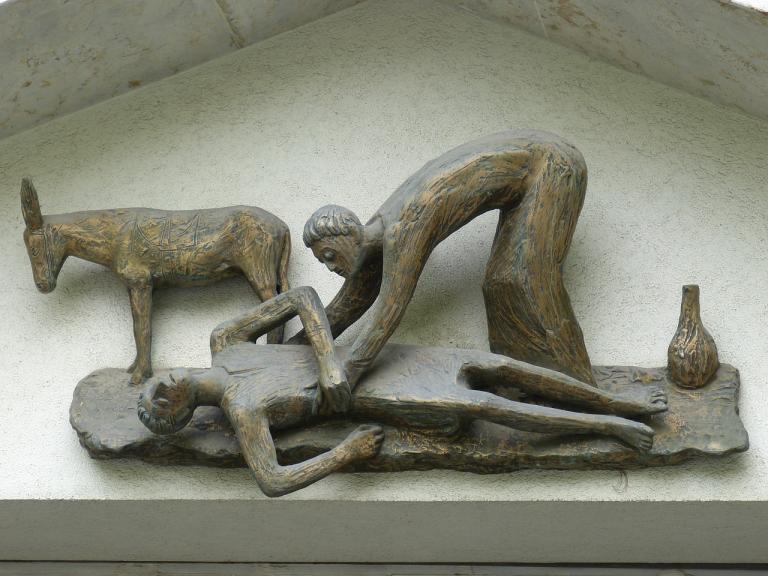
So, today, I’m going to take a story that you all know very well and unpack it for three distinct messages. It’s the parable of the Good Samaritan from the gospel of Luke.
B. Truth Versus Fact
There is a big difference between truth and fact. Something can be true but not factual; while something can be factual but not true! To explain this, I need to provide you with my own definition of truth. I believe that something is true only if it transforms me and aligns me with Love; and something is ultimate truth if it transforms me radically and aligns me permanently with Love.
Any belief that results in creating fear, anger, prejudice or violence in thoughts, words or actions, cannot be true. If you are holding everybody (even your “enemies”, as Jesus enjoined on his followers) in a heart of love, you have found truth. If, because of your beliefs, anybody becomes the target of your anger, then your belief doesn’t square with the core message of Jesus’ example and teaching.
Suppose, now, you were a reporter for the Jerusalem Post and you heard Jesus telling this story. You found it hard to believe, so you spent the next three days interviewing the priests, the Levites and the innkeepers of Jericho. None of them could verify Jesus’s story. In other words, it wasn’t factual. Agreed! It was not based on an actual event. However, by my definition it is indeed true, because, for those who understood the message, it was radically transformative.
C. Love Versus Law
The second great message embedded in this perennial gem is that of ritual human cleanliness versus the overarching Cosmic Law of love. Part of the reason why the priest ignored his mugged countryman, was that it was verboten for a priest to touch a dead or dying person. Such contact would render him ritually defiled and it was a ‘ganza megillah’ to get cleansed and be allowed, once more, to participate in Temple activities. Here is what Leviticus says,
“The Lord said to Moses, “Speak to the priests, the sons of Aaron, and say to them: ‘A priest must not make himself ceremonially unclean for any of his people who die, except for a close relative, such as his mother or father, his son or daughter, his brother, or an unmarried sister who is dependent on him since she has no husband—for her he may make himself unclean. He must not make himself unclean for people related to him by marriage, and so defile himself… The high priest, the one among his brothers who has had the anointing oil poured on his head and who has been ordained to wear the priestly garments … must not enter a place where there is a dead body. He must not make himself unclean, even for his father or mother.”
And, of course, the Levites had similar, though not as stringent, restrictions. The Levites, who came from the same tribe (Levi son of Jacob) as did the priests, had lesser functions. They acted as – to use a Roman Catholic term – ‘sacristans’, who looked after all of the sacred vessels and vestments and furnishings to be employed by the priests during services. A hugely important part of their functions was to regularly inspect both the moral character and physical health of the priests before the latter were allowed to preside over Temple worship. Leviticus 21 contained a long list of conditions that disbarred a man from serving as a priest:
***“*The Lord said to Moses, **“Say to Aaron: ‘For the generations to come none of your descendants who has a defect may come near to offer the food of his God. No man who has any defect may come near: no man who is blind or lame, disfigured or deformed; no man with a crippled foot or hand, or who is a hunchback or a dwarf, or who has any eye defect, or who has festering or running sores or damaged testicles. No descendant of Aaron the priest who has any defect is to come near to present the food offerings to the Lord. He has a defect; he must not come near to offer the food of his God.”
Therefore, it was clear to Jesus’ audience that the priest and the Levite, who ignored their fallen ‘lonsman’, were justified. It was even a display of their holiness. But Jesus would have none of it. The core of his being and the essence of his teaching was the primacy of love. It trumped all other considerations.
In a double demolition, he showed, firstly, the radical inadequacy of the legalistic mindset of the religious leaders; and, secondly, the compassionate heart of the ‘accursed’ Samaritan. The Samaritans were ‘half-breeds’ who were the hybrid progeny of the foreign soldiers and the unimportant ‘little people’ left behind when Assyrians conquered Israel in 721 BCE and when the Babylonians exiled the inhabitants of Jerusalem and its kingdom in 586 BCE.
In one fell swoop, Jesus showed, firstly, that love is a Divine Law before which mere human laws must bow the knee; and, secondly, that love dissolves all religious, national and cultural boundaries.
D. Joshua Versus Jesus
According to Torah, the Israelites, after escaping from Egypt and spending 40 years in the desert, entered the ‘promised land’ at Jericho. They crossed the Jordan river and God collapsed the walls of the city on their behalf. In a sick piece of religious polemic, we read that the Israelites, “devoted the city to the Lord and destroyed with the sword every living thing in it—men and women, young and old, cattle, sheep and donkeys.” [Joshua 6:21] This is how one devotes a city to God?! And if you are to believe the Book of Joshua, they then set out on a 200-year-long genocidal rampage that only ended when David captured Jerusalem in 1010 BCE. So, the slaughter began in Jericho and ended in Jerusalem.
In the parable of Jesus, we find exactly the opposite. The new ‘conquest’ begins in Jerusalem with mugging of an innocent traveler and ends in Jericho, where the wayside victim is nursed back to health by a ‘foreigner.’ And the conquest (love over law; and neighbor as everybody) leads to a new promised land – the kingdom of God.
It would be a new kind of pilgrimage; not the voyeuristic tracing of the brutal battles of an invading horde but the compassionate Camino of a fully-awakened Spirit-in-a-spacesuit. It’s the kind of journey that a Francis of Assisi might make.
Previous Post

August 21, 2018
Circles of Compassion
Next Post

September 4, 2018 Jesus, Mary and Mary
Browse Our Archives
Select a Category "All Lives Matter" "Anatomy of Human Destructiveness" "belonging systems" "bite-sized pieces of God" "Black Lives Matter" "block universe" "butterfly effect" "call to prayer" "counting to 10" "dog-whistle" language "I Am" statements "late term abortion" "lefties" "Nature Nazis" "Nephilim" "opium of the masses" "othering" "personal" God "personal/sensible" God "private" property "punctuated equilibria" "Silent Night" "Sky Gods" "Super Archetypes" "symbolic"experience "TaNaKh" "the difficult passages" "The Prophet" "the seamless garment approach' "virtualized" money "waking Life" 'creatio ex nihilo' 'dissipative structures' 'emanatio ab Deo' 'God the creator' 'God the Redeemer' 'God the Sanctifier' 'in potentia' 'The End Times' 1% abandonment Abortion abortion debate Abraham abstract rationality abundance Adam and Eve advanced beings/civilizations Advent adventure afterlife agape akasha Akashic record Alabaster jar Alan Watts alchemy aleinu alignment alive allegory altered states of consciousness alternate state of consciousness Alzheimer's disease America 2019 America 2020 America 2021 amnesia Anam Chara anatma (no soul) angels animasphere anitya (impermanence) Annuciation apathy apocalypse apophatic language apostles archetype art artists ASC - altered states of consciousness ascension asceticism ashram astral form astral travel astrology atheism Atman attention attention/observation autism avatar awake awakener awakening awareness awareness/imagination Axial Age Babel Baltimore catechism Baptism bardo state Bealtaine Beatitudes beauty behavioral psychology Being-Knowing-Loving belief systems beliefs Benediction Bernard Haisch Bethlehem Bhagavad Gita biblical literalism biblical revelation Big Bang biophilic biosphere birth canal birthright bite-size piece of God black holes blame Blessed Trinity bodhisattva bodhisattva vow body bonding Book of Job Book of Kells Book of Psalms Book of Revelation border wall Brahma Brahma-Vishnu-Shiva Brahman brain brotherhood/sisterhood Buddha Buddha nature Buddhahood Buddhas Buddhism burning bush Cain and Abel camán (hurley) cancer Canon Law canonical gospels Caol Áit caol áiteanna capital punishment capitalism Carl Jung cataphatic language Catherine of Siena Catholics causal void cause and effect cell mates Celtic Christianity Celtic Feast of Bealtaine Celtic spirituality Chalmers channel of healing chaos consciousness chaos theory charism children chreode Christ archetype Christ consciousness Christ/Christa consciousness Christa Consciousness Christian Christian cosmology Christian Trinity Christianity Christmas Christmas club ciotogs civilization classical conditioning climate change climate disruption co-create co-creating reality co-creative power and responsibility co-creative power of attention codependency cognitive flexibility coherence collaboration collective attention collective consciousness collective imagination collective intelligence/effort collective prayer collective unconscious collective/universal consciousness communication Communion of Saints community Companions on the Journey (COJ) compassion compassionate caregiver competition complacency complex/interdependent society Complexity/Chaos Theory complexity/entropy conceptual thought concurrency Confucius connectedness conscience conscious conscious evolution conscious observation conscious observer consciousness consciousness examen consciousness-primary cosmos consciousness-primary reality conservatism consumerism consumption continuous creation conversations conversion cooperation Coronavirus corrupt politics cosmic consciousness Cosmic Mind cosmic patterns cosmic whole cosmology cosmos Council of Constantinople Council of Nicaea countable infinity courage court prophets covenant Covid-19 creating creation creation by subtraction creative intelligence creativity creativity/paradox creator crucifixion culpability cultural identity cultural trance culture cynicism dark night of the soul Darwin daughter of Sion death debate and detachment deconstructionism deity déjá vu dementia demi-urge democracy democratization of Spirit Descartes desert fathers/mothers destiny detachment determinism devil's advocate Dia de Los Muertos dialogue dignity of all sentient beings direct experience disassociation disciple discovery disease disillusionment diversity divination divine brain Divine Feminine divine inspiration Divine Masculine Divine nature divine realm of perfection divinity DNA Donald Hoffman donkeys Down syndrome drama dream dream state dream time dreamers dreams dualism duality dysfunctional family earth Easter Eastern mystics ecology ecumenism ego ego identity ego-soul dialectic Einstein Einstein's "Block Universe" elementals Elijah Elohim eloquence EM field emergence emergent phenomenon emotional heart empathy en mesoi en-souled human person encounters end times endangered species enemies energy enlightenment entanglement entrainment entropy-complexity environmental degradation epigenetics epiphenomena epistemology equality/democracy equanimity equation of enlightenment Erich Fromm esoteric eternal eternal/mortal eternity etheric body ethics Eucharist Eucharistic Prayer of the Cosmos evaluation evil evolution evolution into enlightenment evolution of consciousness evolution of purpose evolution of society evolution of virtues evolution/devolution evolutionary inflection point evolutionary programming evolutionary shift evolutionary trajectory existence existential inflection point exit strategy experiential knowing experiential symbols extending rights/curtailing rights extra-terrestrial societies extra-terrestrials faery folk faith fake news families family Family of Man fate Father God fear Feast of All Souls feedback feminine face of God Ferdinand de Saussure fetus fifth dimension filioque fire flora and fauna Flora Spiritualis flow foreign policy forgiveness fractals fractals of divinity free will freedom friendship fundamentalism Gaia galaxy Gandhi Garden of Eden Garden of Gethsemane Gautama Siddhartha gemilut hasadim generosity Genesis geometry global crises Global Game Plan global narcissism global transformation global warming gnosis Gnostic intermediaries God God as Father God the Father God's Dream God's heart God's immanence God's will God-conscious Godhead gods Golgotha good and evil Good Samaritan goodness Gospel of John Gospel of Luke Gospel of Thomas grace gratitude greed Greek 'prosopon' ground of being guns habituation hate haves and have nots healing heart heaven Hebrew scriptures hell higher consciousness Hindu Hindu stages of human life Hindu trinity Hinduism Hippocrates Hitler holocene extinction Holocene/Anthropocene holy human Holy Spirit Holy Trinity Homo Narcississimus homo sapiens homo sapiens sapiens Homo Sociopathicus homo spiritualis hope hospitality Huang Po human agency human conditioning human evolution human flourishing (eudaimonia) human history human life human nature human nature/divine nature human needs human psyche human species humans as a social species humility hunger/yearning hypnagogic hypnopompic I AM idealism identity identity theft ideology idolatry illusion illusion of scarcity illusion of separation Ilya Prigogine image of God imaginal cells imagination immanence of God immanent aspect of God immanent experience impermanence improvisation impulse of spirit incarnation incarnational experience incarnational phase inclusivity individual subjectivity individuality indulgences industrial revolution Ineffable Source ineffable transcendence inequality inerrancy of the scriptures infallibility inferior mortal realm infinite inflation/deflation information revolution inner tranquility innocence inspiration instinct instinctual responses integration intellect intelligence intention intentional community interconnectedness interdimensional interpersonal relationships intuition Iománaíocht Ireland irrationality Isaiah Islam Issac Issac Newton Jacob Jacob's ladder of Genesis Jane Goodall Jansenism Jean-Paul Sartre Jeremiah Jesus Jesus as Divine Word John the apostle Joseph Campbell Joseph Cardinal Bernadin joy Judaism Judeo-Christian bible judgment justice Kahlil Gibran karma karma gobbler kindness Kingdom of God knowing knowledge and wisdom kosmic laws Kosmos Krishnamurti lack language Lao Tzu Latin "purgare" Latin 'persona' laughter Law of Impermanence Law of Love lay-away living learning legalism Lent letting go liberal/progressive liberation lies life life journey life purpose life-time commitment light likeness of God Lila limbo liminality lineage living systems living water logos longing love loving God loving without knowing lucid dreaming lucid living Ludwig Wittgenstein Luke and John Magi Mahavira mainstream media male/female faces of God manifest realm mantra Mariology Martin Buber Mary and Joseph Mary Magdalene Mary Oliver Mary the mother of Jesus mass media material world materialism materialistic science materialists mathematics matrix matter Maya mea culpa meaning of life media meditation Meister Eckhart meme memory message metanoia metaphor metaphysical universe metaphysics metaverse metta (Buddhism) Middle America Middle Way migrating Milesians military-industrial complex military-industrial demons Mind mind-body problem mindfulness mini-mystics miracles miraculous/mundane mission missionary mitzvah modularity moksha monasticism money Monoimus monotheism moral laws moral values morality morality/applied ethics morality/legality Moses Mother Earth Mother God mother-love motherhood Mount Shasta Mount Thabor multidimensional creatures multiverse music mystery mystic mystical body of Christ mystical impulse mystical poetry mystical self-empowerment mystical spirituality mystical union with Source mystical void mysticism mysticists mystics myth myth of the given mythic realm mythology naivete Namasté narcissism national security state nationalism Nativity natural disasters Natural Order Nature nautral selection NDE near death experience nebula necessity necrophilic neighbor Neils Bohr neural pathways neurotheology New Age philosophers New Age speak New Year resolutions newborn nirvana no-thing-ness Noah's Ark non-conceptual prayer noosphere nuclear nuclear weapons observer effect Old Testament oligarchy omniscience of God one-ness only-begotten ontology operant reinforcers oral language origin of laws Original Blessing original sin orthodoxy othering out-of-body experience overpopulation Pacha Mama pain pair-bonding Palm Sunday pandemic shutdown panspermia parable parallel lives parallel realities parallel universes parapsychological conduits pareidolia past-present-future Pater Noster Pavlov peace Peggy Lee Pena Creek Pentateuch Pentecost pepo perception perceptual state perfection persona personal cosmology personal enlightenment personal evolution personal responsibility personal transformation personality personhood personhood and ensoulment Peter and John Pharisees philosophy physical universe physical water physiosphere pilgrim Planet Earth planetary ascension Plato Plato's ideal realm pleasure principle Plotinus (d. 270 CE) Plutarch pneuma Pneuma Floriensis pneuma spiritualis pneumasphere poets politics post-incarnational phase power of love practice of prayer prana prayer prayer of petition Pre-Conception contract pre-incarnational phase predetermination prejudice priesthood priesthood of women primary reinforcement prime directive prison-industrial complex pro-choice pro-life profit propaganda prophets proverbs psyche psychodrama psychological conditioning psychological evolution psychology punctuated equilibrium pure awareness purgatory purpose pyramid of power Pythagoras Quakers Quakers "Sense of the Meeting" quantum field theory quantum foam quantum mechanics quantum physics quantum physics/mechanics quantum shift quarantined race radah radical love rainbow body raison d'etre Ram Dass Ramana Maharshi rationality/reason re-birth re-gifting intelligence re-incarnation re-incarnational phase re-magining reality reality gestalt reason recession reconciliation recycling reductionism reincarntion reintegration relationships relativism religion religionists religious systems remembering remembering/imagining renewal repetition resource wars response-ability Resurrection revelation revolution Richard Rohr Rig Veda rights/responsibilities Rilke ritual river of life Role-self root causes/social issues ruach Rumi Rupert Sheldrake sacrament sacraments sacrifice Sadducees Sai Baba saints salvation Samhain Samsara Sat-Chit-Ananda Satya Sai Baba scapegoat scarcity science science as revelation scientific fundamentalism scientific revolution scientism scientists Second Coming secondary reinforcement secular power secular/sacred secularization seeker seers Self self-acceptance self-alienation self-awareness self-compassion self-conscious life self-forgiveness self-identification self-identity self-interest/tribal interest self-liberation self-realization self-serving pathology self-understanding sense of self sense of separate self sensorium sentience separate self separation service to self/service to other sexual harrassment shadow shadow pod Shalom Shared Death Experience (SDE) sheep/shepherds Shiva Shiva energy Shroud of Turin signifiers silence simulated reality sin sin of separation sinner skin-encapsulated ego society socio-political division Socrates Son of Man Song of Amhergín soul soul group soul mates soul pod soul service Soul-self sound Source space-time special and general relativity spirit spiritual choices spiritual dis-integration spiritual DNA spiritual evolution spiritual garden spiritual healing spiritual heart spiritual heredity spiritual journey spiritual monoculture spiritual path spiritual power spiritual question/mystical question spiritual seeker spiritual water spirituality St. Augustine St. Francis St. Gregory of Palamas St. Ignatius of Loyola St. John of the Cross St. Patrick St. Paul St. Thomas Aquinas states of consciousness staying asleep staying awake Steven Pinker stillness stochastic terrorism Stockholm Syndrome stories story storytellers storytelling stream stress subconscious subjective consciousness subliminal perception submission suffering Sufi super-consciousness Supernatural Supernatural reality surrender survival survival of the fittest sustaining intelligence symbiosis symbols synchronicity taoism Tarot technology Teilhard de Chardin telepathy telos/teleology temptation tension terrorism the "Magnificat" the abortion process the Art of Dying the Bible the Big Other The Centering Prayer the cross the dead the Fall The Great Schism The Hero's Journey the human experiment the living The Lord's Prayer the Mother the Old Order the Other The Sign of Peace the Veil the World theology theory of entanglement Theory of Everything (TOE) theory of General Relativity Third Heaven "Shehaqim" thirst Thomas Aquinas thought patterns thoughts/tulpas Tikkun Olam time time travel time-space-mind tomb Tonglen Torah trans-lingual trans-rational trans-spatial trans-temporal transcendence transcendence of God transcendent aspect of God transcendent God transcendental experience transcendental realm transcendental/transpersonal Transcendentals Transfiguration transformation transpersonal Tree of Life Tree of the Knowledge of Good and Evil tribalism Trinity true Self trust truth truths tselem Tuatha Dé Danann tulpa ultimate reality Uncategorized unconditional love unconscious unconscious psychological modules uncountable infinity understanding unity Unity Consciousness universal basic income (UBI) universal consciousness universe universe as a living system universe itself as a living system Upanishads values Vatican II Veil of Veronica victimhood Virgin Mary virtues vision visionary experiences visions Vivekananda void of self-consciousness waking consciousness Watson and Crick wave-particle duality wealth wealth and privilege wealth gap Wilder Penfield will to survive William James wisdom witnessing consciousness women's spiritual group Word Word-of-God-Made-Flesh world view wu-wei Yahweh yin and yang Yogananda Zen Zen buddhist monk zero-sum game Zoroaster
Select a Month June 2024 May 2024 February 2024 January 2024 December 2023 September 2023 August 2023 July 2023 June 2023 April 2023 December 2022 November 2022 October 2022 June 2022 December 2021 November 2021 August 2021 July 2021 June 2021 May 2021 April 2021 March 2021 February 2021 January 2021 December 2020 October 2020 August 2020 July 2020 May 2020 April 2020 March 2020 February 2020 January 2020 December 2019 November 2019 October 2019 September 2019 August 2019 July 2019 June 2019 May 2019 April 2019 March 2019 February 2019 January 2019 December 2018 November 2018 October 2018 September 2018 August 2018 July 2018 June 2018 May 2018 April 2018 March 2018 February 2018 January 2018 December 2017 November 2017 October 2017 September 2017 August 2017 July 2017 June 2017 May 2017 April 2017 March 2017 February 2017 January 2017 December 2016 November 2016 October 2016 September 2016 August 2016 July 2016 June 2016 May 2016 April 2016 March 2016 February 2016 January 2016 December 2015
Follow Us!
TAKE THE
Religious Wisdom Quiz
Who said, "Lord, to whom shall we go? You have the words of eternal life"?
Select your answer to see how you score.
Peter James John Judas
Related posts from Companions on the Journey
A Synopsis of My Personal Cosmology - Part...


TRENDING AT PATHEOS New Visions

Did Prayer Cure His Cancer? Or Was It...
At 4 AM one morning, Joshua W. Brown’s wife awoke to a...

8 Ways a Near-Death Experience Rewires the Soul
Does Consciousness Survive Physical Death? After 50 Years of Research, Dr. Raymond...

Holy Longing: What Our Restlessness Is Telling Us
“One can find so many pains when the rain is falling.” -John...

What this is NOT about. This blog is definitely not about...

Who said the Israelites were God’s chosen? That’s right, they did. Who...

The Spirit World Is the Real World: God...
A Monk’s Wisdom on Body and Spirit I sit with Brother Martin...
view all New Visions blogs
Ad-Free & Subscriber Log-In Subscription Support
- About Us
- 2026 Calendar
- Videos
- Podcasts
- Library of World Religions
- Faith In Media Tracker
- Advertise With Us
- Write for Us
- Privacy Policy
- Terms of Service
- Do Not Sell My Data
- Contact Us
- Radiant Digital
- Manage Newsletter Subscriptions
- Unsubscribe From Notifications
- Sitemap
Copyright 2008-2026, Patheos. All rights reserved.
Subscription Support Ad-Free & Subscriber Log-In
Follow Patheos