
BuddhistCatholicContemplativeEvangelicalGeneral ChristianHinduJewishLatter-day SaintMuslimNew VisionsProgressive Christian
Beliefs
- Buddhist
- Catholic
- Contemplative
- Evangelical
- General Christian
- Hindu
- Jewish
- Latter-day Saint
- More Voices
- Muslim
- New Visions
- Pagan
- Progressive Christian
Topics
- Religion News
- Food and Religion
- Sports and Religion
- Religious Art
- Religious Music and Entertainment
- Religious Events
- History and Religion
- Style and Religion
- Politics and Religion
- Women in Religion
- Recreation Outdoors and Religion
- Business Finance and Religion
- Careers Workplace and Religion
- Education and Religion
- Family Parenting and Religion
- Health Fitness and Religion
- Home and Religion
- Relationships and Religion
- Technology and Religion
- Travel and Religion
Columnists
- Buddhist Columnists
- Business Finance and Religion Columnists
- Careers Workplace and Religion Columnists
- Catholic Columnists
- Contemplative Columnists
- Education and Religion Columnists
- Evangelists Columnists
- Family Parenting and Religion Columnists
- General Christian Columnists
- Health Fitness and Religion Columnists
- Hindu Columnists
- History and Religion Columnists
- Home and Religion Columnists
- Jewish Columnists
- More Voices Columnists
- Latter Day Columnists
- Muslim Columnists
- New Visions Columnists
- Nonreligious Columnists
- Pagan Columnists
- Politics and Religion Columnists
- Progressive Columnists
- Recreation Outdoors and Religion Columnists
- Relationships and Religion Columnists
- Religion News Columnists
- Religious Art Columnists
- Religious Events Columnists
- Religious Music and Entertainment Columnists
- Sports and Religion Columnists
- Style and Religion Columnists
- Technology and Religion Columnists
- Travel and Religion Columnists
- Women in Religion Columnists
Resource Library
- 2026 Calendar
- Library of World Religions
- The 100 Most Holy Places on Earth
- Patheos Answers
- Podcasts
- Videos
- Faith Leaders Database
- Anglican Episcopalian
- Bahai
- Baptist
- Buddhism
- Christianity
- Confucianism
- Eastern Orthodoxy
- Hinduism
- Holiness and Pentecostal
- ISKCON
- Islam
- Judaism
- Lutheran
- Methodist
- The Church of Jesus Christ of Latter-day Saints
- New Age
- Paganism
- Presbytarian and Reformed
- Protestantism
- Religion Behind the Scenes
- Roman Catholic
- Scientology
- Shia Islam
- Sikhism
- Sufism
- Sunni Islam
- Taoism
- Zen
- See all religions
Research Tools
 Ad-Free & Subscriber Log-In Subscription Support
Ad-Free & Subscriber Log-In Subscription Support
Follow Patheos 

- Trending:
- Forgiveness
- |
- Marriage
- |
- Consciousness
- |
- Death Penalty
- |
- Election
- |
- Halloween

- HOME
- Me and the Blog
- Defining Pagan
- Rituals & Holidays
- All Posts
- Blogroll
- Publications
- FREE NEWSLETTER
- Home
- Pagan
- Ozark Witchcraft, Superstition, and Folklore
Ozark Witchcraft, Superstition, and Folklore
Last updated on: February 6, 2017 at 12:47 pm by Jason Mankey
Ozark Witchcraft, Superstition, and Folklore 2017-02-06T12:47:19-07:00 Jason Mankey
Patheos Explore the world's faith through different perspectives on religion and spirituality! Patheos has the views of the prevalent religions and spiritualities of the world.
When talking about the history of Modern Witchcraft one of the things that people like to ask me about is “Witchcraft in the Ozarks.” Sometimes this will lead into people talking about how Gerald Gardner visited the area during his brief stay in America in 1947-48. That’s not out of the realm of possibility by the way. Gardner was living with his brother in Memphis Tennessee during his stay in America, and the Ozarks were just just up and around the bend, but there’s no evidence of this actually happening.
Why do people like to bring up the Ozarks in connection Witchcraft? Most of that’s due to one book, Ozark Superstitions (though most of us today own it under its “newer” title Ozark Magic & Folklore). First published in 1947 by Columbia University Press, Superstitions was eventually republished in 1964 by Dover Publications and his been in print ever since. It’s especially popular in Traditional Witchcraft circles these days and is essential reading for anyone interested in the history of magic and the occult in America.
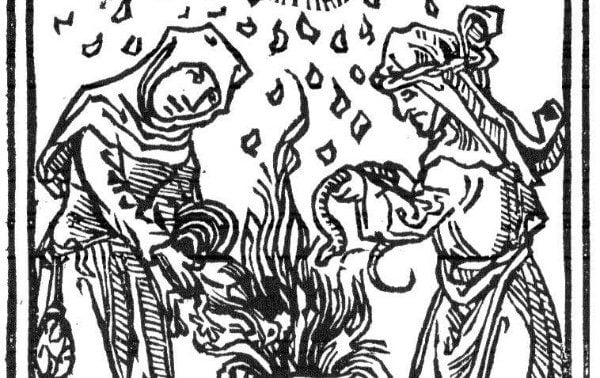
Woodcut from Wikimedia.
The book’s author, Vance Randolph (1892-1980), was a journalist, magazine writer, and folklorist. Though he did not grow up in the Ozarks, he lived there for the majority of his adult life and clearly loved the place and its people.
The Ozarks are a special slice of Americana. Geographically isolated from much of the country until the internet highway system and without much in the way of major urban areas, the people of the Ozarks (an area that stretches from southeastern Missouri and northeastern Arkansas into Oklahoma) developed (or perhaps more accurately “maintained) a wide array of superstitions and magical practices. Culturally, the Ozarks have a lot in common with the people of Appalachia, and their magical practices reflect that.
Randolph’s book is of special interest to Modern Witches because it has led some people to believe that the magical practitioners he writes about self identified that way (as witches). I think the book says just the opposite. Part of the problem with identifying “witchcraft” lies in just how variable the word can be. Some people call any sort of magical operation “witchcraft” while the person performing the operation most likely thinks of what they are doing in a completely different way.
Randolph and his informants share a lot of contradictory information when talking about witches. Randolph writes he is “personally acquainted with more than a score of Witches myself,” (1) and yet just a few paragraphs later writes:
“Although I have known and interviewed twenty-four persons who were regarded by their neighbors as witches, only three admitted that they had sold themselves to the Devil. These three women were quite mad, of course; the point is that their neighbors did not regard them as lunatics, but as witches. The other twenty-one claim that their efforts are directed against the forces of evil, and that their main business is the removal of spells and curses put upon their clients by supernatural means. These practitioners are variously known as witch masters, white witches, witch doctors, faith doctors, goomer doctors and conjure folks, and it is from them that I have obtained much of my information on the subject.” (2)
Certainly people were practicing magic in the Ozarks (and most certainly still do today) but the title of witch was reserved for something particularly sinister (and it’s obvious that Randolph believes those individuals had some sort of mental problem):
“A witch, according to my informants, is a woman who has had dealings with the Devil and thereby acquired some super- natural powers, and who uses these powers to bring evil upon her neighbors.” (3)
After listing a few magical practitioners Randolph continues on, separating his conjurers from witchcraft:
“Newspaper writers call these women witches, and the tourists naturally follow suit, but no real old-time Ozarker would make such a mistake. They may be clairvoyants, fortunetellers, seers, mystics, purveyors of medical advice, seekers of lost property but they are certainly not witches.” (4)
Becoming a witch in the world of Vance’s informants required a will-full act. One can become a witch by firing “a silver bullet at the moon” while uttering a few obscene sayings. Other ways of becoming a witch again require silver bullets, but this time seven of them, and they have to be fired while saying The Lord’s Prayer backwards. (5) More fascinating than these instances requiring a silver bullet, are techniques that would not be out of place in many modern witch circles.
Randolph writes of magical powers being passed through families and from male to female and female to male, and his most elaborate account of a witch’s initiation rite involves both nudity and sexual intercourse:
“When a woman decides to become a witch, according to the fireside legends, she repairs to the family buryin’ ground at midnight, in the dark of the moon. Beginning with a verbal renunciation of the Christian religion, she swears to give herself body and soul to the Devil. She removes every stitch of clothing, which she hangs on an infidel’s tombstone, and delivers her body immediately to the Devil’s representative that is, to the man who is inducting her into the “mystery. The sexual act completed, both parties repeat certain old sayin’s terrible words which assemble devils, and the spirits of the evil dead and end by reciting the Lord’s Prayer backwards. This ceremony is supposed to be witnessed by at least two initiates, also nude, and must be repeated on three consecutive nights. After the first and second vows the candidate is still free to change her mind, but the third pledge is final. Henceforth the woman is a witch and must serve her new master through all eternity.” (6)
Such accounts are of course fascinating to the modern Witch, but also must be taken with a huge grain of salt. While the idea of a magical practice being handed down in such a fashion most likely carries some weight, the part about the Devil and the Lord’s Prayer being said backwards seem unlikely. The problem here is that a story like this wouldn’t have been out of place in 1698, and many of the ideas expressed by Randolph’s informants resemble the urban legends and folktales of early modern Europe during the period of the witch trials.
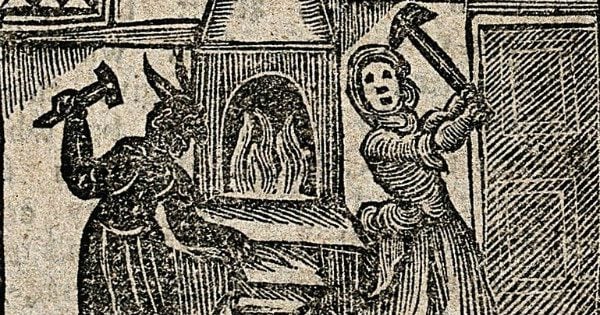
A witch and her devil. From Wikimedia.
Magical traditions passed down among the generations aren’t just limited to “witches.” More benign folk magic practitioners also received information this way. One of the sources for Randolph’s book traces one of her family’s spells back to a Dutch ancestor:
A family near Noel, Missouri, has inherited an “old sayin'” which is guaranteed to cure boils, old sores, pimples, and even blood poisoning. Just cross your hands behind your back and repeat three times:
“Bozz bozzer, mozz mozzer, kozz kozzer !”
The old woman who told me this said that originally her kin-folk knew what the words meant, and they were supposed to be Dutch. But somewhere along the line, an ancestor of hers got the idea that the meaning must be kept secret, and therefore died without revealing it. “And now,” said the old woman, “there aint nobody livin’ that knows, ‘less’n it would be in one o’ them Dutch countries across the water!” (7)
Other spells passed down orally can only be shared with a member of the opposite sex and cannot be repeated more than three times during the transmission. If the receiver of the spell was unable to remember the prayer after those three repetitions they weren’t “fit” enough to receive that bit of magic. (8)
The problem with the material found in a source like Randolph is that you either can cherrypick it to find just the information you want or look at all of it and then evaluate it. The Ozark witches being written about in Superstition often engage in nonsensical practices while the “power doctors” and other magical folk are out using their magical techniques to heal the sick. If I had the magical skills required to perform the operation below I’d use that power for something else:
“A schoolmaster from Pea Ridge, Arkansas, used to tell the story of two young women who lived alone in a nearby farm. They owned no cattle and were never seen to do any milking but always had plenty of butter and homemade cheese. Finally a farmhand peeked in at their window and later swore that he saw these girls hang a dishcloth on the pot rack and squeeze several gallons of milk out of it. Turning about, he looked at the cows in a neighbor’s pasture and saw that their udders were gradually decreasing in size.” (9)
Other tales involving witches and the Devil include an entryway into hell hidden deep in the woods of Missouri or Arkansas (depending on the storyteller). The story is fascinating, but the details are vague, and if people were camping out at the entryway to Satan’s lair I think it would be written about a bit more often:
In various parts of Missouri and Arkansas one hears the story of a great hole in the ground, surrounded by rugged cliffs, where hunters have heard strange sounds and smelled unusual odors. Some say that the Devil lives in that hole, imprisoned under a heavy fall of rock. There are stories of old men who claim to have visited the place as children. Some of these men swear that they heard the Devil’s groans and curses and smelled burning flesh and brimstone. Strange people live on the escarpments, it is said, and throw odd things into the pit at night, particularly when the moon is full. There are tales of dark-visaged “furriners” traveling at night, who make regular pilgrimages to the place from distant parts of the country. (10)
While I’m extremely skeptical of any sort of “pagan witch religion” in the Ozarks, I’m absolutely convinced that Randolph documents a very real (and certainly still living) magical tradition in Superstitions. Randolph’s power doctors are real magical practitioners, and not the scary story designed to keep children up at night that his witches are. Ozark power doctors function very much like English cunning-folk:
These are the so-called “power doctors,” backwoods specialists, each claiming to be endowed with supernatural power to cure certain specific ailments. They seldom attempt any general practice, and most of them take no money for their services, although they may accept and even demand valuable presents on occasion. Some of these people, usually old women, can cool fevers merely by the laying on of hands ;others draw out the fire from burns by spitting or blowing upon the inflamed areas, while still others claim to heal more serious lesions by some similar hocus-pocus. One old lady who specializes in burns says that she always mutters a few words which she “l’arnt out’n the Book” -the Bible,that is- but refuses to tell me what particular text is used.page (11)
Much of the magical tradition documented by Randolph would feel at home in most present day Witch circles. While it’s doubtful I’d use magic alone to treat an ulcer, the techniques used by the power doctors of the Ozarks are very close to my own:
One hillman of my acquaintance treats boils, ulcers, and the like in this wise: he reaches behind him, picks up a stone with-out looking at it, and spits upon it. Stirring the saliva about with his finger, he repeats the words :
What I see increase,
What I rub decrease,and with that he rubs a little on the growth, which is supposed to disappear in a week or so. All this must be done, however,when the moon is waning; if it should be attempted before the full moon the sore would grow larger and larger instead of wasting away. (12)
Many of the magical techniques we use today are legitimately very old and some even stretch back to pagan antiquity, which is why inserting the magic of the Ozarks into contemporary ritual feels so natural (and why people refer to the folk practices there as Witchcraft). It’s also completely possible that many modern Witchcraft traditions inherited the magical traditions of the Ozarks organically from actual practitioners who then joined a Pagan Witchcraft group, and I’m sure some people have lifted magical techniques straight from Randolph’s book.
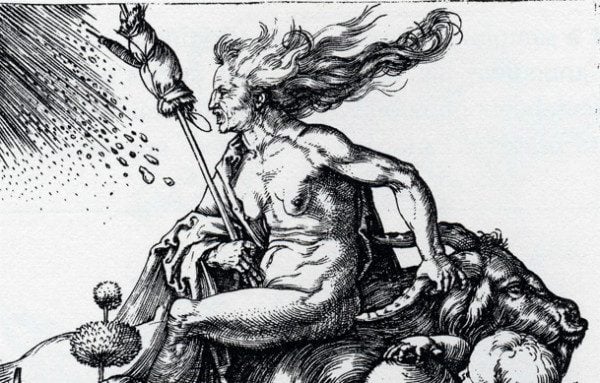
Witch riding a goat, from Wikimedia.
While I don’t believe there was a thriving witch religion in the Ozarks, there certainly was (and is) a thriving magical tradition,and it’s one that should be celebrated for its tenacity. The traditions documented by Vance Randolph were very much Christian, but have contributed to the legacy of American Witchcrafts and Paganism none the less.
NOTES
1. All quotes from Vance Randolph’s Ozark Superstitions, later published as Ozark Magic and Folkore by Dover Publications. Page numbers here refer to the Dover edition, page 264
2. page 265
3. page 265
4. page 265
5. page 266
6. page 267
7. page 132
8. page 122
9. page 270
10. page 277
11. page 121
12. page 125
Previous Post

February 3, 2017
Bad Day? Be a Pagan!
Next Post

February 8, 2017 5 Non-Witchcraft Books for Witches
Browse Our Archives
Select a Category Editorializing Gateways to Paganism Guest Posts Holiday Histories Led Zeppelin News and Views Occult Pagan Pagan TV Club Paganism polytheism Ramble On Reviews Ritual Strange Days Uncategorized
Select a Month August 2026 March 2026 February 2026 November 2025 September 2025 August 2025 April 2025 August 2024 April 2024 February 2024 December 2023 October 2023 August 2023 June 2023 May 2023 January 2023 October 2022 August 2022 July 2022 June 2022 May 2022 April 2022 March 2022 February 2022 January 2022 December 2021 November 2021 October 2021 September 2021 August 2021 July 2021 June 2021 April 2021 March 2021 February 2021 January 2021 December 2020 November 2020 October 2020 August 2020 July 2020 June 2020 May 2020 April 2020 March 2020 February 2020 January 2020 December 2019 November 2019 October 2019 September 2019 August 2019 July 2019 June 2019 May 2019 April 2019 March 2019 February 2019 January 2019 December 2018 November 2018 October 2018 September 2018 August 2018 July 2018 June 2018 May 2018 April 2018 March 2018 February 2018 January 2018 December 2017 November 2017 October 2017 September 2017 August 2017 July 2017 June 2017 May 2017 April 2017 March 2017 February 2017 January 2017 December 2016 November 2016 October 2016 September 2016 August 2016 July 2016 June 2016 May 2016 April 2016 March 2016 February 2016 January 2016 December 2015 November 2015 October 2015 September 2015 August 2015 July 2015 June 2015 May 2015 April 2015 March 2015 February 2015 January 2015 December 2014 November 2014 October 2014 September 2014 August 2014 July 2014 June 2014 May 2014 April 2014 March 2014 February 2014 January 2014 December 2013 November 2013 October 2013 September 2013 August 2013 July 2013 June 2013 May 2013 April 2013 March 2013 February 2013 January 2013 December 2012 November 2012 October 2012 September 2012 August 2012 July 2012 June 2012 April 2012 October 2011 September 2011 August 2011
Follow Us!
TAKE THE
Religious Wisdom Quiz
Who cried out, "My God, my God, why have you forsaken me?" while dying?
Select your answer to see how you score.
Stephen Paul David Jesus
Related posts from Raise the Horns
The Great God Pan Among the Stars

What Makes a Good Ritualist? No Idea

Yule is Also a Time for the Dead
TRENDING AT PATHEOS Pagan

Swimfan: Forgotten Aughts Pleasures
This is a recovery effort. In 2002, My Big Fat Greek Wedding...

Top Three Anti-Catholic Lies About Catholicism
This is my initial transcript for the video, "THE 3 WORST...

Pope Leo Celebrates Mass for Nurses & Docs...
I don't have any idea how he did it, but Pope Leo...

The Sermon on the Mount, Part I: Matthew...
The Sermon on the Mount, Part I (Matthew 4:12-5:12) St. Matthew moves...

What's up from Crossway: Reviewing some of their latest A few weeks...

Janie Learns the Way of the Cross: A...
Teaching children about Jesus' Passion can be challenging. Many parents and educators...
view all Pagan blogs
Ad-Free & Subscriber Log-In Subscription Support
- About Us
- 2026 Calendar
- Videos
- Podcasts
- Library of World Religions
- Faith In Media Tracker
- Advertise With Us
- Write for Us
- Privacy Policy
- Terms of Service
- Do Not Sell My Data
- Contact Us
- Radiant Digital
- Manage Newsletter Subscriptions
- Unsubscribe From Notifications
- Sitemap
Copyright 2008-2026, Patheos. All rights reserved.
Subscription Support Ad-Free & Subscriber Log-In
Follow Patheos