
BuddhistCatholicContemplativeEvangelicalGeneral ChristianHinduJewishLatter-day SaintMuslimNew VisionsProgressive Christian
Beliefs
- Buddhist
- Catholic
- Contemplative
- Evangelical
- General Christian
- Hindu
- Jewish
- Latter-day Saint
- More Voices
- Muslim
- New Visions
- Pagan
- Progressive Christian
Topics
- Religion News
- Food and Religion
- Sports and Religion
- Religious Art
- Religious Music and Entertainment
- Religious Events
- History and Religion
- Style and Religion
- Politics and Religion
- Women in Religion
- Recreation Outdoors and Religion
- Business Finance and Religion
- Careers Workplace and Religion
- Education and Religion
- Family Parenting and Religion
- Health Fitness and Religion
- Home and Religion
- Relationships and Religion
- Technology and Religion
- Travel and Religion
Columnists
- Buddhist Columnists
- Business Finance and Religion Columnists
- Careers Workplace and Religion Columnists
- Catholic Columnists
- Contemplative Columnists
- Education and Religion Columnists
- Evangelists Columnists
- Family Parenting and Religion Columnists
- General Christian Columnists
- Health Fitness and Religion Columnists
- Hindu Columnists
- History and Religion Columnists
- Home and Religion Columnists
- Jewish Columnists
- More Voices Columnists
- Latter Day Columnists
- Muslim Columnists
- New Visions Columnists
- Nonreligious Columnists
- Pagan Columnists
- Politics and Religion Columnists
- Progressive Columnists
- Recreation Outdoors and Religion Columnists
- Relationships and Religion Columnists
- Religion News Columnists
- Religious Art Columnists
- Religious Events Columnists
- Religious Music and Entertainment Columnists
- Sports and Religion Columnists
- Style and Religion Columnists
- Technology and Religion Columnists
- Travel and Religion Columnists
- Women in Religion Columnists
Resource Library
- 2026 Calendar
- Library of World Religions
- The 100 Most Holy Places on Earth
- Patheos Answers
- Podcasts
- Videos
- Faith Leaders Database
- Anglican Episcopalian
- Bahai
- Baptist
- Buddhism
- Christianity
- Confucianism
- Eastern Orthodoxy
- Hinduism
- Holiness and Pentecostal
- ISKCON
- Islam
- Judaism
- Lutheran
- Methodist
- The Church of Jesus Christ of Latter-day Saints
- New Age
- Paganism
- Presbytarian and Reformed
- Protestantism
- Religion Behind the Scenes
- Roman Catholic
- Scientology
- Shia Islam
- Sikhism
- Sufism
- Sunni Islam
- Taoism
- Zen
- See all religions
Research Tools
 Ad-Free & Subscriber Log-In Subscription Support
Ad-Free & Subscriber Log-In Subscription Support
Follow Patheos 

- Trending:
- Forgiveness
- |
- Marriage
- |
- Consciousness
- |
- Death Penalty
- |
- Election
- |
- Halloween

- Home
- Progressive Christian
- History and Religion
- How The Color of Law and a big ol’ bill fit together
How The Color of Law and a big ol’ bill fit together
Last updated on: July 2, 2025 at 4:21 pm by Cara Meredith
How The Color of Law and a big ol’ bill fit together 2025-07-02T16:21:06-07:00 Cara Meredith
Patheos Explore the world's faith through different perspectives on religion and spirituality! Patheos has the views of the prevalent religions and spiritualities of the world.
This spring, I finally picked up The Color of Law by Richard Rothstein.
The book has been on my shelf for several years, namely because I’m interested in the subject but also because I felt determined to make my way through all the books that shared a similar title to my own.
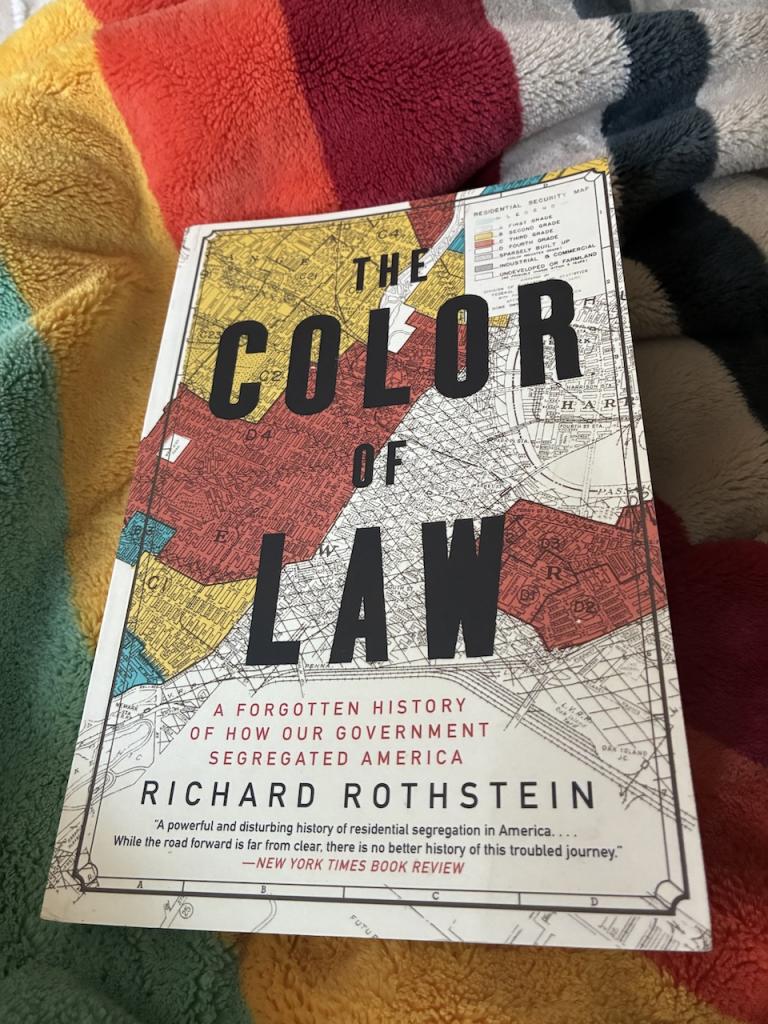
When my first book, The Color of Life, released in 2019, I knew multiple similarities existed with James McBride’s The Color of Water, which came out in 2006. However, I didn’t think much of it until Jemar Tisby released his first book a month before my own (with an imprint of the same publisher, no less), The Color of Compromise. Soon after, I discovered Rothstein’s book and really felt like there was nothing new under the sun.
If you haven’t read *The Color of Law, “*Rothstein describes how the American government systematically imposed residential segregation: with undisguised racial zoning; public housing that purposefully segregated previously mixed communities; subsidies for builders to create whites-only suburbs; tax exemptions for institutions that enforced segregation; and support for violent resistance to African Americans in white neighborhoods.”
Although the book felt a bit outdated at times, particularly when it came to antiquated language around current conversations of race, there was still so much to glean from Rothstein’s findings.
Take, for instance, the construction of the federal interstate highway system. As Rothstein writes, “In many cases, state and local governments, with federal acquiescence, designed interstate highway routes to destroy urban African American communities” (127). Just as these highway planners didn’t hide their racial motivations, the highways built in places like the San Francisco Bay Area, where I live, acted as slum clearance tools.
Wide swaths of land (or, to be clear, land labeled slums) were cleared to asl make room for “hospitals, universities, middle-class housing, and offices,” all in the name of urban renewal — or, as Rothstein writes, Negro removal (139).
Take this story of one African American man:
In 1952, Wilbur Gary, a building contractor, was living with his family in one of Richmond, California’s, public housing projects. He was an African American navy war veteran, a former shipyard worker, and vice-commander of his American Legion post. The Gary family needed to find a new residence — their apartment complex was slated for demolition because the federal Lanham Act had required government projects for war workers to be temporary. A fellow navy veteran, Lieutenant Commander Sidney Hogan, was moving out of Rollingwood, the suburb just outside Richmond built during World War II with an FHA requirement that the suburb be covered with restrictive covenants. Four years earlier, though, the Supreme Court had ruled that covenants were not enforceable, so Hogan sold his property to Wilbur Gary and his wife (139).
This happened in the name of urban renewal, to the detriment of the Black population. And as someone who lives in what is often described as a rather forgotten side of the city I call home, I see how the effects of what happened then affect my neighbors now.
What does it mean to make right the wrongs, to stand on the side of justice, to pave new and better ways forward?
Perhaps we can start by thinking about The One Big, Beautiful Bill that has passed the Senate and made its way to the House. In more ways than one, the bill hurts Americans more than it helps Americans. As many readers know, over 17 million Americans stand to lose Medicaid coverage if the bill passes – a fact that some deny, claiming they don’t receive Medicaid, they receive Medical (California) or Medquest (Hawaii). These folks fail to understand that Medicaid goes by many different names, in all fifty of the states.

Image courtesy of Pixabay
But as Reverend Jes Kast states, “How one chooses to spend money (or where to cut money) is a moral statement. Not just a fiscal statement.” Kast goes on to point followers to Matthew 25:31-46, when Jesus says that nations will be judged by how they treat the most vulnerable.
I’m not sure if the point could be any clearer: If you follow Jesus, then you protect the dignity of the most vulnerable. Then you ensure the protection of those who won’t be protected if such a bill passes the House as well.
I realize I’ve strayed off topic from original commentary about racial zoning, Covenant Laws, and segregation and racism in the name of urban sprawl and renewal, but also, I haven’t.
Because this is looking out for our neighbors. This is protecting the most vulnerable. This is following in the ways of Jesus and standing on the side of justice.
And this we can’t deny.
—
I urge you to pick up a copy of The Color of Law if you haven’t already, then report back to me! Otherwise, all book links kick a few pennies over to support the work of this author.
History and Religion
Previous Post

June 26, 2025
What Ida B. the Queen taught me about speaking up
Next Post

August 8, 2025 What does it mean to have it out with God?
Recent Comments
"Bitterness and envy rots the soul."
How Bishop Budde helped us look ..."
"Do you know the meaning of the word TROLL? You fit the description perfectly. Get ..."
How Bishop Budde helped us look ..."
"To be or nor to be, Shakespeare wrote it to mean the choice between two ..."
"Systems designed to give men more power and value men more highly had become a ..."
Nice Churchy Patriarchy is most definitely ..."
Browse Our Archives
Select a Category Book reviews Uncategorized
Select a Month July 2026 June 2026 December 2025 August 2025 July 2025 June 2025 May 2025 April 2025 March 2025 February 2025 January 2025 December 2024 November 2024 October 2024 September 2024 August 2024 July 2024 June 2024 March 2024 February 2024 January 2024 December 2023 September 2023 June 2023 November 2022 October 2022 September 2022 August 2022 July 2022 June 2022 May 2022 April 2022 November 2021 May 2021 April 2021 March 2021 January 2021 December 2020 November 2020 October 2020 July 2020 June 2020 May 2020 April 2020 March 2020 February 2020 January 2020 December 2019 October 2019 September 2019 August 2019 July 2019 June 2019 May 2019 April 2019 March 2019 February 2019 January 2019 December 2018 November 2018 October 2018 September 2018 August 2018 July 2018
Follow Us!
TAKE THE
Religious Wisdom Quiz
What did Hannah bring annually for Samuel when he lived at the Tabernacle?
Select your answer to see how you score.
A crown A candle A robe A staff
Books by This Author Books by Coloring Outside the Lines
Related posts from Coloring Outside the Lines

What does it mean to have it out...
What Ida B. the Queen taught me about...

The Deacon's Table — Who Actually Gets to...

Life After Lying Prostrate on the Floor of...
TRENDING AT PATHEOS Progressive Christian

What Being a Modern-Day Apostle Means to Me
In my last column, I discussed the ins and outs of modern-day...

Did Ancient China Once Worship the God of...
Across human history, a common thread weaves through the origins of the...

Love Your Neighbor – Including Earth-Kin: Lev. 19,...
God’s command to love your neighbor means acting in an ethical and...

Lead a Church Study of “Jesus and Lao...
Guest writer Jack Thomas (The Irreverent Reverend) reflects on leading his church...

Pastoral Wisdom for Responding to Sermon Pushback
Getting sermon pushback on your social justice sermon? Learn practical, Proverbs-based strategies...

Principles for Understanding the Apostolic Ministry Today
Whenever people discover that my formal ministry title is "apostle," as in...
view all Progressive Christian blogs
What Are Your Thoughts?leave a comment
Ad-Free & Subscriber Log-In Subscription Support
- About Us
- 2026 Calendar
- Videos
- Podcasts
- Library of World Religions
- Faith In Media Tracker
- Advertise With Us
- Write for Us
- Privacy Policy
- Terms of Service
- Do Not Sell My Data
- Contact Us
- Radiant Digital
- Manage Newsletter Subscriptions
- Unsubscribe From Notifications
- Sitemap
Copyright 2008-2026, Patheos. All rights reserved.
Subscription Support Ad-Free & Subscriber Log-In
Follow Patheos