
BuddhistCatholicContemplativeEvangelicalGeneral ChristianHinduJewishLatter-day SaintMuslimNew VisionsProgressive Christian
Beliefs
- Buddhist
- Catholic
- Contemplative
- Evangelical
- General Christian
- Hindu
- Jewish
- Latter-day Saint
- More Voices
- Muslim
- New Visions
- Pagan
- Progressive Christian
Topics
- Religion News
- Food and Religion
- Sports and Religion
- Religious Art
- Religious Music and Entertainment
- Religious Events
- History and Religion
- Style and Religion
- Politics and Religion
- Women in Religion
- Recreation Outdoors and Religion
- Business Finance and Religion
- Careers Workplace and Religion
- Education and Religion
- Family Parenting and Religion
- Health Fitness and Religion
- Home and Religion
- Relationships and Religion
- Technology and Religion
- Travel and Religion
Columnists
- Buddhist Columnists
- Business Finance and Religion Columnists
- Careers Workplace and Religion Columnists
- Catholic Columnists
- Contemplative Columnists
- Education and Religion Columnists
- Evangelists Columnists
- Family Parenting and Religion Columnists
- General Christian Columnists
- Health Fitness and Religion Columnists
- Hindu Columnists
- History and Religion Columnists
- Home and Religion Columnists
- Jewish Columnists
- More Voices Columnists
- Latter Day Columnists
- Muslim Columnists
- New Visions Columnists
- Nonreligious Columnists
- Pagan Columnists
- Politics and Religion Columnists
- Progressive Columnists
- Recreation Outdoors and Religion Columnists
- Relationships and Religion Columnists
- Religion News Columnists
- Religious Art Columnists
- Religious Events Columnists
- Religious Music and Entertainment Columnists
- Sports and Religion Columnists
- Style and Religion Columnists
- Technology and Religion Columnists
- Travel and Religion Columnists
- Women in Religion Columnists
Resource Library
- 2026 Calendar
- Library of World Religions
- The 100 Most Holy Places on Earth
- Patheos Answers
- Podcasts
- Videos
- Faith Leaders Database
- Anglican Episcopalian
- Bahai
- Baptist
- Buddhism
- Christianity
- Confucianism
- Eastern Orthodoxy
- Hinduism
- Holiness and Pentecostal
- ISKCON
- Islam
- Judaism
- Lutheran
- Methodist
- The Church of Jesus Christ of Latter-day Saints
- New Age
- Paganism
- Presbytarian and Reformed
- Protestantism
- Religion Behind the Scenes
- Roman Catholic
- Scientology
- Shia Islam
- Sikhism
- Sufism
- Sunni Islam
- Taoism
- Zen
- See all religions
Research Tools
 Ad-Free & Subscriber Log-In Subscription Support
Ad-Free & Subscriber Log-In Subscription Support
Follow Patheos 

- Trending:
- Forgiveness
- |
- Marriage
- |
- Consciousness
- |
- Death Penalty
- |
- Election
- |
- Halloween

- Home
- Progressive Christian
- Health, Fitness and Religion
- Death and life: What does it mean for us to see?
Death and life: What does it mean for us to see?
Last updated on: November 1, 2024 at 9:01 am by Cara Meredith
Death and life: What does it mean for us to see? 2024-10-25T12:02:45-07:00 Cara Meredith
Patheos Explore the world's faith through different perspectives on religion and spirituality! Patheos has the views of the prevalent religions and spiritualities of the world.
Sometimes we just want to see.
Earlier this week, I woke up, same as always: perhaps a little too early but grateful for the coffee, the silence, and the books that accompanied the darkness of morning.
Perhaps like you, my vision is not exactly picture-perfect. I generally wear glasses at night and in the early morning hours, but then, when daylight arrives, I pop in my contacts for the day. On the day in question, I popped my contacts into my eyes. I took the dog for a walk. But when I sat down to write an email a little while later, something seemed a little off.
My left eye was not seeing as well as my right, and instead, seemed to have worsened several degrees. I closed my right eye, and then my left; I went back and forth, back and forth, closing one eye at a time like you do at the eye doctor, confirming that I was not seeing as well in my left eye as I had the day before.

Image by StockSnap from Pixabay
As I am then sometimes prone to do, my mind began to wander, to employ a little bit of imagination. I’d just had pink eye a couple of weeks before in that same eye, and now that eye had gotten blurrier. Had I contracted some sort of bacterial disease? Should I have used antibiotic drops instead of letting the virus run its course? Should I have not worn my contacts so soon, not have dabbed mascara on my eyelashes, not have used that contact solution for relief?
Worried about eye diseases and progressive, overnight blindness, I called my eye doctor and my primary care physician too; I avoided the Internet, because I was not going to diagnose my own eye disease, but I was going to get a referral to an ophthalmologist ASAP. I was going to figure out this problem once and for all.
I wanted whatever was blocking my ability to see to go away. I wanted to see clearly once again.
I’ll spare you the details to a story, which ends not with eye disease but with what I now believe was a simple switch of a lower-prescription contact in the contact factory and in the daily disposable packaging that has become a part of my morning routine.
Because, instead, I want us to focus on this: I wanted to see.
In this week’s gospel reading, we find ourselves firmly planted in events leading up to the Passover. In the scene prior, a woman named Mary poured expensive perfume on the feet of Jesus and wiped it with her hair. This had caused a ruckus among the disciples, who felt like the perfume could have been sold for a lot of money, the money given to the poor. Then there was the fact that Jesus kept hanging out with those siblings, Mary, Martha, and Lazarus, the third of whom he raised from the dead. The family was utterly grateful to him – he’d brought a dead man back to life, after all – so they wanted to thank and feed and honor Jesus in return.
When word about this raising from the dead spread fast, it prompted a large crowd of Jews to also want to see the man who had been raised from the dead and the man who had raised him from the dead.
After that dinner with the siblings, the crowds wave palm branches before Jesus. They shout, “Hosanna!” They call him blessed. The people have heard about the great things he has done; they want to meet this special healer. They want to see the man named Jesus.
This is where our story picks up, with great throngs of people looking, hoping, wanting to catch a glimpse of the Great Man. When some Greeks go to worship at the festival, they walk up to Philip, who is one of the disciples. “Sir,” they say, “we would like to see Jesus.” Philip, in turn, goes to tell Andrew, who then goes with Philip to tell Jesus.
The interesting thing is that we don’t why the Greeks wanted to see Jesus. The text leaves their motivations a mystery: did they want to see Jesus for the sake of curiosity or because they didn’t like what he was up to? Did they want to see Jesus because they had heard such good things about him or because they had begun to believe or because they wanted to see him killed?
This, we don’t know. But also, does the motivation to see really matter? Does it matter which Jesus they wished to see? Isn’t the fact that they simply, merely wanted to see Jesus enough?
It is here that Jesus gives a response that feels like it’s been lobbed from the farthest reaches of left field: “The hour has come for the Son of Man to be glorified. Very truly I tell you, unless a kernel of wheat falls to the ground and dies, it remains only a single seed. But if it dies, it produces many seeds.” He speaks of himself in third person; he calls himself God’s son and speaks about his future death, even though the people don’t know it yet.
But then he brings it back to the ground, literally, and describes himself as a grain, in terms of life and death. The kernel of wheat is going to fall to the ground and die. But the one seed it leave behind is eventually going to produce many seeds in return.
This is the illustration he gives the people. This is what he offers them see, even if they don’t understand the deeper meaning behind his words, or the trouble he speaks of a couple of sentences later, or even the booming voice that comes down from heaven soon after.
Might this be what Jesus is inviting us to see today too?
Death is coming but life will soon follow, for Jesus is the one who bursts “open like a seed so that new life [will] grow and replenish the earth,” as one theologian writes. Later, he will take “an instrument of torture and [turn] it into a vehicle of hospitality and communion for all people, everywhere.”
What does it mean for us to see this death and this life, this interconnection of vegetal resurrection and of a kind of holy decay that leads to everlasting life?
What does it mean for us to see?
Perhaps our invitation is simple: walk outside. See the dead things. Then see the life that springs forth from those dead things. Find a compost pile, a tree stump, a neglected strawberry container: life is bursting from death, right there.
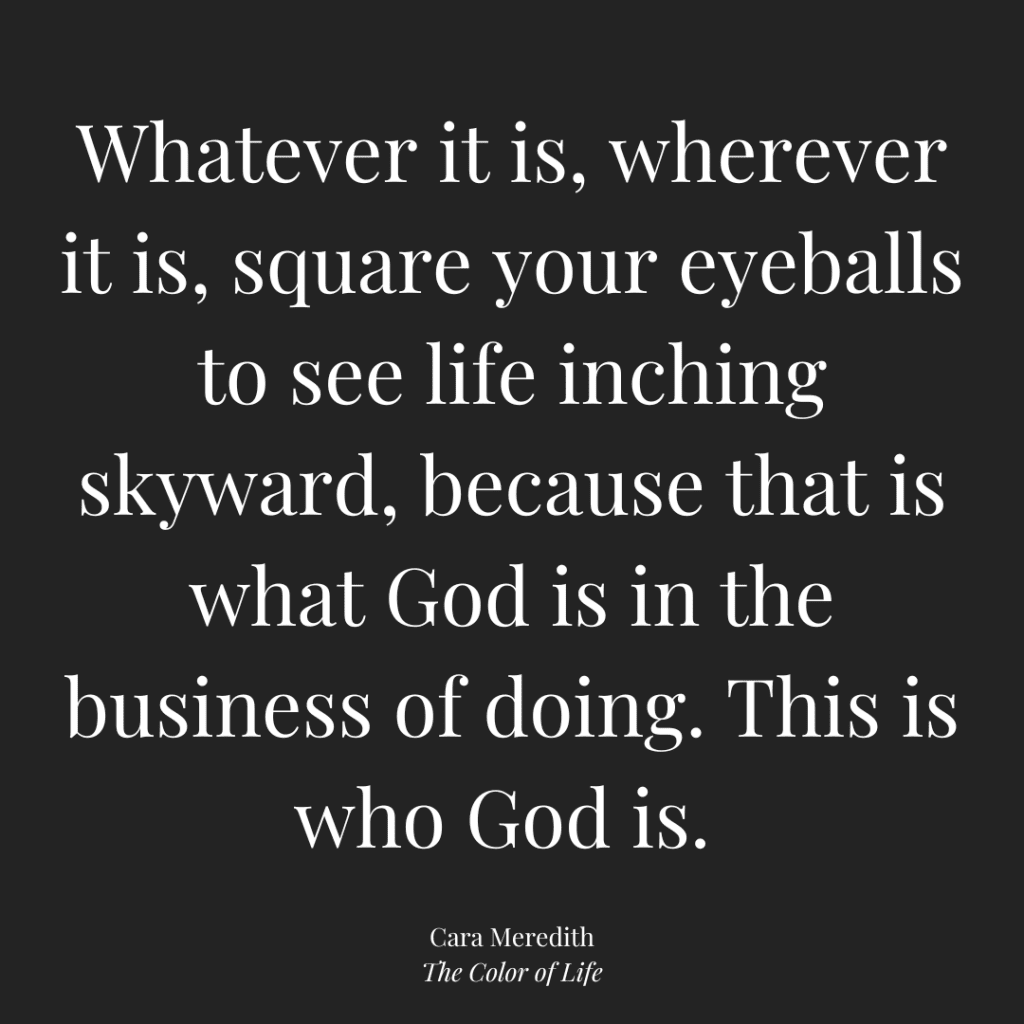
Whatever it is, wherever it is, square your eyeballs (and perhaps, the right prescription, if you’re able) to see life inching skyward, because that is what God is in the business of doing. This is who God is.
Because no matter our motivation, Jesus begs us see the life and death made present all around (and now made real through part of this prayer):
Christ with me, Christ before me, Christ behind me,
Christ in me, Christ beneath me, Christ above me,
Christ on my right, Christ on my left,
Christ when I lie down, Christ when I sit down,
Christ in the heart of every man who thinks of me,
Christ in the mouth of every man who speaks of me,
Christ in the eye that sees me,
Christ in the ear that hears me.
Amen.
—
This is a sermon preached on March 17, 2024 at St. Paul’s Episcopal Church in San Rafael, California. If you liked this post, you might also like “God is here, in this place, with us.” In the meantime, might our eyes be opened to see.
Health, Fitness and Religion
About Cara Meredith
Cara Meredith is a writer, speaker, and part-time development director. The author of The Color of Life (Zondervan) and the forthcoming Church Camp (Broadleaf), she gets a kick out of playing with words. A lot. You can read more about the author here.
Previous Post

October 25, 2024
What holy anger means for the sake of wholeness & liberation
Next Post

November 8, 2024 What if Jesus is in the business of discomfort & challenge?
Recent Comments
"Bitterness and envy rots the soul."
How Bishop Budde helped us look ..."
"Do you know the meaning of the word TROLL? You fit the description perfectly. Get ..."
How Bishop Budde helped us look ..."
"To be or nor to be, Shakespeare wrote it to mean the choice between two ..."
"Systems designed to give men more power and value men more highly had become a ..."
Nice Churchy Patriarchy is most definitely ..."
Browse Our Archives
Select a Category Book reviews Uncategorized
Select a Month July 2026 June 2026 December 2025 August 2025 July 2025 June 2025 May 2025 April 2025 March 2025 February 2025 January 2025 December 2024 November 2024 October 2024 September 2024 August 2024 July 2024 June 2024 March 2024 February 2024 January 2024 December 2023 September 2023 June 2023 November 2022 October 2022 September 2022 August 2022 July 2022 June 2022 May 2022 April 2022 November 2021 May 2021 April 2021 March 2021 January 2021 December 2020 November 2020 October 2020 July 2020 June 2020 May 2020 April 2020 March 2020 February 2020 January 2020 December 2019 October 2019 September 2019 August 2019 July 2019 June 2019 May 2019 April 2019 March 2019 February 2019 January 2019 December 2018 November 2018 October 2018 September 2018 August 2018 July 2018
Follow Us!
TAKE THE
Religious Wisdom Quiz
Who said, "I do not know how to speak; I am too young"?
Select your answer to see how you score.
Isaiah Moses Samuel Jeremiah
Books by This Author Books by Coloring Outside the Lines
Related posts from Coloring Outside the Lines

Can you name the thirst inside your soul?

What holy anger means for the sake of...

What can we do to bring some hope...
Jesus extends an invitation: Come to me &...
TRENDING AT PATHEOS Progressive Christian

What Being a Modern-Day Apostle Means to Me
In my last column, I discussed the ins and outs of modern-day...

Did Ancient China Once Worship the God of...
Across human history, a common thread weaves through the origins of the...

Love Your Neighbor – Including Earth-Kin: Lev. 19,...
God’s command to love your neighbor means acting in an ethical and...

Lead a Church Study of “Jesus and Lao...
Guest writer Jack Thomas (The Irreverent Reverend) reflects on leading his church...

Pastoral Wisdom for Responding to Sermon Pushback
Getting sermon pushback on your social justice sermon? Learn practical, Proverbs-based strategies...

Principles for Understanding the Apostolic Ministry Today
Whenever people discover that my formal ministry title is "apostle," as in...
view all Progressive Christian blogs
What Are Your Thoughts?leave a comment
Ad-Free & Subscriber Log-In Subscription Support
- About Us
- 2026 Calendar
- Videos
- Podcasts
- Library of World Religions
- Faith In Media Tracker
- Advertise With Us
- Write for Us
- Privacy Policy
- Terms of Service
- Do Not Sell My Data
- Contact Us
- Radiant Digital
- Manage Newsletter Subscriptions
- Unsubscribe From Notifications
- Sitemap
Copyright 2008-2026, Patheos. All rights reserved.
Subscription Support Ad-Free & Subscriber Log-In
Follow Patheos