
BuddhistCatholicContemplativeEvangelicalGeneral ChristianHinduJewishLatter-day SaintMuslimNew VisionsProgressive Christian
Beliefs
- Buddhist
- Catholic
- Contemplative
- Evangelical
- General Christian
- Hindu
- Jewish
- Latter-day Saint
- More Voices
- Muslim
- New Visions
- Pagan
- Progressive Christian
Topics
- Religion News
- Food and Religion
- Sports and Religion
- Religious Art
- Religious Music and Entertainment
- Religious Events
- History and Religion
- Style and Religion
- Politics and Religion
- Women in Religion
- Recreation Outdoors and Religion
- Business Finance and Religion
- Careers Workplace and Religion
- Education and Religion
- Family Parenting and Religion
- Health Fitness and Religion
- Home and Religion
- Relationships and Religion
- Technology and Religion
- Travel and Religion
Columnists
- Buddhist Columnists
- Business Finance and Religion Columnists
- Careers Workplace and Religion Columnists
- Catholic Columnists
- Contemplative Columnists
- Education and Religion Columnists
- Evangelists Columnists
- Family Parenting and Religion Columnists
- General Christian Columnists
- Health Fitness and Religion Columnists
- Hindu Columnists
- History and Religion Columnists
- Home and Religion Columnists
- Jewish Columnists
- More Voices Columnists
- Latter Day Columnists
- Muslim Columnists
- New Visions Columnists
- Nonreligious Columnists
- Pagan Columnists
- Politics and Religion Columnists
- Progressive Columnists
- Recreation Outdoors and Religion Columnists
- Relationships and Religion Columnists
- Religion News Columnists
- Religious Art Columnists
- Religious Events Columnists
- Religious Music and Entertainment Columnists
- Sports and Religion Columnists
- Style and Religion Columnists
- Technology and Religion Columnists
- Travel and Religion Columnists
- Women in Religion Columnists
Resource Library
- 2026 Calendar
- Library of World Religions
- The 100 Most Holy Places on Earth
- Patheos Answers
- Podcasts
- Videos
- Faith Leaders Database
- Anglican Episcopalian
- Bahai
- Baptist
- Buddhism
- Christianity
- Confucianism
- Eastern Orthodoxy
- Hinduism
- Holiness and Pentecostal
- ISKCON
- Islam
- Judaism
- Lutheran
- Methodist
- The Church of Jesus Christ of Latter-day Saints
- New Age
- Paganism
- Presbytarian and Reformed
- Protestantism
- Religion Behind the Scenes
- Roman Catholic
- Scientology
- Shia Islam
- Sikhism
- Sufism
- Sunni Islam
- Taoism
- Zen
- See all religions
Research Tools
 Ad-Free & Subscriber Log-In Subscription Support
Ad-Free & Subscriber Log-In Subscription Support
Follow Patheos 

- Trending:
- Forgiveness
- |
- Marriage
- |
- Consciousness
- |
- Death Penalty
- |
- Election
- |
- Halloween

- Home
- Progressive Christian
- Relationships and Religion
- What holy anger means for the sake of wholeness & liberation
What holy anger means for the sake of wholeness & liberation
Last updated on: October 25, 2024 at 12:03 pm by Cara Meredith
What holy anger means for the sake of wholeness & liberation 2024-10-25T12:03:01-07:00 Cara Meredith
Patheos Explore the world's faith through different perspectives on religion and spirituality! Patheos has the views of the prevalent religions and spiritualities of the world.
A singular image of anger often lives in my head.
It’s an image that comes straight from all the cartoons I watched as a kid: generally involving some sort of animal, a mouse or a chipmunk, a duck or a turtle gets incensed about something. Someone ran them off the road. Someone stole a carrot.Someone slept in their bed when it wasn’t their bed to sleep in in the first place. Whatever the someone (or the something, for that matter) was that happened, the cartoon face would soon turn a deep shade of purple. Their body would start to rumble, soon, oftentimes followed by an accompanying shake and jumble of the ground. Sweat poured down their forehead, steam came out of their ears, and the sound of a train, screeching to a halt – the sound of all that built-up anger, I suppose – soon blasted through the speakers.

Image by Azmi Talib from Pixabay
This was what anger looked like, I reasoned. This is what it looked like to get so worked up about something that your face and your body and the world around you couldn’t help but also see and hear and sense the anger present in you.
In turn, this became the most real, tangible definition of anger for me for a very long time. An image straight out of the Looney Tunes playbook became the most real image for it when my family of origin also didn’t necessarily know what to do or how to deal with the basic human emotion. So together, we leaned into pixelated versions of steamed-up animal cartoons to show us the way.
Fast-forward nearly forty years later, and our collective family, as in you and me here, is presented with an image of anger that doesn’t necessarily fit the beloved, peacemaking image of Jesus some of us hold.
Jesus, meek and mild. Jesus, lamb of God who takes away the sin of the world. Jesus, the gentle one we welcomed in just a couple of months ago with songs of cradles and mangers – and of nearby cattle who are lowing, who wake the poor baby, “But little Lord Jesus, No crying he makes.” (Now that’s one angel baby, I tell you).
Where is that Jesus now, when in this week’s gospel reading Jesus goes to Jerusalem and finds people in the temple “selling cattle, sheep, and doves,” along with the “money changers seated at their tables,” and is found turning a deep shade of purple, complete with steam coming out of his ears and a shaking, rumbling earth?
“Making a whip of cords,” John writes, “he drove all of them out of the temple, with the sheep and the cattle. He also poured out the coins of the money changers and overturned their tables. He told those who were selling the doves, ‘Take these things out of here! Stop making my Father’s house a marketplace!’”
Jesus becomes quite angry in this moment, to say the least. He becomes a disrupter, a leveler, an upender; a questioner and a destroyer who does not seek to protect the status quo.
What then does this Jesus have to offer us? What then might this version of Jesus, which isn’t necessarily what we want to see, which isn’t the prettiest version of himself, be inviting us into this morning?
So much, it seems. So much, if we’ll be so brave as to lean in.
As it goes, that emotion called anger is quite natural. Author Mirabai Starr writes that “the power of our anger often correlates with the depth of our love.” Even though “we are conditioned to justify our anger, to find the right place to put blame, and to always feel good about ourselves,” anger can often be an invitation to see new things. Anger can act as a sign of potential change.
In this particular scenario, when Jesus is making whips and dumping out coins and flipping over tables – really, when Jesus is doing everything some of us have been led to believe he shouldn’t be doing or exuding in the moment – he also extends to us a holy anger.
Holy anger moves through him, “on behalf of a more robust, equitable, holistic, and impassioned spiritual practice,” one writer says. Holy anger no longer accepts “business as usual,” at least not when it comes to consumerism in the house of God or to selling holiness on behalf of the one who requires no sales pitch.
Yes, Jesus is peace and Jesus is calm, but also, and also, in this moment, Jesus is zeal. Jesus is determination. And the usual demeaner of Jesus – which is, for some of us, the only image we carry of him – is interrupted for the sake of justice and holiness.
Because that’s exactly what these nine verses are about: holy anger for the sake of justice and holiness.
What holy anger do you then hold for the sake of justice and holiness?
Do you do honor your holy anger when it comes to the fatal shootings that continue to plague the city of Oakland or for the estimated 8.4% (which others say is closer to 28% in another report) of the population that experiences food insecurity in our city? Do you let loose holy anger for more than 30,000 Palestinians who have been killed and over 70,000 who have been wounded in the Gaza Strip since the Israel-Hamas war began? Do you do something about the holy anger that calls for justice and holiness in this place?
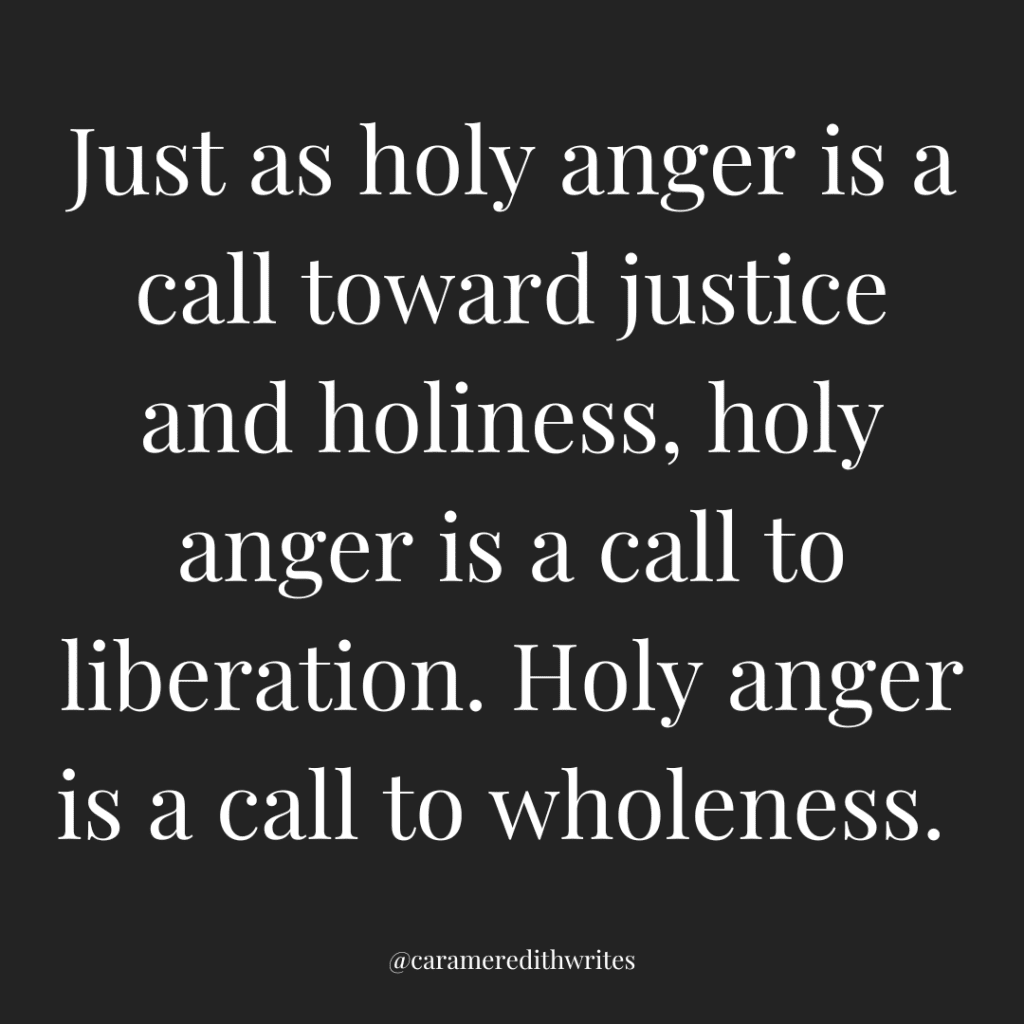
Just as holy anger is a call toward justice and holiness, holy anger is a call to liberation. Holy anger is a call to wholeness.
This is what Jesus was doing in the temple that day, when he couldn’t hold the righteous rage inside himself anymore. This is what came out in flipped tables and dumped out bags of change and perhaps even let loose the cages of doves, previously purchased for a guilt offering.
What then are we going to do? Who then are we going to be? What then shall mark us as the people of St. Paul’s Episcopal Church, shall mark the holy anger we so righteously are allowed to have for the sake of justice and holiness, for the purpose of wholeness and liberation?
For some of us, our job will be to let our bodies experience holy anger for the first time. When our cultures and our genders, our socioeconomic backgrounds and our families, haven’t allowed us to feel this emotion, we will lean into the One who led with holy anger.
For some of us, our job will be to step up. We will write our senator a postcard; we will give as we are able to give; we will get involved in social justice efforts in this place and with these people. We will do everything in our power to make good on Jesus’ example of holy anger so as to be justice and holiness fighters, so as to be wholeness and liberation bringers to a neighborhood, a city, and a world that so desperately needs it.
Our job will be to turn the tables over.
Turn the tables, turn the tables over
Turn the tables, turn the tables over
This is the chorus from a song called “Turn the Tables” by Caroline Cobb. It’s a song about the time Jesus turned over tables in the temple, but it’s also a song about the tables we too are invited to turn over.
It’s a song about holy anger made good for the sake of justice and holiness, made real for the purpose of wholeness and liberation.
Amen.
—
This is from a sermon preached on March 3, 2024 at St. Paul’s Episcopal Church in Oakland, California. If you liked reading this, you also might like my thoughts on a wild kind of mercy. Regardless, permission to turn the tables!
Relationships and Religion
About Cara Meredith
Cara Meredith is a writer, speaker, and part-time development director. The author of The Color of Life (Zondervan) and the forthcoming Church Camp (Broadleaf), she gets a kick out of playing with words. A lot. You can read more about the author here.
Previous Post

October 8, 2024
How does curiosity play a role in the life of faith?
Next Post

November 1, 2024 Death and life: What does it mean for us to see?
Recent Comments
"Bitterness and envy rots the soul."
How Bishop Budde helped us look ..."
"Do you know the meaning of the word TROLL? You fit the description perfectly. Get ..."
How Bishop Budde helped us look ..."
"To be or nor to be, Shakespeare wrote it to mean the choice between two ..."
"Systems designed to give men more power and value men more highly had become a ..."
Nice Churchy Patriarchy is most definitely ..."
Browse Our Archives
Select a Category Book reviews Uncategorized
Select a Month July 2026 June 2026 December 2025 August 2025 July 2025 June 2025 May 2025 April 2025 March 2025 February 2025 January 2025 December 2024 November 2024 October 2024 September 2024 August 2024 July 2024 June 2024 March 2024 February 2024 January 2024 December 2023 September 2023 June 2023 November 2022 October 2022 September 2022 August 2022 July 2022 June 2022 May 2022 April 2022 November 2021 May 2021 April 2021 March 2021 January 2021 December 2020 November 2020 October 2020 July 2020 June 2020 May 2020 April 2020 March 2020 February 2020 January 2020 December 2019 October 2019 September 2019 August 2019 July 2019 June 2019 May 2019 April 2019 March 2019 February 2019 January 2019 December 2018 November 2018 October 2018 September 2018 August 2018 July 2018
Follow Us!
TAKE THE
Religious Wisdom Quiz
Comfort, comfort my people! Prepare the way in the wilderness for the Lord. Whose voice cries out this message?
Select your answer to see how you score.
Isaiah Jesus Jeremiah John the Baptist
Books by This Author Books by Coloring Outside the Lines
Related posts from Coloring Outside the Lines

Can you name the thirst inside your soul?

Death and life: What does it mean for...

What can we do to bring some hope...
Jesus extends an invitation: Come to me &...
TRENDING AT PATHEOS Progressive Christian

What Being a Modern-Day Apostle Means to Me
In my last column, I discussed the ins and outs of modern-day...

Did Ancient China Once Worship the God of...
Across human history, a common thread weaves through the origins of the...

Love Your Neighbor – Including Earth-Kin: Lev. 19,...
God’s command to love your neighbor means acting in an ethical and...

Lead a Church Study of “Jesus and Lao...
Guest writer Jack Thomas (The Irreverent Reverend) reflects on leading his church...

Pastoral Wisdom for Responding to Sermon Pushback
Getting sermon pushback on your social justice sermon? Learn practical, Proverbs-based strategies...

Principles for Understanding the Apostolic Ministry Today
Whenever people discover that my formal ministry title is "apostle," as in...
view all Progressive Christian blogs
What Are Your Thoughts?leave a comment
Ad-Free & Subscriber Log-In Subscription Support
- About Us
- 2026 Calendar
- Videos
- Podcasts
- Library of World Religions
- Faith In Media Tracker
- Advertise With Us
- Write for Us
- Privacy Policy
- Terms of Service
- Do Not Sell My Data
- Contact Us
- Radiant Digital
- Manage Newsletter Subscriptions
- Unsubscribe From Notifications
- Sitemap
Copyright 2008-2026, Patheos. All rights reserved.
Subscription Support Ad-Free & Subscriber Log-In
Follow Patheos