
BuddhistCatholicContemplativeEvangelicalGeneral ChristianHinduJewishLatter-day SaintMuslimNew VisionsProgressive Christian
Beliefs
- Buddhist
- Catholic
- Contemplative
- Evangelical
- General Christian
- Hindu
- Jewish
- Latter-day Saint
- More Voices
- Muslim
- New Visions
- Pagan
- Progressive Christian
Topics
- Religion News
- Food and Religion
- Sports and Religion
- Religious Art
- Religious Music and Entertainment
- Religious Events
- History and Religion
- Style and Religion
- Politics and Religion
- Women in Religion
- Recreation Outdoors and Religion
- Business Finance and Religion
- Careers Workplace and Religion
- Education and Religion
- Family Parenting and Religion
- Health Fitness and Religion
- Home and Religion
- Relationships and Religion
- Technology and Religion
- Travel and Religion
Columnists
- Buddhist Columnists
- Business Finance and Religion Columnists
- Careers Workplace and Religion Columnists
- Catholic Columnists
- Contemplative Columnists
- Education and Religion Columnists
- Evangelists Columnists
- Family Parenting and Religion Columnists
- General Christian Columnists
- Health Fitness and Religion Columnists
- Hindu Columnists
- History and Religion Columnists
- Home and Religion Columnists
- Jewish Columnists
- More Voices Columnists
- Latter Day Columnists
- Muslim Columnists
- New Visions Columnists
- Nonreligious Columnists
- Pagan Columnists
- Politics and Religion Columnists
- Progressive Columnists
- Recreation Outdoors and Religion Columnists
- Relationships and Religion Columnists
- Religion News Columnists
- Religious Art Columnists
- Religious Events Columnists
- Religious Music and Entertainment Columnists
- Sports and Religion Columnists
- Style and Religion Columnists
- Technology and Religion Columnists
- Travel and Religion Columnists
- Women in Religion Columnists
Resource Library
- 2026 Calendar
- Library of World Religions
- The 100 Most Holy Places on Earth
- Patheos Answers
- Podcasts
- Videos
- Faith Leaders Database
- Anglican Episcopalian
- Bahai
- Baptist
- Buddhism
- Christianity
- Confucianism
- Eastern Orthodoxy
- Hinduism
- Holiness and Pentecostal
- ISKCON
- Islam
- Judaism
- Lutheran
- Methodist
- The Church of Jesus Christ of Latter-day Saints
- New Age
- Paganism
- Presbytarian and Reformed
- Protestantism
- Religion Behind the Scenes
- Roman Catholic
- Scientology
- Shia Islam
- Sikhism
- Sufism
- Sunni Islam
- Taoism
- Zen
- See all religions
Research Tools
 Ad-Free & Subscriber Log-In Subscription Support
Ad-Free & Subscriber Log-In Subscription Support
Follow Patheos 

- Trending:
- Forgiveness
- |
- Marriage
- |
- Consciousness
- |
- Death Penalty
- |
- Election
- |
- Halloween

- Home
- Progressive Christian
- Sports and Religion
- How Can We Live in Hope Amid Uncertainty?
How Can We Live in Hope Amid Uncertainty?
Last updated on: September 10, 2024 at 9:01 am by Cara Meredith
How Can We Live in Hope Amid Uncertainty? 2024-09-03T11:05:11-07:00 Cara Meredith
Patheos Explore the world's faith through different perspectives on religion and spirituality! Patheos has the views of the prevalent religions and spiritualities of the world.
Perhaps like some of you, in the fall, my weekends are filled with soccer. I’m not talking about professional futbal on television, I’m talking about the 9-and 11-year youth soccer variety.
Yesterday was no exception. When my younger son took a free kick from the corner (not a corner kick, mind you), the ball sailed through the air and landed right in front of the goal. But there wasn’t a man there. What were the Flaming Hot Cheetos to do? (The Flaming Hot Cheetos is the official name of his team). They needn’t worry, though, not when the other team accidentally proceeded to kick it into their goal and score a point for us. Bravo, Flaming Hot Cheetos.
Although we felt a little bad for the other team, it was an obvious point in our favor.

Image by Michal Jarmoluk from Pixabay
It was not the same for Team Gatorade, however. When Team Gatorade, my other son’s team, had a lovely kick across the field, directly the striker, the striker did exactly what a striker is supposed to do: he dribbled it forward and kicked it into the goal. The parents stood up, whooping and hollering, but the kids stood still, not whooping and hollering. They’d heard the referee’s whistle, along with a declaration about a little thing called “offsides.” Clearly, the striker was not offsides, or so every parent on our side believed, as well as the coach, who later got a yellow card for arguing said offsides versus “No way on God’s green earth” offsides.
This goal was a lose-lose situation: if we argued offsides, we got a yellow card (which we did). If we didn’t argue offsides, we would have walked away wondering if our lack-of-offsides declarations would have paid off in the end.
As it goes, we didn’t get the point. Offsides became victor of that situation.
Although it is perhaps not the most perfect of analogies, yesterday’s offsides dispute finds a similar home in this week’s text.
In Matthew 22, disciples of the Pharisees, along with a handful of Herodians, plot to trap Jesus, once and for all. So, they present him with a declaration, followed by a question: “Teacher,” they say, “we know that you are sincere, AND teach the way of God in accordance with truth, AND show deference to no one; for YOU do not regard people with partiality. Tell us, then, what you think. Is it lawful to pay taxes to the emperor or not?”
They butter him up. They say all the right things. They call him “teacher,” which is truth, and they also speak truths about him: that is sincere, that he’s on the same page as God, and that he treats everyone equally, without partiality.
But then they throw a curveball (or perhaps, in today’s analogy, a possible offsides) at him: “Is it lawful to pay taxes to the emperor or not?” Check yes or no.
Jesus is aware of all of their motives. He is God, after all, so he knows their hearts. He knows what they’re really trying to do.
To them he replies, “WHY are you putting me to the test, you hypocrites? Show me a coin used for the tax.” When they do, I imagine he flips it in his hand a few times: heads, tails – tails, heads. Then, after he’s let them stew for a fine minute or two, he finally says, “Whose head is this, and whose title?” They answer, “The emperor’s.” So “give therefore to the emperor the things that are the emperor’s, and to God the things that are God’s.”
The answer, my friends, is simple. The answer is right here.
“Jesus pushes people to think for themselves,” one theologian writes. He wants them to “determine what is best for them when they engage with the world.” This whole thing – even if it was a set-up, even if their words were far from sincere – wasn’t trickery to Jesus. Although they intended it to be a trick question, their hypocritical words a bait to catch him in the act, once and for all, Jesus wasn’t tripped up by their question.
It wasn’t a matter of offsides verses definitely not offsides: instead, the answer was clear, right there in front of them, if they were only willing to open their eyes and see.
This, certainly, is enough for the rest of us to put in our pockets and go home – but theologian Yung Suk Kim believes something else happens when we look at this passage and put our minds to conscientious, critical engagement with the world.
Kim believes we walk away with an even bigger invitation to love people, including our enemies. Did Jesus not do this in his interactions with the Pharisees and the Herodians? Sure, he called them hypocrites, because they were, but also he didn’t throw them under the bus.
Instead, he did exactly what their buttery praise told them he did: he did not show partiality.
This short passage, which is only seven verses long, leaves a lot to wonder – including what happened in those in-between moments. Perhaps our biggest clue comes at the end; after Jesus gives a final answer, Matthew writes, “When they heard this, they were amazed; and they left him and went away.” There’s a lot that verse doesn’t say, but there’s also a whole lot it does say. They walked away amazed: amazed at his audacity to not give a straight answer or amazed by his plain and simple straight answer? Amazed at his ability to really be the person they’d declared him to be only minutes before? Amazed by his respect toward them?
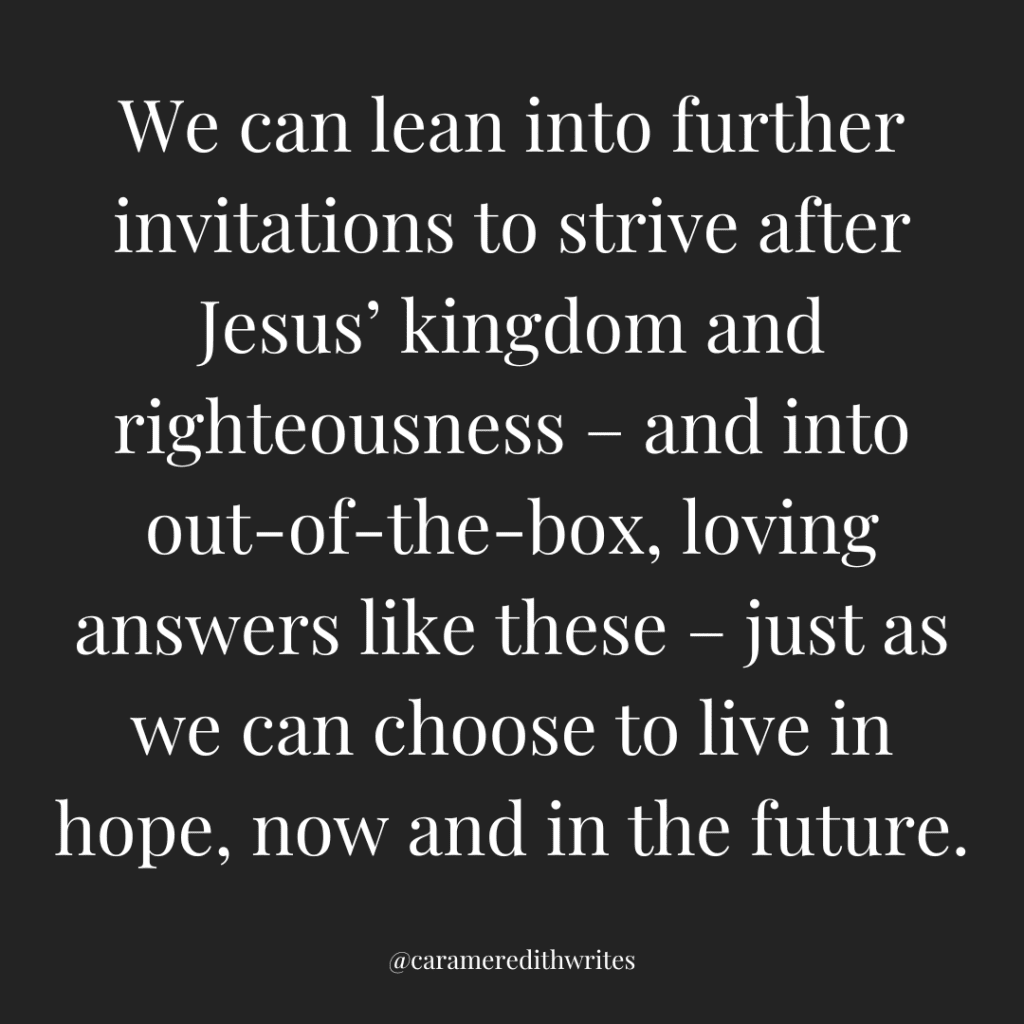
We don’t necessarily know how the origins of their amazement, but as Kim offers, the rest of us can lean into further invitations to strive after Jesus’ kingdom and righteousness – and into out-of-the-box, loving answers like these – just as we can choose to live in hope, now and in the future.
And what better a place and time to love people, strive after the ways of Jesus, and live in hope than right now.
Perhaps like you, my world has been flooded with news of the Israel-Hamas War, begging me take a side. I am not an expert, so I am not here to offer any sort of expert opinion, but I am here to feel the weight of grief and death, to cry for an end, for peace in a place and a situation and a history filled with so much division.
As activist and author Shane Claiborne recently said, the reality is that “Every single Palestinian is made in the image of God. Every single one. Every single Israeli is made in the image of God. Every single one.”
Perhaps our invitation is to grieve the situation in Israel and the situation in Gaza – recognizing, like our passage, the two sides of the coin present in this situation. We can pray for an end to this division and call for ceasefire now – that there would be an “immediate ceasefire in the Gaza Strip and Israel to prevent a humanitarian catastrophe and further loss of innocent lives.” We can call on Jesus, the Prince of Peace. And we can cry out, Lord, have mercy. Christ have mercy. Because sometimes, that is the only thing we can say.
So to close, I wonder if we might offer our collective words up to God. Repeat after me, as we say a prayer over the Israel-Gaza War:
Lord, have mercy. Lord, have mercy.
Christ, have mercy. Christ, have mercy.
Lord, have mercy. Lord, have mercy.
Amen.
—
This sermon was preached nearly a year ago, on October 22, 2023 at St. Paul’s Episcopal Church in San Rafael, California. Obviously, a lot has happened since this sermon first aired. I call for an immediate ceasefire to this unnecessary war. If you liked this piece, you might like last week’s excerpt on loving our neighbor as well!
Sports and Religion
Politics and Religion
About Cara Meredith
Cara Meredith is a writer, speaker, and part-time development director. The author of The Color of Life (Zondervan) and the forthcoming Church Camp (Broadleaf), she gets a kick out of playing with words. A lot. You can read more about the author here.
Previous Post

September 3, 2024
How do we love our neighbor?
Next Post

September 17, 2024 The Power of Dignity: A Reflection on Jesus's Teachings
Recent Comments
"Bitterness and envy rots the soul."
How Bishop Budde helped us look ..."
"Do you know the meaning of the word TROLL? You fit the description perfectly. Get ..."
How Bishop Budde helped us look ..."
"To be or nor to be, Shakespeare wrote it to mean the choice between two ..."
"Systems designed to give men more power and value men more highly had become a ..."
Nice Churchy Patriarchy is most definitely ..."
Browse Our Archives
Select a Category Book reviews Uncategorized
Select a Month July 2026 June 2026 December 2025 August 2025 July 2025 June 2025 May 2025 April 2025 March 2025 February 2025 January 2025 December 2024 November 2024 October 2024 September 2024 August 2024 July 2024 June 2024 March 2024 February 2024 January 2024 December 2023 September 2023 June 2023 November 2022 October 2022 September 2022 August 2022 July 2022 June 2022 May 2022 April 2022 November 2021 May 2021 April 2021 March 2021 January 2021 December 2020 November 2020 October 2020 July 2020 June 2020 May 2020 April 2020 March 2020 February 2020 January 2020 December 2019 October 2019 September 2019 August 2019 July 2019 June 2019 May 2019 April 2019 March 2019 February 2019 January 2019 December 2018 November 2018 October 2018 September 2018 August 2018 July 2018
Follow Us!
TAKE THE
Religious Wisdom Quiz
Who was the first Christian martyr mentioned in Acts?
Select your answer to see how you score.
Philip Barnabas Stephen James
Books by This Author Books by Coloring Outside the Lines
Related posts from Coloring Outside the Lines

The Power of Dignity: A Reflection on Jesus's...

When Hope & Pain Intermingle in Our Souls

The Deacon's Table — Who Actually Gets to...
Life After Lying Prostrate on the Floor of...
TRENDING AT PATHEOS Progressive Christian

What Being a Modern-Day Apostle Means to Me
In my last column, I discussed the ins and outs of modern-day...

Did Ancient China Once Worship the God of...
Across human history, a common thread weaves through the origins of the...

Love Your Neighbor – Including Earth-Kin: Lev. 19,...
God’s command to love your neighbor means acting in an ethical and...

Lead a Church Study of “Jesus and Lao...
Guest writer Jack Thomas (The Irreverent Reverend) reflects on leading his church...

Pastoral Wisdom for Responding to Sermon Pushback
Getting sermon pushback on your social justice sermon? Learn practical, Proverbs-based strategies...

Principles for Understanding the Apostolic Ministry Today
Whenever people discover that my formal ministry title is "apostle," as in...
view all Progressive Christian blogs
What Are Your Thoughts?leave a comment
Ad-Free & Subscriber Log-In Subscription Support
- About Us
- 2026 Calendar
- Videos
- Podcasts
- Library of World Religions
- Faith In Media Tracker
- Advertise With Us
- Write for Us
- Privacy Policy
- Terms of Service
- Do Not Sell My Data
- Contact Us
- Radiant Digital
- Manage Newsletter Subscriptions
- Unsubscribe From Notifications
- Sitemap
Copyright 2008-2026, Patheos. All rights reserved.
Subscription Support Ad-Free & Subscriber Log-In
Follow Patheos