
BuddhistCatholicContemplativeEvangelicalGeneral ChristianHinduJewishLatter-day SaintMuslimNew VisionsProgressive Christian
Beliefs
- Buddhist
- Catholic
- Contemplative
- Evangelical
- General Christian
- Hindu
- Jewish
- Latter-day Saint
- More Voices
- Muslim
- New Visions
- Pagan
- Progressive Christian
Topics
- Religion News
- Food and Religion
- Sports and Religion
- Religious Art
- Religious Music and Entertainment
- Religious Events
- History and Religion
- Style and Religion
- Politics and Religion
- Women in Religion
- Recreation Outdoors and Religion
- Business Finance and Religion
- Careers Workplace and Religion
- Education and Religion
- Family Parenting and Religion
- Health Fitness and Religion
- Home and Religion
- Relationships and Religion
- Technology and Religion
- Travel and Religion
Columnists
- Buddhist Columnists
- Business Finance and Religion Columnists
- Careers Workplace and Religion Columnists
- Catholic Columnists
- Contemplative Columnists
- Education and Religion Columnists
- Evangelists Columnists
- Family Parenting and Religion Columnists
- General Christian Columnists
- Health Fitness and Religion Columnists
- Hindu Columnists
- History and Religion Columnists
- Home and Religion Columnists
- Jewish Columnists
- More Voices Columnists
- Latter Day Columnists
- Muslim Columnists
- New Visions Columnists
- Nonreligious Columnists
- Pagan Columnists
- Politics and Religion Columnists
- Progressive Columnists
- Recreation Outdoors and Religion Columnists
- Relationships and Religion Columnists
- Religion News Columnists
- Religious Art Columnists
- Religious Events Columnists
- Religious Music and Entertainment Columnists
- Sports and Religion Columnists
- Style and Religion Columnists
- Technology and Religion Columnists
- Travel and Religion Columnists
- Women in Religion Columnists
Resource Library
- 2026 Calendar
- Library of World Religions
- The 100 Most Holy Places on Earth
- Patheos Answers
- Podcasts
- Videos
- Faith Leaders Database
- Anglican Episcopalian
- Bahai
- Baptist
- Buddhism
- Christianity
- Confucianism
- Eastern Orthodoxy
- Hinduism
- Holiness and Pentecostal
- ISKCON
- Islam
- Judaism
- Lutheran
- Methodist
- The Church of Jesus Christ of Latter-day Saints
- New Age
- Paganism
- Presbytarian and Reformed
- Protestantism
- Religion Behind the Scenes
- Roman Catholic
- Scientology
- Shia Islam
- Sikhism
- Sufism
- Sunni Islam
- Taoism
- Zen
- See all religions
Research Tools
 Ad-Free & Subscriber Log-In Subscription Support
Ad-Free & Subscriber Log-In Subscription Support
Follow Patheos 

- Trending:
- Forgiveness
- |
- Marriage
- |
- Consciousness
- |
- Death Penalty
- |
- Election
- |
- Halloween

- Home
- Progressive Christian
- The Holy Act of Eating and Drinking: A Spiritual Perspective
The Holy Act of Eating and Drinking: A Spiritual Perspective
Last updated on: August 20, 2024 at 9:01 am by Cara Meredith
The Holy Act of Eating and Drinking: A Spiritual Perspective 2024-08-20T09:01:14-07:00 Cara Meredith
Patheos Explore the world's faith through different perspectives on religion and spirituality! Patheos has the views of the prevalent religions and spiritualities of the world.
Have you ever felt desperate for thirst? So hungry for food that you would have done anything to get food into your belly, stat?
Just about a year ago, a friend of mine decided that to celebrate her 50th birthday, she would invite a handful of girlfriends to trek up a really tall mountain with her. Although I would have rather celebrated the occasion with a fruity drink by an ocean in Mexico, I said yes to the adventure of climbing Half Dome in Yosemite.
Lest you believe this a fairytale of the preacher’s imagination, it actually happened. Six of us drove to the national forest on a Thursday afternoon: we would spend the night near the base, then start hiking at five the next morning.
We loaded our backpacks up, mostly with water but also with food we might want to eat along the trail. I refrained from packing a book, for obvious, climbing-straight-up-a-mountain, no-time-to-read purposes, but did bring an extra pair of socks with me.
By the time we started the climb, it was obvious who lived in the mountain goat category and who more so lived in the mountain …platypus category. Although some of the women seemed to scurry upwards without so much as needing to take a breath, I staked claim to the latter category of slow and steady wins the race. Even though I had trained a little bit, I was out of my element – more suited to the waters of Australia than the hills of California.

More than halfway through the day, we finally reached our destination: two of the women, including the birthday girl, officially summitted Half Dome. The rest of us made it to Sub Dome, just below. We were so proud of ourselves. We were so tired and exhausted.
And I was terribly thirsty. Even though I had packed a lot of water, I seemed to need a lot of water, more water than I’d brought in the first place. (I did just liken myself to a semi-aquatic, egg-laying mammal, after all). Before we were even halfway back down the mountain, I knew my supply was dwindling – and even though downhill wasn’t as hard, I knew I wouldn’t make it back to the base without more water.
That’s when one of the mountain goats, if we can call her that, handed me a liter of water. She didn’t need it. She was fine without. She could make do.
She gave me water when I needed it most. She gave me what I most desperately needed at the time.
I tell you this story, because in a way, it’s not all that different from this week’s Gospel reading when Jesus speaks about a desperation of sorts – a kind of eating and drinking we’re invited into, if we’re to live.
In John 6, Jesus shares a simple truth about himself: I am the living bread that came down from heaven, he says to his disciples. Whoever eats of this bread will live forever, and the bread that I give for the life of the world is my flesh.
For those of us who have long called the Church home, who have perhaps even long called ourselves Christians, perhaps it doesn’t strike us as weird that Jesus would refer to himself as a piece of food – or encourage his followers to gobble down the food that he is.
But to the men who had just crossed a lake in search of him, they didn’t know what to think of the declaration. How can this man give us his flesh to eat? Their question is not unwarranted; we too would probably find ourselves asking the same, had we just begun to follow in the way and path of Jesus.
In response, Jesus spells it out a second time: You’ll eat my body. You’ll drink my blood. Because when you do this, you’ll live.
I am, of course, truncating his words, but the sentiment remains the same: When Jesus is our food, he also becomes the life source pulsing through our insides. After all, this is the one who longs to nourish us, the God who longs to sustain us.
This God is The One Who Feeds our spiritual hunger, who quenches our desperate thirst.
“He is our bread, he is our bread, he is our bread,” one writer says. “Our lectionary asks us to linger over this truth for a reason; this teaching is elemental. It is rock bottom. It is the core of who God is, and who we are. May we ever eat, and live.”
What does it then mean to eat of the living God? To eat the flesh and drink the blood and live, truly live, because in gulping down these elements we are leaning into new life, over and over again?
I think sometimes it means recognizing the deep hunger that lives inside each one of us – a deep hunger that only God can satisfy.
This desperation is often quenched when we come to the table and kneel at the altar: The body of Christ, made for you. The blood of Christ, poured out for you. Whenever it happens, however it happens, we are made new, renewed in this act of eating and drinking.
It’s almost like God hits an internal reset button, deep within our souls. Our insides become rewired to peace, reconnected to love, reaccustomed to the life that is already ours.
But I believe something holy also happens in this place, not just at the altar, but also with the people. Because in Protestantism, the church, as in the people of the church, are often, also called the body of Christ.
When we gather together, we are being fleshy, real versions of Christ to one another. We too are quenching one another’s thirsts, feeding each other’s souls.

When my friend Shannon gave me a liter of water on the side of the mountain, she was filling a real, visceral, physical need in me – but she was also being Christ to me.
When we greet one another, when we call one another by name, when we drop off a meal to someone who’s sick, we are being Christ to one another. When we gather afterwards for coffee hour and engage in conversation, when we package up sandwiches, when we mourn together at a funeral of one of our beloveds, here, we are being Christ to one another.
This is not merely the work of the priest, of Christopher and Erin and others who don robes of Holy Orders in the church – but this is the work of the body of Christ, which is to say, to each one of us.
Top-down, and side-to-side, we receive and we give back. Just as our hunger and thirst is quenched, we also work to quench the hunger and thirst of others in the body.
After all, there’s a desperation of eating and drinking we’re invited into, if we’re to live.
And I don’t know about you, but this is a mountain I’m willing to climb …slow as a platypus I may sometimes be, I say yes to this desperation, to and with this God, to and with this body.
Might it be the same for each one of you.
Amen.
—
This is from a sermon given on August 18, 2025 at St. Paul’s Episcopal Church in San Rafael, California. If you like this style of writing, you might like this post as well.
About Cara Meredith
Cara Meredith is a writer, speaker, and part-time development director. The author of The Color of Life (Zondervan) and the forthcoming Church Camp (Broadleaf), she gets a kick out of playing with words. A lot. You can read more about the author here.
Previous Post

August 15, 2024
The Complex Legacy of Church Camp Experiences
Next Post

September 3, 2024 How do we love our neighbor?
Recent Comments
"Bitterness and envy rots the soul."
How Bishop Budde helped us look ..."
"Do you know the meaning of the word TROLL? You fit the description perfectly. Get ..."
How Bishop Budde helped us look ..."
"To be or nor to be, Shakespeare wrote it to mean the choice between two ..."
"Systems designed to give men more power and value men more highly had become a ..."
Nice Churchy Patriarchy is most definitely ..."
Browse Our Archives
Select a Category Book reviews Uncategorized
Select a Month July 2026 June 2026 December 2025 August 2025 July 2025 June 2025 May 2025 April 2025 March 2025 February 2025 January 2025 December 2024 November 2024 October 2024 September 2024 August 2024 July 2024 June 2024 March 2024 February 2024 January 2024 December 2023 September 2023 June 2023 November 2022 October 2022 September 2022 August 2022 July 2022 June 2022 May 2022 April 2022 November 2021 May 2021 April 2021 March 2021 January 2021 December 2020 November 2020 October 2020 July 2020 June 2020 May 2020 April 2020 March 2020 February 2020 January 2020 December 2019 October 2019 September 2019 August 2019 July 2019 June 2019 May 2019 April 2019 March 2019 February 2019 January 2019 December 2018 November 2018 October 2018 September 2018 August 2018 July 2018
Follow Us!
TAKE THE
Religious Wisdom Quiz
Who said, "Lord, I am not worthy to have you come under my roof" but asked Jesus to heal his servant?
Select your answer to see how you score.
A Roman centurion Peter A scribe A Pharisee
Books by This Author Books by Coloring Outside the Lines
Related posts from Coloring Outside the Lines
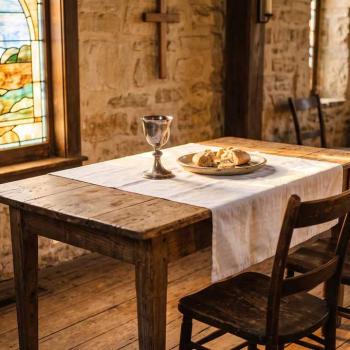
The Deacon's Table — Who Actually Gets to...

Life After Lying Prostrate on the Floor of...

Giving Machines are running with the idea of...

The Deepest South of All is more than...
TRENDING AT PATHEOS Progressive Christian

What Being a Modern-Day Apostle Means to Me
In my last column, I discussed the ins and outs of modern-day...

Did Ancient China Once Worship the God of...
Across human history, a common thread weaves through the origins of the...

Love Your Neighbor – Including Earth-Kin: Lev. 19,...
God’s command to love your neighbor means acting in an ethical and...

Lead a Church Study of “Jesus and Lao...
Guest writer Jack Thomas (The Irreverent Reverend) reflects on leading his church...

Pastoral Wisdom for Responding to Sermon Pushback
Getting sermon pushback on your social justice sermon? Learn practical, Proverbs-based strategies...

Principles for Understanding the Apostolic Ministry Today
Whenever people discover that my formal ministry title is "apostle," as in...
view all Progressive Christian blogs
What Are Your Thoughts?leave a comment
Ad-Free & Subscriber Log-In Subscription Support
- About Us
- 2026 Calendar
- Videos
- Podcasts
- Library of World Religions
- Faith In Media Tracker
- Advertise With Us
- Write for Us
- Privacy Policy
- Terms of Service
- Do Not Sell My Data
- Contact Us
- Radiant Digital
- Manage Newsletter Subscriptions
- Unsubscribe From Notifications
- Sitemap
Copyright 2008-2026, Patheos. All rights reserved.
Subscription Support Ad-Free & Subscriber Log-In
Follow Patheos