
BuddhistCatholicContemplativeEvangelicalGeneral ChristianHinduJewishLatter-day SaintMuslimNew VisionsProgressive Christian
Beliefs
- Buddhist
- Catholic
- Contemplative
- Evangelical
- General Christian
- Hindu
- Jewish
- Latter-day Saint
- More Voices
- Muslim
- New Visions
- Pagan
- Progressive Christian
Topics
- Religion News
- Food and Religion
- Sports and Religion
- Religious Art
- Religious Music and Entertainment
- Religious Events
- History and Religion
- Style and Religion
- Politics and Religion
- Women in Religion
- Recreation Outdoors and Religion
- Business Finance and Religion
- Careers Workplace and Religion
- Education and Religion
- Family Parenting and Religion
- Health Fitness and Religion
- Home and Religion
- Relationships and Religion
- Technology and Religion
- Travel and Religion
Columnists
- Buddhist Columnists
- Business Finance and Religion Columnists
- Careers Workplace and Religion Columnists
- Catholic Columnists
- Contemplative Columnists
- Education and Religion Columnists
- Evangelists Columnists
- Family Parenting and Religion Columnists
- General Christian Columnists
- Health Fitness and Religion Columnists
- Hindu Columnists
- History and Religion Columnists
- Home and Religion Columnists
- Jewish Columnists
- More Voices Columnists
- Latter Day Columnists
- Muslim Columnists
- New Visions Columnists
- Nonreligious Columnists
- Pagan Columnists
- Politics and Religion Columnists
- Progressive Columnists
- Recreation Outdoors and Religion Columnists
- Relationships and Religion Columnists
- Religion News Columnists
- Religious Art Columnists
- Religious Events Columnists
- Religious Music and Entertainment Columnists
- Sports and Religion Columnists
- Style and Religion Columnists
- Technology and Religion Columnists
- Travel and Religion Columnists
- Women in Religion Columnists
Resource Library
- 2026 Calendar
- Library of World Religions
- The 100 Most Holy Places on Earth
- Patheos Answers
- Podcasts
- Videos
- Faith Leaders Database
- Anglican Episcopalian
- Bahai
- Baptist
- Buddhism
- Christianity
- Confucianism
- Eastern Orthodoxy
- Hinduism
- Holiness and Pentecostal
- ISKCON
- Islam
- Judaism
- Lutheran
- Methodist
- The Church of Jesus Christ of Latter-day Saints
- New Age
- Paganism
- Presbytarian and Reformed
- Protestantism
- Religion Behind the Scenes
- Roman Catholic
- Scientology
- Shia Islam
- Sikhism
- Sufism
- Sunni Islam
- Taoism
- Zen
- See all religions
Research Tools
 Ad-Free & Subscriber Log-In Subscription Support
Ad-Free & Subscriber Log-In Subscription Support
Follow Patheos 

- Trending:
- Forgiveness
- |
- Marriage
- |
- Consciousness
- |
- Death Penalty
- |
- Election
- |
- Halloween
 Coffee and Crucifix
- Home
- Catholic
- Is Honoring And Venerating Saints Equal To Worship?
Is Honoring And Venerating Saints Equal To Worship?
Last updated on: December 10, 2020 at 11:30 am by Coffee & Crucifix
Is Honoring And Venerating Saints Equal To Worship? 2020-12-10T11:30:26-06:00 Coffee & Crucifix
Patheos Explore the world's faith through different perspectives on religion and spirituality! Patheos has the views of the prevalent religions and spiritualities of the world.
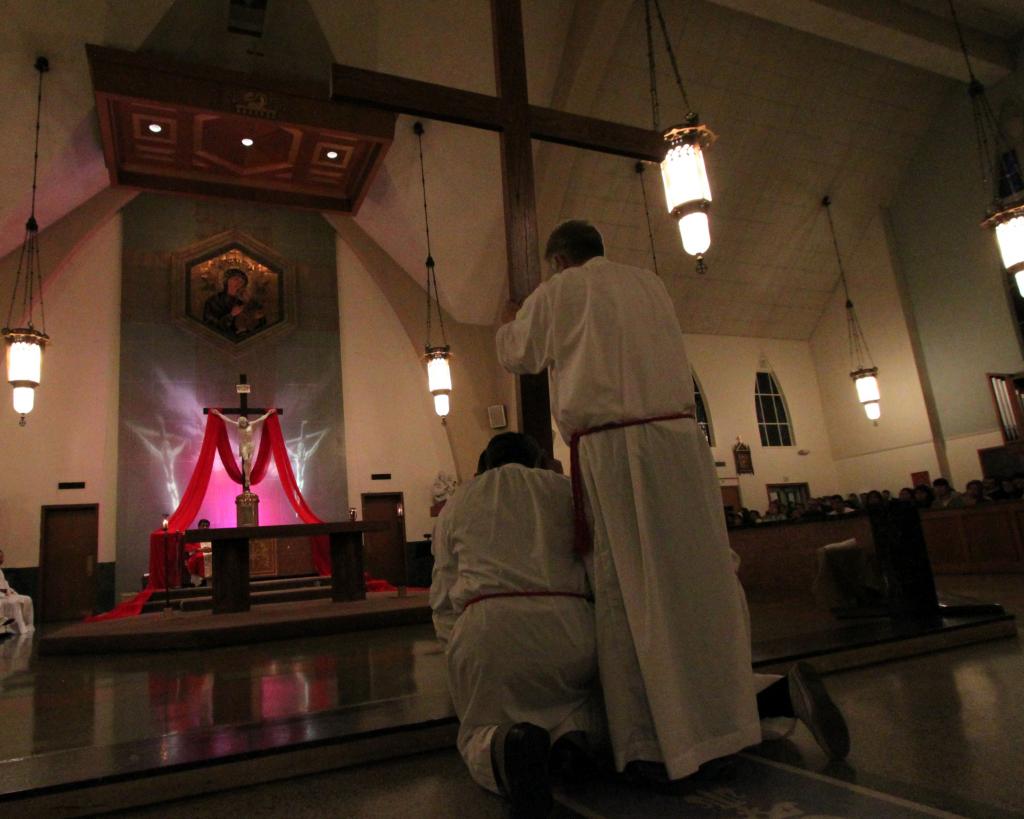
Image credit: Flickr.com
From a non-Catholic Christian perspective, anything to do with giving honor or veneration to the Virgin Mary or saints can be quite intimidating. The first thing that usually comes to mind is the first of the Ten Commandments,
“I am the Lord your God, who brought you out of the land of Egypt, out of the house of bondage. You shall have no other gods before. You shall not make for yourself a graven image, or any likeness of anything that is in heaven above, or that is in the earth beneath, or that is in the water under the earth; you shall not bow down to them or serve them; for I the Lord your God am a jealous God, visiting the iniquity of the fathers upon the children to the third and the fourth generation of those who hate me, but showing steadfast love to thousands of those who love me and keep my commandments.” — Exodus 20:2-6 RSV
The Catholic Church also respects these Commandments when it comes to worship that is meant for God alone. Though the topic of how objects become idols is discussed in my article ‘Do Catholics Worship Idols,’ one of the things that is often rarely talked about in Protestant circles is whether mere honor or veneration is equal to full-on worship. This is where there is a bit of a language barrier because Protestants (namely North American Evangelicals) generally use more simplistic language than Catholics do in describing theological terms. This is also one of the reasons why I find Evangelicals have earned their title because they tend to be far more effective at evangelism than Catholics are.
One of the main reasons why Protestants are often repelled at the idea of venerating the saints is because, in modern English, the word ‘veneration‘ is often attributed to the word ‘worship.’ The definition of worship has been historically used as a way to attest to someone’s worth or significance, and anyone who has particular significance is usually paid a level of due honor or respect. This is one of the reasons why people, especially in positions of authority or political significance, are sometimes addressed as ‘your worship,‘ which is another way of saying phrases like your honor, your eminence or your highness. Nowadays, the Euro-American Protestant understanding of the word worship has been restricted from any honor due to a human except the kind of honor given to God alone.
There are a number of passages to consider when discussing the meaning of worship. To start, Exodus 20:12 (RSV) says, “Honor your father and your mother, that your days may be long in the land which the Lord your God gives you.” I think it comes without saying that, as Christians, we certainly do not worship our parents. But if we took that same type of logic and applied it to the fourth Commandment, one could say that honoring one’s parents is a form of worship. Chances are, the vast majority of Christians would not equate honoring our parents with making them out to be some sort of god and goddess. But in a sense, we do venerate them to a degree higher than we would to those we have no blood-relations with.
The second observation from Scripture would be that the student is not greater than the teacher (Matthew 10:24, Luke 6:40). When we read about saints and prominent figures in the Bible, we read and meditate over how their lives gave glory to God. While they may not be alive on earth, the saints and biblical figures are, in a sense, ‘teachers’ of the faith to us. Some Protestants have been known to keep books or recordings of a particular pastor or teacher who may have passed away long ago, but the effectiveness of their preaching style and biblical citation lives beyond their earthly lives through the legacy they left behind. This is no different than how Catholics treat the prayers and literary works of the saints.
The third being that Jesus commands to give to Caesar what is Caesar’s and to God what is God’s (Matthew 22:21, Mark 12:17). While Roman Emperors are far from being considered canonized saints, it’s worth pointing out that the respect for personal property and recognizing governing authorities (Romans 13:1) is a value taught by Christ. When we show honor or respect, we are not worshipping the person to which respect is due. We are simply giving glory to God by obeying His Word. Of course, obedience has its limitations until people or worldly authorities push you to go against your values and principles,
The Bible is filled with examples of giving specific honor to people. In the passage where an elderly Isaac gives Jacob a blessing, he recites,
“May God give you of the dew of heaven,
and of the fatness of the earth,
and plenty of grain and wine.
Let peoples serve you,
and nations bow down to you.
Be lord over your brothers,
and may your mother’s sons bow down to you.
Cursed be every one who curses you,
and blessed be every one who blesses you!”
— Genesis 27:28-29 RSV
Though this event would have taken place prior to the Law of Moses, there is an implication that there are certain contexts when bowing down does not equal adoration, as for what Exodus 20:2-6 refers to regarding idolatry. Jacob and Esau certainly did not worship their father Isaac as though he were God, nor was Isaac implying that their ancestors would worship them. But the act of honoring the dignity and significance of their patriarch is evident. Similarly, Jesus Himself would have had to kneel down while washing the feet of His disciples (John 13:1-17). If we as Christians are called to imitate Our Lord, sometimes it involves bending a knee — not in adoration, but in an act of service.
This is why the Catholic Church categorizes types of worship such as adoration apart from veneration and earthly honor. As defined by Saint Augustine in his theological work City of God, the distinctions between adoration and veneration are defined as Latria, Dulia and Hyperdulia. Latria being supreme honor and adoration of the Trinity (Father, Son, and Holy Spirit), Dulia being the honor that’s due to the saints, and Hyperdulia which is special honor given to Mary as the Mother of Our Lord and Queen of Heaven.
As far as these terms are concerned, I find it easy to think about them as ‘degrees’ of worship. But on the contrary, Catholic theologians insist that the difference between them are as far apart as what separates Creator from the created. We give honor and veneration to the saints who are created beings, but we adore the Creator.
Regarding the Virgin Mary, Protestants tend to subconsciously categorize her with the saints and living people on earth on the same plane. This is largely because how they interpret such passages like Romans 3:10,23 seemingly implies that Mary would have been a sinner like every other human being — hence why they do not accept the Catholic dogma of the Immaculate Conception as biblical. I think they are well meaning in doing so because every Christian who is well-versed in their Bible takes the Lord’s Commandments seriously. No Christian wants to risk placing a created being at an equal level (or higher than) God Himself.
An interesting observation I’ve noticed is that Protestants actually perform acts of Dulia whether they realize it or not — that is, without praying for the intercession of the person they are honoring. They certainly give honor and recognition to prominent pastors and historical Christian figures such as Martin Luther, John Calvin, John Wycliffe, William Tyndale, John Wesley, Charles Spurgeon, Billy Graham and others for the examples of what they consider to be leading Christlike lives and preaching a biblical message. But much like the saints venerated by Catholics, these people are also mere humans whom I’m convinced would unanimously agree to direct all glory to God and less towards themselves.
When considering the differences between what type of reverence or worship is given to either God or humans, it all boils down to whether God is perfect in humility. I don’t imagine a completely narcissistic deity would command his creations to honor their mother and father, or even give any form of respect to an earthly authority. This is why, as I’ve discussed further in my article A Contemplation Of Soli Deo Gloria (Glory To God Alone), I’ve come to believe that God desires His creations to share in His glory, not remain outside of it. The point of venerating a saint is not to pretend they were impeccable or diminish the role of Christ as Messiah, but to honor how God’s infinite grace has worked through their finite abilities.

About Rene Albert
I'm Rene Albert. I am a husband to a beautiful wife and a father of three children. I'm also a licensed carpenter and construction manager as part of my full-time work. When I'm not busy meeting construction deadlines, changing diapers and chasing little hooligans around the house, I write essays about Catholicism, mere Christian theology and western politics and culture, as well as how they all affect each other. Due to working a full time job in construction, I usually only post two articles per week on average. My goal is to eventually become a full-time writer and possibly start up a podcast or Youtube channel. My writing is a labor of love, so if you enjoy my work and feel called to support me on Patreon, I would be very much appreciative! Pax vobiscum! You can read more about the author here.

Next Post

December 2, 2020 Protestant believes in Purgatory after long drive through Saskatchewan
Browse Our Archives
Select a Category Catholicism Christian Life Christian Life Church History Community Eastern Orthodoxy Entertainment Fiction History Mental Health Movies Music Politics Protestantism Reflection Religion Satire Science Fiction Self esteem Self Love Spirituality Star Wars Suicide Theology Uncategorized
Select a Month June 2023 April 2023 May 2022 April 2022 July 2021 April 2021 March 2021 February 2021 January 2021 December 2020 November 2020 October 2020 September 2020 August 2020 July 2020 June 2020 May 2020 April 2020 March 2020 February 2020 January 2020 December 2019 November 2019 October 2019 September 2019 August 2019 July 2019 June 2019 May 2019 April 2019 March 2019 February 2019 January 2019 December 2018 October 2018 September 2018 August 2018 June 2018 April 2018 January 2018 November 2017 October 2017 July 2017 June 2017 May 2017 April 2017 March 2017 February 2017 December 2016 October 2016 September 2016 August 2016 June 2016 May 2016 March 2016 February 2016
Follow Us!
TAKE THE
Religious Wisdom Quiz
In the Sermon on the Mount, who did Jesus say would "inherit the earth"?
Select your answer to see how you score.
The meek The just The wise The strong
Related posts from Coffee and Crucifix

Martin Scorsese Meets With Pope To Discuss Film...

FAIL! Catholic says, 'And also with you!" instead...

Don't Lose Your Soul In The Culture War

10 Essential Books Every Catholic Should Own
TRENDING AT PATHEOS Catholic

Rejecting Doom: Christian Hope And Human Action
Christianity is a religion of hope. We are to have hope and...

It’s What Comes From Within Which Matters
One of the most difficult things for us to understand is why...

Why I Choose the Eucharist Over the Sermon
Choose the Eucharist, Not the Sermon What are we supposed to get...

5 Design Elements Found in Spiritually Rooted Homes
Putting Spirituality Into Home Decor Our homes are more than our living...

Credo: A Story of God Told with the...
About 10 years ago, I began to imagine a personal "Credo" that...

The Anatomy of Divine Revelation in Catholic Thought
The claim that God has made Himself known to human beings is...
view all Catholic blogs
Ad-Free & Subscriber Log-In Subscription Support
- About Us
- 2026 Calendar
- Videos
- Podcasts
- Library of World Religions
- Faith In Media Tracker
- Advertise With Us
- Write for Us
- Privacy Policy
- Terms of Service
- Do Not Sell My Data
- Contact Us
- Radiant Digital
- Manage Newsletter Subscriptions
- Unsubscribe From Notifications
- Sitemap
Copyright 2008-2026, Patheos. All rights reserved.
Subscription Support Ad-Free & Subscriber Log-In
Follow Patheos