
BuddhistCatholicContemplativeEvangelicalGeneral ChristianHinduJewishLatter-day SaintMuslimNew VisionsProgressive Christian
Beliefs
- Buddhist
- Catholic
- Contemplative
- Evangelical
- General Christian
- Hindu
- Jewish
- Latter-day Saint
- More Voices
- Muslim
- New Visions
- Pagan
- Progressive Christian
Topics
- Religion News
- Food and Religion
- Sports and Religion
- Religious Art
- Religious Music and Entertainment
- Religious Events
- History and Religion
- Style and Religion
- Politics and Religion
- Women in Religion
- Recreation Outdoors and Religion
- Business Finance and Religion
- Careers Workplace and Religion
- Education and Religion
- Family Parenting and Religion
- Health Fitness and Religion
- Home and Religion
- Relationships and Religion
- Technology and Religion
- Travel and Religion
Columnists
- Buddhist Columnists
- Business Finance and Religion Columnists
- Careers Workplace and Religion Columnists
- Catholic Columnists
- Contemplative Columnists
- Education and Religion Columnists
- Evangelists Columnists
- Family Parenting and Religion Columnists
- General Christian Columnists
- Health Fitness and Religion Columnists
- Hindu Columnists
- History and Religion Columnists
- Home and Religion Columnists
- Jewish Columnists
- More Voices Columnists
- Latter Day Columnists
- Muslim Columnists
- New Visions Columnists
- Nonreligious Columnists
- Pagan Columnists
- Politics and Religion Columnists
- Progressive Columnists
- Recreation Outdoors and Religion Columnists
- Relationships and Religion Columnists
- Religion News Columnists
- Religious Art Columnists
- Religious Events Columnists
- Religious Music and Entertainment Columnists
- Sports and Religion Columnists
- Style and Religion Columnists
- Technology and Religion Columnists
- Travel and Religion Columnists
- Women in Religion Columnists
Resource Library
- 2026 Calendar
- Library of World Religions
- The 100 Most Holy Places on Earth
- Patheos Answers
- Podcasts
- Videos
- Faith Leaders Database
- Anglican Episcopalian
- Bahai
- Baptist
- Buddhism
- Christianity
- Confucianism
- Eastern Orthodoxy
- Hinduism
- Holiness and Pentecostal
- ISKCON
- Islam
- Judaism
- Lutheran
- Methodist
- The Church of Jesus Christ of Latter-day Saints
- New Age
- Paganism
- Presbytarian and Reformed
- Protestantism
- Religion Behind the Scenes
- Roman Catholic
- Scientology
- Shia Islam
- Sikhism
- Sufism
- Sunni Islam
- Taoism
- Zen
- See all religions
Research Tools
 Ad-Free & Subscriber Log-In Subscription Support
Ad-Free & Subscriber Log-In Subscription Support
Follow Patheos 

- Trending:
- Forgiveness
- |
- Marriage
- |
- Consciousness
- |
- Death Penalty
- |
- Election
- |
- Halloween
 Coffee and Crucifix
- Home
- Catholic
- My Struggle With Creationism
My Struggle With Creationism
Last updated on: December 10, 2020 at 11:28 am by Coffee & Crucifix
My Struggle With Creationism 2020-12-10T11:28:34-06:00 Coffee & Crucifix
Patheos Explore the world's faith through different perspectives on religion and spirituality! Patheos has the views of the prevalent religions and spiritualities of the world.
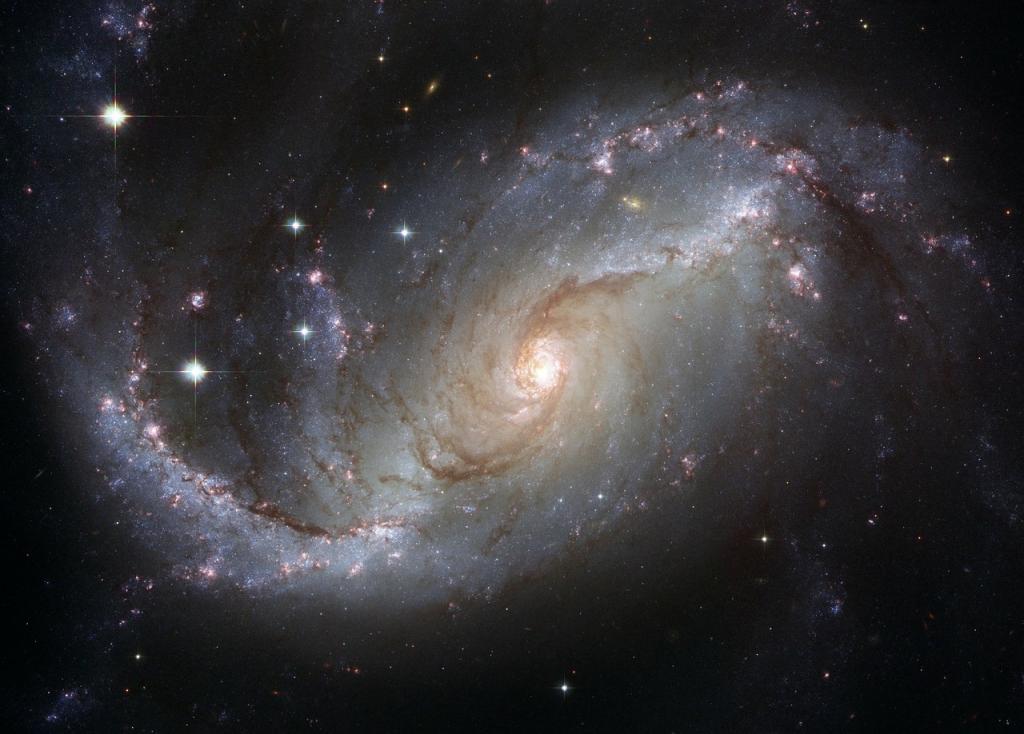
Image credit: needpix.com
In elementary school, I used to spend countless hours in the library reading books about space, the planets in our solar system and other celestial bodies. My favorites were selected books from Isaac Asimov’s Library of the Universe. I absorbed as much information on quasars, pulsars, black holes, white dwarfs and red giants as my adolescent mind could contain. Even as part of a mini science experiment assignment, I mapped out the changing positions of the stars in the sky every night for a week by placing a hand-marked graph on my living room window. It was during my experiment that I learned how the constellations in space continue to rotate around the sky even during the daytime.
As a young Catholic, I remember the first time my faith collided with what I learned after taking it upon myself to read the first chapter of Genesis. The glossary in the back of my family’s Bible also discussed the Firmament, and how it was like an upside-down bowl over the Earth with the sun, moon and stars hung in its fabric. At 10 years old, I remember having a conversation with my father about this subject in the midst of my confusion. He summarized it well in one quote,
“Science and morality are two different things. What we learn from science is what we observe with our eyes, whereas what we learn from how the Bible describes our universe is what we observe from the heart.“
Years later, even after leaving Catholicism to pursue Evangelical Protestantism at a young adult, this was a message I’ve always carried with me. While studying the Bible in my newfound endeavor to grow closer to Christ, I’ve always struggled to see eye-to-eye with my fellow Christian brethren regarding the science of astronomy or paleontology. Many of my friends at the church denominations I’ve attended were unapologetically and outspokenly young-Earth creationists. We’ve devoted entire Bible studies to watching presentations such as The Truth Project (which was a defense of intelligent design but from a young-Earth creationist position). And yet, whenever I read Genesis 1:3, “And God said, “Let there be light”; and there was light,” to me, that doesn’t sound contrary to the Big Bang theory at all. Creationism as described in the Book of Genesis may very well be true, but probably not in the way we interpret it to be. Though admitting to them that I struggled to accept young-Earth creationism would be almost synonymous with renouncing my Christian faith. I think when Bible-literalists run into the contradictions between observable data and what’s written in Scripture, they often think taking scientific observations at face-value demeans God’s omnipotence as far as having the ability to will something into existence instantly. The are trees that are believed to be older than the projected age of a young Earth, such as the Jurupa Oak colony. If God truly is all-powerful, I have no problem believing such a being could create something instantly. This is why the six days of creation in the first chapter of Genesis are often interpreted literally by many Christians. But this is also where Bible-literalism loses me. We know that Genesis was written by Moses as an account for everything leading up to the Exodus out of Egypt. But we also know, even though Moses is considered a prophet of God, he was not there when Creation happened. The Book of Revelation, which is John’s account of his own vision received by God, is often interpreted metaphorically since the beasts and horns represent temporal powers at work on Earth. Even the use of numbers in biblical eschatology bear weighty symbolism. What if the six ‘days’ of creation were not literal 24-hour periods, but what would seem more like six sets of millions of years of celestial formation? What I often wonder is why more Christians do not treat Moses’ revelation of Creation in Genesis in a similar manner as John’s Revelation. A literalistic approach to the Genesis narrative is especially problematic when discussing something as simple as the Earth’s shape — which ties into the rising resurgence of promoters of flat earth. The idea of the flat earth comes from the geocentric model, which essentially asserts that the Earth is at the center of the created universe. For centuries, much of the ancient Jewish, Greek, Roman and Christian world subscribed to this belief. It wasn’t until the 16th century when Catholic astronomer and mathematician Nicolaus Copernicus presented the heliocentric model (in which the planets revolve around the Sun) based on his observations. This was further defended by Catholic astronomer Galileo Galilei, which evolved into controversy with the Church over suspected heresy. Galileo continued to defend the heliocentric model, as he believed it did not contradict the biblical Genesis narrative. It wasn’t until after his death after being under house arrest for years that the Church began to dig deeper and finally accept the heliocentric model as true — and this affair still remains as a black mark on the Church’s history. As far as geocentrism is concerned, what I often wonder is: what if God created other humans on other worlds? What would happen if scientists and astronomers discovered concrete evidence of life on other planets? If it were the case, I don’t believe this would render Christianity to be false. In my opinion, it may be possible that Jesus might have died for the sins of humans from other worlds. Or it could be possible that Earth may be the only planet that has suffered the consequences of Original Sin. Perhaps nowadays, an attachment to the geocentric model may be a symptom of unfettered arrogance in response to the possibility that Earthlings might not be the only life God had created in the universe — therefore we might not be the center of the universe we have long believed ourselves to be. Though this is all speculative thinking on my part, much to the humor of my non-religious readers. Returning to the subject of young-Earth creationism, I’d have to acknowledge the Bible-literalist argument that projecting billions of years of material formation might lack an account for a series of disturbances such as asteroid impacts, earthquakes and volcanic eruptions. Even continental shifts have been debated whether they lasted millions of years or happened within a span of decades. Regardless of what may be true, it only shows that the human mind can easily fathom such catastrophic changes as more of a gradual process rather than instantaneous events. This would be where some would question whether I believe the Bible is actually inspired by God, which I would answer with a resounding ‘yes.’ Non-religious folks would often claim that creationism is a myth, but what many people do not realize is that ‘myths’ do not equal falsehoods. People have often derived moral teachings from stories in ancient Greek and Roman mythology. Whether or not the the characters in the stories were actual gods is questionable, but the stories themselves could have been based on actual events. What is also mind-boggling to me is a study from 2018 suggests that all humans may have descended from two people roughly 100,000 to 200,000 years ago. This would seemingly give credence to the possibility of an ‘Adam’ and an ‘Eve’ actually existing if this is what the Bible is referring to. It is also worth pondering whether the biblical account of Adam’s descendants living up to 900 years might have rather been symbolic numbers of what their actual lifespans were — which would have been drastically longer than the literal genealogical records from the Bible that would estimate the age of the Earth roughly 6000 years old. Regardless of whether the Genesis account is literal, allegorical or metaphorical, something caused our world and us humans to exist the way we are today. If Original Sin and the Fall of Man is real, whether it was a glitch in human evolution or happened verbatim as written in the Scriptures, how we believe it happened should not be the fulcrum of where our salvation is determined. One way or another, something happened. And by acknowledging the fact that we as humans fall short of what we perceive to be a higher state of being should be telling enough that we were designed for a far greater purpose than to merely survive.
“The Bible teaches us how to go to Heaven, not how the Heavens go.” — Galileo Galilei

About Rene Albert
I'm Rene Albert. I am a husband to a beautiful wife and a father of three children. I'm also a licensed carpenter and construction manager as part of my full-time work. When I'm not busy meeting construction deadlines, changing diapers and chasing little hooligans around the house, I write essays about Catholicism, mere Christian theology and western politics and culture, as well as how they all affect each other. Due to working a full time job in construction, I usually only post two articles per week on average. My goal is to eventually become a full-time writer and possibly start up a podcast or Youtube channel. My writing is a labor of love, so if you enjoy my work and feel called to support me on Patreon, I would be very much appreciative! Pax vobiscum! You can read more about the author here.
Previous Post

October 1, 2020
Yes, I Denounce White Supremacy.
Next Post

October 28, 2020 Why I Don’t Celebrate The Reformation (And Neither Should You)
Browse Our Archives
Select a Category Catholicism Christian Life Christian Life Church History Community Eastern Orthodoxy Entertainment Fiction History Mental Health Movies Music Politics Protestantism Reflection Religion Satire Science Fiction Self esteem Self Love Spirituality Star Wars Suicide Theology Uncategorized
Select a Month June 2023 April 2023 May 2022 April 2022 July 2021 April 2021 March 2021 February 2021 January 2021 December 2020 November 2020 October 2020 September 2020 August 2020 July 2020 June 2020 May 2020 April 2020 March 2020 February 2020 January 2020 December 2019 November 2019 October 2019 September 2019 August 2019 July 2019 June 2019 May 2019 April 2019 March 2019 February 2019 January 2019 December 2018 October 2018 September 2018 August 2018 June 2018 April 2018 January 2018 November 2017 October 2017 July 2017 June 2017 May 2017 April 2017 March 2017 February 2017 December 2016 October 2016 September 2016 August 2016 June 2016 May 2016 March 2016 February 2016
Follow Us!
TAKE THE
Religious Wisdom Quiz
Who was the first son of Adam and Eve?
Select your answer to see how you score.
Cain Levi Abel Irad
Related posts from Coffee and Crucifix

Don't Lose Your Soul In The Culture War

10 Essential Books Every Catholic Should Own

GraceLife Church, Civil Disobedience & the Christian Persecution...
Cancel Culture, Boundaries and Blocking on Social Media
TRENDING AT PATHEOS Catholic

Rejecting Doom: Christian Hope And Human Action
Christianity is a religion of hope. We are to have hope and...

It’s What Comes From Within Which Matters
One of the most difficult things for us to understand is why...

Why I Choose the Eucharist Over the Sermon
Choose the Eucharist, Not the Sermon What are we supposed to get...

5 Design Elements Found in Spiritually Rooted Homes
Putting Spirituality Into Home Decor Our homes are more than our living...

Credo: A Story of God Told with the...
About 10 years ago, I began to imagine a personal "Credo" that...

The Anatomy of Divine Revelation in Catholic Thought
The claim that God has made Himself known to human beings is...
view all Catholic blogs
Ad-Free & Subscriber Log-In Subscription Support
- About Us
- 2026 Calendar
- Videos
- Podcasts
- Library of World Religions
- Faith In Media Tracker
- Advertise With Us
- Write for Us
- Privacy Policy
- Terms of Service
- Do Not Sell My Data
- Contact Us
- Radiant Digital
- Manage Newsletter Subscriptions
- Unsubscribe From Notifications
- Sitemap
Copyright 2008-2026, Patheos. All rights reserved.
Subscription Support Ad-Free & Subscriber Log-In
Follow Patheos