
BuddhistCatholicContemplativeEvangelicalGeneral ChristianHinduJewishLatter-day SaintMuslimNew VisionsProgressive Christian
Beliefs
- Buddhist
- Catholic
- Contemplative
- Evangelical
- General Christian
- Hindu
- Jewish
- Latter-day Saint
- More Voices
- Muslim
- New Visions
- Pagan
- Progressive Christian
Topics
- Religion News
- Food and Religion
- Sports and Religion
- Religious Art
- Religious Music and Entertainment
- Religious Events
- History and Religion
- Style and Religion
- Politics and Religion
- Women in Religion
- Recreation Outdoors and Religion
- Business Finance and Religion
- Careers Workplace and Religion
- Education and Religion
- Family Parenting and Religion
- Health Fitness and Religion
- Home and Religion
- Relationships and Religion
- Technology and Religion
- Travel and Religion
Columnists
- Buddhist Columnists
- Business Finance and Religion Columnists
- Careers Workplace and Religion Columnists
- Catholic Columnists
- Contemplative Columnists
- Education and Religion Columnists
- Evangelists Columnists
- Family Parenting and Religion Columnists
- General Christian Columnists
- Health Fitness and Religion Columnists
- Hindu Columnists
- History and Religion Columnists
- Home and Religion Columnists
- Jewish Columnists
- More Voices Columnists
- Latter Day Columnists
- Muslim Columnists
- New Visions Columnists
- Nonreligious Columnists
- Pagan Columnists
- Politics and Religion Columnists
- Progressive Columnists
- Recreation Outdoors and Religion Columnists
- Relationships and Religion Columnists
- Religion News Columnists
- Religious Art Columnists
- Religious Events Columnists
- Religious Music and Entertainment Columnists
- Sports and Religion Columnists
- Style and Religion Columnists
- Technology and Religion Columnists
- Travel and Religion Columnists
- Women in Religion Columnists
Resource Library
- 2026 Calendar
- Library of World Religions
- The 100 Most Holy Places on Earth
- Patheos Answers
- Podcasts
- Videos
- Faith Leaders Database
- Anglican Episcopalian
- Bahai
- Baptist
- Buddhism
- Christianity
- Confucianism
- Eastern Orthodoxy
- Hinduism
- Holiness and Pentecostal
- ISKCON
- Islam
- Judaism
- Lutheran
- Methodist
- The Church of Jesus Christ of Latter-day Saints
- New Age
- Paganism
- Presbytarian and Reformed
- Protestantism
- Religion Behind the Scenes
- Roman Catholic
- Scientology
- Shia Islam
- Sikhism
- Sufism
- Sunni Islam
- Taoism
- Zen
- See all religions
Research Tools
 Ad-Free & Subscriber Log-In Subscription Support
Follow Patheos 

- Trending:
- Advent
- |
- Forgiveness
- |
- Thanksgiving
- |
- Election
- |
- Seasonal Holidays
- |
- Marriage
 Coffee and Crucifix
- Home
- Catholic
- Hand Gestures During Contemporary Worship and the Orans Posture
Hand Gestures During Contemporary Worship and the Orans Posture
Last updated on: January 20, 2020 at 12:37 pm by Coffee & Crucifix
Hand Gestures During Contemporary Worship and the Orans Posture 2020-01-20T12:37:47-06:00 Coffee & Crucifix
Patheos Explore the world's faith through different perspectives on religion and spirituality! Patheos has the views of the prevalent religions and spiritualities of the world.
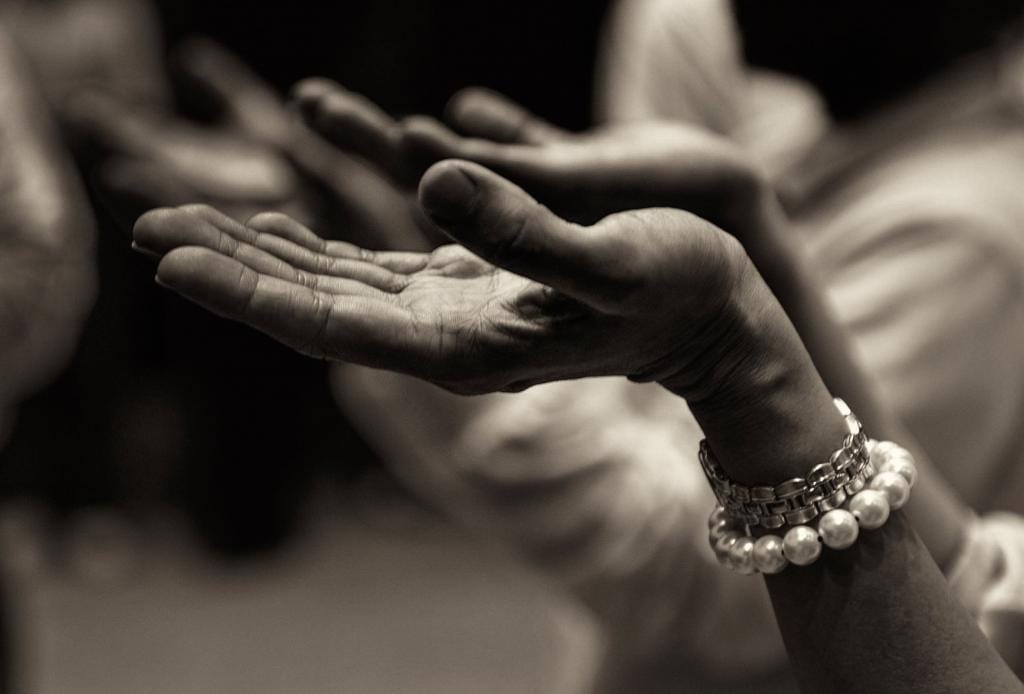
Image credit: pxfuel.com
For the amount of years I’ve spent as an Evangelical, I’ve attended my share of church worship services. Often when the music started playing (whether it be traditional hymns or contemporary songs of praise) there was usually at least a handful of people who would raise their hands in reverence to the Lord.
But to be honest, I’ve always found the sight of people lifting their hands as though they were in some kind of euphoric state rather off-putting. Though in the moments when I would try to immerse myself into the moment of wanting to experience God’s presence, I have to admit I have tried it myself a number of times. I’ve raised my hands while closing my eyes in an attempt to focus on worshiping God and somehow enhance my experience. But in hindsight I always found myself wondering whether other people thought I was just showing off, being pretentious or whether God could see right through my outward gestures as thought I was in it for the high of a dopamine rush.
Some Evangelical Christians would probably think I probably have not fully opened myself up to the Holy Spirit for simply having no desire to raise my hands. To which I would argue, for the amount of times I’ve felt His presence, it was never in a way that motivated me to extend out my hands as though I’m holding an invisible mystical orb in each palm. My most spiritually-intimate moments usually involved marveling at the beauty of creation, breaking down in an wave of emotions amidst surviving the turmoil in life by divine grace, or cowering in the realization of how my existence is but a mere speck in the vastness of the universe while unable to fathom how such an infinite deity could love someone as insignificant as me. Sometimes even a combination of the three. With this in mind, I realize that everyone responds differently to their experiences with the divine.
In my observation, there seems to be much cultural significance towards the use of hand gestures, especially among those who come from charismatic or Pentecostal denominations. Often when charismatics pray together, there is an emphasis on the laying of hands to receive the Holy Spirit, holding hands while praying, and raising hands in enthusiastic praise and adoration. But what is generally accepted as reverent among charismatics and Pentecostals may not seem so reverent in a traditional setting.
Even though I had grown up attending rural Catholic parishes, I had never seen Catholic laypeople lift their hands during Mass until I had reverted to Catholicism and attended urban parishes. This particular gesture is known as the orans posture, which involves outstretching the hands to the sides of the body and lifted upwards. It is an ancient custom that dates all the way back to ancient Greco-Roman and other pagan cultures. In the Early Church, it was adopted to be performed by the priest who leads the congregation while reciting the Lord’s Prayer during Mass, which is still practiced to this day. But in recent years, the orans posture seems to have become a trend among laypeople in light of the charismatic movements of the 20th century.
Because the General Instruction on the Roman Missal (GIRM) is relatively silent about laypeople using the orans posture, many Catholics have taken the liberty to do whatever gestures they want. But from what I understand, the opposition towards the use of the orans posture among laypeople have little to do with cultural significance and more to do with proper reverence.
For example, in a setting where people stand for the National Anthem in both Canada and the United States, it is usually appropriate for the crowd to stand (with the exception of those who might be bound by a wheelchair). But any other gesture that typically stands out among the crowd while reciting the anthems is often frowned upon. One example I can think of is when NFL quarterback Colin Kaepernick chose to kneel during the National Anthem before kickoff in order to raise awareness of systemic racism in America. While an NFL game and a Catholic Mass are in no way comparable, some have argued that Kaepernick’s act of kneeling have garnered ‘unwanted’ political attention where politics should have been left out completely. Regardless of how one feels about Kaepernick, people have attempted publicity stunts and slipping in religious and political activism in sports events for years, so his actions don’t really bother me. However, if the Catholic Mass ought to be taken seriously, all eyes are to be upon the worship of God without individualistic distractions — even if they are well-meaning.
This brings me to my point on why I personally side with following the rubrics regarding the orans posture. Because individualistic actions in crowds tend to draw attention, the priest’s job is to direct the congregation’s focus on Christ. Anytime someone does something out of the ordinary during Mass, it automatically draws our attention. Even something as simple as a kneeler accidentally falling to the floor, someone coughing or sneezing, or even a baby crying — though most of these instances cannot be avoided, whereas the use of individualistic hand gestures is an act of the will. And similar to my experiences witnessing people raising their hands during Mass, it can draw people’s attention away from the heart of worship by inciting jealousy or contempt.
Though to play devil’s advocate, the Lord’s prayer is a community prayer — and many would argue that holding or extending hands is a visible sign of that community. While it being a community prayer may be true, the unifying aspects of it are because we pray it together as the Body of Christ — not because we are in physical contact with one another or elevating certain body parts a few inches closer to the exosphere.
Many poorly catechized Catholics might not know any better and use the orans posture during Mass because they assume they ought to mimic the priest — after all, even the Scriptures mention we are all ‘priests’ in a sense (1 Peter 2:9). This would seemingly justify an excuse to abolish the distinction between the laypeople in the congregation and the ordained clergy.
For someone who isn’t Catholic, I can understand why this particular issue can seem off-putting, completely unnecessary and/or borderline asphyxiating. Some would go as far as saying objecting to the orans posture is no better than how the Pharisees suppressed their followers during Jesus’ time. But like most practices in the Catholic Church, there is usually a lot of prayerful thought and development that goes into establishing these rules.
A priest once told me regarding sexual morality, ‘Where you put your eyes determines your thoughts.’ I feel like this somehow relates to how I approach the subject of the orans posture. I personally cannot control the choices of the people around me, especially if what they are doing isn’t a grave matter. It even boils down to the fact that I could have far greater sin in my heart than the person who is lifting their hands in seeming reverence. While I might not have the gall to pull someone aside in person to tell them they shouldn’t raise their hands during Mass, I would also hate to cause someone to become embittered towards the Church if I wasn’t able to explain it tactfully. So instead I will choose to focus on how my own actions and choices ought to bring glory to God. Hence why I felt called to write this article.
I think anytime we collectively try to inject our own preferences, styles or flavors into the liturgy, it complicates our reasoning for why we worship. I think, as far as holding hands or raising them in praise, there is an appropriate time and place for it. But because of the significance of the orans posture, it is a gesture uniquely reserved for the priest. And since the Mass is considered a memorial sacrifice, I think the collective raising of hands minimizes the role of the priest who takes on the role of shepherd and personification of Christ to the flock.
Previous Post

January 15, 2020
My Review of Star Wars: The Rise of Skywalker ***SPOILERS***
Next Post

January 23, 2020 Religious Trauma Syndrome, De-Conversion & Reversion to Catholicism
Browse Our Archives
Select a Category Catholicism Christian Life Christian Life Church History Community Eastern Orthodoxy Entertainment Fiction History Mental Health Movies Music Politics Protestantism Reflection Religion Satire Science Fiction Self esteem Self Love Spirituality Star Wars Suicide Theology Uncategorized
Select a Month June 2023 April 2023 May 2022 April 2022 July 2021 April 2021 March 2021 February 2021 January 2021 December 2020 November 2020 October 2020 September 2020 August 2020 July 2020 June 2020 May 2020 April 2020 March 2020 February 2020 January 2020 December 2019 November 2019 October 2019 September 2019 August 2019 July 2019 June 2019 May 2019 April 2019 March 2019 February 2019 January 2019 December 2018 October 2018 September 2018 August 2018 June 2018 April 2018 January 2018 November 2017 October 2017 July 2017 June 2017 May 2017 April 2017 March 2017 February 2017 December 2016 October 2016 September 2016 August 2016 June 2016 May 2016 March 2016 February 2016
Follow Us!
TAKE THE
Religious Wisdom Quiz
Who prayed three times a day facing Jerusalem?
Select your answer to see how you score.
Daniel Ezekiel Jonah Micah
Related posts from Coffee and Crucifix
FAIL! Catholic says, 'And also with you!" instead...

Don't Lose Your Soul In The Culture War

10 Essential Books Every Catholic Should Own

GraceLife Church, Civil Disobedience & the Christian Persecution...
TRENDING AT PATHEOS Catholic

The Kingdom Of God In Ordinary Life And...
The kingdom of God is all around us; it is in us...

How Discretion Guides Us Away From Extremes
Prudence is an important virtue for all of us. While we should...

If Baptism Washes Away Sin, Why Do Catholics...
The seven sacraments stand as the foundation of Catholic ecclesial life. The...

The Power of Setting a Good Example
Remember last August when the Chicago White Sox hosted a "Pope Hat...

A Catholic Critique of Biblical Unitarianism
If the statistics are to be believed, Unitarianism is rising worldwide. Although...

How Grandma Tourism Helps Grandparents Live Their Vocation
Grandma, The New Travel Influencer What started as a nostalgia-inspired social media...
view all Catholic blogs
Ad-Free & Subscriber Log-In Subscription Support
- About Us
- 2026 Calendar
- Videos
- Podcasts
- Library of World Religions
- Faith In Media Tracker
- Advertise With Us
- Write for Us
- Privacy Policy
- Terms of Service
- Do Not Sell My Data
- Contact Us
- Radiant Digital
- Manage Newsletter Subscriptions
- Unsubscribe From Notifications
- Sitemap
Copyright 2008-2026, Patheos, part of the Radiant Digital network of media brands. All rights reserved.
Subscription Support Ad-Free & Subscriber Log-In
Follow Patheos