
BuddhistCatholicContemplativeEvangelicalGeneral ChristianHinduJewishLatter-day SaintMuslimNew VisionsProgressive Christian
Beliefs
- Buddhist
- Catholic
- Contemplative
- Evangelical
- General Christian
- Hindu
- Jewish
- Latter-day Saint
- More Voices
- Muslim
- New Visions
- Pagan
- Progressive Christian
Topics
- Religion News
- Food and Religion
- Sports and Religion
- Religious Art
- Religious Music and Entertainment
- Religious Events
- History and Religion
- Style and Religion
- Politics and Religion
- Women in Religion
- Recreation Outdoors and Religion
- Business Finance and Religion
- Careers Workplace and Religion
- Education and Religion
- Family Parenting and Religion
- Health Fitness and Religion
- Home and Religion
- Relationships and Religion
- Technology and Religion
- Travel and Religion
Columnists
- Buddhist Columnists
- Business Finance and Religion Columnists
- Careers Workplace and Religion Columnists
- Catholic Columnists
- Contemplative Columnists
- Education and Religion Columnists
- Evangelists Columnists
- Family Parenting and Religion Columnists
- General Christian Columnists
- Health Fitness and Religion Columnists
- Hindu Columnists
- History and Religion Columnists
- Home and Religion Columnists
- Jewish Columnists
- More Voices Columnists
- Latter Day Columnists
- Muslim Columnists
- New Visions Columnists
- Nonreligious Columnists
- Pagan Columnists
- Politics and Religion Columnists
- Progressive Columnists
- Recreation Outdoors and Religion Columnists
- Relationships and Religion Columnists
- Religion News Columnists
- Religious Art Columnists
- Religious Events Columnists
- Religious Music and Entertainment Columnists
- Sports and Religion Columnists
- Style and Religion Columnists
- Technology and Religion Columnists
- Travel and Religion Columnists
- Women in Religion Columnists
Resource Library
- 2026 Calendar
- Library of World Religions
- The 100 Most Holy Places on Earth
- Patheos Answers
- Podcasts
- Videos
- Faith Leaders Database
- Anglican Episcopalian
- Bahai
- Baptist
- Buddhism
- Christianity
- Confucianism
- Eastern Orthodoxy
- Hinduism
- Holiness and Pentecostal
- ISKCON
- Islam
- Judaism
- Lutheran
- Methodist
- The Church of Jesus Christ of Latter-day Saints
- New Age
- Paganism
- Presbytarian and Reformed
- Protestantism
- Religion Behind the Scenes
- Roman Catholic
- Scientology
- Shia Islam
- Sikhism
- Sufism
- Sunni Islam
- Taoism
- Zen
- See all religions
Research Tools
 Ad-Free & Subscriber Log-In Subscription Support
Ad-Free & Subscriber Log-In Subscription Support
Follow Patheos 

- Trending:
- Forgiveness
- |
- Marriage
- |
- Consciousness
- |
- Death Penalty
- |
- Election
- |
- Halloween
 Coffee and Crucifix
- Home
- Catholic
- Why I Pray For The Dead
Why I Pray For The Dead
Last updated on: November 5, 2019 at 1:12 pm by Coffee & Crucifix
Why I Pray For The Dead 2019-11-05T13:12:04-06:00 Coffee & Crucifix
Patheos Explore the world's faith through different perspectives on religion and spirituality! Patheos has the views of the prevalent religions and spiritualities of the world.
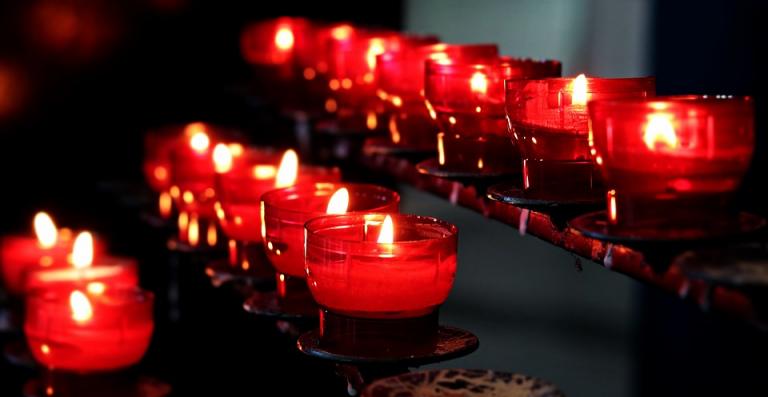
Image credit: pixabay.com
Anytime we lose someone dear to us, it feels like someone plunged their hand into your chest, ripped a piece of your heart out and ran off with it. Even as time goes by, the void where the fragment of your heart was removed never heals back to its original state. In spite of our loved ones leaving this world for the life hereafter, we never cease to love them. This may be why many cultures emphasize keeping the memory of ancestors and loved ones long after they pass away.
When Christians deal with the passing of their loved ones, there is a general assumption they are off to a better place — that their suffering on earth is no more and they will finally experience the fullness of God’s glory. Some Evangelical Christians go as far as celebrating on the anniversary of a loved one’s passing as the moment they entered Heaven’s gates. To hear that God does not abandon the ones He calls His own is certainly a consoling thought. But sometimes the manner in which a person passes away leaves a more haunting impression.
When it comes to those who have ended their lives at their own hands, people in religious circles are often left at a loss of words. In Evangelical Protestant culture where people generally assume they have assurance of salvation, the very act of suicide suddenly forces others to automatically second-guess their beliefs. In Catholic circles, suicide is often thought to be a mortal sin without consideration for the nuances that would possibly make it venial. In spite of no sin being beyond God’s mercy and forgiveness, it’s seems like many believe that suicide, out of all the sins one could ever commit, warrants disqualification from eternal life.
In December of 2018, I lost two cousins to suicide — one on Christmas Eve, the other on New Years Eve. While I wasn’t close to the one who ended his life on Christmas Eve, the news of his passing was still a shock for me and my family. But just when one tragedy was heavy enough, the news of losing the cousin I grew up knowing felt like being struck on both sides of the face. I don’t recall a more dark and devastating Christmas season in my family’s history as long as I can remember. It was a difficult reality to grasp, especially during a season meant for celebration.
In every Christian funeral I’ve ever attended, I’ve noticed the phrase, “God has a plan!” is tossed around so loosely. I understand the intentions behind the phrase are well-meaning. Though I find the mention of it as graceful as swinging a hammer at a bent nail — like a sloppy attempt at making sense of what had happened. When it comes to losing a friend or family member to suicide, it leaves far more questions to wrestle with and broken fragments to pick up for those of us left behind. Questions such as, ‘How could there be some divine plan when human free will repeatedly goes against it?’ After losing two of my cousins to suicide within a week during the Christmas holidays, it’s difficult not to toy with the thought that God’s plan may be full of shit.
This is one of the reasons why I’ve grown to highly abhor Calvinism. I’m sure many Calvinist Christians have wrestled with reconciling mental health, suicide, perseverance of the saints and God’s sovereignty and somehow made sense of it. But for me, it leaves me to wonder how a God who exercises such sovereignty as to predestine a person to eternal damnation (even in the midst of their most desperate hour) and use it as a means to direct all glory to himself. In my mind, either such a narcissistic deity is far too absurd to be real or is a far greater villain than Lucifer himself.
I often wonder if the reason why Calvinism is as popular as it is is due to how people reconcile having their prayers for ‘non-believers’ unanswered. I remember while attending a Christian youth camp as a young adult, a fellow camper shared his testimony at the bonfire and mentioned he knew a guy who died who was currently in Hell. His drawn conclusion was merely based on hearing the guy’s less-than-positive views on God and religion. My initial thoughts were, ‘How does this person know he has the insight to determine that person’s final destination? What if said person had been wounded deeply by religious friends or family and simply was speaking from a place of internal pain?’
If a person has a difficult time believing in the existence of God due to a lack of physical evidence, understanding or a painful history with religion, I don’t believe their non-belief (or lack thereof) is necessarily out of willful rejection. In high school, I recall an atheist friend of mine who was confronted by a Christian friend who asked if he believed in Heaven — to which his response was, ‘I want to.’
Even though I have faith in Jesus and a hope of salvation after I die, I feel it would be arrogant of me to assume that I’m heading straight for Paradise in spite of everything I have done. If only God alone knows our hearts and our pain, isn’t concluding that a deceased person is in a specific realm of the afterlife a way of assuming God’s judgement? What if a person claimed to be faithful during their earthly life, yet used religion as a facade to cover up what was really going on inside (Matthew 15:8-9)?
As much as I like to imagine my deceased loved ones in a better place, I hesitate to entertain the thought of even those I would hold in contempt to be in a state of eternal torment. Even the Apostle Paul once said,
“For I could wish that I myself were accursed and cut off from Christ for the sake of my brethren, my kinsmen by race.” — Romans 9:3 RSV
This is where I’ve come to appreciate how Catholics differ from Protestants in belief of what happens in the afterlife. The Bible mentions that everyone is destined to die once and then face judgment (Hebrews 9:27). At first glance, some would draw the conclusion that ‘facing judgment’ means either going straight to Heaven or Hell. But according to Catholic theology, Purgatory is the threshold which souls already saved by God’s grace cross to enter Paradise. It’s a spiritual state where a soul is not deemed clean enough for Paradise, but not condemned to Hell either (CCC 1030). When one considers those who were born in far corners of the Earth while having little or no exposure to Christianity, it makes sense that God wouldn’t condemn people over invincible ignorance (Romans 2).
Though unless people understand the concept of Purgatory as a means of God’s grace rather than a place to earn salvation, praying for the dead makes absolutely no sense to those who take the Bible quite literally. And unfortunately, there are no shortage of anti-Catholic polemicists who attempt to shut down even the mere mention of it.
Prayer for the dead is rooted in the Catholic understanding of how members of the Body of Christ are in communion with one another, even after death. Even though we are separated from our earthly bodies after death, we continue existing in a metaphysical form. Christians who have died do not cease to be members of the Body of Christ. Catholics believe they can be assisted through our prayers, and they can reciprocate by praying for us as well.
The earliest evidence of prayer for the dead can be found in the Second Book of Maccabees (found in the Jewish Septuagint and included in the Catholic Old Testament). In the aftermath of a battle against the Seleucid Empire, Judah Maccabee finds suspicious-looking amulets on the bodies of his fellow comrades who had died. As it turned out, these men had taken these amulets while ransacking a pagan temple. Because these men had violated the laws of Deuteronomy, Maccabee and his army ‘turned to prayer, beseeching that the sin which had been committed might be wholly blotted out (2 Macc. 12:39-46).’ This passage is also considered in the idea that penance can be performed for the dead as well (CCC 1032).
“It is therefore a holy and wholesome thought to pray for the dead, that they may be loosed from sins.”
— 2 Maccabees 12:46
The first and second books of Maccabees, along with 5 other books, were eventually removed from the Protestant Bible canon in the wake of the Reformation. I think the practice of prayer for the dead definitely invokes some historical animosity of how people within the Church capitalized on people’s deaths through the selling of indulgences — an abuse that never should have become as rampant as it was. Even in modern times, funerals, caskets, cremations and monuments are outrageously expensive and may discourage Christians from considering a dignified burial for their loved ones. I think that alone is reason enough why many Evangelicals misinterpret Jesus’ words when he told his disciple to, “Let the dead bury the dead (Matthew 8:19-22).”
When a loved one dies, an Orthodox Jew performs a ritual known as the Mourner’s Kaddish. It is recited for eleven months after someone passes away for the purpose of offering praise to God in spite of loss. In addition to the Mourner’s Kaddish, a prayer called El Malei Rachamim is recited for the souls of the dead, usually during a burial ceremony or at the grave site. Similarly, a Catholic Mass is usually held with specific intentions — oftentimes for the purpose of praying for a deceased person.
Some fundamentalists would argue that prayer for the dead cheapens the sacrifice of Christ because it implies that His death and resurrection was insufficient in its saving power. On the contrary, prayer for the dead draws its power from it (Jeremiah 29:12-13, Psalm 145:18-19, Matthew 7:7-11, Hebrews 7:15-19). An omnipotent and omnipresent God would be outside the realm of time and space. Granted this, the Sacrifice of the Mass is believed to transcend both time and space as the moment of when Jesus was crucified at Calvary once for all is made present (John 6, 1 Corinthians 10:16, Hebrews 10:10) — not a re-crucifixion as the anti-Catholic fundamentalists claim it to be. It is a moment when the Church Militant (those who continue living on Earth) are united in prayer with the Church Suffering (souls in Purgatory) and the Church Triumphant (the souls in Paradise). This is what the Catholic Church refers to as the Communion of Saints as referred to in the latter part of the Apostles Creed.
In light of a seemingly increasing epidemic of mental health in North America, it pains me to hear there are still Christians who believe anxiety and depression are the direct result of an absence of a relationship with God. When I think of anyone who had lost their lives through succumbing to anxiety and depression, I can’t help but wonder how a God of love and mercy could abandon them in an eternal abyss due to a feeling of hopelessness beyond their control.
While praying for the dead may seem like a most inane practice from a Protestant’s perspective, it is certainly not one that is explicitly forbidden in the Bible. In fact, I would argue that the act of praying for the dead in itself is what expresses a God-given design for humans to be in relationship with one another. And what better way to give glory to God than to express that unconditional, sacrificial love than to offer it through prayer?
“Of course I pray for the dead. The action is so spontaneous, so all but inevitable, that only the most compulsive theological case against it would deter me. And I hardly know how the rest of my prayers would survive if those for the dead were forbidden. At our age, the majority of those we love best are dead. What sort of intercourse with God could I have if what I love best were unmentionable to him?”
— C.S. Lewis, Letters to Malcolm: Chiefly on Prayer
Previous Post
October 29, 2019
A Cautionary Tale For Kanye West
Next Post
November 7, 2019 Four Types Of Catholics You Will Find In North America
Browse Our Archives
Select a Category Catholicism Christian Life Christian Life Church History Community Eastern Orthodoxy Entertainment Fiction History Mental Health Movies Music Politics Protestantism Reflection Religion Satire Science Fiction Self esteem Self Love Spirituality Star Wars Suicide Theology Uncategorized
Select a Month June 2023 April 2023 May 2022 April 2022 July 2021 April 2021 March 2021 February 2021 January 2021 December 2020 November 2020 October 2020 September 2020 August 2020 July 2020 June 2020 May 2020 April 2020 March 2020 February 2020 January 2020 December 2019 November 2019 October 2019 September 2019 August 2019 July 2019 June 2019 May 2019 April 2019 March 2019 February 2019 January 2019 December 2018 October 2018 September 2018 August 2018 June 2018 April 2018 January 2018 November 2017 October 2017 July 2017 June 2017 May 2017 April 2017 March 2017 February 2017 December 2016 October 2016 September 2016 August 2016 June 2016 May 2016 March 2016 February 2016
Follow Us!
TAKE THE
Religious Wisdom Quiz
What did Satan claim was the reason for Job’s faithfulness?
Select your answer to see how you score.
That God had blessed him with wealth and protection That Job was a prophet That Job had personally seen God That Job was unaware of suffering
Related posts from Coffee and Crucifix

Martin Scorsese Meets With Pope To Discuss Film...

FAIL! Catholic says, 'And also with you!" instead...

Don't Lose Your Soul In The Culture War

10 Essential Books Every Catholic Should Own
TRENDING AT PATHEOS Catholic

Rejecting Doom: Christian Hope And Human Action
Christianity is a religion of hope. We are to have hope and...

It’s What Comes From Within Which Matters
One of the most difficult things for us to understand is why...

Why I Choose the Eucharist Over the Sermon
Choose the Eucharist, Not the Sermon What are we supposed to get...

5 Design Elements Found in Spiritually Rooted Homes
Putting Spirituality Into Home Decor Our homes are more than our living...

Credo: A Story of God Told with the...
About 10 years ago, I began to imagine a personal "Credo" that...

The Anatomy of Divine Revelation in Catholic Thought
The claim that God has made Himself known to human beings is...
view all Catholic blogs
Ad-Free & Subscriber Log-In Subscription Support
- About Us
- 2026 Calendar
- Videos
- Podcasts
- Library of World Religions
- Faith In Media Tracker
- Advertise With Us
- Write for Us
- Privacy Policy
- Terms of Service
- Do Not Sell My Data
- Contact Us
- Radiant Digital
- Manage Newsletter Subscriptions
- Unsubscribe From Notifications
- Sitemap
Copyright 2008-2026, Patheos. All rights reserved.
Subscription Support Ad-Free & Subscriber Log-In
Follow Patheos