
BuddhistCatholicContemplativeEvangelicalGeneral ChristianHinduJewishLatter-day SaintMuslimNew VisionsProgressive Christian
Beliefs
- Buddhist
- Catholic
- Contemplative
- Evangelical
- General Christian
- Hindu
- Jewish
- Latter-day Saint
- More Voices
- Muslim
- New Visions
- Pagan
- Progressive Christian
Topics
- Religion News
- Food and Religion
- Sports and Religion
- Religious Art
- Religious Music and Entertainment
- Religious Events
- History and Religion
- Style and Religion
- Politics and Religion
- Women in Religion
- Recreation Outdoors and Religion
- Business Finance and Religion
- Careers Workplace and Religion
- Education and Religion
- Family Parenting and Religion
- Health Fitness and Religion
- Home and Religion
- Relationships and Religion
- Technology and Religion
- Travel and Religion
Columnists
- Buddhist Columnists
- Business Finance and Religion Columnists
- Careers Workplace and Religion Columnists
- Catholic Columnists
- Contemplative Columnists
- Education and Religion Columnists
- Evangelists Columnists
- Family Parenting and Religion Columnists
- General Christian Columnists
- Health Fitness and Religion Columnists
- Hindu Columnists
- History and Religion Columnists
- Home and Religion Columnists
- Jewish Columnists
- More Voices Columnists
- Latter Day Columnists
- Muslim Columnists
- New Visions Columnists
- Nonreligious Columnists
- Pagan Columnists
- Politics and Religion Columnists
- Progressive Columnists
- Recreation Outdoors and Religion Columnists
- Relationships and Religion Columnists
- Religion News Columnists
- Religious Art Columnists
- Religious Events Columnists
- Religious Music and Entertainment Columnists
- Sports and Religion Columnists
- Style and Religion Columnists
- Technology and Religion Columnists
- Travel and Religion Columnists
- Women in Religion Columnists
Resource Library
- 2026 Calendar
- Library of World Religions
- The 100 Most Holy Places on Earth
- Patheos Answers
- Podcasts
- Videos
- Faith Leaders Database
- Anglican Episcopalian
- Bahai
- Baptist
- Buddhism
- Christianity
- Confucianism
- Eastern Orthodoxy
- Hinduism
- Holiness and Pentecostal
- ISKCON
- Islam
- Judaism
- Lutheran
- Methodist
- The Church of Jesus Christ of Latter-day Saints
- New Age
- Paganism
- Presbytarian and Reformed
- Protestantism
- Religion Behind the Scenes
- Roman Catholic
- Scientology
- Shia Islam
- Sikhism
- Sufism
- Sunni Islam
- Taoism
- Zen
- See all religions
Research Tools
 Ad-Free & Subscriber Log-In Subscription Support
Ad-Free & Subscriber Log-In Subscription Support
Follow Patheos 

- Trending:
- Forgiveness
- |
- Marriage
- |
- Consciousness
- |
- Death Penalty
- |
- Election
- |
- Halloween
 Coffee and Crucifix
- Home
- Catholic
- In Defense of Mary’s Perpetual Virginity
In Defense of Mary’s Perpetual Virginity
Last updated on: October 5, 2019 at 1:28 pm by Coffee & Crucifix
In Defense of Mary’s Perpetual Virginity 2019-10-05T13:28:04-06:00 Coffee & Crucifix
Patheos Explore the world's faith through different perspectives on religion and spirituality! Patheos has the views of the prevalent religions and spiritualities of the world.
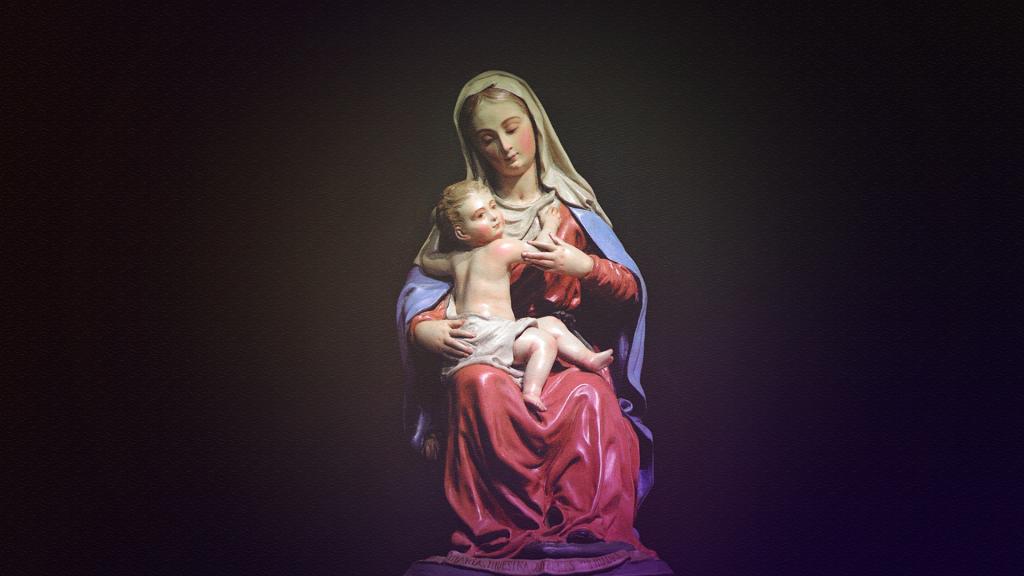
Image credit: pexels.com
In the current secular culture, the idea of prolonged virginity is often scoffed at. I can recall how some of my peers in high school often bragged about ‘getting some’ while poking fun at the less-popular classmates that they’d “probably remain virgins for the rest of their lives.” This bully-mentality has definitely lingered into adulthood for many individuals. Even popular Hollywood films contribute to the stigma by producing caricatures of those who never had a successful relationship let alone slept with anybody, such as ‘The 40-Year-Old Virgin.’ Given how our culture is so immersed in sexual obsession, I think knowing anybody over the age of 30 who hasn’t had at least one sexual partner is almost a rarity. But for a devout Christian to tell their non-religious peers that they’re waiting until marriage to have sex, they put themselves at risk of possibly being ridiculed. This doesn’t mean all non-religious individuals would ever do such a thing, though it seems society generally implies the worth of individuals based on their sexual experiences.
But let’s be honest here…. Christian sexual ethics are indeed bizarre in the eyes of the world. I mean, who would want to wait until marriage to have sex? Even though sexual issues are becoming more openly discussed in the wake of the #MeToo movement, prolonged virginity is still viewed as seemingly repulsive or laughable. I think this is one of the reasons why the notion that Jesus, the Son of God, being born of a virgin and remaining celibate seems to be one of the most outrageous ideas out there. Why would the God who supposedly created sex not want to have sex himself?
For Christians, Jesus’ celibacy isn’t hard to accept because the relationship between Him and His ‘bride’ (the Church) is not sexual in nature. In the case of the virgin birth of Christ, the manner in which Christ enters the world is nothing short of a miracle. There is absolutely no way a human being could be born asexually without something extraordinary happening. It defies all rationality. This is one of the things that makes the person of Jesus Christ so significant — because if the virgin birth was true, then Christ is truly of divine origin.
In the case of Mary and Joseph, having sex would have diminished any credibility towards Jesus being born by supernatural means. Hence why many atheists would joke that the virgin birth is the largest cover-up of an unplanned pregnancy in the history of the world. The whole point of the virgin birth is that Jesus was not the outcome of natural relations between a husband and wife, but rather akin to how God formed life out of the dust of the ground in the beginning of Creation (Genesis 2:7).
But as far as Mary is concerned, many believe she remained a virgin only up until the point of Jesus’ birth. This is interpreted directly from the first chapter of the Gospel of Matthew,
All this took place to fulfill what the Lord had spoken by the prophet:
“Behold, a virgin shall conceive and bear a son,
and his name shall be called Emman′u-el”
(which means, God with us). When Joseph woke from sleep, he did as the angel of the Lord commanded him; he took his wife, but knew her not until she had borne a son; and he called his name Jesus.”
— Matthew 1:22-25 RSV
It is generally assumed by Protestants that Joseph eventually consummated his marriage with Mary after the birth of Jesus, hence the phrasing ‘knew her not until she had borne a son.’ This requires a careful glance at the wording of this passage. For example, when we say we will love someone until the day they die, people generally don’t stop loving their loved one even after they pass away. If anything, that love becomes ever more painful in the midst of longing to see that person again. In light of this, most people would consider it safe to assume that Joseph and Mary eventually had sex. But how do we know that for sure?
For a man like Joseph, hearing that your spouse is carrying a child that is not your own (let alone coming from a divine being far greater than yourself) is a lot to take in. I imagine he must have had over a thousand questions spiralling through his head. Most married couples are not discouraged from having sexual intercourse during pregnancy. But if I was in Joseph’s position and realized my wife had been carrying God Himself in the womb, I would probably be paranoid of getting struck by lightning for even considering to have sexual intimacy with her post-partum.
In the Old Testament, the Ark of the Covenant was the embodiment of God’s presence among the Israelites (2 Sam 6:2, Lev 16:2, Ex 25:22). If someone approached the ark, they would die as a result of their sins for standing before a holy God who does not tolerate even the mildest evil (Ps 5:4-6). Hence why Uzzah was struck dead upon touching the ark in an irreverent manner:
“And David arose and went with all the people who were with him from Ba′ale-judah, to bring up from there the ark of God, which is called by the name of the Lord of hosts who sits enthroned on the cherubim. 3 And they carried the ark of God upon a new cart, and brought it out of the house of Abin′adab which was on the hill; and Uzzah and Ahi′o, the sons of Abin′adab, were driving the new cart 4 with the ark of God; and Ahi′o went before the ark. 5 And David and all the house of Israel were making merry before the Lord with all their might, with songs and lyres and harps and tambourines and castanets and cymbals.
6 And when they came to the threshing floor of Nacon, Uzzah put out his hand to the ark of God and took hold of it, for the oxen stumbled. 7 And the anger of the Lord was kindled against Uzzah; and God smote him there because he put forth his hand to the ark; and he died there beside the ark of God.”
— 2 Samuel 6:2-7 RSV (also see 1 Chronicles 13:7-10)
For this reason, God had established many rules for the Israelites regarding the Ark of the Covenant. It was to be set apart and kept in the temple, hidden from view by a curtain (Ex 26:33). Only the high priests were allowed to enter the Holy of Holies after undergoing ceremonial cleansing. The priest made sacrifices to atone for his own sins and the sins of the people, and then burned incense to conceal the atonement cover (Lev 16). These laws affirmed and enforced the concept of God’s holiness, and not even the high priest could stand in His presence due to the nature of sin.
There is an ancient text called the Protoevangelium of James which narrates that Mary was consecrated as a Jewish temple virgin. It was written around 120 A.D., approximately sixty years after Mary’s earthly life when vivid memories of her life were still alive with those who knew her personally. It is said that Mary’s mother Anne dedicated her to serve the Lord in a similar manner Old Testament prophets like Samuel were dedicated by their parents to serve at the temple. The elderly prophetess Anna was also believed to be a consecrated temple virgin similar to those described in the Mishnah, another ancient Jewish text. With this in mind, it makes sense how Mary would have been ‘set apart’ to eventually become the Theotokos (which, in Greek means ‘God-bearer’).
Because Jesus as the Son of God is known as the New and Everlasting Covenant, the Catholic Church teaches Mary is the Ark of the New Covenant. It is often said, if the very ground Jesus walked on was holy, imagine how holy was the womb that bore Him! Although sexual intimacy in itself is not a bad thing (after all, God created it), it is believed that Joseph refrained from having sexual relations with Mary while they were married because it would have been an offence akin to how Uzzah touched the Old Ark. This is what makes the notion that Mary had other children almost unimaginable for Catholics, especially considering there could be people alive today who share DNA with Jesus as God incarnate.
In an ancient culture that did not take kindly to women who were impregnated by someone other than their spouse, Mary would have been in mortal danger. Considering this, Mary would have needed an earthly guardian or protector, which is why being married to a man like Joseph would have been appropriately beneficial. Joseph was also a descendant of King David, and as David himself said, “I will not present burnt offerings that have cost me nothing!” (1 Chr 21:24). Hence why it’s only fitting that a descendant of King David would offer up something costly, such as his own sexuality.
Interestingly, the Early Protestant Reformers like Martin Luther, John Calvin and Ulrich Zwingli also affirmed Mary’s perpetual virginity — though that belief is lost on the overwhelming majority of non-Catholic Christians nowadays. Because the Protoevangelium of James is not part of the Bible canon, Protestants generally resort to a ‘Scripture-only’ approach to affirm whether Mary remained a virgin or not.
One of the most commonly cited passages in the Bible used to critique Mary’s perpetual virginity is as follows:
While he was still speaking to the crowds, his mother and his brothers were standing outside, wanting to speak to him. Someone told him, ‘Look, your mother and your brothers are standing outside, wanting to speak to you.’ But to the one who had told him this, Jesus replied, ‘Who is my mother, and who are my brothers?’ And pointing to his disciples, he said, ‘Here are my mother and my brothers!’
— Matthew 12:46-49 RSV
At first glance, it almost sounds as though Jesus is denying his own mother, yet simultaneously affirming that he somehow had brothers of his own. It’s a hilarious double-think that many anti-Catholics seem to harbor — they have no problem denying that Jesus had a mother, but will still insist that he had earthly brothers. Yet at the end of the passage He says in verse 50,
‘For whoever does the will of my Father in heaven is my brother and sister and mother.’
If we consider how faithful, receptive and obedient Mary was throughout Scripture, this verse ought to prove that Mary had passed Jesus’ litmus test for the title of ‘mother’ with flying colors.
However, this still leaves us to wonder about Jesus’ brethren, which also seems to be a point of contentious debate due to passages like this:
“Is not this the carpenter’s son? Is not his mother called Mary? And are not his brothers James and Joseph and Simon and Judas? And are not all his sisters with us? Where then did this man get all this?”
— Matthew 13:55-56 RSV
The Greek word for ‘brothers’ is adelphos which, in ancient Jewish culture, not only refers to being born of the same womb, but step-brothers and cousins as well. In the Old Testament, Lot is called the ‘brother’ of Abraham even though he was clearly his nephew (Genesis 14:14). Considering that Joseph was an elderly widow when he took up Mary as his wife, it is highly possible that he might have had other children through a previous marriage. It is also worth noting that in the entire passage where Mary and Joseph lose the twelve-year-old Jesus only to find him at the temple, there is no mention of Jesus having any siblings present. It could also be argued that Jesus’ siblings might not have been born yet, or were left at home in Nazareth. But considering that there is little mention of Joseph after the temple-incident, it is generally accepted that Joseph had died sometime between them and Jesus’ years of ministry.
According to a binding social custom in Jewish tradition, a sibling would be responsible for taking in their widowed mother. If Jesus had brothers or sisters, why wasn’t James (the supposed brother of Jesus) at the foot of the cross with Mary when He said, “Woman behold thy son, son behold thy mother (John 19:26-27)?” And interestingly, John’s mother WAS there (Mark 15:40), which implies that Mary was a mother to John in a unique and deeply spiritual sense.
While this isn’t the most watertight defense, it can be concluded that Mary’s post-partum perpetual virginity may not be necessary, but it’s fitting. It works in harmony with the parallels between the Old Testament narrative of God’s holy presence in the Ark and in the womb through which God incarnate would make his entrance into the world.
The purpose of Mary’s perpetual virginity certainly adds value to the meaning of the gift of sexuality, but does not define the value of Mary as a person. I can easily picture how Catholics would draw from this theological imagery to turn virginity into some kind of fetish that either makes or breaks a person’s ability to find a spouse. Even if she did not remain a virgin after Christ was born, there is no reason for Mary to have other children other than to live her identity as mother to the Savior of the world.
Many non-Catholic Christians would say it doesn’t matter whether Mary was a perpetual virgin and didn’t have more children after Jesus — to which I would argue it isn’t necessary that Mary had other children either. While I understand the intention behind their arguments is to focus more on Jesus, by minimizing Mary’s significance they are actually minimizing Jesus without realizing it. It’s like the ear saying to the eye that it is not needed (1 Corinthians 12:16).
Everything to do with Mary has to do with who Jesus really is. If anything, Mary’s perpetual virginity refutes the worldly notion that a person’s inherent worth is based on their sexual experiences. And if her purpose is to be the Ark of the New Covenant, then that is who God designed her to be.
For, if she had other children, the Savior would not have ignored them and entrusted His mother to someone else; nor would she have become someone else’s mother. She would not have abandoned her own to live with others, knowing well that it ill becomes a woman to abandon her husband or her children.”
— St. Athanasius of Alexandria
Sources:
https://www.rationalchristianity.net/touch_ark.html
https://www.catholic.com/tract/mary-ever-virgin
http://www.newadvent.org/fathers/0847.htm
Did Jewish Temple Virgins Exist and was Mary a Temple Virgin?
Previous Post
September 29, 2019
What's Wrong With Priestly Celibacy?
Next Post

October 8, 2019 Who Is 'SUSAN FROM THE PARISH COUNCIL?'
Browse Our Archives
Select a Category Catholicism Christian Life Christian Life Church History Community Eastern Orthodoxy Entertainment Fiction History Mental Health Movies Music Politics Protestantism Reflection Religion Satire Science Fiction Self esteem Self Love Spirituality Star Wars Suicide Theology Uncategorized
Select a Month June 2023 April 2023 May 2022 April 2022 July 2021 April 2021 March 2021 February 2021 January 2021 December 2020 November 2020 October 2020 September 2020 August 2020 July 2020 June 2020 May 2020 April 2020 March 2020 February 2020 January 2020 December 2019 November 2019 October 2019 September 2019 August 2019 July 2019 June 2019 May 2019 April 2019 March 2019 February 2019 January 2019 December 2018 October 2018 September 2018 August 2018 June 2018 April 2018 January 2018 November 2017 October 2017 July 2017 June 2017 May 2017 April 2017 March 2017 February 2017 December 2016 October 2016 September 2016 August 2016 June 2016 May 2016 March 2016 February 2016
Follow Us!
TAKE THE
Religious Wisdom Quiz
True or False: The Gospel of John records seven miracles (signs) of Jesus.
Select your answer to see how you score.
TRUE FALSE
Related posts from Coffee and Crucifix

Martin Scorsese Meets With Pope To Discuss Film...

FAIL! Catholic says, 'And also with you!" instead...

Don't Lose Your Soul In The Culture War

10 Essential Books Every Catholic Should Own
TRENDING AT PATHEOS Catholic

The Parable Of The Sower And The Word...
One of Christ’s most famous parables is that of the sower who...

Rejecting Doom: Christian Hope And Human Action
Christianity is a religion of hope. We are to have hope and...

Why I Choose the Eucharist Over the Sermon
Choose the Eucharist, Not the Sermon What are we supposed to get...

5 Design Elements Found in Spiritually Rooted Homes
Putting Spirituality Into Home Decor Our homes are more than our living...

Credo: A Story of God Told with the...
About 10 years ago, I began to imagine a personal "Credo" that...

The Anatomy of Divine Revelation in Catholic Thought
The claim that God has made Himself known to human beings is...
view all Catholic blogs
Ad-Free & Subscriber Log-In Subscription Support
- About Us
- 2026 Calendar
- Videos
- Podcasts
- Library of World Religions
- Faith In Media Tracker
- Advertise With Us
- Write for Us
- Privacy Policy
- Terms of Service
- Do Not Sell My Data
- Contact Us
- Radiant Digital
- Manage Newsletter Subscriptions
- Unsubscribe From Notifications
- Sitemap
Copyright 2008-2026, Patheos. All rights reserved.
Subscription Support Ad-Free & Subscriber Log-In
Follow Patheos