
BuddhistCatholicContemplativeEvangelicalGeneral ChristianHinduJewishLatter-day SaintMuslimNew VisionsProgressive Christian
Beliefs
- Buddhist
- Catholic
- Contemplative
- Evangelical
- General Christian
- Hindu
- Jewish
- Latter-day Saint
- More Voices
- Muslim
- New Visions
- Pagan
- Progressive Christian
Topics
- Religion News
- Food and Religion
- Sports and Religion
- Religious Art
- Religious Music and Entertainment
- Religious Events
- History and Religion
- Style and Religion
- Politics and Religion
- Women in Religion
- Recreation Outdoors and Religion
- Business Finance and Religion
- Careers Workplace and Religion
- Education and Religion
- Family Parenting and Religion
- Health Fitness and Religion
- Home and Religion
- Relationships and Religion
- Technology and Religion
- Travel and Religion
Columnists
- Buddhist Columnists
- Business Finance and Religion Columnists
- Careers Workplace and Religion Columnists
- Catholic Columnists
- Contemplative Columnists
- Education and Religion Columnists
- Evangelists Columnists
- Family Parenting and Religion Columnists
- General Christian Columnists
- Health Fitness and Religion Columnists
- Hindu Columnists
- History and Religion Columnists
- Home and Religion Columnists
- Jewish Columnists
- More Voices Columnists
- Latter Day Columnists
- Muslim Columnists
- New Visions Columnists
- Nonreligious Columnists
- Pagan Columnists
- Politics and Religion Columnists
- Progressive Columnists
- Recreation Outdoors and Religion Columnists
- Relationships and Religion Columnists
- Religion News Columnists
- Religious Art Columnists
- Religious Events Columnists
- Religious Music and Entertainment Columnists
- Sports and Religion Columnists
- Style and Religion Columnists
- Technology and Religion Columnists
- Travel and Religion Columnists
- Women in Religion Columnists
Resource Library
- 2026 Calendar
- Library of World Religions
- The 100 Most Holy Places on Earth
- Patheos Answers
- Podcasts
- Videos
- Faith Leaders Database
- Anglican Episcopalian
- Bahai
- Baptist
- Buddhism
- Christianity
- Confucianism
- Eastern Orthodoxy
- Hinduism
- Holiness and Pentecostal
- ISKCON
- Islam
- Judaism
- Lutheran
- Methodist
- The Church of Jesus Christ of Latter-day Saints
- New Age
- Paganism
- Presbytarian and Reformed
- Protestantism
- Religion Behind the Scenes
- Roman Catholic
- Scientology
- Shia Islam
- Sikhism
- Sufism
- Sunni Islam
- Taoism
- Zen
- See all religions
Research Tools
 Ad-Free & Subscriber Log-In Subscription Support
Ad-Free & Subscriber Log-In Subscription Support
Follow Patheos 

- Trending:
- Forgiveness
- |
- Marriage
- |
- Consciousness
- |
- Death Penalty
- |
- Election
- |
- Halloween
 Coffee and Crucifix
- Home
- Catholic
- In Defense of Mary: Mediatrix & Queen of Heaven?
In Defense of Mary: Mediatrix & Queen of Heaven?
Last updated on: June 20, 2019 at 10:54 am by Coffee & Crucifix
In Defense of Mary: Mediatrix & Queen of Heaven? 2019-06-20T10:54:25-06:00 Coffee & Crucifix
Patheos Explore the world's faith through different perspectives on religion and spirituality! Patheos has the views of the prevalent religions and spiritualities of the world.
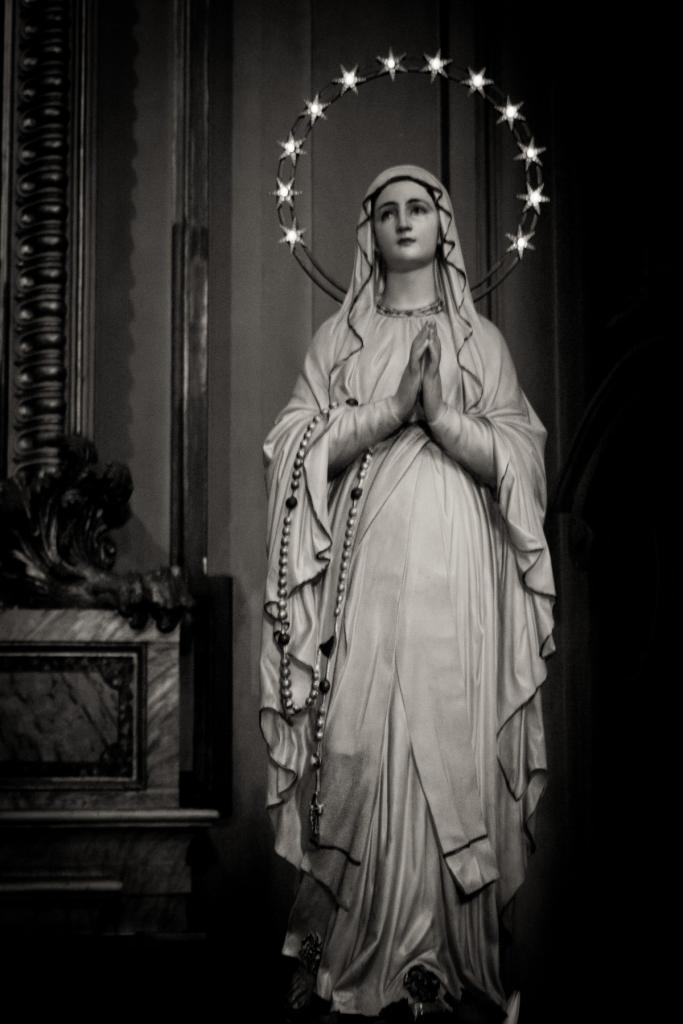
Image credit: pxhere.com
I remember receiving a set of anti-Catholic tracts from someone I met at an Evangelical Bible camp when I was 17 years old. They were intended to paint Catholic doctrine in a light that seemingly contrasted the Bible. Among the many doctrines it attempted to refute were regarding how the Catholic Church portrays Mary, such as her role as Mediatrix and Queen of Heaven.
The tracts referred to an ancient Babylonian king named Nimrod and his mother the queen named Semiramis. It is believed Nimrod had an incestuous relationship with Semiramis and their legacy had influenced other religions that reflected an imagery of a goddess mother with a divine son. This is one of the reasons why some people claim that ancient deities are often recycled through the ages. Many fundamentalist anti-Catholics believe Semiramis and her son Nimrod were resurrected in pagan religions in the form of the Egyptian goddess Isis and her son Horus as well as the Indian goddess Devaki and her son Krishna, to name a couple. One of the most cited Bible verses in opposition to Mary as Queen of Heaven comes from the Book of Jeremiah,
Do you not see what they are doing in the cities of Judah and in the streets of Jerusalem? The children gather wood, the fathers kindle fire, and the women knead dough, to make cakes for the queen of heaven; and they pour out drink offerings to other gods, to provoke me to anger. 1
Then all the men who knew that their wives had offered incense to other gods, and all the women who stood by, a great assembly, all the people who dwelt in Pathros in the land of Egypt, answered Jeremiah: “As for the word which you have spoken to us in the name of the Lord, we will not listen to you. But we will do everything that we have vowed, burn incense to the queen of heaven and pour out libations to her, as we did, both we and our fathers, our kings and our princes, in the cities of Judah and in the streets of Jerusalem; for then we had plenty of food, and prospered, and saw no evil. But since we left off burning incense to the queen of heaven and pouring out libations to her, we have lacked everything and have been consumed by the sword and by famine.” 2
A Conspiracy Theorist Mentality?
Some Bible-literalists would easily correlate these verses with the Catholic rituals of consecrating the Eucharist (making cakes and pouring out drinks) as well as the burning of incense during Mass. Interestingly enough, much of this rhetoric was popularized by a 19th-century pamphlet called ’The Two Babylons,’ published by Presbyterian theologian Alexander Hislop. The book’s arguments about Catholicism being a continuation of pagan worship of Semiramis and Nimrod have been unanimously rejected by modern scholars as having a misunderstood knowledge of ancient Babylonian religion. 3
About four years after I left Catholicism to pursue Evangelicalism, the documentary film series Zeitgeist was released. The first part claimed Christ Himself was a recycled deity whose attributes were borrowed from other pagan religions for the purpose of political opportunism. They even went as far as to claim gods like Horus were born on December 25th and died for people’s sins — which is odd, considering these ancient religions never used the Roman calendar. 4 I found it interesting how Zeitgeist used eerily similar tactics to discredit the existence of Christ as how the Bible tracts attempted to discredit the Catholic view of the Virgin Mary. Despite their contrasting religious beliefs, fundamentalists and atheistic conspiracy theorists seem to share an equally passionate hatred for the Church of Rome.
Truly, nothing is new under the sun. 5 And there is no limit to how far people (even so-called Christians) will twist the narrative to suit an agenda. 6
In a conspiracy theorist mindset, it’s easy to assume there are direct connections between cultural and historical parallels where there aren’t any at all. 7 I imagine this could be why many orthodox Jews would dismiss the notion of Christ being the fulfillment of the Jewish covenant. I’m sure many attributes that Christians refer Christ to (such as Lamb of God in relation to the sacrificial Passover lamb) would sound absolutely absurd to them; and I can easily understand how Mary being somehow ‘Queen of Heaven’ and a special ‘mediator’ would sound equally absurd to a Christian who subscribes to a ‘Bible alone’ mentality.
Queenship in the Old Testament
Many Protestants would claim it appears as though Catholics elevate Mary to the same level or above Jesus. After all, the Bible teaches there is only one mediator between God and mankind 8 and Jesus is the only way to God the Father. 9 Because the Bible is the primary means upon which our understanding of Jesus comes from, sometimes groups will try to view it through a lens that suits their narrative. I used to believe the rhetoric the anti-Catholic tracts shared about the Virgin Mary being a recycled version of Semiramis. But little did I realize that there’s more to the Catholic view on Mary than what we see at first glance.
When it comes to the case for Christ’s legitimacy as the Son of God, Christians often look at the parallels between the Old and New Testaments. While the queenship and intercessory role of Mary is not explicitly mentioned in Scripture, there are passages that implicitly allude to them. One of the closest glimpses of Mary’s queenship in the Bible reads as follows,
“And a great portent appeared in heaven, a woman clothed with the sun, with the moon under her feet, and on her head a crown of twelve stars; she was with child and she cried out in her pangs of birth, in anguish for delivery.” 10
Jesus is referred to the Son of David in the New Testament since he is a descendant of King David. 11 At the right hand of each Davidic king would sit his mother, who is the queen. 12 Every new king of Israel introduced in both 1st and 2nd Kings would also have their mother listed. 13 The queen mother would intercede as a trusted advisor on behalf of the Israelite people with the king. An example in Scripture of a Jewish queen mother interceding to the king would be between Bathsheba and her son King Solomon,
So Bathshe′ba went to King Solomon, to speak to him on behalf of Adoni′jah. And the king rose to meet her, and bowed down to her; then he sat on his throne, and had a seat brought for the king’s mother; and she sat on his right.
Then she said, “I have one small request to make of you; do not refuse me.”
And the king said to her, “Make your request, my mother; for I will not refuse you.”
She said, “Let Ab′ishag the Shu′nammite be given to Adoni′hah your brother as his wife.” 14
In the New Testament, we first see Mary intercede for the people to Jesus at the Wedding at Cana.
On the third day there was a marriage at Cana in Galilee, and the mother of Jesus was there; Jesus also was invited to the marriage, with his disciples.
When the wine failed, the mother of Jesus said to him, “They have no wine.”
And Jesus said to her, “O woman, what have you to do with me? My hour has not yet come.”
His mother said to the servants, “Do whatever he tells you.” 15
In this passage, Mary interceded for the wedding guests to Jesus in a similar way Bathsheba approached King Solomon on Adonijah’s behalf.
Who Is My Mother?
I’ve heard opponents of Catholic theology cite this same passage, claiming that if Mary truly was elevated to such a position as Mother of God and Queen of Heaven, Jesus would not have called her ‘woman.’ In a modern English lens, it reads as though Jesus was rebuking Mary quite harshly. Because the Bible refers to Jesus as the Son of Man 16 and the New Adam, 17 the Early Church Fathers referred to Mary as the New Eve. 18 This is what the Catholic Church refers to as the woman whose offspring shall crush the serpent’s head. 19
Some Protestants would even point out the passage of Scripture when Jesus supposedly denied Mary as his own mother,
While he was still speaking to the people, behold, his mother and his brethren stood outside, asking to speak to him. But he replied to the man who told him, “Who is my mother, and who are my brethren?” And stretching out his hand toward his disciples, he said, “Here are my mother and my brethren! For whoever does the will of my Father in heaven is my brother, and sister, and mother.” 20
When looking at this passage carefully while considering other parts of the Bible, Jesus is not implying that Mary is not his own mother. If doing the will of God is considered a litmus test for spiritual motherhood, then Mary had already fulfilled it by willfully submitting to God’s plan for the salvation of humanity. 21
While most modern-day Protestants are hesitant to give honour to Mary out of fear of breaking the first of the Ten Commandments, this does not mean they are in the wrong for feeling this way. I would argue that their skepticism and hesitation is proof in itself of their love and devotion to God alone. Likewise, Catholics are not bound to strictly approach Mary with intercessory prayer and are free to approach Christ directly at any time. But the practice of approaching Mary is no different than asking our living brothers and sisters to pray for us on earth — with the exception that Mary is closer to Jesus than anyone else who ever lived! While the explicit biblical citation of Mary’s role as Mediatrix and Queen may be lacking, Protestants can be assured that the Catholic Church agrees with them regarding Jesus as the sole Mediator to God the Father. As Pope Paul VI wrote,
“There is but one Mediator as we know from the words of the apostle, “for there is one God and one mediator of God and men, the man Christ Jesus, who gave himself a redemption for all”. (1 Tim. 2:5-6) The maternal duty of Mary toward men in no wise obscures or diminishes this unique mediation of Christ, but rather shows His power. For all the salvific influence of the Blessed Virgin on men originates, not from some inner necessity, but from the divine pleasure. It flows forth from the superabundance of the merits of Christ, rests on His mediation, depends entirely on it and draws all its power from it. In no way does it impede, but rather does it foster the immediate union of the faithful with Christ.” 22
Some would say that Mary’s intercession and queenship is not important or needed in the broad scheme of things. To which I would say, can the ear say to the eye they are not needed? 23 If God has commanded us to honour our father and mother, I don’t believe Mary ought to be an exception from the rule. I think how we view the role of Mary influences how we view women in general — including our own wives, sisters and mothers. I doubt any father with a healthy sense of self-confidence would feel threatened by their children showing affection for their mother. If Mary is truly Queen and a special mediator between the Son of God and mankind, it is because it is her God-given role in the Body of Christ — not because of some plot by Satan to fool people into worshiping a recycled pagan deity. But because it is in harmony with the biblical narrative of Davidic royal customs and a work of the parts of the Body of Christ in communion with one another.
“Never be afraid of loving the Blessed Virgin too much. You can never love her more than Jesus did.**”
– St. Maximilian Kolbe
REFERENCES:
1 Jeremiah 7:17-18 RSV
2 Jeremiah 44:15-18 RSV
3 Wikipedia: https://en.wikipedia.org/wiki/The_Two_Babylons
4 Wikipedia: https://en.wikipedia.org/wiki/Zeitgeist_(film_series)#Synopsis
5 Ecclesiastes 1:9
6 Judges 17:6, 21:25; Psalm 101:7; Proverbs 12:17, 14:8, 19:9, 24:28; Jeremiah 9:6, 17:9; Romans 3:13, 16:18; 2 Corinthians 11:13; Ephesians 5:6
7 Isaiah 8:12
8 1 Timothy 2:5
9 John 14:6
10 Revelation 12:1-2 RSV
11 Matthew 21:9, Mark 10:48, Luke 1:32, John 7:42
12 1 Kings 2:19, Jeremiah 13:18
13 1 Kings 14:21, 22:42; 2 Kings 14:2, 15:2, 15:33, 18:2, 21:19, 22:1, 23:31, 23:36, 24:8
14 1 Kings 2:19-21 RSV
15 John 2:1-5 RSV
16 Matthew 20:28
17 1 Corinthians 15:22
18 Irenaeus: Against Heresies, III.22; Justin Martyr: Dialogue With Trypho
19 Genesis 3:15
20 Matthew 12:46-50 RSV
21 Luke 1:38,46-49
22 Lumen Gentium, paragraph 60
23 1 Corinthians 12:21
Previous Post

June 10, 2019
My Critique of Calvinism: PART VII - In Summary
Next Post

June 23, 2019 I Long For Christian Unity
Browse Our Archives
Select a Category Catholicism Christian Life Christian Life Church History Community Eastern Orthodoxy Entertainment Fiction History Mental Health Movies Music Politics Protestantism Reflection Religion Satire Science Fiction Self esteem Self Love Spirituality Star Wars Suicide Theology Uncategorized
Select a Month June 2023 April 2023 May 2022 April 2022 July 2021 April 2021 March 2021 February 2021 January 2021 December 2020 November 2020 October 2020 September 2020 August 2020 July 2020 June 2020 May 2020 April 2020 March 2020 February 2020 January 2020 December 2019 November 2019 October 2019 September 2019 August 2019 July 2019 June 2019 May 2019 April 2019 March 2019 February 2019 January 2019 December 2018 October 2018 September 2018 August 2018 June 2018 April 2018 January 2018 November 2017 October 2017 July 2017 June 2017 May 2017 April 2017 March 2017 February 2017 December 2016 October 2016 September 2016 August 2016 June 2016 May 2016 March 2016 February 2016
Follow Us!
TAKE THE
Religious Wisdom Quiz
What does the Black Horse in Revelations represent?
Select your answer to see how you score.
Death Famine The End Times War
Related posts from Coffee and Crucifix

Martin Scorsese Meets With Pope To Discuss Film...

FAIL! Catholic says, 'And also with you!" instead...

Don't Lose Your Soul In The Culture War

10 Essential Books Every Catholic Should Own
TRENDING AT PATHEOS Catholic

Creation, Preservation, and Teleology in Catholic Theology
As I write this, it is very early Monday morning. Like millions...

The Parable Of The Sower And The Word...
One of Christ’s most famous parables is that of the sower who...

Rejecting Doom: Christian Hope And Human Action
Christianity is a religion of hope. We are to have hope and...

Why I Choose the Eucharist Over the Sermon
Choose the Eucharist, Not the Sermon What are we supposed to get...

5 Design Elements Found in Spiritually Rooted Homes
Putting Spirituality Into Home Decor Our homes are more than our living...

Credo: A Story of God Told with the...
About 10 years ago, I began to imagine a personal "Credo" that...
view all Catholic blogs
Ad-Free & Subscriber Log-In Subscription Support
- About Us
- 2026 Calendar
- Videos
- Podcasts
- Library of World Religions
- Faith In Media Tracker
- Advertise With Us
- Write for Us
- Privacy Policy
- Terms of Service
- Do Not Sell My Data
- Contact Us
- Radiant Digital
- Manage Newsletter Subscriptions
- Unsubscribe From Notifications
- Sitemap
Copyright 2008-2026, Patheos. All rights reserved.
Subscription Support Ad-Free & Subscriber Log-In
Follow Patheos