
BuddhistCatholicContemplativeEvangelicalGeneral ChristianHinduJewishLatter-day SaintMuslimNew VisionsProgressive Christian
Beliefs
- Buddhist
- Catholic
- Contemplative
- Evangelical
- General Christian
- Hindu
- Jewish
- Latter-day Saint
- More Voices
- Muslim
- New Visions
- Pagan
- Progressive Christian
Topics
- Religion News
- Food and Religion
- Sports and Religion
- Religious Art
- Religious Music and Entertainment
- Religious Events
- History and Religion
- Style and Religion
- Politics and Religion
- Women in Religion
- Recreation Outdoors and Religion
- Business Finance and Religion
- Careers Workplace and Religion
- Education and Religion
- Family Parenting and Religion
- Health Fitness and Religion
- Home and Religion
- Relationships and Religion
- Technology and Religion
- Travel and Religion
Columnists
- Buddhist Columnists
- Business Finance and Religion Columnists
- Careers Workplace and Religion Columnists
- Catholic Columnists
- Contemplative Columnists
- Education and Religion Columnists
- Evangelists Columnists
- Family Parenting and Religion Columnists
- General Christian Columnists
- Health Fitness and Religion Columnists
- Hindu Columnists
- History and Religion Columnists
- Home and Religion Columnists
- Jewish Columnists
- More Voices Columnists
- Latter Day Columnists
- Muslim Columnists
- New Visions Columnists
- Nonreligious Columnists
- Pagan Columnists
- Politics and Religion Columnists
- Progressive Columnists
- Recreation Outdoors and Religion Columnists
- Relationships and Religion Columnists
- Religion News Columnists
- Religious Art Columnists
- Religious Events Columnists
- Religious Music and Entertainment Columnists
- Sports and Religion Columnists
- Style and Religion Columnists
- Technology and Religion Columnists
- Travel and Religion Columnists
- Women in Religion Columnists
Resource Library
- 2026 Calendar
- Library of World Religions
- The 100 Most Holy Places on Earth
- Patheos Answers
- Podcasts
- Videos
- Faith Leaders Database
- Anglican Episcopalian
- Bahai
- Baptist
- Buddhism
- Christianity
- Confucianism
- Eastern Orthodoxy
- Hinduism
- Holiness and Pentecostal
- ISKCON
- Islam
- Judaism
- Lutheran
- Methodist
- The Church of Jesus Christ of Latter-day Saints
- New Age
- Paganism
- Presbytarian and Reformed
- Protestantism
- Religion Behind the Scenes
- Roman Catholic
- Scientology
- Shia Islam
- Sikhism
- Sufism
- Sunni Islam
- Taoism
- Zen
- See all religions
Research Tools
 Ad-Free & Subscriber Log-In Subscription Support
Ad-Free & Subscriber Log-In Subscription Support
Follow Patheos 

- Trending:
- Forgiveness
- |
- Marriage
- |
- Consciousness
- |
- Death Penalty
- |
- Election
- |
- Halloween
 Coffee and Crucifix
- Home
- Catholic
- Does It Matter How We Worship?
Does It Matter How We Worship?
Last updated on: May 28, 2019 at 10:44 pm by Coffee & Crucifix
Does It Matter How We Worship? 2019-05-28T22:44:59-06:00 Coffee & Crucifix
Patheos Explore the world's faith through different perspectives on religion and spirituality! Patheos has the views of the prevalent religions and spiritualities of the world.
As a teenager who had been raised Catholic, what first drew me to Evangelicalism was how laid back it seemed. Especially with the contemporary worship music and how the youth pastors prayed to Jesus like talking to a longtime BFF. These non-traditional approaches to Christian worship seemed directly in contrast to the so-called vain repetition of traditional liturgy.
What also drew me to Evangelicalism was how they seemingly removed the ‘religious’ aspect from Christianity and made Jesus a more relatable God – like a close friend as opposed to a wrathful bearded man in the sky. Given this mindset, it was easy for me to view traditional rules and rituals as ungodly, undesirable or cultish. By their standards, worship seemed to be defined as more of an individualistic preference to approaching God; or maybe even an attempt at making God Himself more approachable.
Playing In A ‘Worship’ Band
The church denomination I had been attending at the time had two different Sunday services: traditional and contemporary. I usually attended the contemporary one since I had always felt somewhat out of place at the former. As I involved myself in the music teams, we were taught a certain ethic when leading the congregation into worship…
We are playing for Jesus, not ourselves.
We are leading the congregation into worship, not trying to ‘out-perform’ them.
We are not up there to show off.
As a musician who had been involved in few rock bands, I’ve always felt good being on stage. I’m sure some of the other members of our music teams must have felt that way, too. The temptation to wrap myself up into the performance aspect of musical worship was quite strong. I wanted to give my best quality performance just like Abel had offered the best of his flock. But part of me also did not give a single thought about the quality of the heart behind the performances.
There were also times when we would try different ‘styles’ once in a while. Adding different instruments or creating some kind of fancy guitar riff seemed to add to the atmosphere of the song. I usually enjoyed adding light distortion to my guitar, but it was often frowned upon for being too aggressive.

Hillsong UNITED is a contemporary worship band associated with Hillsong Church in Sydney, Australia. (Photo credit: hillsong.com)
With that in mind, I’ve always felt a desire to create a heavy-metal worship service to draw in the ‘unchurched.’ so they can worship Jesus in the form of banging their heads and losing themselves in the mosh pit. But how would such an experience set itself apart from going to a typical rock concert anywhere else? Would I be isolating a whole demographic of people who don’t enjoy that type of music by creating such an outlet?
What Is Worship?
Over the years as I acquired more friendships with people of different walks of life, I realized that individualistic forms of worship weren’t exclusive to what I experienced in Evangelical Christianity. Some friends of mine who were into New Age practices used to say they felt closer to the divine through recreational drug use and engaging in passionate sex. At first, I was caught off guard upon hearing this. As a Christian, I always believed sex and music were gifts from God and not something inherently evil. Though I wasn’t too sure about drug use. With that in mind, it somehow seemed sensible that these gifts can be used to glorify God.
But does it actually matter how we use these gifts?
I had not realized it at the time, but during my time as a church musician I had been making worship performance all about myself and not about Christ. I realized how I had been treating worship was similar to how the Israelites had been acting at the end of the book of Judges. Perhaps I had been trying to create God in my own image by worshiping in a way that was right within my own eyes?
As an Evangelical, I found myself becoming disillusioned with what I considered to be ‘contemporary Christianity.’ I often wondered how the Early Church might have worshiped while living in persecution under the Roman Empire. One of the questions that has always lingered in my mind was,
What is worship?
What does it mean to worship?
Is there a right and a wrong way to worship?
Finding Christ In The Eucharist
I remember when a Messianic Jew did a presentation one evening at the church I was attending. I was in awe at how he recited the Passover meal and talked about the connections between what we knew as Holy Communion and the Jewish Passover. But what struck me was how the traditional Passover meal reminded me so much of what I had grown up seeing countless times in a Catholic Mass!

Above: Eucharistic Adoration is an act of worship observed by Catholics, Anglicans, Lutherans and some Orthodox Christians. (Photo credit: stmaryevanston.org)
What also changed my perspective on worship was after I first attended Eucharistic Adoration at a local Catholic Church. There were no theatrical light shows, no flashy video screens, no loud cheering, dancing, jumping or raising of hands. Just silence. Deafening silence that was only broken by a reading of Scripture or chanting of hymns heard from the unseen choir. Dozens of candles illuminated the room. All eyes were fixated upon the Eucharist displayed upon the Altar at the very epicenter.
While some would consider this a form of idolatry, it is worth noting that Communion was at the forefront of Christian worship even in the days of the Early Church. Catholics and Orthodox Christians may differ theologically from Lutherans and Anglicans regarding Communion. But they all acknowledge a Real Presence of God in the Sacred Passover we now call the Eucharist.
If Eucharistic Adoration is considered idolatry by those willing to replace it with an upbeat worship band, I’ve come to believe that contemporary Christianity has lost all credibility.
Traditional Latin Mass and the Byzantine Divine Liturgy
Considering where I was in my walk with Christ, returning to Catholicism was the best step I could have taken. But what I did not expect was to find out that the Catholic Church has it’s own internal problems of disunity — most often between modernists and traditionalists.
Before the Second Vatican Council of the 1960’s, all Catholic Masses were recited in Latin. Since then, they have been performed in the local language of wherever the parishes resided. I had the privilege to attend a Latin Mass in my own city for the first time this year. It was very beautiful and very reverent, especially with how the tabernacle was at the center directly behind the altar. The priest was facing the tabernacle (ad orientum) so the focus of the congregation was directed towards the Eucharist itself. This seemed like a far more reverent practice of worship than what I was used to, yet my only grievance was I had no idea what was going on due to everything being in Latin except for the homily. Oddly enough, it seemed to add a level of mysteriousness to the liturgy.
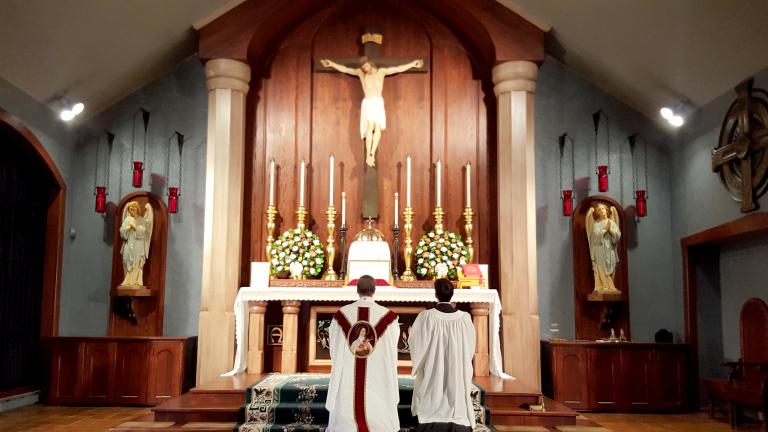
Above: Traditional Latin Mass with the priest and altar server facing Ad Orientum. (Photo credit: wikipedia.com)
Earlier this year, I also attended a Byzantine Divine Liturgy at a local Ukrainian Catholic Church for the first time. As a Roman Catholic, I was deeply moved by the beauty of the liturgy and the brilliant iconography accommodating it. They recited things in patterns of three — including the sign of the cross. Like the Latin Mass, the priest also faced ad orientum for almost the entire service. Unlike the typical wafer I usually received, they distributed their Eucharist in the form of bread cubes dipped in the chalice. They used a small spoon to toss it in our mouths as we approached in the lineup down the aisle. It seemed like a more sanitary procedure as opposed to drinking from the same chalice like what Roman Catholics do.
I feel as though all these qualities I found so attractive should be readopted into the usual Catholic liturgy. One can only wonder that a movement within Catholicism would gain such widespread attention because of people like myself who desire a return to orthodoxy. Especially out of a sheer disdain for contemporary worship.
On the other hand, my heart that was so shaped by my formative Evangelical years breaks for those who would show up at these traditional services feeling completely unwelcome. As mysterious and intimidating as God may be, I believe He desires all to become members of His Church. While I’ve fallen in love with the Latin Mass and Divine Liturgy, I firmly believer the Gospel ought to be shared in a language that is easily understood.
Worship Is Worship, Right?
Don’t get me wrong, I don’t believe there is anything inherently wrong with contemporary worship music either. It definitely has value in bringing people to Christianity, just as it did for me while attending youth group. Contemporary worship music can certainly be effective in evangelizing during a youth group or concert-type event, but I believe there is an appropriate time and place for it.

Above: An artist’s depiction of the unseen spiritual happenings when the Eucharist is consecrated during a Catholic Mass. (Photo credit: littlestsouls.wordpress.com)
If God truly is all-powerful, it seems as though God doesn’t actually need our worship, but we do it out of a desire through faith to please Him. It benefits us more than it would for Him. Granted this, perhaps there is some merit as for making worship more of a personal expression?
Worship is worship, right?
Some would argue that a person isn’t harming anyone by worshiping however way they prefer to. Though I think it’s worthwhile wondering whether we are unknowingly doing more harm to Christian unity by elevating individualistic preference above the needs of corporate worship. Does pandering to individuality actually benefit people collectively? Or are we causing more division in the Body of Christ by compartmentalizing believers into how they prefer to worship?
I think many people who search for a church community to fulfill their emotional and spiritual needs often settle with what piques their interests — just as I have done in my past church-hopping experiences. It’s common to hear people say, ‘What may be fulfilling to you may not be fulfilling to me!’ In my finite understanding, preferential worship style seems to be a by-product of post-modern moral relativism. Though I’m sure relativism has been an ongoing problem of human society. Again, the Bible verse that seems to pop in my mind states,
“In those days there was no king in Israel; every man did what was right in his own eyes.”
— Judges 21:25 RSV
Are We ‘Altering’ The Formula?
Oftentimes, what we desire in a relationship with God might not be what our souls are truly in need of. It’s easy to give up on Christianity when an aspect of church life fails to meet our expectations. A quote that has resonated with me seems to sum it up quite well…
“Christianity has not been tried and found wanting; it has been found difficult and not tried.” – G.K. Chesterton
I’ve often heard fellow Christians compare God to a doctor, and us as His patients. In order to be cured from illness, we usually take a physician’s advice on how we ought to receive treatment. If we try to alter the prescription, we risk ourselves to worsen our symptoms, cause an overdose or worse. In many ways, I think adapting how we worship God to our own preferences can potentially be spiritually harmful.
Do we risk indulging in sin when worshiping the divine through our own subjective desires?
It’s an interesting thought, I find. Especially when considering how the Bible reveals how God instructed mankind how He wanted to be worshiped through the ages.
It seems we are free to choose whether to worship God or not. Though the right to how we worship Him is not truly ours to claim. And as the cliché says — if you wouldn’t do it at Calvary, you probably shouldn’t do it at church.
Contemporary Christian Worship
Previous Post
January 24, 2018
"One True Church?"
Next Post

April 17, 2018 ‘Sweet Jesus’ and the Marketing of Hate
Browse Our Archives
Select a Category Catholicism Christian Life Christian Life Church History Community Eastern Orthodoxy Entertainment Fiction History Mental Health Movies Music Politics Protestantism Reflection Religion Satire Science Fiction Self esteem Self Love Spirituality Star Wars Suicide Theology Uncategorized
Select a Month June 2023 April 2023 May 2022 April 2022 July 2021 April 2021 March 2021 February 2021 January 2021 December 2020 November 2020 October 2020 September 2020 August 2020 July 2020 June 2020 May 2020 April 2020 March 2020 February 2020 January 2020 December 2019 November 2019 October 2019 September 2019 August 2019 July 2019 June 2019 May 2019 April 2019 March 2019 February 2019 January 2019 December 2018 October 2018 September 2018 August 2018 June 2018 April 2018 January 2018 November 2017 October 2017 July 2017 June 2017 May 2017 April 2017 March 2017 February 2017 December 2016 October 2016 September 2016 August 2016 June 2016 May 2016 March 2016 February 2016
Follow Us!
TAKE THE
Religious Wisdom Quiz
Who was the first son of Adam and Eve?
Select your answer to see how you score.
Cain Levi Abel Irad
Related posts from Coffee and Crucifix

Martin Scorsese Meets With Pope To Discuss Film...

FAIL! Catholic says, 'And also with you!" instead...

Don't Lose Your Soul In The Culture War

10 Essential Books Every Catholic Should Own
TRENDING AT PATHEOS Catholic

Rejecting Doom: Christian Hope And Human Action
Christianity is a religion of hope. We are to have hope and...

It’s What Comes From Within Which Matters
One of the most difficult things for us to understand is why...

Why I Choose the Eucharist Over the Sermon
Choose the Eucharist, Not the Sermon What are we supposed to get...

5 Design Elements Found in Spiritually Rooted Homes
Putting Spirituality Into Home Decor Our homes are more than our living...

Credo: A Story of God Told with the...
About 10 years ago, I began to imagine a personal "Credo" that...

The Anatomy of Divine Revelation in Catholic Thought
The claim that God has made Himself known to human beings is...
view all Catholic blogs
Ad-Free & Subscriber Log-In Subscription Support
- About Us
- 2026 Calendar
- Videos
- Podcasts
- Library of World Religions
- Faith In Media Tracker
- Advertise With Us
- Write for Us
- Privacy Policy
- Terms of Service
- Do Not Sell My Data
- Contact Us
- Radiant Digital
- Manage Newsletter Subscriptions
- Unsubscribe From Notifications
- Sitemap
Copyright 2008-2026, Patheos. All rights reserved.
Subscription Support Ad-Free & Subscriber Log-In
Follow Patheos