
BuddhistCatholicContemplativeEvangelicalGeneral ChristianHinduJewishLatter-day SaintMuslimNew VisionsProgressive Christian
Beliefs
- Buddhist
- Catholic
- Contemplative
- Evangelical
- General Christian
- Hindu
- Jewish
- Latter-day Saint
- More Voices
- Muslim
- New Visions
- Pagan
- Progressive Christian
Topics
- Religion News
- Food and Religion
- Sports and Religion
- Religious Art
- Religious Music and Entertainment
- Religious Events
- History and Religion
- Style and Religion
- Politics and Religion
- Women in Religion
- Recreation Outdoors and Religion
- Business Finance and Religion
- Careers Workplace and Religion
- Education and Religion
- Family Parenting and Religion
- Health Fitness and Religion
- Home and Religion
- Relationships and Religion
- Technology and Religion
- Travel and Religion
Columnists
- Buddhist Columnists
- Business Finance and Religion Columnists
- Careers Workplace and Religion Columnists
- Catholic Columnists
- Contemplative Columnists
- Education and Religion Columnists
- Evangelists Columnists
- Family Parenting and Religion Columnists
- General Christian Columnists
- Health Fitness and Religion Columnists
- Hindu Columnists
- History and Religion Columnists
- Home and Religion Columnists
- Jewish Columnists
- More Voices Columnists
- Latter Day Columnists
- Muslim Columnists
- New Visions Columnists
- Nonreligious Columnists
- Pagan Columnists
- Politics and Religion Columnists
- Progressive Columnists
- Recreation Outdoors and Religion Columnists
- Relationships and Religion Columnists
- Religion News Columnists
- Religious Art Columnists
- Religious Events Columnists
- Religious Music and Entertainment Columnists
- Sports and Religion Columnists
- Style and Religion Columnists
- Technology and Religion Columnists
- Travel and Religion Columnists
- Women in Religion Columnists
Resource Library
- 2026 Calendar
- Library of World Religions
- The 100 Most Holy Places on Earth
- Patheos Answers
- Podcasts
- Videos
- Faith Leaders Database
- Anglican Episcopalian
- Bahai
- Baptist
- Buddhism
- Christianity
- Confucianism
- Eastern Orthodoxy
- Hinduism
- Holiness and Pentecostal
- ISKCON
- Islam
- Judaism
- Lutheran
- Methodist
- The Church of Jesus Christ of Latter-day Saints
- New Age
- Paganism
- Presbytarian and Reformed
- Protestantism
- Religion Behind the Scenes
- Roman Catholic
- Scientology
- Shia Islam
- Sikhism
- Sufism
- Sunni Islam
- Taoism
- Zen
- See all religions
Research Tools
 Ad-Free & Subscriber Log-In Subscription Support
Ad-Free & Subscriber Log-In Subscription Support
Follow Patheos 

- Trending:
- Forgiveness
- |
- Marriage
- |
- Consciousness
- |
- Death Penalty
- |
- Election
- |
- Halloween
 Coffee and Crucifix
- Home
- Catholic
- “One True Church?”
“One True Church?”
Last updated on: June 11, 2020 at 9:02 am by Coffee & Crucifix
“One True Church?” 2020-06-11T09:02:03-06:00 Coffee & Crucifix
Patheos Explore the world's faith through different perspectives on religion and spirituality! Patheos has the views of the prevalent religions and spiritualities of the world.
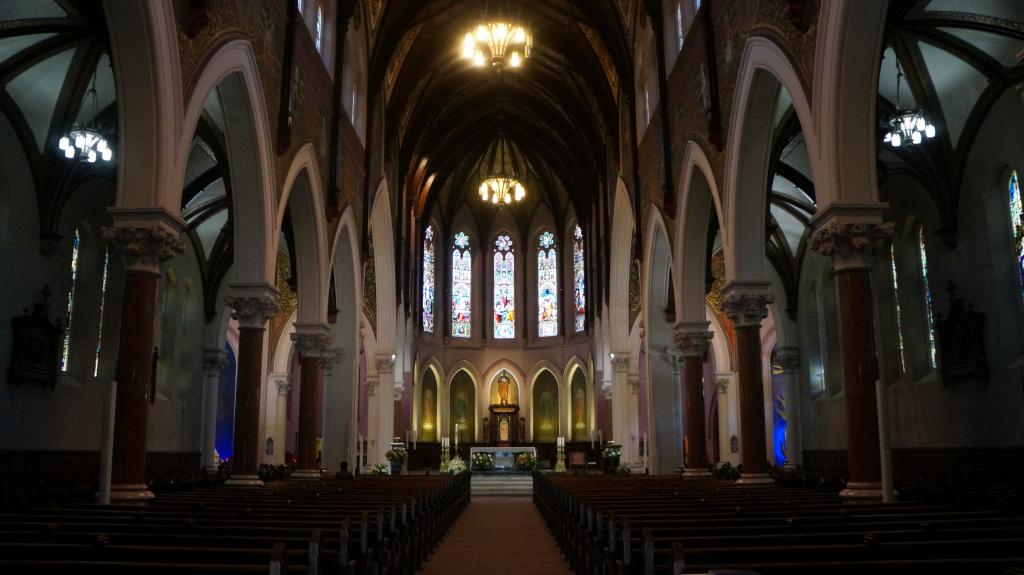
Image credit: Wikipedia.com
There’s an area in my city called Church Street where there are at least ten different church denominations within a span of five city blocks. What’s encouraging to know is all these denominations seem to work alongside each other in helping the homeless and at-risk individuals in the city’s downtown core. A willingness to work together to improve the quality of life of the marginalized and less fortunate is definitely a sign of a strong community. My impression is it seems these particular congregations on Church Street have a uniquely positive working relationship with each other.
Sadly, many different church denominations throughout the world are completely at odds with each other when it comes to doctrinal matters, despite claiming to worship the same God. Much of this stems from how these groups interpret the Bible, which can be traced back to movements in history such as the Protestant Reformation 1 and the Great Schism. 2 It would appear Christianity seems to have a crisis of unity among its followers.
But surely they must all share some things in common? In the Bible, there are two examples I can think of that seem to address this particular issue — the first being when St. John sees another man performing an exorcism without their approval,
“John answered, “Master, we saw a man casting out demons in your name, and we forbade him, because he does not follow with us.” But Jesus said to him, “Do not forbid him; for he that is not against you is for you.“ 3
The second passage being when St. Paul addresses the issue of disunity among members in the Church of Corinth,
“I appeal to you, brethren, by the name of our Lord Jesus Christ, that all of you agree and that there be no dissensions among you, but that you be united in the same mind and the same judgment. For it has been reported to me by Chlo′e’s people that there is quarreling among you, my brethren. What I mean is that each one of you says, “I belong to Paul,” or “I belong to Apol′los,” or “I belong to Cephas,” or “I belong to Christ.” Is Christ divided? Was Paul crucified for you? Or were you baptized in the name of Paul? For Christ did not send me to baptize but to preach the gospel, and not with eloquent wisdom, lest the cross of Christ be emptied of its power.” 4
Does it really matter what church any of us belong to, as long as we believe in Jesus? I would have to argue that it shouldn’t. After all, nobody chooses what part of the world or what culture to be born into. I have several Evangelical friends who have embarked on many missions trips around the world where Christians are persecuted as an underground minority. From my understanding, none of these uncontrollable factors should have any bearing on a person’s salvation; and if God is all-powerful, He should not be limited by sacraments or church membership. 5 Church-shopping and listening to conflicting opinions among my own Christian friends made me think about what the nature of truth really is. Over time, I began to struggle with the idea that as long as you believed in Jesus it didn’t matter what denomination you were from. But what about Mormons and Jehovah’s witnesses who deny the Trinity? They still believe in Jesus too, don’t they? I began to find a relativistic approach to whether all denominations were ‘right in their own way’ to be an insufficient explanation for the seemingly petty inconsistencies.
Or does it mean God’s grace doesn’t care about semantics?
As an Evangelical, I struggled with what seemed to me like a false dichotomy that there were two types of people in this world: those who were automatically saved through faith in Jesus and those who were not. What about Orthodox Jews? What about atheists who grew up in Christian homes who had been wounded by reckless actions committed by fellow congregates? What about Muslims who believe Jesus existed but was merely a prophet rather than God Himself? What about aboriginal tribes living in isolated corners of the world who have no idea who Jesus really is? The more I thought about these things, the more I found myself resenting the idea of a God who would create people predestined for eternal suffering simply for being unaware.
Surely, there must be elements of truth found in different religions though, right? One of the positive outcomes of the New Age movement is how it paved the way for religious tolerance in western society. But does this mean all religions are true?
On the other hand, maybe it’s possible we are judged based on where our hearts are at regardless of what part of the world we are from? 6 Maybe it’s possible that God judges us individually through means beyond our comprehension? It isn’t my place to determine where people’s hearts stand in God’s eyes. But that being said, I have no doubt there will be people in heaven who identified as Muslim, Mormon or having no religious affiliation whatsoever during their earthly lives.
It seems having faith in Jesus is about having a relationship with Him as opposed to going through the motions of systematic rituals. But if we are supposedly justified by faith, why is it so many Protestants believe Catholics are not real Christians, yet are willing to accept differing Protestants as their own brethren? Some arguments I’ve heard was that Catholics believe in a counterfeit Jesus and their theology is entirely works-based and recycled paganism, but much of these arguments are stemmed from hostile historical animosity.
One of the most controversial statements by the Catholic Church is the Latin phrase, “Extra Ecclesiam Nulla Salus,” which means, “There is one universal Church of the faithful, outside of which there is absolutely no salvation.“ 7 At first glance, this seems like a very bigoted and narrow-minded statement. How arrogant can any religious institution be to claim they are the only true one out there? Doesn’t every religion claim to have THE truth, or elements of truth we can all learn from?
On the other hand, this doesn’t seem any more offensive or ‘intolerant’ than the very words of Jesus when He says,
“I am the way, and the truth, and the life; no one comes to the Father, but by me.“ 8
From a non-Christian perspective, this is probably one of the most offensive verses because it implies there is only one way to Heaven. By today’s political standards, it can be viewed as intolerant or narrow-minded. In such a vast and culturally diverse world, who is anyone to think non-Christians wouldn’t go to Heaven when they die just because they either don’t believe Jesus is God, or haven’t been properly introduced to Christianity?
It is commonly repeated among American Evangelicals that Jesus is not a religion. But if Jesus came to abolish religion, then what did He mean when He said, “If you love me, keep my commandments?” 9 What did He mean when He said, “I have come not to abolish the law but to fulfill it?” 10 What did St. Paul mean when he said, “…stand firm and hold to the traditions which you were taught by us, either by word of mouth or by letter?” 11 The problem with wanting to abolish religion is it’s completely inconsistent with what the Bible teaches. To blame all wars and corruption on religion is to deny the human condition and personal responsibility due to Original Sin, like blaming a car accident on the vehicle rather than the driver who was at fault. In my opinion, the desire to abolish religion is akin to what motivated the Nazis to set up death camps for the Jews.
In my observation of history, I find it compelling how many church denominations split off and multiplied into several smaller ones. As some grew into flourishing faith-communities, others either died off or became indistinguishable from the secular world. Yet the ones that survived the test of time are the ones that seemed to have adhered to orthodoxy — which is quite reminiscent to the parable of the true vine. 12 I think if the Devil actually exists, one way he could be attempting to destroy the Church would be to split it into smaller groups that are easier to pick off and eliminate.
With that in mind, I can fully agree with the notion that denominations are completely unbiblical.
One major point I cannot stress enough is just because many non-Catholic Christians aren’t united under the Pope’s umbrella, it doesn’t make their faith and ministry invalid, nor does it mean these people are going to Hell. If what they believe reflects what is mentioned in the Apostles Creed and the Nicene Creed, who is anybody to say they are not Christians? The Catechism of the Catholic Church especially states regarding non-Catholic Christians,
“Justified by faith in Baptism, [they] are incorporated into Christ; they therefore have a right to be called Christians, and with good reason are accepted as brothers by the children of the Catholic Church. Baptism therefore constitutes the sacramental bond of unity existing among all who through it are reborn.” 13
A friend of mine once said that the Christian Church as a whole is like a giant stew — the combination of all the unique ingredients and spices are what make the flavor of the stew. In that sense, I believe Catholics and Protestants can most certainly learn from each other. Protestants generally have a tremendous amount of zeal for biblical literacy and evangelism that is certainly lacking in many Catholic laypeople, whereas Catholics strongly value unity and have a serious sense of reverence in their worship that Protestants can surely take note of. I am convinced God has been and will continue to use these combined qualities to enhance His Kingdom. We are united by virtue of faith and baptism.
Above: Fr. Mike Schmitz uses a metaphor to describe how the Church has journeyed through history.
One of the biggest reasons why I returned to Catholicism is my desire for Christian unity. Although it’s tough to boast about unity when Catholicism has its own internal issues of division, I long for the day Christ becomes unified with all believers and we can no longer segregate ourselves into ideological groups. The fact that Christianity survived nearly two thousand years of persecution, war, corruption, scandal and schism to this day is a testimony to me that there must be something truly divine protecting it from dying off — and the same can especially be said for Catholicism.
As for whether the Catholic Church is the ‘One True Church,’ I do not have a sufficient answer. This is a much more complex topic than I’m used to writing about. I am not a theologian, a historian nor a biblical scholar, but my personal convictions have led me to believe I need Jesus as a solid foundation to base my life upon. I need His Church because life is messy and, regardless of how much Scripture I can memorize, I honestly don’t know any better. 14
In summary, I believe in my heart of hearts the Catholic Church is truly founded by Christ Himself; and in the end, His fractured Body will reunite and denominations will cease to exist…. 15
…and just as I believe Jesus died and rose again for the forgiveness of sins, that is something I accept out of faith.
“I do not pray for these only, but also for those who believe in me through their world, that they may all be one; even as thou, Father, art in me, and I in thee, that they also may be in us, so that the world may believe that thou hast sent me.“
— John 17:20-21 RSV
References:
1 Wikipedia: https://en.wikipedia.org/wiki/Reformation
2 Wikipedia: https://en.wikipedia.org/wiki/East%E2%80%93West_Schism
3 Luke 9:49-50
4 Corinthians 1:10-13,17
5 CCC 1257
6 Romans 2
7 Fourth Lateran Council, Canon I; Catholic Answers: https://www.catholic.com/magazine/print-edition/what-no-salvation-outside-the-church-means
8 John 14:6
9 John 4:1-42
10 Matthew 5:17-20
11 2 Thessalonians 2:15
12 John 15:1-11
13 CCC 1271
14 Ephesians 2:20, Acts 8:30-31
15 Galatians 3:28

About Rene Albert
I'm Rene Albert. I am a husband to a beautiful wife and a father of three children. I'm also a licensed carpenter and construction manager as part of my full-time work. When I'm not busy meeting construction deadlines, changing diapers and chasing little hooligans around the house, I write essays about Catholicism, mere Christian theology and western politics and culture, as well as how they all affect each other. Due to working a full time job in construction, I usually only post two articles per week on average. My goal is to eventually become a full-time writer and possibly start up a podcast or Youtube channel. My writing is a labor of love, so if you enjoy my work and feel called to support me on Patreon, I would be very much appreciative! Pax vobiscum! You can read more about the author here.
Previous Post

January 10, 2018
My Review of Star Wars: The Last Jedi **SPOILERS**
Next Post
April 4, 2018 Does It Matter How We Worship?
Browse Our Archives
Select a Category Catholicism Christian Life Christian Life Church History Community Eastern Orthodoxy Entertainment Fiction History Mental Health Movies Music Politics Protestantism Reflection Religion Satire Science Fiction Self esteem Self Love Spirituality Star Wars Suicide Theology Uncategorized
Select a Month June 2023 April 2023 May 2022 April 2022 July 2021 April 2021 March 2021 February 2021 January 2021 December 2020 November 2020 October 2020 September 2020 August 2020 July 2020 June 2020 May 2020 April 2020 March 2020 February 2020 January 2020 December 2019 November 2019 October 2019 September 2019 August 2019 July 2019 June 2019 May 2019 April 2019 March 2019 February 2019 January 2019 December 2018 October 2018 September 2018 August 2018 June 2018 April 2018 January 2018 November 2017 October 2017 July 2017 June 2017 May 2017 April 2017 March 2017 February 2017 December 2016 October 2016 September 2016 August 2016 June 2016 May 2016 March 2016 February 2016
Follow Us!
TAKE THE
Religious Wisdom Quiz
What is the central prayer of Christian faith, taught by Jesus?
Select your answer to see how you score.
The Lord's Prayer The Jesus Prayer The Shema The Hail Mary
Related posts from Coffee and Crucifix

Martin Scorsese Meets With Pope To Discuss Film...

FAIL! Catholic says, 'And also with you!" instead...

Don't Lose Your Soul In The Culture War

10 Essential Books Every Catholic Should Own
TRENDING AT PATHEOS Catholic

Rejecting Doom: Christian Hope And Human Action
Christianity is a religion of hope. We are to have hope and...

It’s What Comes From Within Which Matters
One of the most difficult things for us to understand is why...

Why I Choose the Eucharist Over the Sermon
Choose the Eucharist, Not the Sermon What are we supposed to get...

5 Design Elements Found in Spiritually Rooted Homes
Putting Spirituality Into Home Decor Our homes are more than our living...

Credo: A Story of God Told with the...
About 10 years ago, I began to imagine a personal "Credo" that...

The Anatomy of Divine Revelation in Catholic Thought
The claim that God has made Himself known to human beings is...
view all Catholic blogs
Ad-Free & Subscriber Log-In Subscription Support
- About Us
- 2026 Calendar
- Videos
- Podcasts
- Library of World Religions
- Faith In Media Tracker
- Advertise With Us
- Write for Us
- Privacy Policy
- Terms of Service
- Do Not Sell My Data
- Contact Us
- Radiant Digital
- Manage Newsletter Subscriptions
- Unsubscribe From Notifications
- Sitemap
Copyright 2008-2026, Patheos. All rights reserved.
Subscription Support Ad-Free & Subscriber Log-In
Follow Patheos