
BuddhistCatholicContemplativeEvangelicalGeneral ChristianHinduJewishLatter-day SaintMuslimNew VisionsProgressive Christian
Beliefs
- Buddhist
- Catholic
- Contemplative
- Evangelical
- General Christian
- Hindu
- Jewish
- Latter-day Saint
- More Voices
- Muslim
- New Visions
- Pagan
- Progressive Christian
Topics
- Religion News
- Food and Religion
- Sports and Religion
- Religious Art
- Religious Music and Entertainment
- Religious Events
- History and Religion
- Style and Religion
- Politics and Religion
- Women in Religion
- Recreation Outdoors and Religion
- Business Finance and Religion
- Careers Workplace and Religion
- Education and Religion
- Family Parenting and Religion
- Health Fitness and Religion
- Home and Religion
- Relationships and Religion
- Technology and Religion
- Travel and Religion
Columnists
- Buddhist Columnists
- Business Finance and Religion Columnists
- Careers Workplace and Religion Columnists
- Catholic Columnists
- Contemplative Columnists
- Education and Religion Columnists
- Evangelists Columnists
- Family Parenting and Religion Columnists
- General Christian Columnists
- Health Fitness and Religion Columnists
- Hindu Columnists
- History and Religion Columnists
- Home and Religion Columnists
- Jewish Columnists
- More Voices Columnists
- Latter Day Columnists
- Muslim Columnists
- New Visions Columnists
- Nonreligious Columnists
- Pagan Columnists
- Politics and Religion Columnists
- Progressive Columnists
- Recreation Outdoors and Religion Columnists
- Relationships and Religion Columnists
- Religion News Columnists
- Religious Art Columnists
- Religious Events Columnists
- Religious Music and Entertainment Columnists
- Sports and Religion Columnists
- Style and Religion Columnists
- Technology and Religion Columnists
- Travel and Religion Columnists
- Women in Religion Columnists
Resource Library
- 2026 Calendar
- Library of World Religions
- The 100 Most Holy Places on Earth
- Patheos Answers
- Podcasts
- Videos
- Faith Leaders Database
- Anglican Episcopalian
- Bahai
- Baptist
- Buddhism
- Christianity
- Confucianism
- Eastern Orthodoxy
- Hinduism
- Holiness and Pentecostal
- ISKCON
- Islam
- Judaism
- Lutheran
- Methodist
- The Church of Jesus Christ of Latter-day Saints
- New Age
- Paganism
- Presbytarian and Reformed
- Protestantism
- Religion Behind the Scenes
- Roman Catholic
- Scientology
- Shia Islam
- Sikhism
- Sufism
- Sunni Islam
- Taoism
- Zen
- See all religions
Research Tools
 Ad-Free & Subscriber Log-In Subscription Support
Ad-Free & Subscriber Log-In Subscription Support
Follow Patheos 

- Trending:
- Forgiveness
- |
- Marriage
- |
- Consciousness
- |
- Death Penalty
- |
- Election
- |
- Halloween
 Coffee and Crucifix
- Home
- Catholic
- My Thoughts on the Christian Persecution Complex
My Thoughts on the Christian Persecution Complex
Last updated on: September 17, 2019 at 8:46 am by Coffee & Crucifix
My Thoughts on the Christian Persecution Complex 2019-09-17T08:46:27-06:00 Coffee & Crucifix
Patheos Explore the world's faith through different perspectives on religion and spirituality! Patheos has the views of the prevalent religions and spiritualities of the world.
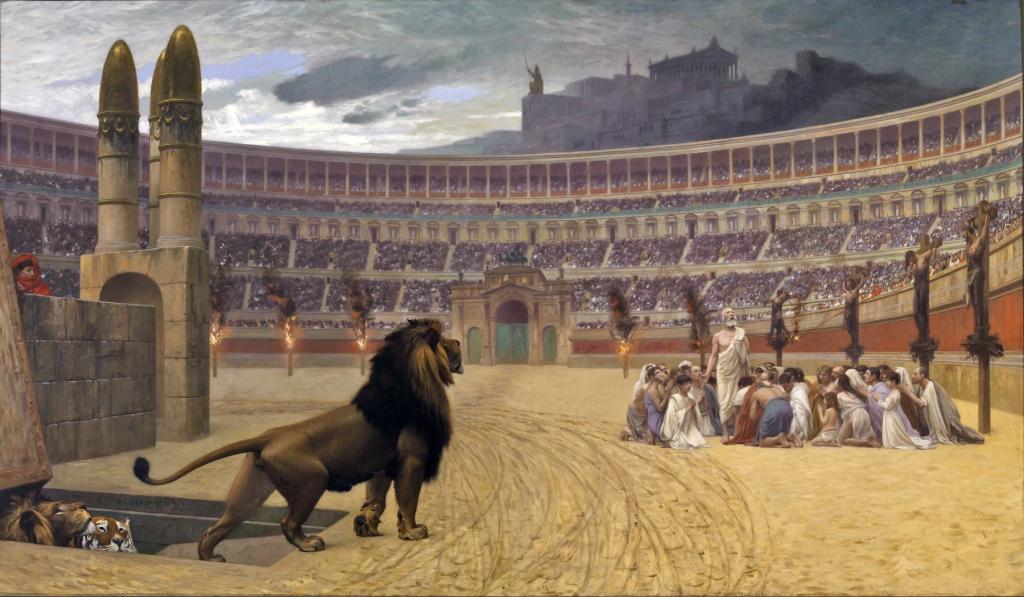
Image credit: Wikimedia Commons
I remember in my youth, I was told by many pastors, mentors, youth group and camp counselors that becoming a Christian is like painting a target on our backs, and we will always face hostility or opposition of some form as long as we choose to follow Christ.
It’s quite common for Christians to view personal hardships like financial or medical emergencies as a form of spiritual opposition. While I believe they can certainly be influenced by metaphysical vibes, I think any form of hardship should be expected when it comes to living life on Earth – not to say I’m brushing off the possibilities of strange happenings.
But when I think of spiritual opposition, I prefer to think of something more dire and conflicting than jumping through the hurdles of everyday life.
Christian persecution is a topic I think about quite often, even more so now that I have children of my own. We certainly have it good here in North America where we can get away with speaking our minds, whereas in other parts of the world a mere slip of the tongue can lead to a death sentence. As a parent, I want the best for my children, and I always fear for their safety and well-being. I look at the faces of my kids and hope to God they and their own offspring will never have to deal with any form of violent oppression from others for upholding the values our family holds dear.
Sometimes people, like myself, like to openly share their beliefs or debate with friends or colleagues, whether it’s in-person or online. Before the age of social media, I remember having several conversations with my friends in high school who all seemed to span a pretty wide demographic in political and religious thought. I’ve always remembered our discussions being quite civil (for the most part), but sometimes some of my more religious friends would find themselves highly discouraged with the worldviews that were in contrast with their own.
From my own observation, many religious persons seem to have a habit of not disconnecting personal opinion from personal salvation.
Nowadays, it’s easy to say what we think on the internet because it’s easy to hide behind the anonymity of a keyboard. People often don’t identify an online presence with a person who has feelings or thoughts of their own, therefore somehow justifying the use of slander, shaming and name-calling in order to discredit their opponents. It’s a shame that something so technologically advanced and widely accessible as the internet has turned into a cesspool of fruitless bickering, when it could be used for so much better purposes.
What also seems to contribute to fruitless dialogue is when North American Christians sensationalize persecution. Sometimes it seems like some Christians play the victim or pull out the ‘persecution card’ over mere disagreements in discussions. It’s difficult to legitimize crying ‘wolf’ when many injustices in Western society have actually been invoked by Christians themselves – like the residential schools abuses or the Salem witch trials for example. These types of examples seem to pay more credibility to the idea of the ‘Christian persecution complex.’
In my opinion, mere disagreement is not what I consider to be persecution.
The workplace is also one of the least ideal places to discuss politics and religion. In my lifetime, I’ve had three employers who happened to be Christian friends of mine. It’s easy to talk about religion when your boss and co-workers all share a similar belief in God. But when denominational or theological semantics come into play, discussions can heat up pretty quickly. That being said, I’ve had to sever ties with one particular employer due to hostile and abusive treatment on the job.
Even Christians can treat their own quite horribly – and history proves it. Jesus certainly wasn’t joking about division among believers when He said, “…a man’s foes will be those of his own household (Matthew 10:36).”
The Church is not without sin. While the actions of individuals certainly don’t define the core meaning of the Gospel, it’s easy for people to write off an entire religion because of an individual member who has wounded them deeply. I almost abandoned religion myself because of the mistreatment I have experienced from ultra-conservatives as a cradle-Catholic and as an Evangelical in my adult years. It’s not an easy thing to shake off, and sometimes it’s difficult to not feel like I have an ax to grind.
But I do believe there’s a difference between someone saying, ‘I’d like to challenge what you believe in because I don’t agree with it,’ versus someone screaming in your face, ‘You’re a f***ing hypocrite and you’re going to hell unless you agree with me!‘
Verbal and physical bullying, as well as suppression and violence is what I consider to be the very definition of persecution.
This is why the art of fruitful dialogue is so important, yet seems to be completely lost to many. It can help make sense of what a person feels, ease the pain caused by injustice, leave room for reconciliation and bring closure to those who have suffered tremendously at the hands of careless people. But sometimes that’s difficult to encourage between a minority and a majority, especially when emotions run high.
Sometimes continuous failed attempts at dialogue can build up over time and explode into violence. And as intolerance to differing opinions becomes more tolerated, violence can suddenly become a more freely accepted form of coercion. It can snowball to the point when no one can reasonably dialogue with one another anymore without killing each other.
It’s not unrealistic for Christianity to become a minority here in North America. In fact, the cultural shift towards secularization in Western society indicates this could only be a short generation or two away from becoming a reality. When a minority becomes a majority, how will they treat the former-majority? Would it be in the same manner of injustice they were served as a minority, or perhaps worse?
It’s a slow fade that only time will reveal before the pendulum swings in the opposite direction.
And then comes the idea of martyrdom.
There’s something intimidating about the idea of dying for an ideology – even more so when it’s for something, or someone, you can’t really see or aren’t always completely sure of. It’s an act of faith.
When I think of people who were martyred for their faith it makes me wonder, what kind of truth is worth dying for? What kind of belief is worth clinging to when someone points a gun to your face, or threatens to slaughter your family in front of you?
I once heard a quote by Tertullian, a Christian apologist from the second century,
“The blood of the martyrs is the seed of the Church.”
One movie I found that displays a seemingly accurate depiction of what persecution is like was none other than Silence, directed by Martin Scorcese. What I found interesting about the film was the manner in how Japanese Christians were forced to either apostatize by merely stepping on an image of Jesus or the Virgin Mary, or suffer unimaginable torment. It seems like such an easy way out of a painful death, yet many of these believers willingly refused to step on their Savior and Mother and embraced death. It was also compelling to see what lengths the Japanese authorities would go to force them to recant their faith – even to tell one of the priests they would continue to brutally torment some of his followers who had already apostatized, unless he renounced his own faith himself.
Martyrdom is certainly not as easy as people think it is.
In light of the massacre of Coptic Christians in Egypt, it’s interesting to see how many elite, left-leaning celebrities are vocal against injustice towards minorities all over the world, yet they continue to remain silent about Christian men, women and children in the middle-East who are being kidnapped, raped, tortured and beheaded by ISIS and other extremist groups. Pope Francis along with several other religious leaders were quick to condemn the terrorist attack on a gay nightclub in Orlando, Florida. But the fact that these so-called social justice warriors have said nothing about these horrific massacres speaks volumes of their contempt. Their apathy towards Christian minorities in the Middle-East seems to be no different than how they are viewed as a majority here in the West.
This is one of the problems I have with partisan politics. It has created an unfair absolute that applies the privilege of Western majorities to the minorities who live under the gun in foreign lands. Even though it may be hard for some to imagine that violence and bloodshed of believers in Christ could happen in modern-day America, it would be naive of us to believe it would never happen. What may start out as a minor conflict among ideological groups can snowball into something worse over time if not addressed or dealt with soon enough.
And when it comes to dealing with people who want nothing more than to see you suffer and die for what you believe in, there is absolutely no reasoning with them.
Regardless of where you are in the world or where your political affiliation lies, persecution is still persecution.
If we stand for something we believe in so strongly, we should be prepared to answer for ourselves and be willing to suffer for it. Regardless of what beliefs we align with, we ought to expect hostility for what we stand for, but we should not seek out to be persecuted – whether it’s for personal attention or to show off how holy or right we are to others. If God knows our hearts better than we do, there’s no hiding our ulterior motives. Persecution is not something to be taken lightly, nor is it something we should ever desire or hope for.
But martyrdom amidst persecution certainly bears a strong witness.
“If the world hates you, know that it has hated me before it hated you. If you were of the world, the world would love its own; but because you are not of the world, but I chose you out of the world, therefore the world hates you. Remember the word that I said to you, ‘A servant is not greater than his master.’ If they persecuted me, they will persecute you; if they kept my word, they will keep yours also. But all this they will do to you on my account, because they do not know him who sent me.”
— John 15:18-21 RSV
Previous Post

May 18, 2017
Courage In An Unusual Situation
Next Post

June 26, 2017 In Defence of the Trinity
Browse Our Archives
Select a Category Catholicism Christian Life Christian Life Church History Community Eastern Orthodoxy Entertainment Fiction History Mental Health Movies Music Politics Protestantism Reflection Religion Satire Science Fiction Self esteem Self Love Spirituality Star Wars Suicide Theology Uncategorized
Select a Month June 2023 April 2023 May 2022 April 2022 July 2021 April 2021 March 2021 February 2021 January 2021 December 2020 November 2020 October 2020 September 2020 August 2020 July 2020 June 2020 May 2020 April 2020 March 2020 February 2020 January 2020 December 2019 November 2019 October 2019 September 2019 August 2019 July 2019 June 2019 May 2019 April 2019 March 2019 February 2019 January 2019 December 2018 October 2018 September 2018 August 2018 June 2018 April 2018 January 2018 November 2017 October 2017 July 2017 June 2017 May 2017 April 2017 March 2017 February 2017 December 2016 October 2016 September 2016 August 2016 June 2016 May 2016 March 2016 February 2016
Follow Us!
TAKE THE
Religious Wisdom Quiz
What does the Bible say about pride?
Select your answer to see how you score.
It's always good It goes before a fall Pride is the best It's ignored
Related posts from Coffee and Crucifix

Martin Scorsese Meets With Pope To Discuss Film...

FAIL! Catholic says, 'And also with you!" instead...

Don't Lose Your Soul In The Culture War

10 Essential Books Every Catholic Should Own
TRENDING AT PATHEOS Catholic

Rejecting Doom: Christian Hope And Human Action
Christianity is a religion of hope. We are to have hope and...

It’s What Comes From Within Which Matters
One of the most difficult things for us to understand is why...

Why I Choose the Eucharist Over the Sermon
Choose the Eucharist, Not the Sermon What are we supposed to get...

5 Design Elements Found in Spiritually Rooted Homes
Putting Spirituality Into Home Decor Our homes are more than our living...

Credo: A Story of God Told with the...
About 10 years ago, I began to imagine a personal "Credo" that...

The Anatomy of Divine Revelation in Catholic Thought
The claim that God has made Himself known to human beings is...
view all Catholic blogs
Ad-Free & Subscriber Log-In Subscription Support
- About Us
- 2026 Calendar
- Videos
- Podcasts
- Library of World Religions
- Faith In Media Tracker
- Advertise With Us
- Write for Us
- Privacy Policy
- Terms of Service
- Do Not Sell My Data
- Contact Us
- Radiant Digital
- Manage Newsletter Subscriptions
- Unsubscribe From Notifications
- Sitemap
Copyright 2008-2026, Patheos. All rights reserved.
Subscription Support Ad-Free & Subscriber Log-In
Follow Patheos