
BuddhistCatholicContemplativeEvangelicalGeneral ChristianHinduJewishLatter-day SaintMuslimNew VisionsProgressive Christian
Beliefs
- Buddhist
- Catholic
- Contemplative
- Evangelical
- General Christian
- Hindu
- Jewish
- Latter-day Saint
- More Voices
- Muslim
- New Visions
- Pagan
- Progressive Christian
Topics
- Religion News
- Food and Religion
- Sports and Religion
- Religious Art
- Religious Music and Entertainment
- Religious Events
- History and Religion
- Style and Religion
- Politics and Religion
- Women in Religion
- Recreation Outdoors and Religion
- Business Finance and Religion
- Careers Workplace and Religion
- Education and Religion
- Family Parenting and Religion
- Health Fitness and Religion
- Home and Religion
- Relationships and Religion
- Technology and Religion
- Travel and Religion
Columnists
- Buddhist Columnists
- Business Finance and Religion Columnists
- Careers Workplace and Religion Columnists
- Catholic Columnists
- Contemplative Columnists
- Education and Religion Columnists
- Evangelists Columnists
- Family Parenting and Religion Columnists
- General Christian Columnists
- Health Fitness and Religion Columnists
- Hindu Columnists
- History and Religion Columnists
- Home and Religion Columnists
- Jewish Columnists
- More Voices Columnists
- Latter Day Columnists
- Muslim Columnists
- New Visions Columnists
- Nonreligious Columnists
- Pagan Columnists
- Politics and Religion Columnists
- Progressive Columnists
- Recreation Outdoors and Religion Columnists
- Relationships and Religion Columnists
- Religion News Columnists
- Religious Art Columnists
- Religious Events Columnists
- Religious Music and Entertainment Columnists
- Sports and Religion Columnists
- Style and Religion Columnists
- Technology and Religion Columnists
- Travel and Religion Columnists
- Women in Religion Columnists
Resource Library
- 2026 Calendar
- Library of World Religions
- The 100 Most Holy Places on Earth
- Patheos Answers
- Podcasts
- Videos
- Faith Leaders Database
- Anglican Episcopalian
- Bahai
- Baptist
- Buddhism
- Christianity
- Confucianism
- Eastern Orthodoxy
- Hinduism
- Holiness and Pentecostal
- ISKCON
- Islam
- Judaism
- Lutheran
- Methodist
- The Church of Jesus Christ of Latter-day Saints
- New Age
- Paganism
- Presbytarian and Reformed
- Protestantism
- Religion Behind the Scenes
- Roman Catholic
- Scientology
- Shia Islam
- Sikhism
- Sufism
- Sunni Islam
- Taoism
- Zen
- See all religions
Research Tools
 Ad-Free & Subscriber Log-In Subscription Support
Ad-Free & Subscriber Log-In Subscription Support
Follow Patheos 

- Trending:
- Forgiveness
- |
- Marriage
- |
- Consciousness
- |
- Death Penalty
- |
- Election
- |
- Halloween

- Home
- Religion News
- Islamic Ethics Call Leaders to Serve, Not Rule
Islamic Ethics Call Leaders to Serve, Not Rule
Last updated on: May 16, 2025 at 8:08 am by Debbie Almontaser
Islamic Ethics Call Leaders to Serve, Not Rule 2025-05-16T08:08:32-05:00 Debbie Almontaser
Patheos Explore the world's faith through different perspectives on religion and spirituality! Patheos has the views of the prevalent religions and spiritualities of the world.
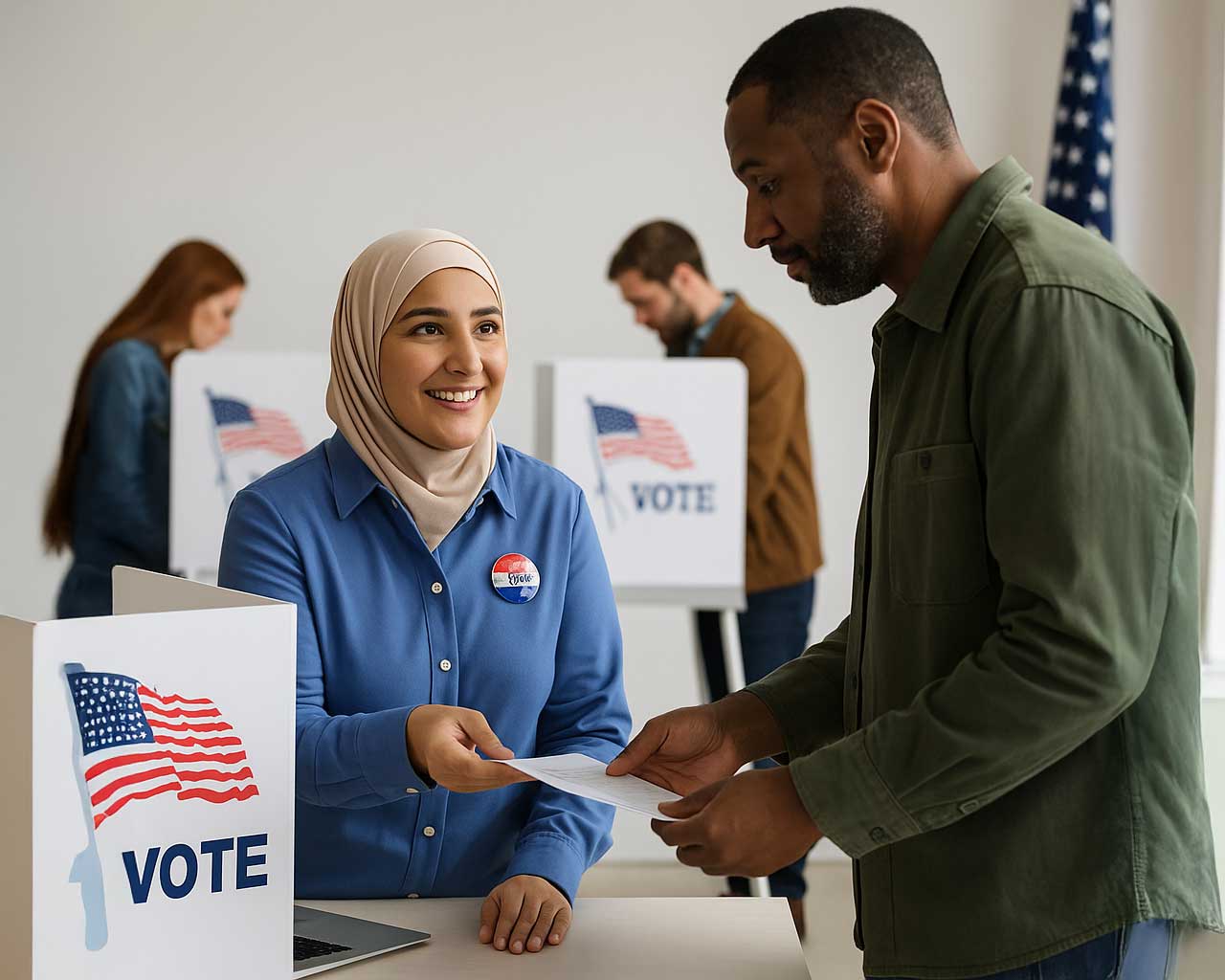
Volunteering, voting, organizing, protesting, and even running for office can all be acts of sacred duty when done with integrity and purpose. | Image Created in Dalle for Patheos.
Stewards, Not Sovereigns: An Islamic Reflection on Power and Political Duty
In the Islamic tradition, leadership is not defined by dominion but by accountability. Political power is not a privilege to be hoarded, but a trust—an amanah—that must be wielded with justice, humility, and unwavering service to the people. The Prophet Muhammad (peace be upon him) said: “Each of you is a shepherd, and each of you is responsible for his flock.” In those words is a radical reframing of leadership—not as superiority, but as stewardship.
As a Muslim woman, educator, and civic leader in America, I have spent much of my life navigating the intersection of faith and power. And I believe we are called, more urgently than ever, to draw from our traditions—not just to critique unjust political authority, but to shape models of leadership rooted in ethics, equity, and service.
Leadership as Trust, Not Tyranny
The Qur’an offers repeated warnings against arrogance in leadership. In Surah Al-Baqarah (2:247), when the Israelites questioned why Talut (Saul) was chosen to be their
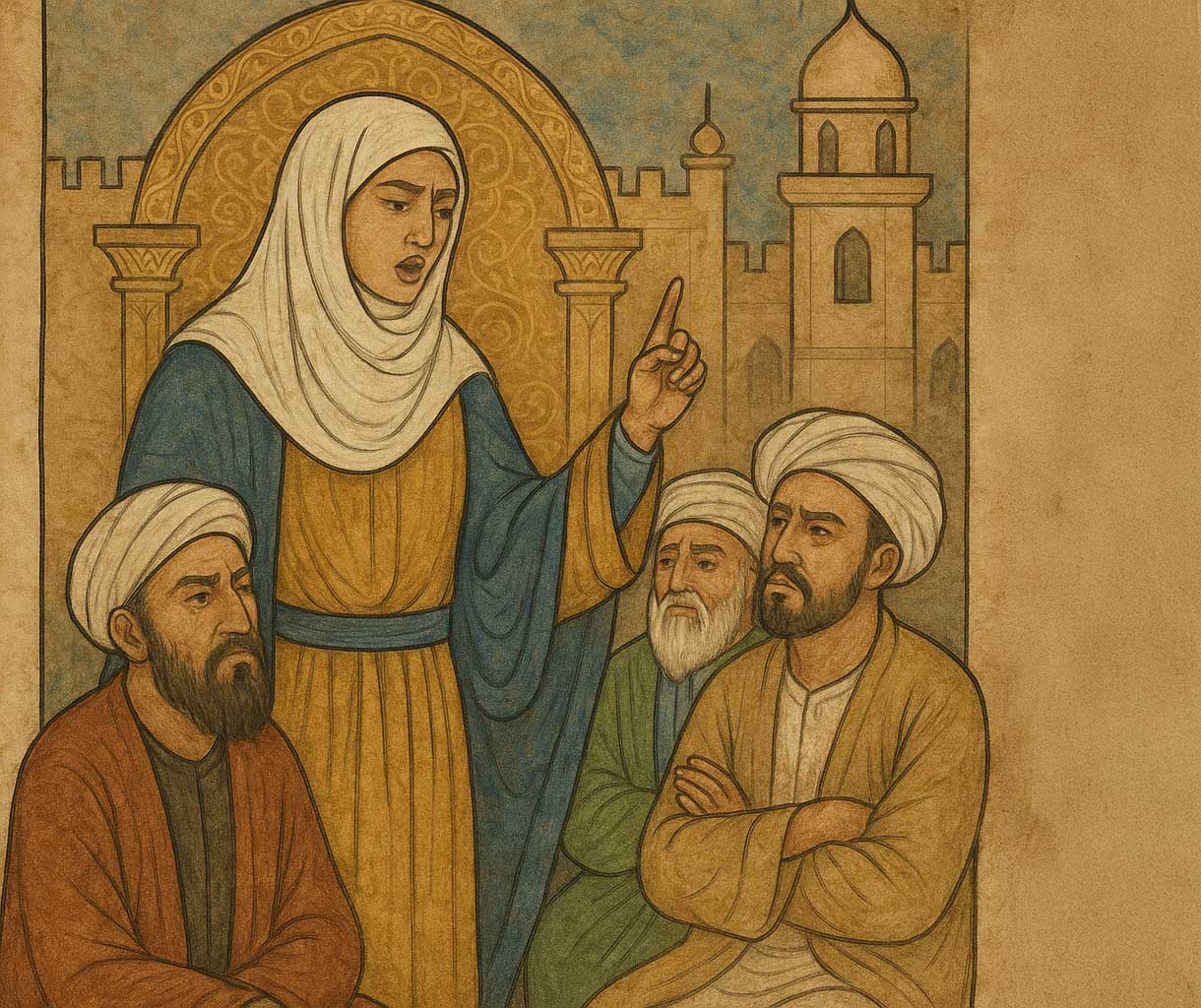
A traditional Islamic painting evokes the sacred duty of leadership as stewardship—grounded in justice, humility, and service to the people. | Image created in Dalle for Patheos.
king, God responded that He had chosen him for his knowledge and physical strength—and then added, “God grants His authority to whom He wills, and Allah is All-Encompassing, All-Knowing.” It wasn’t lineage or popularity that mattered—it was readiness, capability, and ultimately divine trust.
Power in Islam is never unchecked. The Qur’an reminds us in Surah Al-Imran (3:26): “You give power to whom You will and You take it away from whom You will.” Authority is temporary. It is bestowed—and it can be taken.
That framing alone should humble any political leader, Muslim or otherwise. True Islamic governance, at its heart, is not about control. It is about service and justice.
The Prophet’s Model: Leadership by Example
The Prophet Muhammad (peace be upon him) wasn’t a king. He lived simply, mended his own clothes, and walked among the people. As a political leader in Medina, he governed through shura—consultation—with Jews, Christians, and Muslims alike. The Constitution of Medina was one of history’s first interfaith civic compacts, ensuring rights and protections for all communities.
He warned his companions against desiring political office. In one hadith, the Prophet said to a man who sought leadership: “You are asking for a position of authority, but it is a trust, and on the Day of Judgment, it will be a cause of regret unless one fulfills its obligations.” (Sahih Muslim)
This is the prophetic model. Leadership as burden—not glory. A platform to lift the vulnerable—not the ego.
Limits on Authority: No Obedience in Disobedience
Islam is clear: no political authority is above divine law or human dignity.
The Prophet taught: “There is no obedience to the creation in disobedience to the Creator.” (Ahmad, al-Hakim) In other words, allegiance to leadership is conditional—grounded in justice and moral righteousness. Blind obedience is not Islamic. Moral courage is.
Historically, Muslim scholars such as Imam Abu Hanifa and Imam Malik refused to endorse corrupt rulers. Imam Ahmad ibn Hanbal endured torture rather than endorse a political doctrine he believed was false. This legacy of ethical dissent is part of our tradition.
In today’s climate, where authoritarianism is cloaked in religious language and policy decisions often contradict the core ethics of Islam—such as justice, compassion, and truth—it becomes all the more urgent for Muslims to uphold these prophetic principles.
Faithful Engagement in a Secular System
In pluralistic democracies like the U.S., Muslims are not seeking to impose faith, but to be informed by it. Our civic engagement is not about converting others—it is about applying values of justice and equity that benefit everyone.
When I advocate for equity in education, speak up for the rights of immigrants, or challenge policies that harm the poor and marginalized, I am not doing so in spite of my faith. I am doing it because of my faith.
Our faith teaches us to stand with the oppressed—regardless of race, religion, or nationality. As the Qur’an says in Surah An-Nisa (4:135): “O you who believe! Stand firmly for justice, as witnesses to God, even against yourselves or your own kin.”
That means we must hold our leaders accountable—whether they share our religion or not. Voting, organizing, protesting, and even running for office can all be acts of sacred duty when done with integrity and purpose.
The Political Now: Islam and Power Today
In this election season, many in power are using fear as a weapon. Whether it’s the scapegoating of immigrants, the surveillance of Muslim communities, or the erosion of civil rights, we are seeing what happens when leadership forgets that it is a trust—not a weapon.
But Islam does not teach withdrawal from society. It teaches engagement—with purpose, clarity, and ethics.
I am reminded of a beautiful saying of Caliph Abu Bakr (may God be pleased with him) when he addressed the people upon taking leadership: “If I do well, help me; and if I do wrong, set me right.” Imagine if every politician said that. Imagine if every voter expected that.
A Call for Sacred Accountability
So what does Islam say about political authority?
- It says that leaders must serve—not dominate.
- It says that power must be checked—not worshipped.
- It says that people of faith must speak truth to power, even when it is uncomfortable.
- And, it says that civic engagement, rooted in compassion and justice, is not optional—it is essential.
As Muslims, we are not waiting for perfect leaders. We are called to be principled people—who hold our leaders accountable and who lead when necessary, with the ethics of service and the courage of our convictions.
In a time when politics feels poisoned and leadership feels distant, our tradition offers a hopeful, radical vision: that those who lead must do so with humility, justice, and a heart tethered to the people—not to their own power.
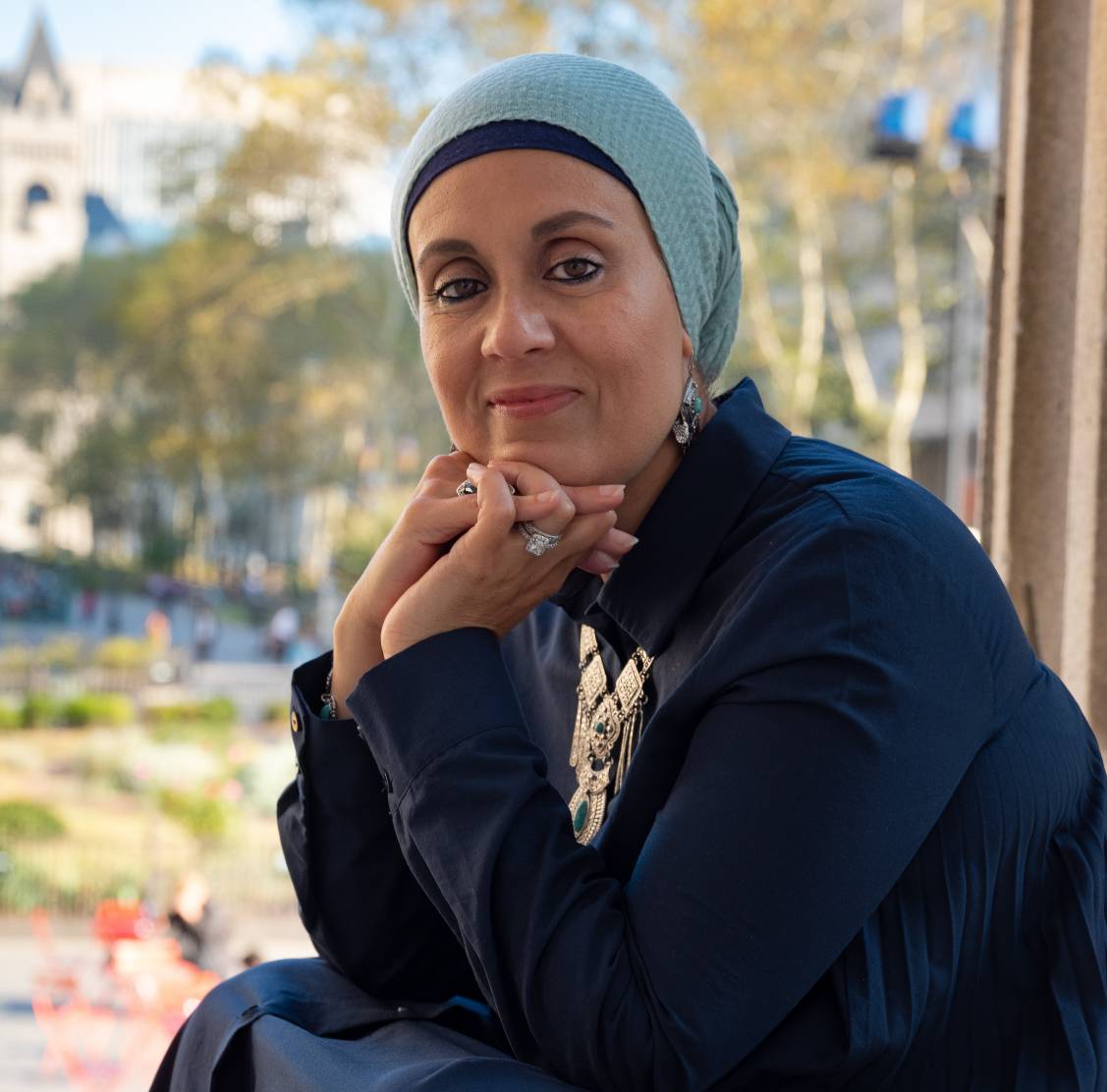
About Debbie Almontaser
Dr. Debbie Almontaser is an internationally recognized educator, speaker, author, and advocate for cross-cultural understanding. As the Founder and CEO of Bridging Cultures Group, she is a respected community leader dedicated to promoting diversity and inclusivity. Over her extensive 25-year career in the NYC Public School System, Dr. Almontaser has held various roles, including special education teacher, literacy trainer, multicultural specialist, and diversity advisor. Notably, she established the Khalil Gibran International Academy in Brooklyn, NY, fostering an environment of cross-cultural understanding among students. You can read more about the author here.
Previous Post

May 1, 2025
Can Tech And Media Get Faith Right In AI Revolution?
Next Post
May 16, 2025 Why the Dead Sea Scrolls Matter Beyond Religion
Recent Comments
"Conservatives act like secularism is the enemy. A neutral secular government was designed to protect ..."
How Faith and Religion Shaped America’s ..."
"As a Pagan who is beyond tired of the same basic articles every October leading ..."
Rinse, Repeat, Ramadan: The Explainer Trap
"We need to ask ourselves what happens when a large majority of a population can ..."
What Research Really Shows About Religion ..."
"Good advice. I find more meaning and purpose when I reason with historical context. I ..."
Why the Truth Behind Your Holidays ..."
Browse Our Archives
Select a Category Beyond Christmas: Multi-faith Coverage During The Holidays Diversity Faith Amid the Fray: Reporting During Political Turbulence Faith and Inclusion After DEI: Media’s Role in Religious Representation Faith in the Digital Age: Ensuring Accuracy in Emerging Media Reporting Religious Persecution: How Media Can Inform Reports Uncategorized
Select a Month July 2026 March 2026 February 2026 December 2025 November 2025 October 2025 September 2025 August 2025 July 2025 June 2025 May 2025 April 2025 March 2025 February 2025 January 2025 December 2024 November 2024
Follow Us!
TAKE THE
Religious Wisdom Quiz
What does Paul say happens when we are baptized into Christ Jesus?
Select your answer to see how you score.
We receive the Holy Spirit We become children of God We are saved We are baptized into his death
Related posts from Coalition For Faith And Media

Why the Media Only Sees Faith in a...
How Faith and Religion Shaped America's First 250...
Rinse, Repeat, Ramadan: The Explainer Trap

5 Ways Newsrooms Can Improve Faith Coverage in...
TRENDING AT PATHEOS Religion News

Should Churches Endorse Political Candidates?
Amid a highly charged election season, federal court filings last month will...

Surrogacy's $15 Billion Boom Raises Hard Moral Questions
The current surrogacy situation is confusing and fast-evolving. Most of Europe...

Why the Media Only Sees Faith in a...
Faith Beyond the Headlines Faith rarely makes headlines when it is quietly...

Patheos July 2026 Featured Writer: Dr. Joey Cochran
Dr. Joey Cochran is a historian of religion, a General Editor of...

Patheos June 2026 Featured Writer: Dr. James F....
Dr. James F. McGrath holds the Clarence L. Goodwin Chair in New...

How Faith and Religion Shaped America's First 250...
Faith and the Founding: What Media Gets Wrong Religion has shaped America...
view all Religion News blogs
What Are Your Thoughts?leave a comment
Ad-Free & Subscriber Log-In Subscription Support
- About Us
- 2026 Calendar
- Videos
- Podcasts
- Library of World Religions
- Faith In Media Tracker
- Advertise With Us
- Write for Us
- Privacy Policy
- Terms of Service
- Do Not Sell My Data
- Contact Us
- Radiant Digital
- Manage Newsletter Subscriptions
- Unsubscribe From Notifications
- Sitemap
Copyright 2008-2026, Patheos. All rights reserved.
Subscription Support Ad-Free & Subscriber Log-In
Follow Patheos