
BuddhistCatholicContemplativeEvangelicalGeneral ChristianHinduJewishLatter-day SaintMuslimNew VisionsProgressive Christian
Beliefs
- Buddhist
- Catholic
- Contemplative
- Evangelical
- General Christian
- Hindu
- Jewish
- Latter-day Saint
- More Voices
- Muslim
- New Visions
- Pagan
- Progressive Christian
Topics
- Religion News
- Food and Religion
- Sports and Religion
- Religious Art
- Religious Music and Entertainment
- Religious Events
- History and Religion
- Style and Religion
- Politics and Religion
- Women in Religion
- Recreation Outdoors and Religion
- Business Finance and Religion
- Careers Workplace and Religion
- Education and Religion
- Family Parenting and Religion
- Health Fitness and Religion
- Home and Religion
- Relationships and Religion
- Technology and Religion
- Travel and Religion
Columnists
- Buddhist Columnists
- Business Finance and Religion Columnists
- Careers Workplace and Religion Columnists
- Catholic Columnists
- Contemplative Columnists
- Education and Religion Columnists
- Evangelists Columnists
- Family Parenting and Religion Columnists
- General Christian Columnists
- Health Fitness and Religion Columnists
- Hindu Columnists
- History and Religion Columnists
- Home and Religion Columnists
- Jewish Columnists
- More Voices Columnists
- Latter Day Columnists
- Muslim Columnists
- New Visions Columnists
- Nonreligious Columnists
- Pagan Columnists
- Politics and Religion Columnists
- Progressive Columnists
- Recreation Outdoors and Religion Columnists
- Relationships and Religion Columnists
- Religion News Columnists
- Religious Art Columnists
- Religious Events Columnists
- Religious Music and Entertainment Columnists
- Sports and Religion Columnists
- Style and Religion Columnists
- Technology and Religion Columnists
- Travel and Religion Columnists
- Women in Religion Columnists
Resource Library
- 2026 Calendar
- Library of World Religions
- The 100 Most Holy Places on Earth
- Patheos Answers
- Podcasts
- Videos
- Faith Leaders Database
- Anglican Episcopalian
- Bahai
- Baptist
- Buddhism
- Christianity
- Confucianism
- Eastern Orthodoxy
- Hinduism
- Holiness and Pentecostal
- ISKCON
- Islam
- Judaism
- Lutheran
- Methodist
- The Church of Jesus Christ of Latter-day Saints
- New Age
- Paganism
- Presbytarian and Reformed
- Protestantism
- Religion Behind the Scenes
- Roman Catholic
- Scientology
- Shia Islam
- Sikhism
- Sufism
- Sunni Islam
- Taoism
- Zen
- See all religions
Research Tools
 Ad-Free & Subscriber Log-In Subscription Support
Ad-Free & Subscriber Log-In Subscription Support
Follow Patheos 

- Trending:
- Forgiveness
- |
- Marriage
- |
- Consciousness
- |
- Death Penalty
- |
- Election
- |
- Halloween

- Home
- Evangelical
- Religion News
- Why the Fastest-Growing Churches Get Worship Wrong
Why the Fastest-Growing Churches Get Worship Wrong
Last updated on: August 6, 2026 at 12:27 pm by Shawn Paul Wood
Why the Fastest-Growing Churches Get Worship Wrong 2026-08-06T12:27:31-05:00 Shawn Paul Wood
Patheos Explore the world's faith through different perspectives on religion and spirituality! Patheos has the views of the prevalent religions and spiritualities of the world.
Here I Am to Worship, But Only if The Math is Right
A new Lifeway Research study says most churchgoers are “content with their church’s worship style.” Seventy-five percent, in fact.
That’s the headline, and on its own, it reads like good news for every Sunday morning in America.
It doesn’t stay alone for long, though. Set that number next to two other stories already making the rounds this year—both covered in “Close to Home.”
- Only one type of Protestant church is actually growing right now, riding the same style of praise radio that has looped for a decade.
- And the biggest crossover hit in Christian music history came from a band nobody would file under “worship.” Everyone’s comfortable. Growth and culture keep moving anyway — just not toward the thing everyone claims to be content with.
That’s the confluence worth sitting in for a minute. If contentment is real, why does growth cluster inside one narrow worship style? If the industry insists worship music has to sound one specific way, why does the breakout moment sound nothing like it?
Comfort gets sold to us as the safe zone. Maybe comfort is actually where things go quietly wrong, while everyone insists they’re fine.
I want to walk through a study, a genre, and a growth chart that don’t line up as neatly as the headlines suggest — and by the end, ask you to look at your own Sunday and figure out which zone you’re actually standing in.
Fair warning: This one’s going to hit close to home. Why? The comfort zone may actually be the danger zone.
Before your pastor mentions the news in the announcements, stay aware of other faith-based issues that hit “close to home.” Subscribe to our free newsletter to stay informed about what’s happening in the Church and how real Christians can help defend the love and work of Christ.
The Study: Content, But Complicated

Music in church? Yes. But God’s musical tastes don’t sound the same either. (Image Credit: Freepik)
Here’s what Lifeway actually found. Researchers surveyed 1,200 Protestant churchgoers last September and asked how they felt about their congregation’s worship style.
- 75% said satisfied.
- 13% wanted more liturgy.
- 5% wanted less.
- And the rest shrugged.
Break it down by age, though, and the story gets interesting fast. Churchgoers 18 to 49 reported only 69% satisfaction — the lowest of any age bracket. Churchgoers 50 to 64 hit 80%. And younger adults were twice as likely as older ones to say they wanted more liturgy in their worship style, not less. That said, 18% and 19% of the under-50 crowd asked for more structure, while only 9% of the 50-plus crowd did.
Denominations split the numbers even further. Lutherans lean heavily liturgical (56% attend very liturgical churches). Non-denominational churchgoers lean the opposite way — 45% report no liturgical style at all. Baptists sit comfortably in the middle at 71% satisfaction.
Translation: Contentment isn’t one flat number. It’s generational and denominational, shaped entirely by whatever worship style first came into a person’s experience. It’s in the mix of malaise found at whatever church someone attends, how they choose to celebrate the risen Lord, and how their passion for praise manifests in a public forum.
Nobody polled these churchgoers on the other worship styles they never got a chance to try. Satisfaction measured against a menu of one option isn’t really satisfaction. It’s just the absence of a complaint.
That distinction matters because the same pattern shows up somewhere already discussed this year — a Christian rock band and a billion streams.
One Station, Every Sunday

Rock on! (Image Credit: Yohan Joy via Unsplash)
Back in July, Close to Home featured Skillet’s billion streams, exposing a problem in Christian music.
The short version: Skillet’s “Monster” — an industrial rock song about internal struggle, not a worship anthem — became the only Christian-adjacent track to cross a billion Spotify streams. Meanwhile, Christian and gospel streaming grew 18.5% in a single year, quadrupling the national average. The audience wants variety. Lecrae, Lauren Daigle, and NOBIGDYL are all proof of that.
But turn on praise radio and none of that variety survives the drive to the station. Radio and CCM playlists still funnel almost everything into one contemporary worship template, because that template is cheap to produce, easy to license, and safe to sell for every station manager chasing the same format. I called it an access problem, not an appeal problem. The appeal was always there. The pipeline narrowed it.
Worship style works the same way. Five to ten legitimate styles exist within American Christianity, and most churchgoers will spend their entire lives within one of them without ever sampling the rest. It’s not because they chose it over the others. The real reason is only that the others never got airtime in their town, their denomination, or their Spotify algorithm.
Contentment, in both cases, describes people who adapted to the only option handed to them. It doesn’t describe people who compared five options and picked the best one.
The Thriving Church Math Doesn’t Add Up
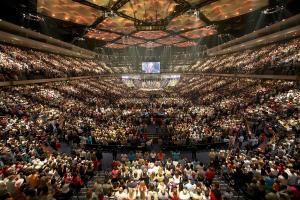
A former home of the Houston Rockets is now the largest U.S. church. (Image credit: @ToBeDaniel via Wikimedia Commons)
In June, Close to Home shared a study claiming only one kind of thriving church exists today.
The answer was active, experiential Protestant churches — Baptist, Pentecostal, non-denominational, Assemblies of God — built on contemporary worship and personal relationship over ritual. Passive, liturgical denominations are shrinking. Non-denominational churches alone grew from 5% of Protestants in 1972 to roughly 30% today.
Set that next to the Lifeway numbers, and something doesn’t line up. The demographic filling those thriving churches — contemporary, low-liturgy spaces, mostly — is the exact demographic reporting the lowest satisfaction with worship style and the highest demand for more liturgy. The group supposedly voting with its feet for casual, experiential worship is, by its own survey answers, hungriest for the thing it’s supposedly rejecting.
Dear Lifeway: That’s not a contradiction that the data resolves. It’s a contradiction the data exposes.
This growth isn’t happening because a generation studied every worship style and ranked contemporary first. It’s happening because contemporary carries the marketing budget, the radio presence, and the church-planting playbook. Growth measures what got promoted on praise radio and everywhere else. It doesn’t measure what would have won a fair fight.
Here or There, Pick the Room You Actually Want

Worship, at its heart, is between you and God. Whichever you life, He’ll meet you there. (Image Credit: Keagan Henman via Unsplash)
Line up all three stories, and one pattern runs through every single one. A study says churchgoers are content, but contentment correlates with age and access, not with real comparison.
A rock band proves Christian music’s problem was never appeal, only distribution. A denominational study crowns one worship style as the thriving church, while the very people filling those pews admit they want more of what that style deliberately strips out.
None of this means your church picked wrong, or that praise radio owes you a liturgy segment between the traffic report and the next chart-topper. It means “content” and “thriving church” are doing less work than headlines give them credit for. Both phrases describe what got distributed, not what got chosen.
So here’s the question I actually want to leave you with, and it’s not rhetorical. Have you ever walked into a worship style you didn’t grow up in — liturgical, charismatic, blended, quiet, loud, incense, drum kit — on purpose, just to see if it moved you? Or did you settle into whatever style your zip code, your parents, and your car radio handed you, and call the settling “contentment”?
Here or there, the room is still worship. But only one of you gets to decide whether you ever walked into the other room to check.
General Christian
Religious Music and Entertainment

About Shawn Paul Wood
Shawn Paul Wood, Th.D., is an award-winning copywriter, contributor, and content strategist, and ghostwriter of several faith-based articles, speeches, columns, and books who has worked for some of the most admirable brands in their respective industries for over 20 years. As Founder of Woodworks Communications, he leads teams of content strategists and marketing professionals to expand the brands of corporate leaders, serial entrepreneurs, and respected ministers of the Gospel. He aims to help others develop self-discovery through stories and the written word to proclaim the Word to the world. For more information about his portfolio or help telling your story, visit WoodworksCommunications.com. You can read more about the author here.
Previous Post

August 4, 2026
Will Believers Sit Through Passion of the Christ Again
Next Post

August 12, 2026 Biblical Masculinity: Jesus Already Nailed It
Recent Comments
Browse Our Archives
Select a Category Bible Business Church Editorial Education Entertainment History Lifestyle Music News Politics Uncategorized
Select a Month October 2026 September 2026 August 2026 July 2026 June 2026 May 2026 April 2026 March 2026 January 2026 December 2025 November 2025 September 2025 August 2025 July 2025 June 2025 May 2025 April 2025 March 2025 February 2025 January 2025 December 2024 November 2024 October 2024 September 2024 August 2024 July 2024 June 2024 May 2024 April 2024 March 2024 February 2024 January 2024 December 2023 November 2023 October 2023 September 2023
Follow Us!
TAKE THE
Religious Wisdom Quiz
Who was known as "the disciple whom Jesus loved"?
Select your answer to see how you score.
Peter James John Thomas
Related posts from Close to Home

Prop Bet: Josh Howerton and Internet Trolls Who...

Christian Media Taught Us How to Respect with...

This Filmmaker is Making a Movie to Find...

Middle Earth Takes a Step Closer Knocking on...
TRENDING AT PATHEOS Evangelical

Catholic Evangelization: Sharing Your Faith Every Day
Welcome back to the Graceful Awakening mini-series called, “From Faith to Mission.” ...

The Pillar of the Boatmen: the Ancient Monument...
The Pillar of the Boatmen is a Romano-Gaulish sculpture that dates from...

In one sense walking into Westminster Abbey is like walking down the...

'Super Scam Me' Exposes AI Jon Bon Jovi...
Leslie Pickett believed she was in a relationship with Jon Bon Jovi....

The Brazilian Remake of Kendricks' 'Flywheel' Opens in...
“Flywheel,” the story that launched the Kendrick Brothers’ filmmaking career is getting...

The Dangers of Gradual Accommodation (Winking at Sin)
Recently, the “law of gradualness” resurfaced during the opening of a weeklong,...
view all Evangelical blogs
What Are Your Thoughts?leave a comment
Ad-Free & Subscriber Log-In Subscription Support
- About Us
- 2026 Calendar
- Videos
- Podcasts
- Library of World Religions
- Faith In Media Tracker
- Advertise With Us
- Write for Us
- Privacy Policy
- Terms of Service
- Do Not Sell My Data
- Contact Us
- Radiant Digital
- Manage Newsletter Subscriptions
- Unsubscribe From Notifications
- Sitemap
Copyright 2008-2026, Patheos. All rights reserved.
Subscription Support Ad-Free & Subscriber Log-In
Follow Patheos