
BuddhistCatholicContemplativeEvangelicalGeneral ChristianHinduJewishLatter-day SaintMuslimNew VisionsProgressive Christian
Beliefs
- Buddhist
- Catholic
- Contemplative
- Evangelical
- General Christian
- Hindu
- Jewish
- Latter-day Saint
- More Voices
- Muslim
- New Visions
- Pagan
- Progressive Christian
Topics
- Religion News
- Food and Religion
- Sports and Religion
- Religious Art
- Religious Music and Entertainment
- Religious Events
- History and Religion
- Style and Religion
- Politics and Religion
- Women in Religion
- Recreation Outdoors and Religion
- Business Finance and Religion
- Careers Workplace and Religion
- Education and Religion
- Family Parenting and Religion
- Health Fitness and Religion
- Home and Religion
- Relationships and Religion
- Technology and Religion
- Travel and Religion
Columnists
- Buddhist Columnists
- Business Finance and Religion Columnists
- Careers Workplace and Religion Columnists
- Catholic Columnists
- Contemplative Columnists
- Education and Religion Columnists
- Evangelists Columnists
- Family Parenting and Religion Columnists
- General Christian Columnists
- Health Fitness and Religion Columnists
- Hindu Columnists
- History and Religion Columnists
- Home and Religion Columnists
- Jewish Columnists
- More Voices Columnists
- Latter Day Columnists
- Muslim Columnists
- New Visions Columnists
- Nonreligious Columnists
- Pagan Columnists
- Politics and Religion Columnists
- Progressive Columnists
- Recreation Outdoors and Religion Columnists
- Relationships and Religion Columnists
- Religion News Columnists
- Religious Art Columnists
- Religious Events Columnists
- Religious Music and Entertainment Columnists
- Sports and Religion Columnists
- Style and Religion Columnists
- Technology and Religion Columnists
- Travel and Religion Columnists
- Women in Religion Columnists
Resource Library
- 2026 Calendar
- Library of World Religions
- The 100 Most Holy Places on Earth
- Patheos Answers
- Podcasts
- Videos
- Faith Leaders Database
- Anglican Episcopalian
- Bahai
- Baptist
- Buddhism
- Christianity
- Confucianism
- Eastern Orthodoxy
- Hinduism
- Holiness and Pentecostal
- ISKCON
- Islam
- Judaism
- Lutheran
- Methodist
- The Church of Jesus Christ of Latter-day Saints
- New Age
- Paganism
- Presbytarian and Reformed
- Protestantism
- Religion Behind the Scenes
- Roman Catholic
- Scientology
- Shia Islam
- Sikhism
- Sufism
- Sunni Islam
- Taoism
- Zen
- See all religions
Research Tools
 Ad-Free & Subscriber Log-In Subscription Support
Ad-Free & Subscriber Log-In Subscription Support
Follow Patheos 

- Trending:
- Forgiveness
- |
- Marriage
- |
- Consciousness
- |
- Death Penalty
- |
- Election
- |
- Halloween

- Home
- Evangelical
- Religion News
- The Biblist: 10 Surprises About the Bible You May Not Know
The Biblist: 10 Surprises About the Bible You May Not Know
Last updated on: April 25, 2025 at 5:34 pm by Shawn Paul Wood
The Biblist: 10 Surprises About the Bible You May Not Know 2025-04-25T17:34:12-05:00 Shawn Paul Wood
Patheos Explore the world's faith through different perspectives on religion and spirituality! Patheos has the views of the prevalent religions and spiritualities of the world.
Many Bible fans, readers, teachers, and theologians can recall some of the common trivia questions found in the Bible’s over 720,000 words (depending on the version you’re reading). They have been heard in VBS or from the pulpit in church, at home or among friends. These were surprises at one time:
- Shortest verse: John 11:35
- Longest verse: Esther 8:9
- How many chapters in the Bible: 1,189
- Most common number in the Bible: 12
- Longest name in the Bible: Mahershalalhashbaz (Isaiah 8:1-3)
- Shortest name in the Bible: 7 are tied: Ai (Joshua 7:2), Ar (Numbers 21:15), No (Jeremiah 46:25) and Ur (Genesis 11:28). People’s name that have only two letters are Og (a giant king, Numbers 21:33), Er (Genesis 38:3), Ir (1Chronicles 7:12), So (2Kings 17:4), Uz (Genesis 10:23) and lastly On (Numbers 16:1).
No matter how often you read the Bible or if you can count the times you have gone “cover to cover,” there are some surprises in the Bible you may not recall. You have read this scripture a dozen times, but when you slow down long enough, someone points out a note you never knew was there. Those are the surprises in the Bible that never fail to delight, surprise, or completely confuse God’s people.
Are there more surprises in the Bible that you may not have known? Would these biblical unearthed moments give you joy or frustration? (The answer is “yes” by the way.) These revelations will hit close to home, maybe your funny bone or where it hurts. Let’s find out how in the latest edition of “The Biblist.”
Before we delve into those questions and gain an understanding, stay in touch with faith-based issues that hit “close to home.” Subscribe to our free newsletter and never miss what’s being said about the Church and being done in the Church—and what real Christians can say and do in return to defend the love and work of Christ.
1. Jesus was not an only child
In every room Jesus walked into, He was the center of attention. While that part is not among the surprises in the Bible, his family makeup may be. Everyone knew there was something different, something special about Him—including his brothers and sisters. Most Christians only talk about Mary, Joseph, and their son, Jesus, but they were a married couple with other children. Seriously!
“Isn’t this the carpenter’s son? Isn’t his mother’s name Mary, and aren’t his brothers James, Joseph, Simon and Judas? Aren’t all his sisters with us? Where then did this man get all these things?” (Matthew 13:55-56 NIV).
2. The Sinner’s Bible
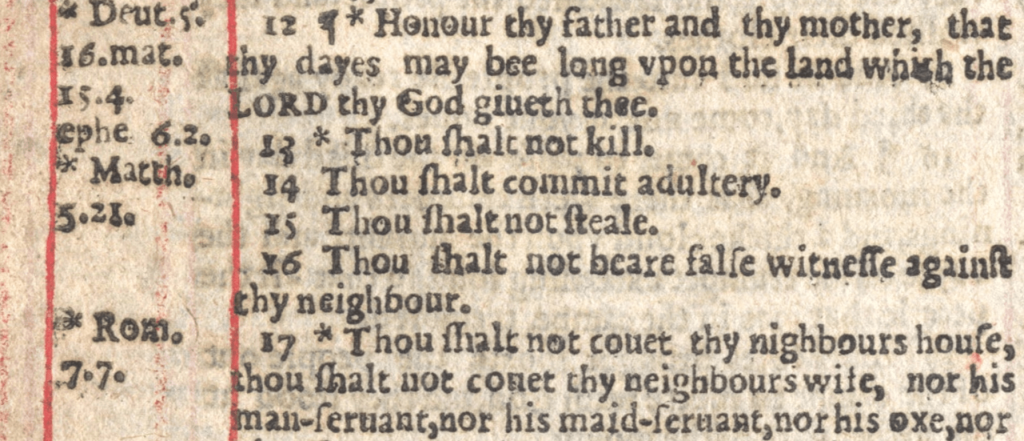
God inspires the Word. The typeface is input by man. (Image Credit: Bonhamms via Wikimedia)
That is a real page of Exodus 20 printed in 1631, now known as “The Sinner’s Bible” or “The Wicked Bible.” In verse 14, the “not” was missing, so the 7th Commandment reads, “Thou shalt commit adultery.” There were 1,000 Bibles printed with that unfortunate typo. A year later, most were recovered and destroyed, but today, there are still 10 that still exist.
3. Astronomy proves the Bible
For millennia, scientists of all disciplines have fastidiously pursued science in an attempt to disprove scripture. And then there are times when those same scientists had to marvel at the cosmic truths inside the Bible to learn that God stated what took man to prove in centuries.
- “He stretches out the north over empty space; He hangs the earth on nothing” (Job 26:7). Although it is believed in the 3rd century BCE that Aristotle began to scribe that the earth was floating in space, it wasn’t until James Bradley in 1725 provided scientific evidence for the Earth’s orbit around the sun. Yet, “hangs on the earth on nothing” was written in 3500 BC?!
- “It is He who sits above the circle of the earth” (Isaiah 40:22). Today, the flat-earther craze is global, but about 2,800 years ago, a prophet proclaimed the planet was round because God told him that.
- “As the host of heaven cannot be numbered, nor the sand of the sea measured…” (Jeremiah 33:22). Revered astrophysicist Neil DeGrasse Tyson shares the vast depth of the universe. He shares that it’s proven that there are countless billions of stars in the universe. Yet, nearly 4,000 years ago, the prophet Jeremiah said those same stars “cannot be numbered.” Thanks for the news flash, Neil.
4. People don’t care about the 8th Commandment
“Thou shalt not steal” (Exodus 20:15 KJV)
For decades, it has been said and proven that the Bible is the most-sold book ever. It’s the first Best-Seller, but imagine how many more numbers the Holy Bible would ring at the cash registers if people paid every time. As the most widely printed book on Earth, several surveys show the Bible is the most stolen book of all time. This is not one of the surprises in the Bible, but about it?! Ironic much?
5. There’s something in the water
The flood was a biblical line in the proverbial sand, a divine Etch-a-Sketch. And God shook that thing up good. We know about the animals that Noah walked into the Ark (Genesis 7:15), and we have even seen archaeological reports of where it may have landed. But what happened to humanity’s life expectancy? Before the flood, Methuselah lived to be 969, and his son, Lamech, died at the perfect age of 777. Adam lived 930 years, and his third son, Seth, lived 912 years. Even Noah lived 950 years.
Then, the flood happens. Look at the ages. It was the reverse fountain of youth:
- “Abraham lived a hundred and seventy-five years. Then Abraham breathed his last and died at a good old age, an old man and full of years; and he was gathered to his people.” (Genesis 25:7-8 NIV)
- “Isaac lived a hundred and eighty years. Then he breathed his last and died and was gathered to his people, old and full of years. And his sons Esau and Jacob buried him.” (Genesis 35:28-29 NIV)
- “Jacob lived in Egypt seventeen years, and the years of his life were a hundred and forty-seven.” (Genesis 47:28 NIV)
- “David was thirty years old when he became king, and he reigned forty years.” (2 Samuel 5:4 NIV)
6. Picture this
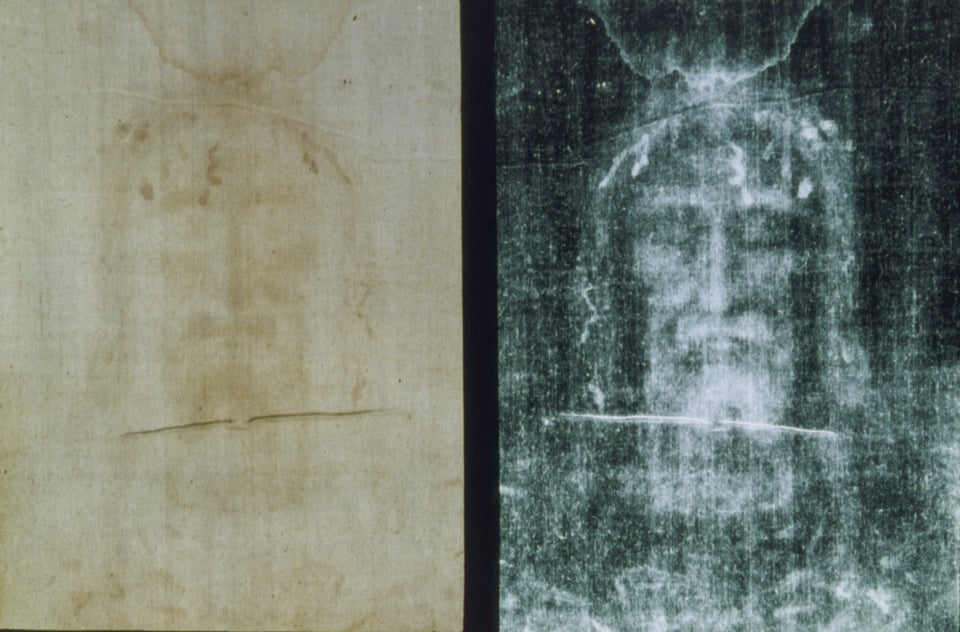
The Shroud of Turin is the closest many scholars believe we’ll ever get to know what Jesus looked like. (Image Credit: Dianelos Georgoudis via Wikimedia)
Look hard enough online; more than a dozen scholars will say there is no physical description of Jesus in the Bible. That’s not entirely true.
- His feet. Revelation 1:15 says Jesus’ feet are “onto fine (or burnished) brass as if refined in a furnace.”
- His hair and eyes. Revelation 1:14 describes John’s vision of Jesus with hair “like wool, as white as snow” and eyes “like a flame of fire.”
- His appearance. Although it is Jesus of Nazareth, He’s not what we would consider a cover model. Isaiah 53:2-3 says that Jesus would have “no form or comeliness; And when we see Him, there is no beauty that we should desire Him.” Jesus may have a “dad bod” or not, but one thing is clear: he wasn’t a Middle Eastern Ryan Gosling or [insert your favorite actor here]. (No offense, Jesus.)
7. What did she say?
One of the most unfortunate numbers in the Bible reminds us of how women were perceived in biblical days. Make no mistake: Women have been the backbone behind every man’s righteous posture in the Bible. Yet, there’s this: There are approximately 1,770 men mentioned in the Bible. There are only 188 women. Of that, only 93 speak! All told, women say only 14,056 of the words in the Bible. Fortunately, today we have video because there are dynamic women speakers, teachers, evangelists, and yes, SBC, even pastors.
8. The Word of God never returns void
The Bible has been translated into **at least 3,756 languages—**complete translations available in 756 languages and the New Testament in an additional 1,726. Smaller portions of the Bible have been translated into another 1,274 languages. God called John Wycliffe for a strong purpose: translating the Bible from the Latin Vulgate into English. In the late 1300s, not every convert to Christianity could read Latin. “Surprises in the Bible?” Because ordinary people had no clue what was in it outside of what they were told.
Yet, what he did was considered sacrilege and heretical. The Papacy ruled over the Latin Vulgate because it locked out the laity of proper understanding. It was about control, and the Gospel is only to be controlled by the Lord. Because of his work, the Council of Constance erased his teachings in 1428—four decades after Wycliffe’s death. His bones were exhumed and burned to ashes when he was later scatted along the River Swift.
Yet, close to 3,800 languages later, we still admonish Wycliffe’s great work. As the kids say, “Not today, Satan.”
9. 3
Much can be said about numerology and the Bible. There’s another practice called “gematria,” which is how each letter in the Hebrew alphabet has a numerical value, such as “aleph” equals one and “beta” equals two. However, numerology studies how each Arabic numeral represents a theme, which can be seen and depicted in life.
It’s important to know that numerology is a Pagan practice, so it shouldn’t be equated to the Bible. How numbers evoke emotion and bring things to mind is solely symbolic of the Word of God. Yet, it’s fascinating to see how things can align when numbers come up in the Bible. Take the number three. We know that as the number of the Trinity, but that doesn’t explain why the word “Trinity” is nowhere in the Bible.
The concept of the Godhead—God, the Father; God, the Son; God, the Holy Spirit—is derived from Biblical passages and scholarly writings. The Council of Nicaea, in 325 AD, finalized the concept of the Trinity. Outside of the three gifts given to the baby Jesus, 3 shows up in a few novel ways:
- The Bible informs the world’s three primary religions: Christianity, Judaism, and Islam
- The Bible is written across three continents: Asia, Europe, and Africa
- The Bible was written in three original languages: Aramaic, Greek, and Hebrew
10. Amen

Enough said! (Image Credit: Steve Harvey via Unsplash [no, not that Steve Harvey])
When the Hebrew word “āmēn” was first used, it was meant to convey an exclamation, much like it is today in church. However, this is one of those surprises in the Bible many don’t consider. It was used as an exclamation in the Bible, too. Fundamentally, the word means “truly” or, most commonly, “so be it!” Because faith and ardent belief are required to understand the Word of God, that is also the last word in the entire Bible.
“The grace of our Lord Jesus Christ be with you all. Amen.” (Revelation 22:21 KJV)
Progressive Christian
Religious Music and Entertainment

About Shawn Paul Wood
Shawn Paul Wood, Th.D., is an award-winning copywriter, contributor, and content strategist, and ghostwriter of several faith-based articles, speeches, columns, and books who has worked for some of the most admirable brands in their respective industries for over 20 years. As Founder of Woodworks Communications, he leads teams of content strategists and marketing professionals to expand the brands of corporate leaders, serial entrepreneurs, and respected ministers of the Gospel. He aims to help others develop self-discovery through stories and the written word to proclaim the Word to the world. For more information about his portfolio or help telling your story, visit WoodworksCommunications.com. You can read more about the author here.
Previous Post

April 16, 2025
Why The Passion of the Christ's Real Meaning Means More
Next Post
May 7, 2025 'Christ on the Water' has Sean Duffy Drowning in Hate Mail
Recent Comments
Browse Our Archives
Select a Category Bible Business Church Editorial Education Entertainment History Lifestyle Music News Politics Uncategorized
Select a Month October 2026 September 2026 August 2026 July 2026 June 2026 May 2026 April 2026 March 2026 January 2026 December 2025 November 2025 September 2025 August 2025 July 2025 June 2025 May 2025 April 2025 March 2025 February 2025 January 2025 December 2024 November 2024 October 2024 September 2024 August 2024 July 2024 June 2024 May 2024 April 2024 March 2024 February 2024 January 2024 December 2023 November 2023 October 2023 September 2023
Follow Us!
TAKE THE
Religious Wisdom Quiz
What king was killed by an arrow in battle, fulfilling Elijah's prophecy?
Select your answer to see how you score.
Joash Ahab Jeroboam Ahaziah
Related posts from Close to Home

Prop Bet: Josh Howerton and Internet Trolls Who...

Christian Media Taught Us How to Respect with...
Would Hollywood Attract Gen Z By Having a...

The Biblist: The Top 20 Words Jesus Said...
TRENDING AT PATHEOS Evangelical

The Problem with False Prophets
Miller’s Station UMC| 10/18/26| Anchor Verse: Jeremiah 23: 1, 9-23 I...

Emotion in Early Christianity by Andrew Crislip
Andrew Crislip’s Emotion in Early Christianity examines an often overlooked dimension of...

16 Spiritual Touchstones for a More Grounded Life
After decades of spiritual study, here are 16 principles I try...

Catholic Evangelization: Sharing Your Faith Every Day
Welcome back to the Graceful Awakening mini-series called, “From Faith to Mission.” ...

The Pillar of the Boatmen: the Ancient Monument...
The Pillar of the Boatmen is a Romano-Gaulish sculpture that dates from...

In one sense walking into Westminster Abbey is like walking down the...
view all Evangelical blogs
What Are Your Thoughts?leave a comment
Ad-Free & Subscriber Log-In Subscription Support
- About Us
- 2026 Calendar
- Videos
- Podcasts
- Library of World Religions
- Faith In Media Tracker
- Advertise With Us
- Write for Us
- Privacy Policy
- Terms of Service
- Do Not Sell My Data
- Contact Us
- Radiant Digital
- Manage Newsletter Subscriptions
- Unsubscribe From Notifications
- Sitemap
Copyright 2008-2026, Patheos. All rights reserved.
Subscription Support Ad-Free & Subscriber Log-In
Follow Patheos