
BuddhistCatholicContemplativeEvangelicalGeneral ChristianHinduJewishLatter-day SaintMuslimNew VisionsProgressive Christian
Beliefs
- Buddhist
- Catholic
- Contemplative
- Evangelical
- General Christian
- Hindu
- Jewish
- Latter-day Saint
- More Voices
- Muslim
- New Visions
- Pagan
- Progressive Christian
Topics
- Religion News
- Food and Religion
- Sports and Religion
- Religious Art
- Religious Music and Entertainment
- Religious Events
- History and Religion
- Style and Religion
- Politics and Religion
- Women in Religion
- Recreation Outdoors and Religion
- Business Finance and Religion
- Careers Workplace and Religion
- Education and Religion
- Family Parenting and Religion
- Health Fitness and Religion
- Home and Religion
- Relationships and Religion
- Technology and Religion
- Travel and Religion
Columnists
- Buddhist Columnists
- Business Finance and Religion Columnists
- Careers Workplace and Religion Columnists
- Catholic Columnists
- Contemplative Columnists
- Education and Religion Columnists
- Evangelists Columnists
- Family Parenting and Religion Columnists
- General Christian Columnists
- Health Fitness and Religion Columnists
- Hindu Columnists
- History and Religion Columnists
- Home and Religion Columnists
- Jewish Columnists
- More Voices Columnists
- Latter Day Columnists
- Muslim Columnists
- New Visions Columnists
- Nonreligious Columnists
- Pagan Columnists
- Politics and Religion Columnists
- Progressive Columnists
- Recreation Outdoors and Religion Columnists
- Relationships and Religion Columnists
- Religion News Columnists
- Religious Art Columnists
- Religious Events Columnists
- Religious Music and Entertainment Columnists
- Sports and Religion Columnists
- Style and Religion Columnists
- Technology and Religion Columnists
- Travel and Religion Columnists
- Women in Religion Columnists
Resource Library
- 2026 Calendar
- Library of World Religions
- The 100 Most Holy Places on Earth
- Patheos Answers
- Podcasts
- Videos
- Faith Leaders Database
- Anglican Episcopalian
- Bahai
- Baptist
- Buddhism
- Christianity
- Confucianism
- Eastern Orthodoxy
- Hinduism
- Holiness and Pentecostal
- ISKCON
- Islam
- Judaism
- Lutheran
- Methodist
- The Church of Jesus Christ of Latter-day Saints
- New Age
- Paganism
- Presbytarian and Reformed
- Protestantism
- Religion Behind the Scenes
- Roman Catholic
- Scientology
- Shia Islam
- Sikhism
- Sufism
- Sunni Islam
- Taoism
- Zen
- See all religions
Research Tools
 Ad-Free & Subscriber Log-In Subscription Support
Ad-Free & Subscriber Log-In Subscription Support
Follow Patheos 

- Trending:
- Forgiveness
- |
- Marriage
- |
- Consciousness
- |
- Death Penalty
- |
- Election
- |
- Halloween

- Home
- Evangelical
- Religion News
- Are New Year’s Resolutions Something Christians Should Do?
Are New Year’s Resolutions Something Christians Should Do?
Last updated on: January 8, 2025 at 11:44 am by Shawn Paul Wood
Are New Year’s Resolutions Something Christians Should Do? 2025-01-08T11:44:51-06:00 Shawn Paul Wood
Patheos Explore the world's faith through different perspectives on religion and spirituality! Patheos has the views of the prevalent religions and spiritualities of the world.
“Do not call to mind the former things; pay no attention to the things of old. Behold, I am about to do something new; even now it is coming. Do you not see it?” (Isaiah 43:18-19 BSB)
Someone shares this scripture during most New Year’s Eve services or perhaps this first Sunday following the big crystal ball dropping into 2025. With the calendar changing years, the “old has passed away.” And, fortunately, or not, “the new has come.” We often hear the term “resolutions” with every gulp of blackeyed peas, but do they mean anything to Christians? Really?
New Year’s resolutions are firm decisions we plant in our minds as the tentpoles of success for the following months. Then comes February, when most of those commitments vanish, like the back rows in church during closing remarks. Did you know resolutions have been made for over 4,000 years? Ancient Babylonians had a religious New Year’s Day festival called “Akitu.” It was a 12-day celebration of sowing barley and hoping for a rich harvest. The Sumerian people would promise to pay debts, share with others, and remain dedicated to their word.
Their gods would bestow favors if they kept their promises (apparently, it was an honor system). Although some were sacrificed to their highest God, Marduk, this event is considered the first of “resolutions” to begin a new year. Fast-forward to Caesarian Rome. Did you know the month of New Year’s is named after a two-faced god named Janus?
He would look back on the year that was, take a record of your efforts, and set you up for blessings for the year to come. Sounds like a foolproof system. With all the pagan ritualism associated with New Year’s Eve, why do Christians make New Year’s resolutions–and believe in them?
Before we delve into that question, do you want to stay in touch with faith-based issues “close to home?” Subscribe to our free newsletter and never miss what’s being said about the Church or what Christians can say back.
John Wesley: New Year’s Resolutions Guy?
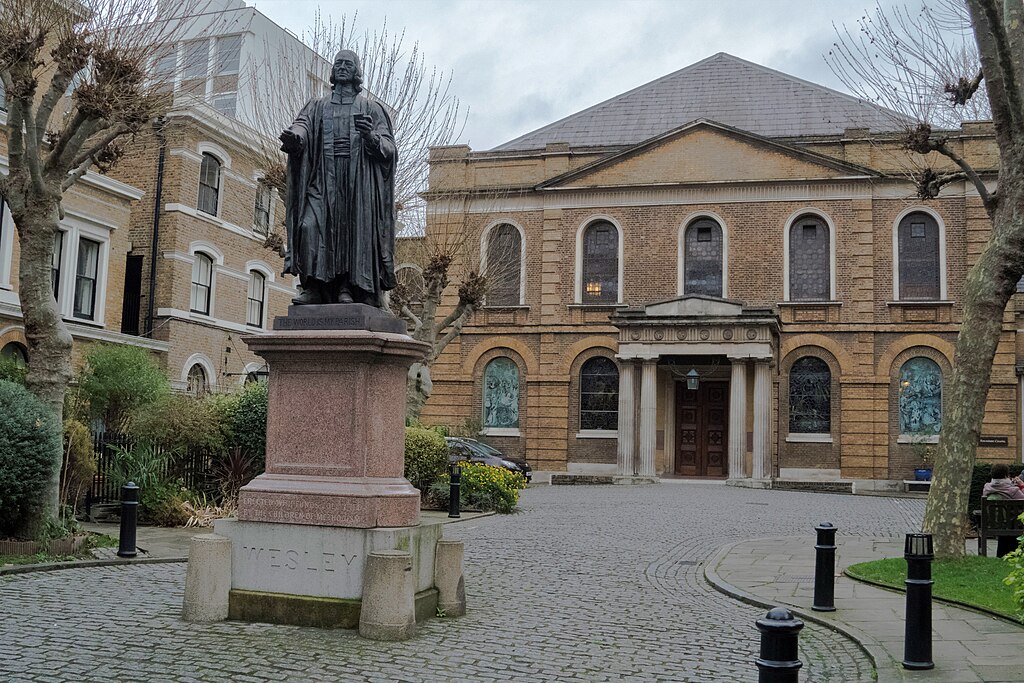
So, this guy is the reason for New Year’s resolution in the Church?! (Image Credit: Wesley’s Chapel, Methodist headquarters, London, England via Wikimedia)
In the middle of the 18th century, an Anglican minister and evangelist traveled across England, claiming many bold opinions in barns, tents, and public squares. Things like:
- The American Revolution was misleading because how can colonists “proclaim freedom and practice slavery?”
- Orthodoxy was fake because anyone could possess standards of religion and still be lost in the eyes of God.
- Religion should never be kept inside the church, for only outside of it can change people’s lives.
Those three strong opinions slapped the British in the face because that kind of unabashed thought was thought to be outside decorum, which is why many British evangelists of note (i.e., George Whitfield, Gilbert Tennent, Jonathan Edwards) came to the States in the first place. Wesley was banned from Anglican churches for “unorthodox methods” and became the father of what would later be called “tent revivals.” He would start a “holy club” with his brother Charles at Oxford, eventually becoming the United Methodist Church.
Overseeing this separate church was a mighty undertaking. Because Wesley mandated remaining unorthodox and evangelistic, he created a “Covenant Renewal” service for all members. In 1755, he coined the term “Watch Night” for a service. The prayers were thought to cause the service to go overtime or last “into the night” or “overnight.” Naturally, this became an annual event.
Yes, the New Year’s celebration service at midnight in churches of all denominations today, where resolutions are considered the norm for Christians, happened because of John Wesley.
So, are they safe to be considered “Christian” now? Eh, it depends on your interpretation of righteousness.
The Righteousness of Resolutions

New Year’s resolutions are about staking a claim like this. (Image Credit: Hugues de Buyer-Mimeure via Unsplash)
If you strive for “right standing by God,” a spiritual focus should be about complete reliance on His Word and will. New Year’s resolutions don’t quite work like that for most people. They give us a checklist for needs and want to provide a parameter for managing life more effectively- our way.
Chronologically speaking, the only difference between December 31 and January 1 is a number. It’s a day like any other. Both are 24 hours long, and each consists of day and night. Yet, the mythical idea that we can Etch-a-Sketch life between those two days is remarkable for anyone, specifically a Christian. We know doing anything in our power is pointless, but we keep trying.
Then, when New Year’s resolutions come around, we tend to think that our work will take shape now. We’re no better than the Apostle Paul, who said, “I have the desire to do what is good, but I cannot carry it out” (Romans 7:18). Stopping smoking, eating junk, cursing, or any other vice is a good desire, but come February, what are you doing? Once you shatter your glass ceiling, you convince yourself, “Welp, there is always next year.”
If any child of God wants to make a resolution, create one. If you wish to do so, that too, but understand the pressure placed on our shoulders that is there because we allow it. God doesn’t. Whatever resolution you make to fix your troubles, God knows what’s coming. Take Samuel.
But the Lord said to Samuel, “Do not look on his appearance or on the height of his stature, because I have rejected him. For the Lord sees not as man sees: man looks on the outward appearance, but the Lord looks on the heart.” (1 Samuel 16:7 ESV)
And if you enjoy talking to the “New Year Baby,” remember there’s something different about all New Year’s resolutions: They may be God’s ideas for your life.
A man’s mind plans his way [as he journeys through life], but the LORD directs his steps and establishes them. (Proverbs 16:9 AMP)
Should the child of God rely on resolutions? If you want. Better yet, should the child of God rest until they reach a destination? Absolutely.
For example, what if your resolution is losing weight? God has a destination where you can arrive with solid wisdom to help you achieve that goal. “For physical exercise is of limited value, but godliness is valuable in every way, holding promise for the present life and for the one to come.” (1 Timothy 4:8 BSB)
Jesus isn’t saying we shouldn’t work out or strive to live healthier, but do it righteously. “‘All things are lawful for me,’ but not all things are helpful. ‘All things are lawful for me,’ but I will not be dominated by anything.'” (1 Corinthians 6:12 ESV)
Make every day a destination for your spiritual life, and resolutions aren’t as necessary. God wants us to arrive and reach a finish line.
General Christian
History and Religion

About Shawn Paul Wood
Shawn Paul Wood, Th.D., is an award-winning copywriter, contributor, and content strategist, and ghostwriter of several faith-based articles, speeches, columns, and books who has worked for some of the most admirable brands in their respective industries for over 20 years. As Founder of Woodworks Communications, with a master’s and doctorate in Theology, he leads teams of content strategists and marketing professionals to expand the brands of corporate leaders, serial entrepreneurs, and respected ministers of the Gospel. Before working with global communications agencies, he was a media relations director and communications executive for noted leaders, such as Abide, D/FW International Airport, UNCF, Mannatech, Christians United for Israel, Avocados from Mexico, U.S. Navy SEAL Chris Kyle, Darden, and Bishop T.D. Jakes. He aims to help others develop self-discovery through stories and the written word to proclaim the Word to the world. For more information or help telling your story, visit WoodworksCommunications.com. You can read more about the author here.
Previous Post

December 23, 2024
"Sexually Explicit" Loophole Removes Bible in Texas Schools
Next Post

January 16, 2025 In Memoriam: Coach Bill McCartney, Promise Keepers Founder
Recent Comments
Browse Our Archives
Select a Category Bible Business Church Editorial Education Entertainment History Lifestyle Music News Politics Uncategorized
Select a Month October 2026 September 2026 August 2026 July 2026 June 2026 May 2026 April 2026 March 2026 January 2026 December 2025 November 2025 September 2025 August 2025 July 2025 June 2025 May 2025 April 2025 March 2025 February 2025 January 2025 December 2024 November 2024 October 2024 September 2024 August 2024 July 2024 June 2024 May 2024 April 2024 March 2024 February 2024 January 2024 December 2023 November 2023 October 2023 September 2023
Follow Us!
TAKE THE
Religious Wisdom Quiz
Who said, "Who am I, that I should go to Pharaoh?"
Select your answer to see how you score.
Moses Aaron Joshua Elijah
Related posts from Close to Home
This Filmmaker is Making a Movie to Find...

The Biblist: The Top 20 Words Jesus Said...

Barna: Why Don't Believers Have More of a...

Biblical Masculinity: Jesus Already Nailed It
TRENDING AT PATHEOS Evangelical

The First Eucharistic Controversy: Christ’s Real Presence
For Catholics, the Eucharist is the source and summit of the Christian...

What a Stop Sign Can Teach Us About...
How to Make a Decision When You Can't Hear God Main point:...

Archdiocese Hosts Military Marriage Retreat in Germany
RASTATT, Germany — The transient military lifestyle, with its frequent deployments and...

Nearly every morning, I make the drive to Detroit with my high-school-age...

The Real AI Story Is Adoption Without Trust
Artificial intelligence has crossed a political threshold. It is no longer a...

A new article, written by Jeff Lindsay and Gale L. Pooley,...
view all Evangelical blogs
What Are Your Thoughts?leave a comment
Ad-Free & Subscriber Log-In Subscription Support
- About Us
- 2026 Calendar
- Videos
- Podcasts
- Library of World Religions
- Faith In Media Tracker
- Advertise With Us
- Write for Us
- Privacy Policy
- Terms of Service
- Do Not Sell My Data
- Contact Us
- Radiant Digital
- Manage Newsletter Subscriptions
- Unsubscribe From Notifications
- Sitemap
Copyright 2008-2026, Patheos. All rights reserved.
Subscription Support Ad-Free & Subscriber Log-In
Follow Patheos