
BuddhistCatholicContemplativeEvangelicalGeneral ChristianHinduJewishLatter-day SaintMuslimNew VisionsProgressive Christian
Beliefs
- Buddhist
- Catholic
- Contemplative
- Evangelical
- General Christian
- Hindu
- Jewish
- Latter-day Saint
- More Voices
- Muslim
- New Visions
- Pagan
- Progressive Christian
Topics
- Religion News
- Food and Religion
- Sports and Religion
- Religious Art
- Religious Music and Entertainment
- Religious Events
- History and Religion
- Style and Religion
- Politics and Religion
- Women in Religion
- Recreation Outdoors and Religion
- Business Finance and Religion
- Careers Workplace and Religion
- Education and Religion
- Family Parenting and Religion
- Health Fitness and Religion
- Home and Religion
- Relationships and Religion
- Technology and Religion
- Travel and Religion
Columnists
- Buddhist Columnists
- Business Finance and Religion Columnists
- Careers Workplace and Religion Columnists
- Catholic Columnists
- Contemplative Columnists
- Education and Religion Columnists
- Evangelists Columnists
- Family Parenting and Religion Columnists
- General Christian Columnists
- Health Fitness and Religion Columnists
- Hindu Columnists
- History and Religion Columnists
- Home and Religion Columnists
- Jewish Columnists
- More Voices Columnists
- Latter Day Columnists
- Muslim Columnists
- New Visions Columnists
- Nonreligious Columnists
- Pagan Columnists
- Politics and Religion Columnists
- Progressive Columnists
- Recreation Outdoors and Religion Columnists
- Relationships and Religion Columnists
- Religion News Columnists
- Religious Art Columnists
- Religious Events Columnists
- Religious Music and Entertainment Columnists
- Sports and Religion Columnists
- Style and Religion Columnists
- Technology and Religion Columnists
- Travel and Religion Columnists
- Women in Religion Columnists
Resource Library
- 2026 Calendar
- Library of World Religions
- The 100 Most Holy Places on Earth
- Patheos Answers
- Podcasts
- Videos
- Faith Leaders Database
- Anglican Episcopalian
- Bahai
- Baptist
- Buddhism
- Christianity
- Confucianism
- Eastern Orthodoxy
- Hinduism
- Holiness and Pentecostal
- ISKCON
- Islam
- Judaism
- Lutheran
- Methodist
- The Church of Jesus Christ of Latter-day Saints
- New Age
- Paganism
- Presbytarian and Reformed
- Protestantism
- Religion Behind the Scenes
- Roman Catholic
- Scientology
- Shia Islam
- Sikhism
- Sufism
- Sunni Islam
- Taoism
- Zen
- See all religions
Research Tools
 Ad-Free & Subscriber Log-In Subscription Support
Ad-Free & Subscriber Log-In Subscription Support
Follow Patheos 

- Trending:
- Forgiveness
- |
- Marriage
- |
- Consciousness
- |
- Death Penalty
- |
- Election
- |
- Halloween

- Home
- Evangelical
- Religion News
- Is Thanksgiving Truly a Christian Holiday or Just a Day?
Is Thanksgiving Truly a Christian Holiday or Just a Day?
Last updated on: November 20, 2024 at 12:18 pm by Shawn Paul Wood
Is Thanksgiving Truly a Christian Holiday or Just a Day? 2024-11-20T12:18:42-06:00 Shawn Paul Wood
Patheos Explore the world's faith through different perspectives on religion and spirituality! Patheos has the views of the prevalent religions and spiritualities of the world.
Most churchgoers believe Thanksgiving belongs to them; it’s a Christian holiday. The very name of the occasion is a phrase from the Bible; it’s what we do.
And on that day you will say, “Give thanks to the LORD, call on His name. Make known His deeds among the peoples; make them remember that His name is exalted.” Praise the LORD in song, for He has done glorious things; let this be known throughout the earth.
The essence of Thanksgiving is to express gratitude to the Lord and our loved ones for what we cherish and are able to share with others. There’s nothing Jesus-ish about the actual day, though, right? President Lincoln made Thanksgiving a federal holiday, but when did it become a Christian holiday? Was it always a date set aside to include God Almighty, or did Christians slide into its DMs and make something, sort of…um, Jesus-ish out of it?
Before we delve into this question, do you want to stay in touch with the faith-based issues that hit close to home? Subscribe to our free newsletter and never miss what’s being said about the Church and what Christians can say back.
The Roots of Thanksgiving
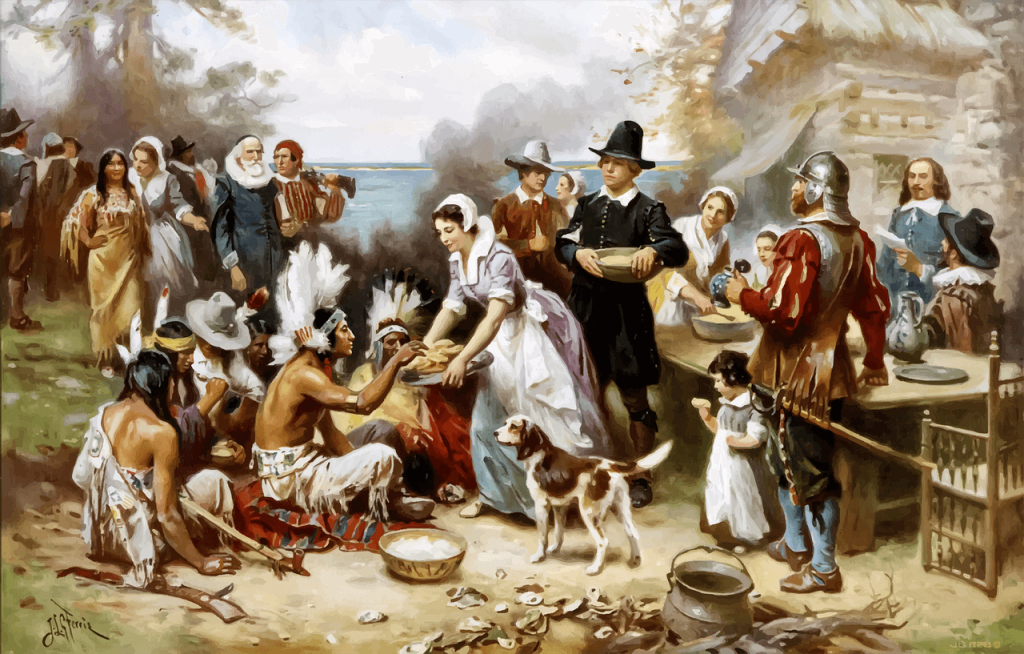
“The Pageant of a Nation,” an oil painting depicting the First Thanksgiving in 1620 (Image Credit: Jean Leon Gerome Ferris via Vintagraph)
Ask anyone, from a fourth grader to a senior citizen, about “the first Thanksgiving.” What comes to mind? What would they draw on manila paper if they were asked to put something on the refrigerator? Black hats with buckles. Long black robes with puffy white collars. Patent leather penny loafers with heels that make men walk knobby-kneed and slightly bowlegged.
In 1620, Christian separatists left the Orthodox, regimented Anglican Church of England and came to the New World to encounter a God of peace, liberty, and love. They landed at Plymouth Rock, starving, delirious, and riddled with scurvy. They also met a tribe of people named the Wampanoag who already lived there. As historians have learned, Chief Ousamequin (the “Sachem”) offered these newcomers a peace treaty and hoped for protection against their rivals, the Narragansetts.
The next year, the Pilgrim Governor William Bradford declared a feast of gratitude with the Wampanoag.
“Inasmuch as the great Father has given us this year an abundant harvest of Indian corn, wheat, peas, beans, squashes, and garden vegetables, and has made the forests to abound with game and the sea with fish and clams, and inasmuch as He has protected us from the ravages of the savages, has spared us from pestilence and disease, has granted us freedom to worship God according to the dictates of our own conscience.”
His words honored God and gave thanks to the Lord. They lifted up their eyes to the heavens. Yet, it can not be said the entire celebration was a “Christian holiday,” or was even what is now known as “Thanksgiving.” It was a harvest feast celebrating the lost–both Pilgrims and the Wampanoag–and commemorating good tidings for the future. Not for nothing, but they lived on the East Coast, so turkey, ham, and all the fixins’ had no place on their banquet table. It was probably a spread of mussels, lobster, bass, clams, and oysters, along with venison, corn, walnuts, and, of course, pumpkins.
Not many wild turkeys roam the New England coastline.
The meal in 1620 wasn’t a time of exclusive religious gaiety between the groups—only recognition of one another. Later, the Puritans showed up and helped evangelize the Pilgrims to thank God more vigorously during that time. Certainly, as any person of faith would do. However, through the colonial settlement, resistance from natural elements, lack of food, and creating a new life, it wouldn’t be until 1668 that the new colony on Plymouth Rock officially declared a “moment of Thanksgiving” to the Lord, which was on the fourth Thursday in November, according to the historical record.
Now, we have a Christian holiday, right? Well, not quite.
The Branches of Thanksgiving
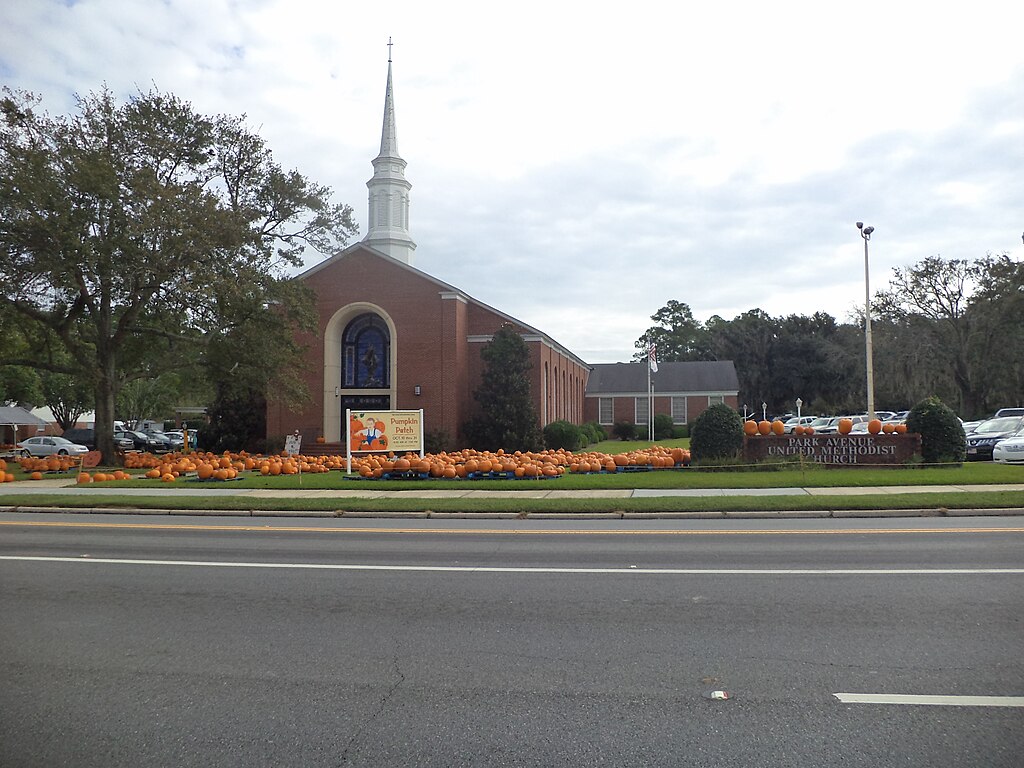
Pumpkin Patch at Park Avenue United Methodist Church, Valdosta, Lowndes County, Georgia (Image Credit: Michael Rivera via Wikimedia Commons)
Like any family tree, there are roots that dig deep and branches that reach out. From the turn of the 17th century, we know the Christian faith connected to Thanksgiving relates as far as Puritans who ate seafood, baked pumpkins, and were friends with a local tribe of Native Americans. As with all good things with God, it takes time to flourish. Fast-forward to October 3, 1789.
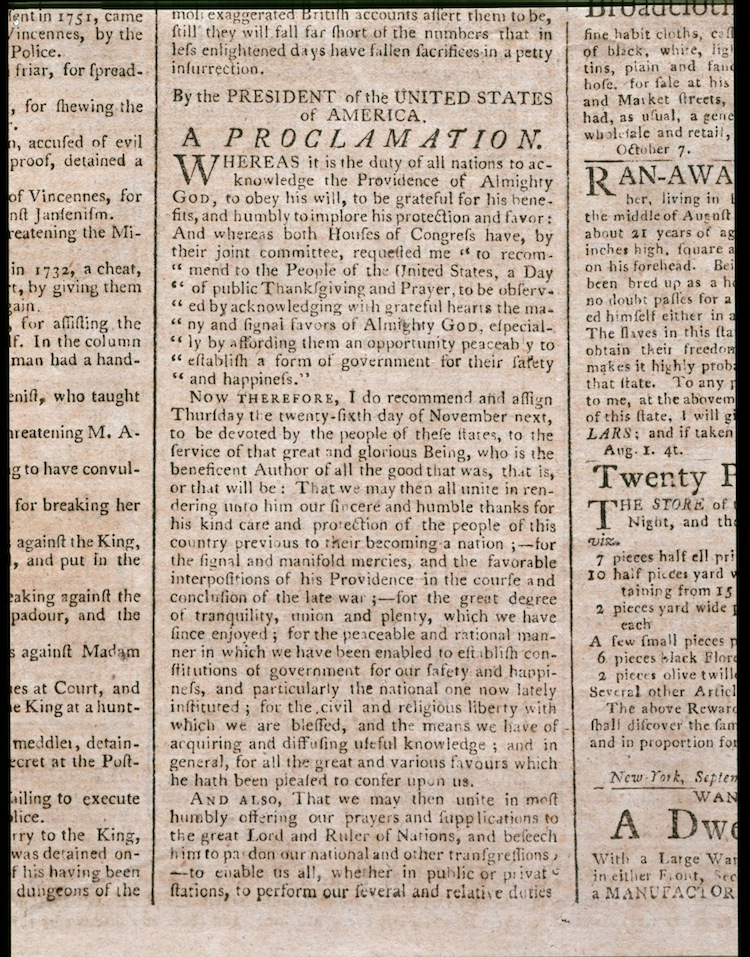
George Washington’s Thanksgiving Proclamation, 1789 (Image Credit: MountVernon.org)
George Washington, who was not an adult Christian, proclaimed the last Thursday of November to be a day of Thanksgiving to give thanks to the “Almighty.” Although raised in the Anglican church, he grew up as a deist. (And that’s different from a theist, who believes “a god” is actively involved in the world; Deists believe a god is there, but laws are already set up.)
That is a polished way to say that Washington “believed in a higher power” for his faith. He didn’t adhere to a Messiah but believed an inner strength came from core values provided by our Creator. In that proclamation, Washington wrote for “the People of the United States a day of public thanks-giving” to be held on “Thursday the 26th day of November,” 1789.
This served as the first national celebration of a holiday known as “Thanksgiving,” but it wasn’t necessarily dedicated to the Lord and thanks to the God we celebrate. People of God like to consider it a holy day, one set apart to draw attention to the Lord and our gratefulness.
But who am I, and who are my people, that we should be able to give as generously as this? For everything comes from You, and from Your own hand we have given to You.
Puritans came to America to celebrate God and their religion of honoring Jesus Christ. They read that scripture and honored the Lord when President Washington declared that day. However, the Pilgrims were not the Puritans. This is a common oversight in U.S. history. The Pilgrims were separatists. They left the Monarchy of England to live a life unencumbered by royal oversight–some were English Protestants leaving the Anglican church, and others were not.
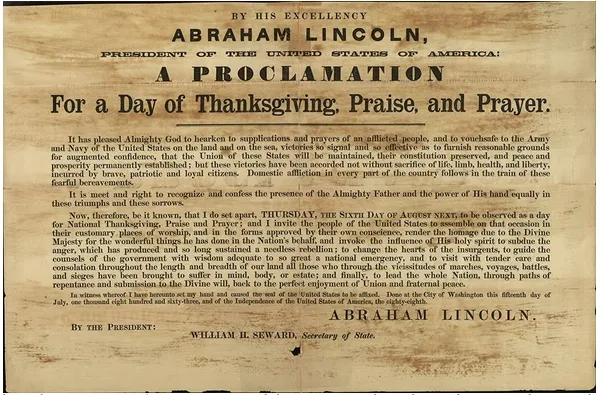
A copy of Abraham Lincoln’s Thanksgiving proclamation in 1863 (Image Credit: National Archives)
It took the advent of a Civil War and a Great Emancipator to make things more official.
On October 3, 1863, President Abraham Lincoln issued a proclamation (that honored Washington’s initial address in 1789) designating the last Thursday of November as “a day of Thanksgiving.” President Lincoln asked God for “blessings of fruitful fields and healthful skies.” He invited Americans to observe that day in 1790, pointing out that these blessings came from “the ever-watchful providence of God.”
“The year that is drawing towards its close, has been filled with the blessings of fruitful fields and healthful skies. To these bounties, which are so constantly enjoyed that we are prone to forget the source from which they come, others have been added, which are of so extraordinary a nature, that they cannot fail to penetrate and soften even the heart which is habitually insensible to the ever-watchful providence of Almighty God.”
The Purpose of Thanksgiving
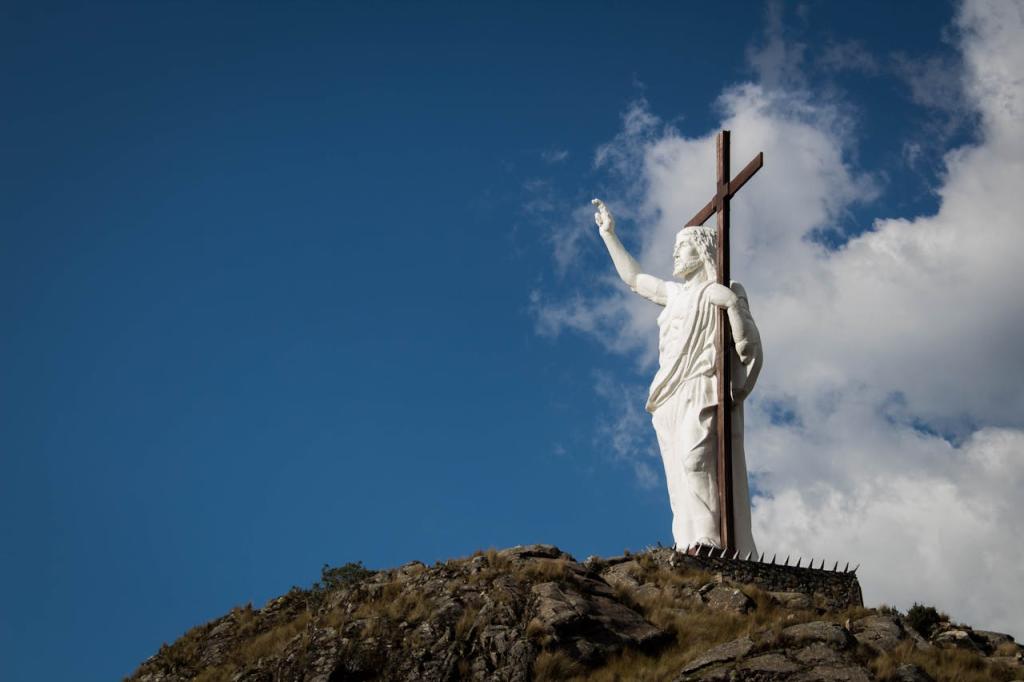
It didn’t begin as a holiday, but Thanksgiving is now a Christian holiday. (Image Credit: Renzo Tirado via Pexels)
What many believe began when Henry VIII declared himself as head of the Church of England in 1536 did become the open door for the English Reformation and an open mind toward Protestantism. The Anglican Church centered amid the Monarchy and the movement leading people to the New World for many reasons, including religious freedom. Thanksgiving is a beautiful day of fresh cooking, family loving, and football watching. For Christians, there is a substantial amount of God thanking.
Whether or not when the Pilgrims hosted the inaugural feast in 1620, God was the centerpiece of inspiration; thankfulness was the order of the day. And while it went from Pilgrims to Puritans, Washington to Lincoln, everyone had a different idea of what Thanksgiving should be. A 2024 Statista survey shows how U.S. adults think about the special day.
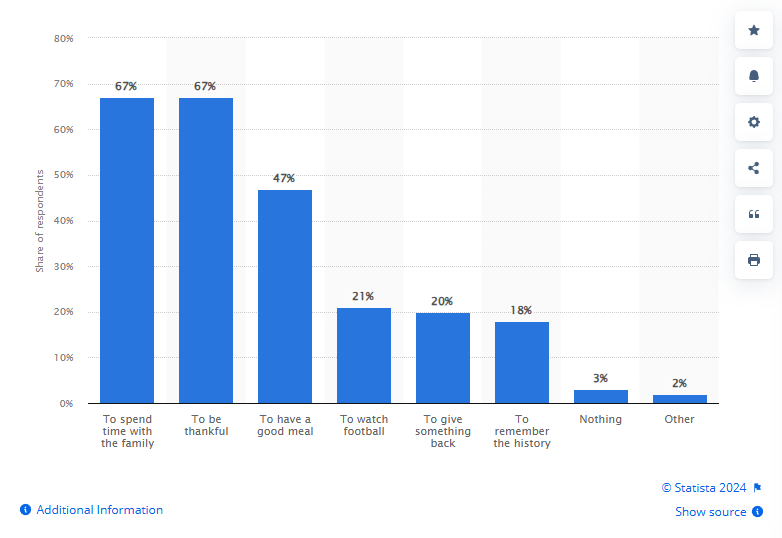
Family? Check. Good food? Check. Football? Check. No God, however. Where did the symbolism of this righteous day go? On the shelves awaiting Black Friday and the near $10 billion shopping spree? Maybe it’s the tryptophan that makes the majority of Americans forget to thank God? Whatever the case, the handle should be about why we give thanks.
They’ll tell you not to eat this or that food—perfectly good food God created to be eaten heartily and with thanksgiving by believers who know better! Everything God created is good, and to be received with thanks. Nothing is to be sneered at and thrown out. God’s Word and our prayers make every item in creation holy.
The day was created by strangers coming together, grateful for their friendship and communion. Christian people had an ardent belief that all things worth being thankful for should be addressed to God. It took 200 years for everything to become as official as we think it to be, but Thanksgiving is now a Christian holiday. Yet, whenever Christians got involved in 1663, we began offering thanks horizontally and vertically. The truth is Thanksgiving is not linked to any other holiday or celebrated day on the calendar—it is what you make it.
We use the word for the Body of Christ to inspire the act. Eat the turkey and watch the football. Enjoy your family and friends. Regardless of history, we focus on Christianity, so thanks be to God.
General Christian
History and Religion

About Shawn Paul Wood
Shawn Paul Wood, Th.D., is an award-winning copywriter, contributor, and content strategist, and ghostwriter of several faith-based articles, speeches, columns, and books who has worked for some of the most admirable brands in their respective industries for over 20 years. As Founder of Woodworks Communications, with a master’s and doctorate in Theology, he leads teams of content strategists and marketing professionals to expand the brands of corporate leaders, serial entrepreneurs, and respected ministers of the Gospel. Before working with global communications agencies, he was a media relations director and communications executive for noted leaders, such as Abide, D/FW International Airport, UNCF, Mannatech, Christians United for Israel, Avocados from Mexico, U.S. Navy SEAL Chris Kyle, Darden, and Bishop T.D. Jakes. He aims to help others develop self-discovery through stories and the written word to proclaim the Word to the world. For more information or help telling your story, visit WoodworksCommunications.com. You can read more about the author here.
Previous Post

November 13, 2024
Simple Questions About Christian Faith Needing Answers
Next Post

November 27, 2024 X-Machina: AI-Powered Jesus is a Thing in Switzerland Church
Recent Comments
Browse Our Archives
Select a Category Bible Business Church Editorial Education Entertainment History Lifestyle Music News Politics Uncategorized
Select a Month October 2026 September 2026 August 2026 July 2026 June 2026 May 2026 April 2026 March 2026 January 2026 December 2025 November 2025 September 2025 August 2025 July 2025 June 2025 May 2025 April 2025 March 2025 February 2025 January 2025 December 2024 November 2024 October 2024 September 2024 August 2024 July 2024 June 2024 May 2024 April 2024 March 2024 February 2024 January 2024 December 2023 November 2023 October 2023 September 2023
Follow Us!
TAKE THE
Religious Wisdom Quiz
True or False: 1 Peter teaches that judgment must begin with the family of God.
Select your answer to see how you score.
TRUE FALSE
Related posts from Close to Home

The Biblist: The Top 20 Words Jesus Said...
Burnt Beams From Jerusalem's Fall: God Lets the...
Yes, There Are Women Preachers and the Bible...
Are We Really a Christian Nation, And Why...
TRENDING AT PATHEOS Evangelical

How to Make a Decision When You Can't...
Main point: It’s much more valuable to stay close to God so...

Archdiocese Hosts Military Marriage Retreat in Germany
RASTATT, Germany — The transient military lifestyle, with its frequent deployments and...

Nearly every morning, I make the drive to Detroit with my high-school-age...

The Real AI Story Is Adoption Without Trust
Artificial intelligence has crossed a political threshold. It is no longer a...

A new article, written by Jeff Lindsay and Gale L. Pooley,...

Swimfan: Forgotten Aughts Pleasures
This is a recovery effort. In 2002, My Big Fat Greek Wedding...
view all Evangelical blogs
What Are Your Thoughts?leave a comment
Ad-Free & Subscriber Log-In Subscription Support
- About Us
- 2026 Calendar
- Videos
- Podcasts
- Library of World Religions
- Faith In Media Tracker
- Advertise With Us
- Write for Us
- Privacy Policy
- Terms of Service
- Do Not Sell My Data
- Contact Us
- Radiant Digital
- Manage Newsletter Subscriptions
- Unsubscribe From Notifications
- Sitemap
Copyright 2008-2026, Patheos. All rights reserved.
Subscription Support Ad-Free & Subscriber Log-In
Follow Patheos