
BuddhistCatholicContemplativeEvangelicalGeneral ChristianHinduJewishLatter-day SaintMuslimNew VisionsProgressive Christian
Beliefs
- Buddhist
- Catholic
- Contemplative
- Evangelical
- General Christian
- Hindu
- Jewish
- Latter-day Saint
- More Voices
- Muslim
- New Visions
- Pagan
- Progressive Christian
Topics
- Religion News
- Food and Religion
- Sports and Religion
- Religious Art
- Religious Music and Entertainment
- Religious Events
- History and Religion
- Style and Religion
- Politics and Religion
- Women in Religion
- Recreation Outdoors and Religion
- Business Finance and Religion
- Careers Workplace and Religion
- Education and Religion
- Family Parenting and Religion
- Health Fitness and Religion
- Home and Religion
- Relationships and Religion
- Technology and Religion
- Travel and Religion
Columnists
- Buddhist Columnists
- Business Finance and Religion Columnists
- Careers Workplace and Religion Columnists
- Catholic Columnists
- Contemplative Columnists
- Education and Religion Columnists
- Evangelists Columnists
- Family Parenting and Religion Columnists
- General Christian Columnists
- Health Fitness and Religion Columnists
- Hindu Columnists
- History and Religion Columnists
- Home and Religion Columnists
- Jewish Columnists
- More Voices Columnists
- Latter Day Columnists
- Muslim Columnists
- New Visions Columnists
- Nonreligious Columnists
- Pagan Columnists
- Politics and Religion Columnists
- Progressive Columnists
- Recreation Outdoors and Religion Columnists
- Relationships and Religion Columnists
- Religion News Columnists
- Religious Art Columnists
- Religious Events Columnists
- Religious Music and Entertainment Columnists
- Sports and Religion Columnists
- Style and Religion Columnists
- Technology and Religion Columnists
- Travel and Religion Columnists
- Women in Religion Columnists
Resource Library
- 2026 Calendar
- Library of World Religions
- The 100 Most Holy Places on Earth
- Patheos Answers
- Podcasts
- Videos
- Faith Leaders Database
- Anglican Episcopalian
- Bahai
- Baptist
- Buddhism
- Christianity
- Confucianism
- Eastern Orthodoxy
- Hinduism
- Holiness and Pentecostal
- ISKCON
- Islam
- Judaism
- Lutheran
- Methodist
- The Church of Jesus Christ of Latter-day Saints
- New Age
- Paganism
- Presbytarian and Reformed
- Protestantism
- Religion Behind the Scenes
- Roman Catholic
- Scientology
- Shia Islam
- Sikhism
- Sufism
- Sunni Islam
- Taoism
- Zen
- See all religions
Research Tools
 Ad-Free & Subscriber Log-In Subscription Support
Ad-Free & Subscriber Log-In Subscription Support
Follow Patheos 

- Trending:
- Forgiveness
- |
- Marriage
- |
- Consciousness
- |
- Death Penalty
- |
- Election
- |
- Halloween
 Cinemeditations
- Home
- Religious Music & Entertainment
- Review: “Almost Human” Finds Humanity Amidst Technology
Review: “Almost Human” Finds Humanity Amidst Technology
Last updated on: November 17, 2013 at 11:39 pm by Andrew Johnson
Review: “Almost Human” Finds Humanity Amidst Technology 2013-11-17T23:39:25-05:00 Andrew Johnson
Patheos Explore the world's faith through different perspectives on religion and spirituality! Patheos has the views of the prevalent religions and spiritualities of the world.
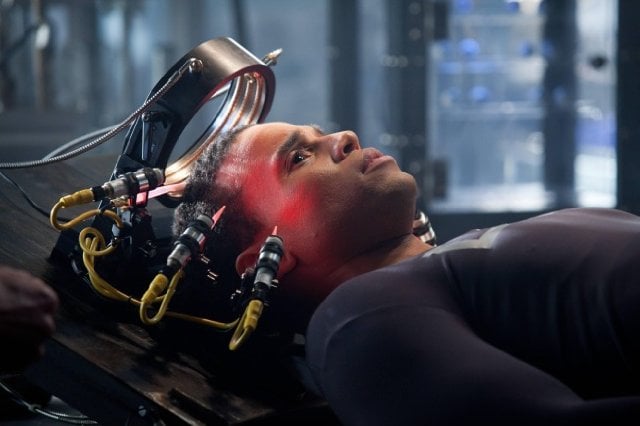
Sci-fi fans rejoice! Almost Human, the new hour-long weekly adventure from Fringe executive producer Joel Wyman, is finally here. The pilot aired last night as part of a two-night premiere event (the show will air regularly at 8 p.m. on Mondays), and you know what? There’s a lot to like.
Almost Human opens with police officer John Kennex (Star Trek’s Karl Urban) leading a squad in an urban assault on a mysterious gang known as The Syndicate. Things quickly go horribly wrong, however, and he wakes up 17 months later missing a leg and vague memories of what happened. When he returns to the force, he’s dismayed to discover it’s now mandatory for human officers to be paired with a synthetic android. After he casually disposes of his first partner—in one of the pilot’s most humorous scenes—he’s assigned to an older DRN model, a.k.a. Dorian (Michael Ealy). The DRNs were discontinued because they were emotionally unpredictable, much like humans, but Dorian’s laid-back and empathetic personality makes him an ideal match for Kennex’s gruff exterior.
There’s a lot of talent to work with here. Urban and Ealy achieve a smooth chemistry that makes the setup enjoyable, even though it’s familiar. Kennex’s boss, Captain Sandra Maldonado, was originally supposed to be played by a man, but I’m grateful the part went to Lili Taylor. It’s nice to see that in the future the glass ceiling has at least been cracked, and a woman is in charge of the LAPD. She comes across like a maternal figure for Kennex in the pilot, and I’m hopeful the show will add a few more layers to her as it progresses. Parenthood’s Minka Kelly plays a fellow officer but unfortunately doesn’t receive much screen time in the pilot, and Mackenzie Crook briefly shows up as the technician who introduces Kennex to Dorian.
Visually speaking, the show was clearly inspired by Blade Runner, which also followed a police officer and his interactions with androids. The cityscape is dominated by neon lights, dirty streets, and architecture that combines Eastern and Western influences. Wyman may be stealing, but at least he’s stealing from the best. The pilot (directed by Brad Anderson) reveals that street gangs are responsible for a lot of the crime, and there’s a seedy underbelly where all sorts of illicit activities take place. Kennex himself visits an underground medical center for dangerous treatments that could help him regain his memory, and one gets the impression there’s a lot to explore. The city feels grounded, like there could be a thousand intriguing things hiding behind every corner, and I’m looking forward to seeing more.
The pilot does a good job of introducing a lot of ideas that could be developed in future episodes. Kennex has a psychological aversion to synthetic technology—his robotic leg hasn’t fully integrated into his body and will occasionally freeze up. Dorian, meanwhile, wants to be accepted as an equal being, capable of emotional intimacy and friendship. It’s pretty much a given that they’ll be able to put aside their differences and work together, but the issues raised by their partnership could add a lot of complexity to their relationship. Do artificially intelligent beings deserve the same rights as humans? What makes something “human,” anyway? Are machines capable of genuine love? The central conceit of the show is interesting but familiar: we’ve all seen buddy cop programs, including a few where one of the partners was a little, shall we say, different. The success of Almost Human will depend entirely on how well the characters develop as they grapple with the world around them.
Executive producers Joel Wyman and J.J. Abrams recently spoke to Patheos and other outlets about their vision for the show, revealing that they see it, at least for now, as primarily a police procedural with a few subplots and themes that could be expanded on gradually. While the futuristic setting could allow for some interesting spins on traditional tropes, it’s certainly not uncommon for genre shows to embrace a “mission of the week”-style structure, especially early on. There’s a lot that Almost Human could explore, from our increasing reliance on technology to the issue of robot “rights,” and I personally hope that we’ll start to see more of a serialized structure soon. The time is ripe for another great science-fiction show in the vein of Battlestar Galactica, which used its premise as a launching point to build a grander mythology. Wyman’s previous show, Fringe, managed to function as a weekly procedural while also constructing larger story arcs, so hopefully Almost Human will manage to find the right balance between episodic adventures and serialized storytelling.
The pilot isn’t perfect. The primary case involving a potential gang attack on police headquarters is wrapped up a bit too neatly, and there’s no real antagonist except for a vague organization known only as The Syndicate. Overall, though, it’s a promising start to a series that could be perfect for sci-fi fans looking for a new hour-long adventure on Monday nights. I’ll have a review of the second episode after it airs tonight, and I’ve got my fingers crossed it stays this good…
Previous Post
November 11, 2013
J.J. Abrams and Joel Wyman Talk "Almost Human"
Next Post

November 19, 2013 "Almost Human" Review: Can The Show Go More Than "Skin" Deep?
Browse Our Archives
Select a Category Film Reviews Interviews Lists News TV Reviews
Select a Month January 2014 November 2013 September 2013
Follow Us!
TAKE THE
Religious Wisdom Quiz
Which king prayed and saw the shadow go backward as a sign from God?
Select your answer to see how you score.
Solomon Uzziah Hezekiah Ahab
Related posts from Cinemeditations
"Almost Human" Review: Can The Show Go More...
J.J. Abrams and Joel Wyman Talk "Almost Human"

"Breaking Bad" Review: "Felina" Redeems Walt... Or Does...

Review: There's More To "Masters Of Sex" Than...
TRENDING AT PATHEOS Religious Music & Entertainment

"Les Diabolique" and Transgression
Alongside something like Arrival, Vertigo, or Charade, Les Diaboliques is a...

"The Plague Dogs" and Mortality
So, flashback to the late 70s, early 80s. Walt Disney Studios is...

With the recent and highly successful release of Christopher Nolan’s epic film,...

"L'avventura" and Human Weakness
Today's piece is going to be a little different for a few...

I first want to apologize for not posting or writing anything. I'm...

I've engaged in the multi-year project of reading through the Church Fathers,...
view all Religious Music & Entertainment blogs
Ad-Free & Subscriber Log-In Subscription Support
- About Us
- 2026 Calendar
- Videos
- Podcasts
- Library of World Religions
- Faith In Media Tracker
- Advertise With Us
- Write for Us
- Privacy Policy
- Terms of Service
- Do Not Sell My Data
- Contact Us
- Radiant Digital
- Manage Newsletter Subscriptions
- Unsubscribe From Notifications
- Sitemap
Copyright 2008-2026, Patheos. All rights reserved.
Subscription Support Ad-Free & Subscriber Log-In
Follow Patheos