
BuddhistCatholicContemplativeEvangelicalGeneral ChristianHinduJewishLatter-day SaintMuslimNew VisionsProgressive Christian
Beliefs
- Buddhist
- Catholic
- Contemplative
- Evangelical
- General Christian
- Hindu
- Jewish
- Latter-day Saint
- More Voices
- Muslim
- New Visions
- Pagan
- Progressive Christian
Topics
- Religion News
- Food and Religion
- Sports and Religion
- Religious Art
- Religious Music and Entertainment
- Religious Events
- History and Religion
- Style and Religion
- Politics and Religion
- Women in Religion
- Recreation Outdoors and Religion
- Business Finance and Religion
- Careers Workplace and Religion
- Education and Religion
- Family Parenting and Religion
- Health Fitness and Religion
- Home and Religion
- Relationships and Religion
- Technology and Religion
- Travel and Religion
Columnists
- Buddhist Columnists
- Business Finance and Religion Columnists
- Careers Workplace and Religion Columnists
- Catholic Columnists
- Contemplative Columnists
- Education and Religion Columnists
- Evangelists Columnists
- Family Parenting and Religion Columnists
- General Christian Columnists
- Health Fitness and Religion Columnists
- Hindu Columnists
- History and Religion Columnists
- Home and Religion Columnists
- Jewish Columnists
- More Voices Columnists
- Latter Day Columnists
- Muslim Columnists
- New Visions Columnists
- Nonreligious Columnists
- Pagan Columnists
- Politics and Religion Columnists
- Progressive Columnists
- Recreation Outdoors and Religion Columnists
- Relationships and Religion Columnists
- Religion News Columnists
- Religious Art Columnists
- Religious Events Columnists
- Religious Music and Entertainment Columnists
- Sports and Religion Columnists
- Style and Religion Columnists
- Technology and Religion Columnists
- Travel and Religion Columnists
- Women in Religion Columnists
Resource Library
- 2026 Calendar
- Library of World Religions
- The 100 Most Holy Places on Earth
- Patheos Answers
- Podcasts
- Videos
- Faith Leaders Database
- Anglican Episcopalian
- Bahai
- Baptist
- Buddhism
- Christianity
- Confucianism
- Eastern Orthodoxy
- Hinduism
- Holiness and Pentecostal
- ISKCON
- Islam
- Judaism
- Lutheran
- Methodist
- The Church of Jesus Christ of Latter-day Saints
- New Age
- Paganism
- Presbytarian and Reformed
- Protestantism
- Religion Behind the Scenes
- Roman Catholic
- Scientology
- Shia Islam
- Sikhism
- Sufism
- Sunni Islam
- Taoism
- Zen
- See all religions
Research Tools
 Ad-Free & Subscriber Log-In Subscription Support
Ad-Free & Subscriber Log-In Subscription Support
Follow Patheos 

- Trending:
- Forgiveness
- |
- Marriage
- |
- Consciousness
- |
- Death Penalty
- |
- Election
- |
- Halloween
 Church for Men
- Home
- Evangelical
- I worship in a television studio
I worship in a television studio
Last updated on: October 29, 2018 at 7:19 am by David Murrow
I worship in a television studio 2018-10-29T07:19:11-09:00 David Murrow
Patheos Explore the world's faith through different perspectives on religion and spirituality! Patheos has the views of the prevalent religions and spiritualities of the world.
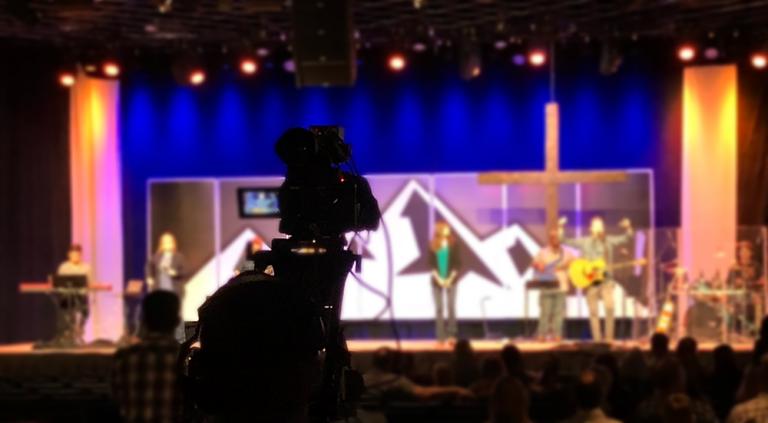
Photo © 2018 David Murrow
A television studio is a dark, windowless room with professional lighting and sound equipment, a studio audience and cameras. It’s a light-controlled, soundproof environment in which everything is focused on a stage area. Content is tightly managed to fit within an established time parameter.
I worship God in a room like this every week.
Churches used to build sanctuaries. Many had soaring ceilings. Decorations and symbols told the story of the Bible. Natural light poured through windows (both clear and stained glass).

Photo © 2018 David Murrow
But the worship spaces we build today are dark, cavernous rooms designed to capture sound and images and broadcast them to the world. The studio audience (aka, the congregation) is almost an afterthought.
To understand why our churches now resemble TV studios we must go back to the 1970s.
Radio and TV preachers and televangelists were a big deal in the disco era. Pulpiteers such as Billy Graham, Pat Robertson, Robert Schuller, Jim and Tammy Faye Bakker, and Jerry Falwell reached millions of viewers each week via the airwaves.
Churchgoers began watching and listening to their broadcasts. Predictably, they compared these superstar communicators to their own pastors, who couldn’t possibly measure up.
This created dissatisfaction among churchgoers. For the first time people realized they didn’t have to put up with lousy preaching and mediocre music. They could jump into their big, shiny 1970s cars and drive on brand new, mostly-deserted-on-Sunday-morning freeways across town to sit under the best preacher.
And thus the church-hopping movement began. Big churches got bigger, while smaller churches shriveled.
Add to this the significant number of people who simply stopped going to church and watched it on TV. Televised ministries grew rich off their donations, while small, local churches withered for lack of support.
Church innovators of the 1980s such as Rick Warren, Bill Hybels and Chuck Smith noticed the trend. They invented the “seeker friendly” church model, in part to compete with TV.
From the beginning, seeker friendly worship was designed to capture the TV generation. These churches blacked out the windows, hung professional lights and rolled in the cameras. A rock band warmed up the crowd. Worship services were planned down to the minute. And sermon length increased to give these gifted communicators more pulpit time.
They also eliminated many of the interpersonal elements of worship that would throw things off schedule. Small-church staples such as personal testimonies, prayer-and-share and recognizing visitors were tossed overboard in order to fit everything into the allotted 58 minutes and 30 seconds of broadcast airtime.
In 1970, only about 50 churches in America drew a crowd of more than 2,000 worshippers on a weekend. Today, well over a thousand U.S. congregations regularly eclipse that number. Almost every one of these king-size congregations worships in a room specially built for TV.
YouTube has accelerated the TV-studio-as-sanctuary trend. Pastors can now reach tens of thousands of viewers online. The crowd that actually comes to church plays the role of studio audience for a much larger congregation out in cyberspace.
So, is it wrong for churches to resemble TV studios? Not at all. Jesus didn’t leave behind any church blueprints. He made it clear that where we worship is not nearly as important as how we worship (John 4:20-24).
But…
If our Sunday worship services are made-for-TV, why attend them live? That’s the very question many Christians are beginning to ask.
You see, almost everything we do in our worship services today can be recorded and distributed online. That’s presenting a huge problem, which I’ll examine in my next post.

About David Murrow
David Murrow is director of Church for Men, an organization that helps Christian congregations reach men and boys. He is the author of Why Men Hate Going to Church, an inspirational bestseller with more than 150,000 copies in print in more than a dozen languages. The book has been reviewed in newspapers such as the Wall Street Journal, Washington Post, New York Times and many others. He’s spoken about the gender gap on the NBC Nightly News, Fox News Channel and PBS. You can read more about the author here.
Previous Post

October 21, 2018
Why seeker-friendly churches are losing seekers
Next Post

November 5, 2018 How Churches Create Isolated Christians
Browse Our Archives
Select a Category boys Bullying children's ministry Church Church planting church structure Communication Conservatism devotion Discipleship eternity evangelism Family Fathers Feminism Feminization giving thanks God Humor Jesus Leadership Liberalism Marketing marriage masculinity men's ministry men's studies mission movies Parenting Pastoring persecution Politics pop culture Prayer Preaching and teaching Prison Ministry religion secularism sex spiritual growth sports women Worship youth culture youth ministry
Select a Month July 2020 April 2020 January 2020 December 2019 November 2019 August 2019 July 2019 June 2019 May 2019 April 2019 March 2019 February 2019 January 2019 December 2018 November 2018 October 2018 May 2016 April 2016 March 2016 February 2016 January 2016 December 2015 November 2015 October 2015 September 2015 August 2015 July 2015 June 2015 May 2015 April 2015 March 2015 February 2015 January 2015 December 2014 November 2014 October 2014 September 2014 August 2014 July 2014 June 2014 May 2014 April 2014 March 2014 February 2014 January 2014 December 2013 November 2013 October 2013 September 2013 August 2013 July 2013 June 2013 May 2013 April 2013 March 2013
Follow Us!
TAKE THE
Religious Wisdom Quiz
True or False: The Israelites were commanded to observe the Day of Atonement once a year.
Select your answer to see how you score.
FALSE TRUE
Related posts from Church for Men

Post-COVID Slump: Is it Just a Flesh Wound?

For God's Sake — Shorten Your Sermon

Why Evangelical Men Prefer Trump over Pence

Worship Leader Accused of Playing Well-Known Song
TRENDING AT PATHEOS Evangelical

The REST of Your Life: A Creative Wrestles...
This week I had a conversation with a good friend from church....

How the author of the world's best hymn...
I've been working with John Newton for a while now. This makes...

Long before this Lectio Divina, Psalm 130 - the song - started...

What About the Trees? Another Living Parable
After I finished writing the last article about falling leaves as a...

Why Classical Education Is a Conversation, Not a...
Come and Read: Joy in Classical Education When I was a little...

Cornell University has received a great deal of negative publicity and intense...
view all Evangelical blogs
Ad-Free & Subscriber Log-In Subscription Support
- About Us
- 2026 Calendar
- Videos
- Podcasts
- Library of World Religions
- Faith In Media Tracker
- Advertise With Us
- Write for Us
- Privacy Policy
- Terms of Service
- Do Not Sell My Data
- Contact Us
- Radiant Digital
- Manage Newsletter Subscriptions
- Unsubscribe From Notifications
- Sitemap
Copyright 2008-2026, Patheos. All rights reserved.
Subscription Support Ad-Free & Subscriber Log-In
Follow Patheos