
BuddhistCatholicContemplativeEvangelicalGeneral ChristianHinduJewishLatter-day SaintMuslimNew VisionsProgressive Christian
Beliefs
- Buddhist
- Catholic
- Contemplative
- Evangelical
- General Christian
- Hindu
- Jewish
- Latter-day Saint
- More Voices
- Muslim
- New Visions
- Pagan
- Progressive Christian
Topics
- Religion News
- Food and Religion
- Sports and Religion
- Religious Art
- Religious Music and Entertainment
- Religious Events
- History and Religion
- Style and Religion
- Politics and Religion
- Women in Religion
- Recreation Outdoors and Religion
- Business Finance and Religion
- Careers Workplace and Religion
- Education and Religion
- Family Parenting and Religion
- Health Fitness and Religion
- Home and Religion
- Relationships and Religion
- Technology and Religion
- Travel and Religion
Columnists
- Buddhist Columnists
- Business Finance and Religion Columnists
- Careers Workplace and Religion Columnists
- Catholic Columnists
- Contemplative Columnists
- Education and Religion Columnists
- Evangelists Columnists
- Family Parenting and Religion Columnists
- General Christian Columnists
- Health Fitness and Religion Columnists
- Hindu Columnists
- History and Religion Columnists
- Home and Religion Columnists
- Jewish Columnists
- More Voices Columnists
- Latter Day Columnists
- Muslim Columnists
- New Visions Columnists
- Nonreligious Columnists
- Pagan Columnists
- Politics and Religion Columnists
- Progressive Columnists
- Recreation Outdoors and Religion Columnists
- Relationships and Religion Columnists
- Religion News Columnists
- Religious Art Columnists
- Religious Events Columnists
- Religious Music and Entertainment Columnists
- Sports and Religion Columnists
- Style and Religion Columnists
- Technology and Religion Columnists
- Travel and Religion Columnists
- Women in Religion Columnists
Resource Library
- 2026 Calendar
- Library of World Religions
- The 100 Most Holy Places on Earth
- Patheos Answers
- Podcasts
- Videos
- Faith Leaders Database
- Anglican Episcopalian
- Bahai
- Baptist
- Buddhism
- Christianity
- Confucianism
- Eastern Orthodoxy
- Hinduism
- Holiness and Pentecostal
- ISKCON
- Islam
- Judaism
- Lutheran
- Methodist
- The Church of Jesus Christ of Latter-day Saints
- New Age
- Paganism
- Presbytarian and Reformed
- Protestantism
- Religion Behind the Scenes
- Roman Catholic
- Scientology
- Shia Islam
- Sikhism
- Sufism
- Sunni Islam
- Taoism
- Zen
- See all religions
Research Tools
 Ad-Free & Subscriber Log-In Subscription Support
Ad-Free & Subscriber Log-In Subscription Support
Follow Patheos 

- Trending:
- Forgiveness
- |
- Marriage
- |
- Consciousness
- |
- Death Penalty
- |
- Election
- |
- Halloween
 Church for Men
- Home
- Evangelical
- Why men aren’t buying the church’s core product (part 2)
Why men aren’t buying the church’s core product (part 2)
Last updated on: April 16, 2014 at 12:00 am by David Murrow
Why men aren’t buying the church’s core product (part 2) 2014-04-14T19:33:32-09:00 David Murrow
Patheos Explore the world's faith through different perspectives on religion and spirituality! Patheos has the views of the prevalent religions and spiritualities of the world.
Listen to a podcast of this post by clicking here.
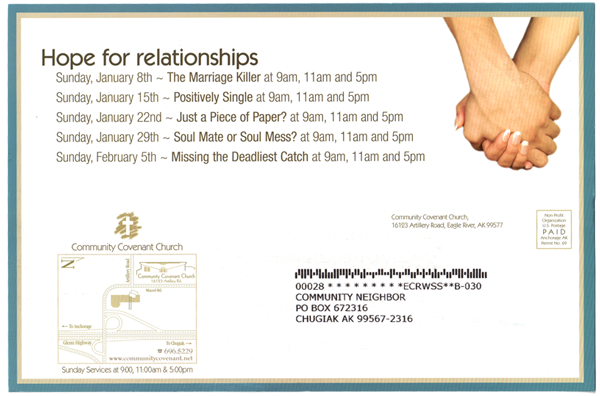 Right after Christmas, I received three cards in the mail from three local churches (one is pictured above). This is not unusual; lots of churches advertise this time of year. What was unusual was the fact that all three churches were advertising sermon series on the same topic: relationships.
In my last blog entry I explained why the Evangelical church’s “core product” has recently shifted from personal salvation to personal relationships. Church used to be the place that saved your soul; today it’s the place that saves your messed up family.
As a young man growing up in church, I can’t remember ever hearing a sermon about relationships – much less a series. Sermons of the 1970s focused on evangelism, mission, personal holiness and discipleship. Most pastors didn’t see relationships as a topic worthy of the pulpit.
Boy — do they now.
American Christianity is in the process of rebranding itself. The gospel is no longer described as a life-and-death mission, it’s a “personal relationship with Jesus.” Many pastors and churches have embraced a slogan like this: “Christianity is not a religion, it’s a relationship.” Evangelistic organizations are dropping their mission-oriented names. As an example, Campus Crusade for Christ is in the process of renaming itself, “Cru.”
These marketing moves are bringing people in the doors. With more than 40% of U.S. children born out of wedlock and family disruption common, people are looking for help with their relationships. A Gospel focused on relationships addresses a felt need in today’s broken world.
There’s only one problem: the Bible hardly devotes any attention to interpersonal relationships.
First, that term: personal relationship with Jesus. It never appears in scripture. Across 66 books of the Bible, never once are humans commanded to enter into a relationship with God or Jesus. This metaphor is the creation of 20th century preachers who wanted to make the Gospel appealing to their core constituency: women.
Second, if you read what Jesus really said about relationships, you’ll be shocked. He did not come to bring people together, he came to divide them (Matt. 10:34-35). He said that any man who did not hate his family members was not worthy to be his disciple (Luke 14:26) He promised lavish rewards to those left their families behind for His kingdom (Luke 18:29-30). Not exactly the kinds of things you hear on Family Life Today.
And third, if you step back and examine the broad themes of the Bible, interpersonal relationships would not even make the top ten list. The apostle Paul addresses relationships infrequently, often for the purpose of keeping the early church from slipping into immorality. Almost every Christian book and sermon on relationships is taken from the few things Paul had to say about them.
Don’t misunderstand me. There’s nothing wrong with the church dispensing relationship advice, particularly in small groups. Parachurch organizations such as Focus on the Family and Family Life are doing commendable work. Churches are wise to offer counseling and conflict resolution. The Bible clearly endorses marriage, fidelity and comity between individuals. The greatest commandments are to love the Lord and our neighbor.
But is this what the Gospel is really about? Is relational harmony the main reason people should come to church? Is it “core product” we offer to the world?
Here’s my concern: if people come to see the church as “in the relationship business,” we set ourselves up for a number of unpleasant consequences:
- More women and fewer men involved in church, since women are so much more relationship-focused than men
- Fewer young men in attendance
- Further alienation of singles as teaching focuses increasingly on marriage and children
- Less focus on mission, evangelism and outreach
- More passivity among the men who do go to church
- A growing reputation as a feminized institution
- Increased pressure to accept alternative relationships (unmarried, homosexual, polyamorous, etc.)
- People blaming the church when their relationships go sour
- Fewer people accepting Christ’s gift of salvation
The Gospel is relevant to every area of life – relationships included. But Christ did not die a horrible death on the cross so you could have a regular date night. We need to keep the main thing the main thing. Men are interested in relationships, but they’re motivated by mission. The Gospel’s message of redemption must remain front and center, even if it doesn’t bring as many people in the doors.
To join the conversation, leave your comments below – or join us on our Facebook page. To
Previous Post
April 8, 2014
Why men aren't buying the church's core product (part 1)
Next Post

April 23, 2014 How we destroyed our man-building infrastructure
Browse Our Archives
Select a Category boys Bullying children's ministry Church Church planting church structure Communication Conservatism devotion Discipleship eternity evangelism Family Fathers Feminism Feminization giving thanks God Humor Jesus Leadership Liberalism Marketing marriage masculinity men's ministry men's studies mission movies Parenting Pastoring persecution Politics pop culture Prayer Preaching and teaching Prison Ministry religion secularism sex spiritual growth sports women Worship youth culture youth ministry
Select a Month July 2020 April 2020 January 2020 December 2019 November 2019 August 2019 July 2019 June 2019 May 2019 April 2019 March 2019 February 2019 January 2019 December 2018 November 2018 October 2018 May 2016 April 2016 March 2016 February 2016 January 2016 December 2015 November 2015 October 2015 September 2015 August 2015 July 2015 June 2015 May 2015 April 2015 March 2015 February 2015 January 2015 December 2014 November 2014 October 2014 September 2014 August 2014 July 2014 June 2014 May 2014 April 2014 March 2014 February 2014 January 2014 December 2013 November 2013 October 2013 September 2013 August 2013 July 2013 June 2013 May 2013 April 2013 March 2013
Follow Us!
TAKE THE
Religious Wisdom Quiz
Who was the prophet after Moses?
Select your answer to see how you score.
Joshua Elijah Isaiah Samuel
Related posts from Church for Men

Post-COVID Slump: Is it Just a Flesh Wound?

For God's Sake — Shorten Your Sermon

Why Evangelical Men Prefer Trump over Pence

Worship Leader Accused of Playing Well-Known Song
TRENDING AT PATHEOS Evangelical

The REST of Your Life: A Creative Wrestles...
This week I had a conversation with a good friend from church....

How the author of the world's best hymn...
I've been working with John Newton for a while now. This makes...

Long before this Lectio Divina, Psalm 130 - the song - started...

What About the Trees? Another Living Parable
After I finished writing the last article about falling leaves as a...

Why Classical Education Is a Conversation, Not a...
Come and Read: Joy in Classical Education When I was a little...

Cornell University has received a great deal of negative publicity and intense...
view all Evangelical blogs
Ad-Free & Subscriber Log-In Subscription Support
- About Us
- 2026 Calendar
- Videos
- Podcasts
- Library of World Religions
- Faith In Media Tracker
- Advertise With Us
- Write for Us
- Privacy Policy
- Terms of Service
- Do Not Sell My Data
- Contact Us
- Radiant Digital
- Manage Newsletter Subscriptions
- Unsubscribe From Notifications
- Sitemap
Copyright 2008-2026, Patheos. All rights reserved.
Subscription Support Ad-Free & Subscriber Log-In
Follow Patheos