
BuddhistCatholicContemplativeEvangelicalGeneral ChristianHinduJewishLatter-day SaintMuslimNew VisionsProgressive Christian
Beliefs
- Buddhist
- Catholic
- Contemplative
- Evangelical
- General Christian
- Hindu
- Jewish
- Latter-day Saint
- More Voices
- Muslim
- New Visions
- Pagan
- Progressive Christian
Topics
- Religion News
- Food and Religion
- Sports and Religion
- Religious Art
- Religious Music and Entertainment
- Religious Events
- History and Religion
- Style and Religion
- Politics and Religion
- Women in Religion
- Recreation Outdoors and Religion
- Business Finance and Religion
- Careers Workplace and Religion
- Education and Religion
- Family Parenting and Religion
- Health Fitness and Religion
- Home and Religion
- Relationships and Religion
- Technology and Religion
- Travel and Religion
Columnists
- Buddhist Columnists
- Business Finance and Religion Columnists
- Careers Workplace and Religion Columnists
- Catholic Columnists
- Contemplative Columnists
- Education and Religion Columnists
- Evangelists Columnists
- Family Parenting and Religion Columnists
- General Christian Columnists
- Health Fitness and Religion Columnists
- Hindu Columnists
- History and Religion Columnists
- Home and Religion Columnists
- Jewish Columnists
- More Voices Columnists
- Latter Day Columnists
- Muslim Columnists
- New Visions Columnists
- Nonreligious Columnists
- Pagan Columnists
- Politics and Religion Columnists
- Progressive Columnists
- Recreation Outdoors and Religion Columnists
- Relationships and Religion Columnists
- Religion News Columnists
- Religious Art Columnists
- Religious Events Columnists
- Religious Music and Entertainment Columnists
- Sports and Religion Columnists
- Style and Religion Columnists
- Technology and Religion Columnists
- Travel and Religion Columnists
- Women in Religion Columnists
Resource Library
- 2026 Calendar
- Library of World Religions
- The 100 Most Holy Places on Earth
- Patheos Answers
- Podcasts
- Videos
- Faith Leaders Database
- Anglican Episcopalian
- Bahai
- Baptist
- Buddhism
- Christianity
- Confucianism
- Eastern Orthodoxy
- Hinduism
- Holiness and Pentecostal
- ISKCON
- Islam
- Judaism
- Lutheran
- Methodist
- The Church of Jesus Christ of Latter-day Saints
- New Age
- Paganism
- Presbytarian and Reformed
- Protestantism
- Religion Behind the Scenes
- Roman Catholic
- Scientology
- Shia Islam
- Sikhism
- Sufism
- Sunni Islam
- Taoism
- Zen
- See all religions
Research Tools
 Ad-Free & Subscriber Log-In Subscription Support
Ad-Free & Subscriber Log-In Subscription Support
Follow Patheos 

- Trending:
- Forgiveness
- |
- Marriage
- |
- Consciousness
- |
- Death Penalty
- |
- Election
- |
- Halloween
 Church and Workers
- Home
- Careers, Workplace and Religion
- Relationships and generational poverty
Relationships and generational poverty
Last updated on: April 22, 2014 at 9:55 pm by Made to Flourish
Relationships and generational poverty 2014-03-31T22:02:08+00:00 Made to Flourish
Patheos Explore the world's faith through different perspectives on religion and spirituality! Patheos has the views of the prevalent religions and spiritualities of the world.
 Kyle Bushre
What do your local cold weather shelter, clothing drive, soup kitchen, and Christmas gift baskets all have in common? If you said they all serve the less fortunate in your community, you would be right. But you would also be right if you said they tend to harm the poor by perpetuating incapacity. You would be correct if you answered that none of these activities actually solve any problems in the long term, and that there is a sense in which the provision of these services may actually contribute to the perpetuation of poverty. You would be correct if you said none of these ministries require volunteers to actually meet, know, and befriend the poor. And you would be spot-on if you noted that because they do not require relationships, none of these ministries necessarily creates opportunities to talk about Jesus. The fact is that there are all sorts of needs in the community, and well-meaning Christians have crafted thousands of ministries that attempt to meet those needs at arm’s length; ministry done for the poor, but not with the poor.
It surprised me to learn a few years ago that the problem of generational poverty is not primarily material; it is relational. Those who are poor feel disempowered, voiceless, and regarded as unimportant. There are many things they would like to learn from those who live sustainably. But there are also many things they would like to contribute. They have expertise, opinions, humor, skills, and nuanced perspectives on life they would like to share within the context of mutually beneficial relationships. I asked my friend Roberta what she would tell middle-class people about the generationally poor if she had the chance, and she said, “If you don’t know how to do something, just ask me. I might know how to do it and can show you.” This is a woman who recently took her furnace apart, fixed it, and reassembled it, so her offer is legitimate. My homeless friend Dustin recently saw me in a coffee shop and announced it was my lucky day because he got a good deal on children’s books and wanted to give me one for my kids. To assume the poor must merely be the recipients of middle-class mercy is demeaning and leads to undignified forms of ministry. But worse, it further spreads the chasm that keeps the middle class and the poor from growing together in diverse relationships. As Robert Lupton notes, “Wherever there [is] sustained one-way giving, unwholesome dynamics and pathologies [fester] under the cover of kindheartedness,”
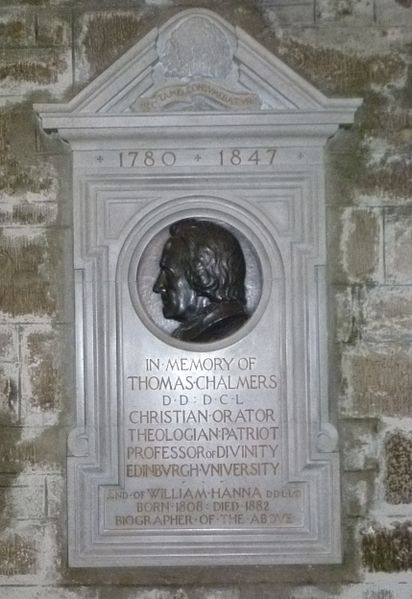
Pastor Thomas Chalmers saw the depth of this chasm. In 1819, he took a job at a church in St. John, one of the poorest neighborhoods of Glasgow, Scotland. Because he was a popular preacher, his church was filled every week, but not by the people of St. John. Rich people traveled from all over Glasgow and filled the seats, preventing the poor of the community from having the chance to attend if they had any inclination to do so. Chalmers was moved for his neighbors, not simply because they were materially poor, but because he had the riches of the gospel to share and could see so many people among the poor in need of Christ.
I suppose at this point–were Chalmers pastoring in a church today–he might decide that the rich were his target audience, that churches cannot reach everyone, and must choose to whom they will cater their programs. But that is not what Chalmers did. Instead, he did the seemingly impossible. He appealed to the local government and had all public assistance shut down in St. John. He then turned to his congregation and called them to take on the burdens of the people. An elder and a deacon were assigned to each of 25 districts. These leaders built relationships with the people, shared the gospel, showed concern, and helped find solutions to financial and employment-related problems. The only funding available was the money put in the plate on Sunday, but by building relationships, solutions were discovered that did not require one-way handouts. Poor Law Commissioner Edward Tufnell was assigned by the city to observe the results and he was amazed:
This system has been attended by the most triumphant success. This personal attention of the rich to the poor seems to be one of the most efficient means of preventing pauperism. It is a subject of perpetual complaint that the poor do not receive the charities of the rich with gratitude. The reason of this appears to be, that the donation of a few shillings from a rich man to a poor man is no subtraction from the giver’s comfort, and consequently is no proof of his interest in the other’s welfare. If the rich give their time to the poor, they part with a commodity which the poor see is valuable to the givers, and consequently esteem the attention the more, as it implies an interest in their prosperity, and a feeling seems to be engendered in their minds of unwillingness to press on the kindness of those who thus prove themselves willing to sympathize with them in distress, and to do their utmost to relieve it. This feeling acts as a spur to the exertions of the poor; their efforts to depend on their own resources is greater, and consequently the chance of their becoming dependent on the bounty of others less.
One-way giving is no proof of interest in another person’s welfare. Relationships are real compassion. Suffering with our poor brothers and sisters through life together is the only real solution to end the cycle of generational poverty.
Chalmers’ church grew. He added a Sunday afternoon service to accommodate all the people from the neighborhood who wanted to come. The poor do not want middle-class stuff; they want friendship and dignity in mutually beneficial relationships. They want to know their presence in the church community is welcome and just as vital as anyone else’s.
How do we build these relationships? We build them on the common ground of mutually beneficial social capital.
Kyle Bushre is the Pastor of Outreach at King Street Church in Chambersburg, Pa. He’s an alumnus of Trinity Evangelical Divinity School and a Kern Scholar. Bushre is pursuing a doctor of ministry degree and exploring more effective ways for the church to show compassion.
For Reflection:
- How does one-way giving rob the poor of dignity? How does reciprocal giving build dignity?
- What would the reaction be in your church if you committed to only engaging in ministries that fostered healthy relationships?
Read the previous posts in this series, Generational Poverty and Engaging the Culture.
From the Kern Pastors Network. Image: Wikimedia Commons.

Previous Post

April 18, 2014
Engaging the culture
Next Post
April 26, 2014 The church--an employment agency?
Browse Our Archives
Select a Category Conferences Local Church
Select a Month April 2014 March 2014 February 2014 January 2014 December 2013
TAKE THE
Religious Wisdom Quiz
What Christian group does not celebrate Christmas?
Select your answer to see how you score.
Methodists Orthodox Christians Jehovah’s Witnesses Baptists
Related posts from Church and Workers
The church--an employment agency?

What would God's March Madness look like?

Tents, culture, gospel: A post from a Kern...
TRENDING AT PATHEOS Careers, Workplace and Religion

St. Francis by Bill Droel Pope Leo XIV declares 2026 as “Year...

Catholics are schooled in the faith by memorizing dogmatic points and lots...

The Good News of Our Human Limitations -...
After another day of trying to meet deadlines and working on projects,...

Quiet Holy Attentiveness (podcast) with Sarah Clarkson
We know that quiet is an essential aspect of the spiritual life,...

Every Vocation Everywhere All At Once
What is a vocation? How does it endure through the years? Can...

I promise this is not going to become a Taylor Swift Studies...
view all Careers, Workplace and Religion blogs
Ad-Free & Subscriber Log-In Subscription Support
- About Us
- 2026 Calendar
- Videos
- Podcasts
- Library of World Religions
- Faith In Media Tracker
- Advertise With Us
- Write for Us
- Privacy Policy
- Terms of Service
- Do Not Sell My Data
- Contact Us
- Radiant Digital
- Manage Newsletter Subscriptions
- Unsubscribe From Notifications
- Sitemap
Copyright 2008-2026, Patheos. All rights reserved.
Subscription Support Ad-Free & Subscriber Log-In
Follow Patheos