
BuddhistCatholicContemplativeEvangelicalGeneral ChristianHinduJewishLatter-day SaintMuslimNew VisionsProgressive Christian
Beliefs
- Buddhist
- Catholic
- Contemplative
- Evangelical
- General Christian
- Hindu
- Jewish
- Latter-day Saint
- More Voices
- Muslim
- New Visions
- Pagan
- Progressive Christian
Topics
- Religion News
- Food and Religion
- Sports and Religion
- Religious Art
- Religious Music and Entertainment
- Religious Events
- History and Religion
- Style and Religion
- Politics and Religion
- Women in Religion
- Recreation Outdoors and Religion
- Business Finance and Religion
- Careers Workplace and Religion
- Education and Religion
- Family Parenting and Religion
- Health Fitness and Religion
- Home and Religion
- Relationships and Religion
- Technology and Religion
- Travel and Religion
Columnists
- Buddhist Columnists
- Business Finance and Religion Columnists
- Careers Workplace and Religion Columnists
- Catholic Columnists
- Contemplative Columnists
- Education and Religion Columnists
- Evangelists Columnists
- Family Parenting and Religion Columnists
- General Christian Columnists
- Health Fitness and Religion Columnists
- Hindu Columnists
- History and Religion Columnists
- Home and Religion Columnists
- Jewish Columnists
- More Voices Columnists
- Latter Day Columnists
- Muslim Columnists
- New Visions Columnists
- Nonreligious Columnists
- Pagan Columnists
- Politics and Religion Columnists
- Progressive Columnists
- Recreation Outdoors and Religion Columnists
- Relationships and Religion Columnists
- Religion News Columnists
- Religious Art Columnists
- Religious Events Columnists
- Religious Music and Entertainment Columnists
- Sports and Religion Columnists
- Style and Religion Columnists
- Technology and Religion Columnists
- Travel and Religion Columnists
- Women in Religion Columnists
Resource Library
- 2026 Calendar
- Library of World Religions
- The 100 Most Holy Places on Earth
- Patheos Answers
- Podcasts
- Videos
- Faith Leaders Database
- Anglican Episcopalian
- Bahai
- Baptist
- Buddhism
- Christianity
- Confucianism
- Eastern Orthodoxy
- Hinduism
- Holiness and Pentecostal
- ISKCON
- Islam
- Judaism
- Lutheran
- Methodist
- The Church of Jesus Christ of Latter-day Saints
- New Age
- Paganism
- Presbytarian and Reformed
- Protestantism
- Religion Behind the Scenes
- Roman Catholic
- Scientology
- Shia Islam
- Sikhism
- Sufism
- Sunni Islam
- Taoism
- Zen
- See all religions
Research Tools
 Ad-Free & Subscriber Log-In Subscription Support
Ad-Free & Subscriber Log-In Subscription Support
Follow Patheos 

- Trending:
- Forgiveness
- |
- Marriage
- |
- Consciousness
- |
- Death Penalty
- |
- Election
- |
- Halloween
 Christ Path Seminar
- Home
- New Visions
- Faith in the Occupy Generation: Balancing Concept and Experience
Faith in the Occupy Generation: Balancing Concept and Experience
Last updated on: September 12, 2013 at 2:03 pm by Matthew Fox
Faith in the Occupy Generation: Balancing Concept and Experience 2013-09-12T14:03:21-04:00 Matthew Fox
Patheos Explore the world's faith through different perspectives on religion and spirituality! Patheos has the views of the prevalent religions and spiritualities of the world.
We started this series of posts by looking at the first of seven themes that we’ve seen in our intensive interviews with many of the coming generation’s evolving mystics and prophets. We witnessed the deeply ecumenical nature of the Occupy generation’s evolving spirituality…a spirituality that we feel will become the template for faith in the 21st century, moving away from the forms of institutional religion to embrace the one underlying reality at the root of all faith traditions.
The second theme that we see in the spirituality of the Occupy Generation is an ongoing dialogue between experience and concept.
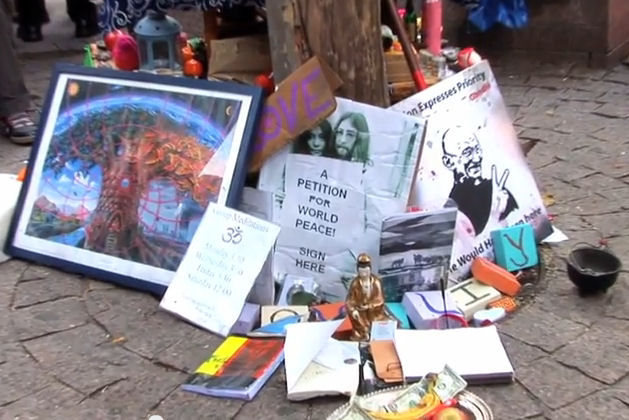
A makeshift altar at one of the Occupy encampments
An Excerpt from Chapter 2 of Occupy Spirituality: A Radical Vision for a New Generation
by Adam Bucko and Matthew Fox, published by North Atlantic Books, copyright © 2013. Reprinted by permission of publisher.
ADAM BUCKO: This new spirituality…starts from life rather than concepts. Nonetheless, concepts are celebrated as tools to connect the dots and deepen the experience. So this new spirituality is lived in a constant dialogue between experience and concepts, where one informs the other, thus leading to subtler and subtler understandings
MATTHEW FOX: Here I’m thinking, when it comes to concepts, that the Four Paths of Creation Spirituality could be really helpful. Paths are conceptual, but they’re thoroughly grounded in experience, and they return to experience. The backbone of the Creation Spirituality tradition is its naming of the spiritual journey in the Four Paths.
The Four Paths address the question, where will God—where will the experience of the divine—be found in our life? Creation Spirituality responds: the divine will be found in these places:
In the Via Positiva: in the awe, wonder, and mystery of nature and of all beings, each of whom is a “word of God.”
In the Via Negativa: in darkness and nothingness, in the silence and emptying, in the letting go and letting be, and in the pain and suffering that constitute an equally real part of our spiritual journey.
In the Via Creativa: in our generativity, we cocreate with God; in our imaginative output, we trust our images enough to birth them and ride them into existence.
In the Via Transformativa: in the relief of suffering, in the combatting of injustice, in the struggle for homeostasis, for balance in society and history, and in the celebration that happens when persons struggling for justice and trying to live in mutuality come together to praise and give thanks for the gift of being and being together.
Since I’ve been teaching them for forty years, I’ve had a lot of feedback from so many different kinds of people, and I find that they validate not only individuals’ experiences but the lineage. They validate the naming of archetypal religious icons that are still useful to us, whether we’re talking in Christian language about the cross or about the resurrection, or about the mystical experience that creation is, or about compassion.
But I find that they work across the board, and they help to explain when our spirituall practices are just one experience of the spiritual journey—such as, for example, the process of emptying, the process of silence, and so forth—as valid and important as that is, it’s only one part of the journey. So, these Four Paths give us an integrated conceptual framework that can help us create a well-integrated spiritual life.
ADAM BUCKO: I agree, the Four Paths are extremely useful here. They really deal with all of life and all of what we are and are capable of as human beings. If you don’t have the whole picture, it’s easy to just take one of those paths and practice it, thinking that it’s the whole path. And it’s not. I think that the beauty of the Four Paths is that they really reconcile different schools of spirituality that perhaps traditionally have not always agreed with each other. They reconcile things like action and contemplation, and contemplation and creativity, creativity and social justice.
I think that the beauty of the Four Paths is that they really reconcile different schools of spirituality that perhaps traditionally have not always agreed with each other. They reconcile things like action and contemplation, and contemplation and creativity, creativity and social justice.
MATTHEW FOX: Each of the paths is valuable in itself. But also, any one of the paths done on its own could be seductive. For example, the fourth path, being an activist: I remember one of my students said to me, when I first met her, “I am a cause junkie.” One can become a cause junkie—one can make one ’s whole life social activism and leave no room for the soul, no room for the mystical juice that, first of all, is the very goal of social justice. The goal of social justice is that the whole community can live life fully. It’s about celebration of life. If you’ve left that out of your path because you’re so married to being this warrior twenty-four hours a day, seven days a week, then first of all you’re going to run out of steam and juice, but also you’re not going to taste what it is you’re really trying to bring about, which is the flow of justice that allows the flow of life to move on.
So there is a danger that any one of these paths can be an end in itself. That’s one of the great values of the Four Paths: to remind us that we move in and out, in and out. That’s how they feed one another, and that’s literally how one stays young, because one is staying spiritually alive.
ADAM BUCKO: I feel that experience without concepts could be almost dangerous. You can have many experiences, yet not be changed by them, because you don’t have a framework that can connect the dots, connect those experiences. I have observed people who have had many experiences, but each time, because they don’t have useful concepts, they have to go back and start from scratch.
MATTHEW FOX : That’s a very important point. Also, you can become addicted to these experiences. It’s experience for experience ’s sake exclusively, and you’re not growing from it, and you’re not serving others through these experiences.
Of course, the opposite is also dangerous and, in fact, is probably far more of a disease than the first, and that is to live just in a conceptual world with no experience. And that, I think, is at the essence of defunct religion.
ADAM BUCKO: Because it leads to fundamentalism.
MATTHEW FOX: That’s right, and then it leads to ideology. Then all the juice of your faith is put to defending your ideology. Anyone who’s not in it is out and lost. So then faith becomes a fortress, it becomes a system that beats up on others, but it’s also beating up on those inside it, because their souls are shrinking; they’re not growing.
All of this may sound wonderful in concept – but how are our young people actually putting it into action? In our next post we’ll look at how our young people are grounding this new spirituality in holistic practices that feed not only their souls, but also their minds, bodies and spirits.
__________________________________________________________
Don’t miss the Occupy Spirituality Book Club on Patheos, September 16-30!
See when Matthew Fox and Adam Bucko will be speaking about Occupy Spirituality in your area: http;//www.matthewfox.org/calendar
Next Post

September 4, 2013 Occupy Spirituality: A Dance between Body, Mind and Soul
Browse Our Archives
Select a Category Andrew Harvey Christ Path program Community Creation Spirituality Deep Ecumenism Gail Ransom Gospel of Thomas Historical Jesus Matthew Fox Mysticism Occupy Generation Occupy Spirituality Phila Hoopes Sacred Activism Uncategorized Via Creativa Via Negativa Via Positiva Via Transformativa
Select a Month September 2013 August 2013 July 2013 June 2013
Follow Us!
TAKE THE
Religious Wisdom Quiz
Who succeeded Moses as leader of the Israelites?
Select your answer to see how you score.
Joshua Caleb Aaron Eli
Related posts from Christ Path Seminar

Don't Just Read Occupy Spirituality - Live It!

The Difference Between Religion and Spirituality
Occupy Spirituality: Creating Communities in the Service of...

Occupy Spirituality: Redefining Leadership as Dynamic, Democratic and...
TRENDING AT PATHEOS New Visions

Did Prayer Cure His Cancer? Or Was It...
At 4 AM one morning, Joshua W. Brown’s wife awoke to a...

8 Ways a Near-Death Experience Rewires the Soul
Does Consciousness Survive Physical Death? After 50 Years of Research, Dr. Raymond...

Holy Longing: What Our Restlessness Is Telling Us
“One can find so many pains when the rain is falling.” -John...

What this is NOT about. This blog is definitely not about...

Who said the Israelites were God’s chosen? That’s right, they did. Who...

The Spirit World Is the Real World: God...
A Monk’s Wisdom on Body and Spirit I sit with Brother Martin...
view all New Visions blogs
Ad-Free & Subscriber Log-In Subscription Support
- About Us
- 2026 Calendar
- Videos
- Podcasts
- Library of World Religions
- Faith In Media Tracker
- Advertise With Us
- Write for Us
- Privacy Policy
- Terms of Service
- Do Not Sell My Data
- Contact Us
- Radiant Digital
- Manage Newsletter Subscriptions
- Unsubscribe From Notifications
- Sitemap
Copyright 2008-2026, Patheos. All rights reserved.
Subscription Support Ad-Free & Subscriber Log-In
Follow Patheos