
BuddhistCatholicContemplativeEvangelicalGeneral ChristianHinduJewishLatter-day SaintMuslimNew VisionsProgressive Christian
Beliefs
- Buddhist
- Catholic
- Contemplative
- Evangelical
- General Christian
- Hindu
- Jewish
- Latter-day Saint
- More Voices
- Muslim
- New Visions
- Pagan
- Progressive Christian
Topics
- Religion News
- Food and Religion
- Sports and Religion
- Religious Art
- Religious Music and Entertainment
- Religious Events
- History and Religion
- Style and Religion
- Politics and Religion
- Women in Religion
- Recreation Outdoors and Religion
- Business Finance and Religion
- Careers Workplace and Religion
- Education and Religion
- Family Parenting and Religion
- Health Fitness and Religion
- Home and Religion
- Relationships and Religion
- Technology and Religion
- Travel and Religion
Columnists
- Buddhist Columnists
- Business Finance and Religion Columnists
- Careers Workplace and Religion Columnists
- Catholic Columnists
- Contemplative Columnists
- Education and Religion Columnists
- Evangelists Columnists
- Family Parenting and Religion Columnists
- General Christian Columnists
- Health Fitness and Religion Columnists
- Hindu Columnists
- History and Religion Columnists
- Home and Religion Columnists
- Jewish Columnists
- More Voices Columnists
- Latter Day Columnists
- Muslim Columnists
- New Visions Columnists
- Nonreligious Columnists
- Pagan Columnists
- Politics and Religion Columnists
- Progressive Columnists
- Recreation Outdoors and Religion Columnists
- Relationships and Religion Columnists
- Religion News Columnists
- Religious Art Columnists
- Religious Events Columnists
- Religious Music and Entertainment Columnists
- Sports and Religion Columnists
- Style and Religion Columnists
- Technology and Religion Columnists
- Travel and Religion Columnists
- Women in Religion Columnists
Resource Library
- 2026 Calendar
- Library of World Religions
- The 100 Most Holy Places on Earth
- Patheos Answers
- Podcasts
- Videos
- Faith Leaders Database
- Anglican Episcopalian
- Bahai
- Baptist
- Buddhism
- Christianity
- Confucianism
- Eastern Orthodoxy
- Hinduism
- Holiness and Pentecostal
- ISKCON
- Islam
- Judaism
- Lutheran
- Methodist
- The Church of Jesus Christ of Latter-day Saints
- New Age
- Paganism
- Presbytarian and Reformed
- Protestantism
- Religion Behind the Scenes
- Roman Catholic
- Scientology
- Shia Islam
- Sikhism
- Sufism
- Sunni Islam
- Taoism
- Zen
- See all religions
Research Tools
 Ad-Free & Subscriber Log-In Subscription Support
Ad-Free & Subscriber Log-In Subscription Support
Follow Patheos 

- Trending:
- Forgiveness
- |
- Marriage
- |
- Consciousness
- |
- Death Penalty
- |
- Election
- |
- Halloween
 Christopher Closeup
- Home
- Catholic
- Religious Music & Entertainment
- Leadership in Mercy: The Power of Mercy on Our Lives
Leadership in Mercy: The Power of Mercy on Our Lives
Last updated on: October 26, 2016 at 8:44 am by Tony Rossi
Leadership in Mercy: The Power of Mercy on Our Lives 2016-10-26T08:44:24-05:00 Tony Rossi
Patheos Explore the world's faith through different perspectives on religion and spirituality! Patheos has the views of the prevalent religions and spiritualities of the world.
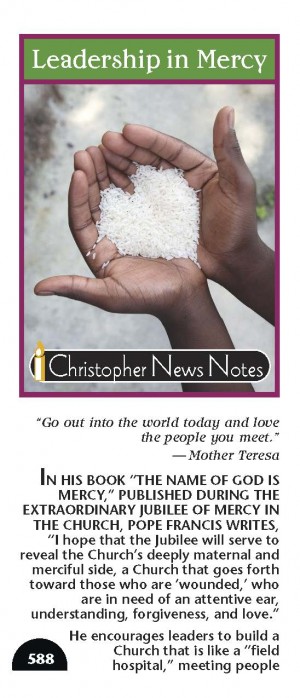 (The following is the text of the Christopher News Note “Leadership in Mercy.” If you’d like a pdf or hard copy, see the end of this post.)
“Go out into the world today and love the people you meet.” — Mother Teresa
In his book “The Name of God is Mercy,” published during the Extraordinary Jubilee of Mercy in the Church, Pope Francis writes, “I hope that the Jubilee will serve to reveal the Church’s deeply maternal and merciful side, a Church that goes forth toward those who are ‘wounded,’ who are in need of an attentive ear, understanding, forgiveness, and love.”
He encourages leaders to build a Church that is like a “field hospital,” meeting people where they are and ministering to their wounds.
Extending the call for mercy beyond the Jubilee Year, the Pope refers to the era we are living in as a kairos, which is a Greek word meaning “opportune time.” Pope Francis says, “I believe that this is a time for mercy.”
Mercy in Our Midst
“His mercy is as welcome in time of distress as clouds of rain in time of drought.” — Sirach 35:26
The Christophers’ Leadership in Mercy initiative publishes short stories and reflections by a broad range of people about the influence that mercy has had on their lives and on the world around them.
Brother Benedict Janecko, O.S.B, a Benedictine brother for over fifty years at the Archabbey of St. Vincent in Latrobe, Pennsylvania, tells of how a visit to 91-year-old Loretta Schrum, who was ailing and near death, helped revive his “drooping spirit.” She asked for water and he provided it. Then she took his hand and wouldn’t let go. He writes, “The whole ritual reminded me of Matthew 25, ‘Whoever offers food, drink, clothing and visits to others in need shall inherit the kingdom.’” He concludes, “I stopped to minister to Loretta, but she really ministered to me.”
Martha Smolka of Holy Cross Parish in Youngwood, Pennsylvania, tells of how God spoke to her through nature. While on a five-day silent retreat, she swatted a June bug that flew at her head while in the chapel in prayer. The June bug landed on its back in the pew in front of her and struggled to return to its feet so it could fly away. And so it did. Smolka saw this as God giving her a message about her own struggles. She knew that God was reminding her how similar she had been to this June bug, unable to move forward until she righted herself, which in her case meant allowing God to enter her life.
And in a beautiful account, Jeff Daws tells of a trip he took with his wife to Philadelphia for a medical conference she was attending. It was February and Daws took in some sights on one particularly cold and windy day. He writes, “As I contemplated what to have for lunch, I noticed a homeless man sitting on top of a sidewalk-level grate trying to catch as much heat coming through the grate as possible.”
Daws entered a nearby establishment to order lunch, intent on getting the homeless man something to eat as well. He kept looking out the window to make sure the man didn’t leave, and a woman standing beside him noticed the man too. She asked if Daws would give him some money for her, and handed him $20. He crossed the street to approach the man with the meal and money in hand.
Daws writes, “I then gave him the food that I ordered for him, along with a large cup of coffee and the money that the woman had given to me for him. He proceeded to ask me what my name was and I told him ‘Jeff.’ He then said, ‘Jeff, I’m going to pray for you.’ I was immediately taken aback by his statement. I asked what his name was, and he told me it was ‘Gary.’ I said, ‘Gary, we’re going to be praying for each other then.’ I then asked him to promise me that he would try to find a warm place for the night. He said it would be difficult but he would try. As I was leaving, I said, ‘God bless you, Gary,’ and he had a huge smile on his face.”
Daws later shared this story with his parish priest, who gave him a unique perspective on these events. In reflecting on the priest’s insights, Daws says, “In many cases, homeless people have very few possessions, and he gave two of them to me. He gave me his name (Gary) and his faith (by telling me that he was going to pray for me)… I am eternally grateful to [my parish priest] for allowing me to think of that encounter in a much, much different way.”
Pursuing the Corporal Works
“I really only love God as much as the person I love the least.” — Dorothy Day
In her Christopher Award-winning book “Mercy in the City,” Kerry Weber, a Mercy Associate and managing editor of America magazine, tells of how, as a young woman living in New York City, she managed to complete all seven corporal works of mercy to fulfill a Lenten observance.
Talking about the tradition of giving things up for Lent and why she decided to add corporal works to her usual abstinences, Weber says, “At its best, giving something up is a reminder to do something more.” She recalls a priest telling her, “When you’re fasting, you should feel a little uncomfortable. It allows you to cultivate a hunger for other things.” And it was this hunger that led her to become immersed for 40 days in the works of service commanded to us by Christ.
Weber’s journey brings her to places around New York City and beyond, including the breadline at St. Francis of Assisi Church on 34th Street where she hands out sandwiches to the hungry; a fluid station at the NYC Half marathon to give water to the thirsty; the Maryhouse Catholic Worker community on the Lower East Side to distribute clothing to women in need; the Hurtado Shelter on 16th Street to care for the homeless; a home for retired Sisters of Mercy to visit the sick; the Old Calvary Cemetery in Queens to talk with a gravedigger and come as close as she can during that time to burying the dead; and all the way out to San Quentin State in California to visit the imprisoned.
Referencing the call to show mercy in order to receive it, Weber writes, “It’s easy to think that God’s mercy is a kind of get-out-of-jail-free card, but to consider it as such robs the term of its richness.” Contemplating the gravity of this biblical command, she recalls the words of St. Basil the Great, who said, “The bread which you do not use is the bread of the hungry; the garment hanging in your wardrobe is the garment of him who is naked…the acts of charity that you do not perform are so many injustices that you commit.”
In her visit to San Quentin State Prison, Weber becomes so engrossed in her conversation with a group of men who have sat down with her to discuss their faith that she forgets they are prisoners. She later says to the prison chaplain, “It doesn’t seem like the people I spoke with are capable of doing the things that got them here.”
The chaplain responds, “We’re all capable of doing what put them here.” He goes on to describe some of the difficult backgrounds of the inmates. Weber acknowledges that such difficulties don’t necessitate criminality but resolves to embrace the teaching of Christ and not pass judgment on their souls, saying, “It’s hard to say what motivates people to do the things they do.”
A near 80-year-old nun named Sister Camille acts as Weber’s guide in her visit to the retired Sisters of Mercy. Talking about their order’s history and their early mission to visit the imprisoned, Sister Camille tells the story of a man on death row who rebuked the sisters for approaching him, insisting he had no need of their mercy and insisting on his innocence. Weeks passed as he witnessed their interactions with the other prisoners, and then finally he called on them to minister to him. Weber writes, “They went to him, and he eventually became Catholic, and in the end he also became the last man to die by hanging in New York State. And after his execution, the person who committed the crime confessed to it.”
Sister Camille relates visiting the sick to visiting the imprisoned, saying, “There’s more than a physical sickness involved in this. There’s the excruciating sickness of loneliness and alienation and condemnation.”
Weber talks about the supportive atmosphere found among the sisters where “they make an effort to be there to support one another so that none is sick of heart.” She then contrasts that with the loneliness of the men she met at San Quentin, and has a profound realization about when and how to “visit” people, saying, “Maybe, I think, the point is not to seek out the sick. Maybe it’s just to recognize when people are not well, whether it’s because they’re physically ill or lonely.”
Reflecting on what can be gained by setting out to perform the corporal works, Weber points to the mere fact that it can be the beginning of developing habits for a lifetime, writing, “Maybe in the end, the Works of Mercy aren’t things that can be completed the way one can finish playing a board game or painting a picture. Each act is not an isolated incident, but a part of a process, akin to sweeping the floor. You have to do it regularly or things begin to get messy. They must become habits without becoming mindless. Ultimately, the Works of Mercy point us toward ways in which we can build God’s reign on earth. There’s no guarantee we get to see how it ends, but I know I certainly won’t make progress if I don’t begin.”
“A Christian is committed to the belief that Love and Mercy are the most powerful forces on earth.”
– Thomas Merton
To receive a pdf or mailed copy of “Teach Yourself to Think More Clearly” – or to subscribe to Christopher News Notes via email or snail mail – send your request to [email protected]
Stay in touch! Like The Christophers on Facebook:

Next Post

November 1, 2016 Pint-Sized Prophets Who Teach Us We Are All Born to Be Healers
Browse Our Archives
Select a Category Act One American Idol Andy Griffith Show Audrey Assad Baseball Bible Books Catholic Charities Christmas Christopher Awards Christopher Closeup Christopher News Notes Current Events Down syndrome Education Father Jonathan Morris Father Keller Films Forgiveness Fringe Government Hallmark History Holidays Humor Inspiration Leadership Lost Marriage Media Medical Military Movies Music NY Med Once Upon a Time Once Upon a Time Parenting Patheos Movie Club Person of Interest Politics Pope Francis Prayer Pro Life Saints Senior Citizens Signed Sealed Delivered Special Needs Sports Three Minutes a Day TV Uncategorized Volunteering Women Youth
Select a Month March 2017 February 2017 January 2017 December 2016 November 2016 October 2016 September 2016 August 2016 July 2016 June 2016 May 2016 April 2016 March 2016 February 2016 January 2016 December 2015 November 2015 October 2015 September 2015 August 2015 July 2015 June 2015 May 2015 April 2015 March 2015 February 2015 January 2015 December 2014 November 2014 October 2014 September 2014 August 2014 July 2014 June 2014 May 2014 April 2014 March 2014 February 2014 January 2014 December 2013 November 2013 October 2013 September 2013 August 2013 July 2013 June 2013 May 2013 April 2013 March 2013 February 2013 January 2013 December 2012 November 2012 October 2012 September 2012 August 2012 July 2012 June 2012 May 2012 April 2012 March 2012 February 2012 January 2012
Follow Us!
TAKE THE
Religious Wisdom Quiz
She is more precious than rubies, and nothing you desire compares to her. Her ways are pleasant and all her paths are peace. Who is she?
Select your answer to see how you score.
Understanding Wisdom Knowledge A virtuous woman
Related posts from Christopher Closeup

The 2017 Christopher Award winners for TV, Film,...

Mary Tyler Moore Provided Catholic Laughs in Two...
Phillip Phillips Sings His Hit "Home" at Steven...

'We're All Sick Pilgrims Drifting Toward God, Whether...
TRENDING AT PATHEOS Catholic

Rejecting Doom: Christian Hope And Human Action
Christianity is a religion of hope. We are to have hope and...

It’s What Comes From Within Which Matters
One of the most difficult things for us to understand is why...

Why I Choose the Eucharist Over the Sermon
Choose the Eucharist, Not the Sermon What are we supposed to get...

5 Design Elements Found in Spiritually Rooted Homes
Putting Spirituality Into Home Decor Our homes are more than our living...

Credo: A Story of God Told with the...
About 10 years ago, I began to imagine a personal "Credo" that...

The Anatomy of Divine Revelation in Catholic Thought
The claim that God has made Himself known to human beings is...
view all Catholic blogs
Ad-Free & Subscriber Log-In Subscription Support
- About Us
- 2026 Calendar
- Videos
- Podcasts
- Library of World Religions
- Faith In Media Tracker
- Advertise With Us
- Write for Us
- Privacy Policy
- Terms of Service
- Do Not Sell My Data
- Contact Us
- Radiant Digital
- Manage Newsletter Subscriptions
- Unsubscribe From Notifications
- Sitemap
Copyright 2008-2026, Patheos. All rights reserved.
Subscription Support Ad-Free & Subscriber Log-In
Follow Patheos