
BuddhistCatholicContemplativeEvangelicalGeneral ChristianHinduJewishLatter-day SaintMuslimNew VisionsProgressive Christian
Beliefs
- Buddhist
- Catholic
- Contemplative
- Evangelical
- General Christian
- Hindu
- Jewish
- Latter-day Saint
- More Voices
- Muslim
- New Visions
- Pagan
- Progressive Christian
Topics
- Religion News
- Food and Religion
- Sports and Religion
- Religious Art
- Religious Music and Entertainment
- Religious Events
- History and Religion
- Style and Religion
- Politics and Religion
- Women in Religion
- Recreation Outdoors and Religion
- Business Finance and Religion
- Careers Workplace and Religion
- Education and Religion
- Family Parenting and Religion
- Health Fitness and Religion
- Home and Religion
- Relationships and Religion
- Technology and Religion
- Travel and Religion
Columnists
- Buddhist Columnists
- Business Finance and Religion Columnists
- Careers Workplace and Religion Columnists
- Catholic Columnists
- Contemplative Columnists
- Education and Religion Columnists
- Evangelists Columnists
- Family Parenting and Religion Columnists
- General Christian Columnists
- Health Fitness and Religion Columnists
- Hindu Columnists
- History and Religion Columnists
- Home and Religion Columnists
- Jewish Columnists
- More Voices Columnists
- Latter Day Columnists
- Muslim Columnists
- New Visions Columnists
- Nonreligious Columnists
- Pagan Columnists
- Politics and Religion Columnists
- Progressive Columnists
- Recreation Outdoors and Religion Columnists
- Relationships and Religion Columnists
- Religion News Columnists
- Religious Art Columnists
- Religious Events Columnists
- Religious Music and Entertainment Columnists
- Sports and Religion Columnists
- Style and Religion Columnists
- Technology and Religion Columnists
- Travel and Religion Columnists
- Women in Religion Columnists
Resource Library
- 2026 Calendar
- Library of World Religions
- The 100 Most Holy Places on Earth
- Patheos Answers
- Podcasts
- Videos
- Faith Leaders Database
- Anglican Episcopalian
- Bahai
- Baptist
- Buddhism
- Christianity
- Confucianism
- Eastern Orthodoxy
- Hinduism
- Holiness and Pentecostal
- ISKCON
- Islam
- Judaism
- Lutheran
- Methodist
- The Church of Jesus Christ of Latter-day Saints
- New Age
- Paganism
- Presbytarian and Reformed
- Protestantism
- Religion Behind the Scenes
- Roman Catholic
- Scientology
- Shia Islam
- Sikhism
- Sufism
- Sunni Islam
- Taoism
- Zen
- See all religions
Research Tools
 Ad-Free & Subscriber Log-In Subscription Support
Ad-Free & Subscriber Log-In Subscription Support
Follow Patheos 

- Trending:
- Forgiveness
- |
- Marriage
- |
- Consciousness
- |
- Death Penalty
- |
- Election
- |
- Halloween
 Christopher Closeup
- Home
- Catholic
- Religious Music & Entertainment
- Guilt – and What to Do About It
Guilt – and What to Do About It
Last updated on: March 16, 2016 at 10:15 am by Tony Rossi
Guilt – and What to Do About It 2016-03-16T10:15:24-05:00 Tony Rossi
Patheos Explore the world's faith through different perspectives on religion and spirituality! Patheos has the views of the prevalent religions and spiritualities of the world.
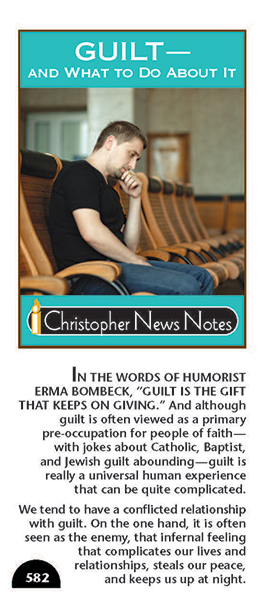 (The following is the text of the Christopher News Note “Guilt – and What to Do About It” (which was written by a freelancer). If you’d like a pdf or hard copy, see the end of this post.)
In the words of humorist Erma Bombeck, “Guilt is the gift that keeps on giving.” And although guilt is often viewed as a primary pre-occupation for people of faith — with jokes about Catholic, Baptist, and Jewish guilt abounding — guilt is really a universal human experience that can be quite complicated.
We tend to have a conflicted relationship with guilt. On the one hand, it is often seen as the enemy, that infernal feeling that complicates our lives and relationships, steals our peace, and keeps us up at night.
On the other hand, we often wonder if society as a whole has lost a proper sense of guilt. A new study found that, when asked for one word to describe the recent generation of college graduates, corporate executives identified the word, “entitled.” Of course, people of any age can sometimes act as if it is their God-given right to be as demanding as they want with no regard for the feelings of the people they are imposing upon. They annoy us with impunity and react with outrage if we dare to suggest that they have done anything wrong.
The truth is, our relationship with guilt is complicated because guilt is complicated. Psychologists note that guilt can be our undoing just as it can be the catalyst for healing. It all depends on how we think of it and respond to it.
Two Kinds of Guilt
There are really two kinds of guilt. Neurotic guilt is the negative emotion that causes us to feel stuck in our shame, to wallow in wrongdoing and ruminate endlessly about the mess we’ve made. By contrast, godly guilt is often a hopeful emotion. It helps us identify an emotional or moral injury and take proactive steps to heal it.
Consider the example of Bethany, a 40-year-old mother of four, who told her best friend, Marta: “I couldn’t believe I completely forgot my mom’s birthday. I felt so awful. It had been a terrible week. All the kids got a stomach bug at the same time and I had a make-it-or-break-it project due at work. I knew her birthday was coming and I even picked out a gift, but then ‘the week that was’ happened and it just completely slipped my mind. Of course, I called as soon as I remembered. I really appreciated how understanding Mom was. I was able to work out a plan to take her to dinner at her favorite restaurant later that week and I managed to pick up the gift in time as well. I felt bad about missing the actual day, but it was really nice to get some special mother-daughter time.”
Bethany’s experience of guilt was actually quite positive because it reminded her of the importance of showing her mother how special she was, even though she had inadvertently neglected her actual birthday. Bethany’s experience of godly guilt propelled her to make a plan and take positive steps to fix the problem. In fact, she did such a good job that she was able to take a failure and turn it into a success.
Neurotic guilt is a different story. Jeanne endured an experience similar to Bethany’s in that she forgot the birthday of her friend Maria, but the way she handled it was far different. As she told someone at work, “I had every intention of doing something special for Maria, but then the kids got sick and I had a work thing come up and my schedule just fell apart. It totally slipped my mind. When I realized a day later I was so embarrassed. She’s always been so sweet to me. Like that time she made meals for me and my family for a week when I was recovering from gall bladder surgery. I know I can always count on her. I can’t believe how badly I blew this. The worst thing is that I can’t even bring myself to call her. She left a message the other day and I didn’t pick up. I just felt so ashamed. The longer I avoid her the worse it gets, but I just don’t know what to say at this point.”
Jeanne’s experience of neurotic guilt paralyzed her. Rather than being able to take responsibility for her lapse and take steps to correct it, she took an unfortunate situation and made it even worse. Neurotic guilt is like that. It makes us confuse feeling bad about what we’ve done for actual remorse, and causes us to hesitate when corrective action is called for.
Consolations & Desolations
St. Ignatius of Loyola taught those under his spiritual direction to discern the difference between what he called “consolations” and “desolations.” He explained that “consolations” are “movements of the Holy Spirit” which we experience as thoughts, feelings, or impulses that inspire us to draw closer to God or be more like the person He wants us to be.
By contrast, “desolations” are thoughts, feelings, or impulses that pull us away from God or make us behave in a manner that draws us away from the person God wants us to be.
Although it can seem strange to think that guilt could be a consolation, godly guilt always is. While neither kind of guilt feels good, the godly kind is a consolation in that it makes us take steps to right a wrong, make amends, and experience the healing that comes from our efforts. In this sense, godly guilt is actually an experience of hope. We commit some error, but then feel a loving correction of the Holy Spirit that reminds us of who we are meant to be and helps us identify the steps we can take to resolve the problem we’ve caused. Finally, it helps us learn from our error so that we can avoid it in the future.
Using St. Ignatius’s model, it’s easy to see that neurotic guilt is definitely a desolation. It causes us to feel stuck and powerless in the face of our mistakes and sins. It tells us that there is nothing we can do to fix things anyway so why bother trying. It locks us in a prison of remorse with no chance of parole and no opportunity of reconciling ourselves with the people we may have hurt.
Neurotic guilt causes us to curse the darkness, while godly guilt enables us to light the candle that shows us new ways of being and illuminates our path to freedom. The truth is, sometimes we need to feel guilty for the things we have done wrong, but if our guilt causes us to remain stuck, then that isn’t God’s will for us. When we have done something that hurts others or makes us feel ashamed of ourselves, we needn’t stay trapped in a prison of our own design. Rather, we can let the loving correction of the Holy Spirit enkindle in us the fire that will bring light, warmth, and comfort in even the blackest night.
This is Your Brain on Guilt
In his book, “Broken Gods: Hope, Healing, and the Seven Longings of the Human Heart,” Dr. Gregory Popcak observes that our brains lock down and are unable to either solve problems or learn from our mistakes when “under the influence” of neurotic guilt. He notes that brain science shows that when we practice a spirit of Curiosity, Openness, Acceptance, and Love (COAL) toward ourselves — even in the face of our greatest failings — we are best able to free our minds to cooperate with God’s grace and make real change.
Curiosity refers to our willingness to take a nonjudgmental stance toward ourselves. That doesn’t mean shirking our responsibility, but rather being willing to ask ourselves, “What is the intention or need this sinful behavior is attempting to address?” When we do this we can begin to brainstorm new, godly ways to meet the need driving out sinful or destructive behavior.
Openness makes transformation possible. While curiosity allows us to ask questions about our motivations, openness allows us to receive the answers with an open heart. Often, when we try to consider our motivations, memories or insights come forward and we bat them out of the way thinking, “That’s ridiculous! That couldn’t have anything to do with this!” Being unwilling to consider the possibility that God is revealing something to us is simply foolish. Before we reject a memory or insight, we should at least take it to prayer. Our minds are not random. They are orderly. If we are prompted to recall a thought, insight or memory while we are prayerfully reflecting on some struggle, then it can be helpful to pray further about those connections even if we ultimately reject them as irrelevant. Openness does not require us to accept, as gospel, every silly thought that pops into our heads, but it requires us to admit that there might be more to our initial thoughts than meets the eye. Our prayerful openness gives God the chance to develop the pictures that begin to emerge under the light of His grace.
Acceptance facilitates spiritual transformation. Although acceptance is the opposite of self-criticism, it is not the same thing as approval of our transgressions. Acceptance is the quality that allows us to trust that God’s grace is sufficient (2 Cor. 12:9) and rest in Him when we find our efforts are not up to the task at hand. Yes, we have to make what changes we can in our lives, but acceptance allows us to be patient in our change without beating ourselves up for not being perfect just yet.
Love means that we are committed to working for someone else’s good. To love ourselves is to be similarly committed to working for our own good. When we love ourselves, we are committed to changing and growing in a spirit of kindness, gentleness, and respect.
“Repentant tears wash out the stain of guilt.”
– St. Augustine
To receive a pdf or mailed copy of “Guilt – and What to Do About It” – or to subscribe to Christopher News Notes via email or snail mail – send your request to [email protected]
Stay in touch! Like The Christophers on Facebook:
Previous Post

March 14, 2016
Finding the Face of Jesus in the People of Northern Uganda
Next Post

March 16, 2016 Jennifer Garner on Faith, Doubt, and "Miracles From Heaven"
Browse Our Archives
Select a Category Act One American Idol Andy Griffith Show Audrey Assad Baseball Bible Books Catholic Charities Christmas Christopher Awards Christopher Closeup Christopher News Notes Current Events Down syndrome Education Father Jonathan Morris Father Keller Films Forgiveness Fringe Government Hallmark History Holidays Humor Inspiration Leadership Lost Marriage Media Medical Military Movies Music NY Med Once Upon a Time Once Upon a Time Parenting Patheos Movie Club Person of Interest Politics Pope Francis Prayer Pro Life Saints Senior Citizens Signed Sealed Delivered Special Needs Sports Three Minutes a Day TV Uncategorized Volunteering Women Youth
Select a Month March 2017 February 2017 January 2017 December 2016 November 2016 October 2016 September 2016 August 2016 July 2016 June 2016 May 2016 April 2016 March 2016 February 2016 January 2016 December 2015 November 2015 October 2015 September 2015 August 2015 July 2015 June 2015 May 2015 April 2015 March 2015 February 2015 January 2015 December 2014 November 2014 October 2014 September 2014 August 2014 July 2014 June 2014 May 2014 April 2014 March 2014 February 2014 January 2014 December 2013 November 2013 October 2013 September 2013 August 2013 July 2013 June 2013 May 2013 April 2013 March 2013 February 2013 January 2013 December 2012 November 2012 October 2012 September 2012 August 2012 July 2012 June 2012 May 2012 April 2012 March 2012 February 2012 January 2012
Follow Us!
TAKE THE
Religious Wisdom Quiz
Which Christian group primarily uses icons in worship?
Select your answer to see how you score.
Quaker Anglican Baptist Eastern Orthodox
Related posts from Christopher Closeup

The 2017 Christopher Award winners for TV, Film,...

Mary Tyler Moore Provided Catholic Laughs in Two...

Phillip Phillips Sings His Hit "Home" at Steven...

'We're All Sick Pilgrims Drifting Toward God, Whether...
TRENDING AT PATHEOS Catholic

Rejecting Doom: Christian Hope And Human Action
Christianity is a religion of hope. We are to have hope and...

It’s What Comes From Within Which Matters
One of the most difficult things for us to understand is why...

Why I Choose the Eucharist Over the Sermon
Choose the Eucharist, Not the Sermon What are we supposed to get...

5 Design Elements Found in Spiritually Rooted Homes
Putting Spirituality Into Home Decor Our homes are more than our living...

Credo: A Story of God Told with the...
About 10 years ago, I began to imagine a personal "Credo" that...

The Anatomy of Divine Revelation in Catholic Thought
The claim that God has made Himself known to human beings is...
view all Catholic blogs
Ad-Free & Subscriber Log-In Subscription Support
- About Us
- 2026 Calendar
- Videos
- Podcasts
- Library of World Religions
- Faith In Media Tracker
- Advertise With Us
- Write for Us
- Privacy Policy
- Terms of Service
- Do Not Sell My Data
- Contact Us
- Radiant Digital
- Manage Newsletter Subscriptions
- Unsubscribe From Notifications
- Sitemap
Copyright 2008-2026, Patheos. All rights reserved.
Subscription Support Ad-Free & Subscriber Log-In
Follow Patheos