
BuddhistCatholicContemplativeEvangelicalGeneral ChristianHinduJewishLatter-day SaintMuslimNew VisionsProgressive Christian
Beliefs
- Buddhist
- Catholic
- Contemplative
- Evangelical
- General Christian
- Hindu
- Jewish
- Latter-day Saint
- More Voices
- Muslim
- New Visions
- Pagan
- Progressive Christian
Topics
- Religion News
- Food and Religion
- Sports and Religion
- Religious Art
- Religious Music and Entertainment
- Religious Events
- History and Religion
- Style and Religion
- Politics and Religion
- Women in Religion
- Recreation Outdoors and Religion
- Business Finance and Religion
- Careers Workplace and Religion
- Education and Religion
- Family Parenting and Religion
- Health Fitness and Religion
- Home and Religion
- Relationships and Religion
- Technology and Religion
- Travel and Religion
Columnists
- Buddhist Columnists
- Business Finance and Religion Columnists
- Careers Workplace and Religion Columnists
- Catholic Columnists
- Contemplative Columnists
- Education and Religion Columnists
- Evangelists Columnists
- Family Parenting and Religion Columnists
- General Christian Columnists
- Health Fitness and Religion Columnists
- Hindu Columnists
- History and Religion Columnists
- Home and Religion Columnists
- Jewish Columnists
- More Voices Columnists
- Latter Day Columnists
- Muslim Columnists
- New Visions Columnists
- Nonreligious Columnists
- Pagan Columnists
- Politics and Religion Columnists
- Progressive Columnists
- Recreation Outdoors and Religion Columnists
- Relationships and Religion Columnists
- Religion News Columnists
- Religious Art Columnists
- Religious Events Columnists
- Religious Music and Entertainment Columnists
- Sports and Religion Columnists
- Style and Religion Columnists
- Technology and Religion Columnists
- Travel and Religion Columnists
- Women in Religion Columnists
Resource Library
- 2026 Calendar
- Library of World Religions
- The 100 Most Holy Places on Earth
- Patheos Answers
- Podcasts
- Videos
- Faith Leaders Database
- Anglican Episcopalian
- Bahai
- Baptist
- Buddhism
- Christianity
- Confucianism
- Eastern Orthodoxy
- Hinduism
- Holiness and Pentecostal
- ISKCON
- Islam
- Judaism
- Lutheran
- Methodist
- The Church of Jesus Christ of Latter-day Saints
- New Age
- Paganism
- Presbytarian and Reformed
- Protestantism
- Religion Behind the Scenes
- Roman Catholic
- Scientology
- Shia Islam
- Sikhism
- Sufism
- Sunni Islam
- Taoism
- Zen
- See all religions
Research Tools
 Ad-Free & Subscriber Log-In Subscription Support
Ad-Free & Subscriber Log-In Subscription Support
Follow Patheos 

- Trending:
- Forgiveness
- |
- Marriage
- |
- Consciousness
- |
- Death Penalty
- |
- Election
- |
- Halloween
 Christopher Closeup
- Home
- Catholic
- Religious Music & Entertainment
- Finding Serenity in Silence
Finding Serenity in Silence
Last updated on: December 2, 2015 at 10:01 am by Tony Rossi
Finding Serenity in Silence 2015-12-02T10:01:49-05:00 Tony Rossi
Patheos Explore the world's faith through different perspectives on religion and spirituality! Patheos has the views of the prevalent religions and spiritualities of the world.
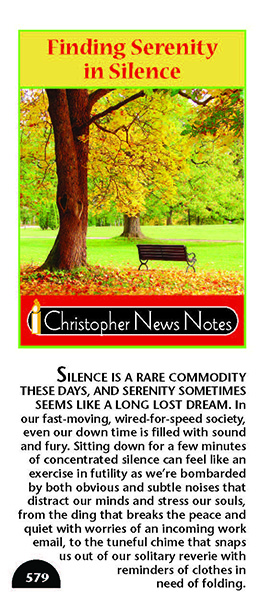 The following is the text of the Christopher News Note “Finding Serenity in Silence” (which was written by a freelancer). If you’d like a pdf or hard copy, see the end of this post:
Silence is a rare commodity these days, and serenity sometimes seems like a long lost dream. In our fast-moving, wired-for-speed society, even our down time is filled with sound and fury. Sitting down for a few minutes of concentrated silence can feel like an exercise in futility as we’re bombarded by both obvious and subtle noises that distract our minds and stress our souls, from the ding that breaks the peace and quiet with worries of an incoming work email, to the tuneful chime that snaps us out of our solitary reverie with reminders of clothes in need of folding.
In some ways, it seems like a losing battle. It’s tempting to think that it would be easier to simply accept the constant buzz and whir as the new status quo. But when we do that, we risk drowning out the still small voices inside that call us to prayer, creativity, solitude, and, ultimately, serenity.
If our goal is to find serenity through silence, it helps if we start by defining “serenity.” What exactly are we seeking through those quiet moments when we listen for the whisper of the Spirit? In the first part of a prayer written by Reinhold Niebuhr and popularized by Alcoholics Anonymous, we pray: “Lord, grant me the serenity to accept the things I cannot change, courage to change the things I can, and wisdom to know the difference.”
So serenity is an interior attitude, a space where we are not shaken by problems and fears, where we navigate the ups and downs of our lives knowing that things are unfolding as they should. So how do we get there? In silence.
Beneath the Chaos of Daily Life
Saints and sages, medical experts and business leaders, spiritual teachers and self-help gurus alike all agree that even a few minutes of dedicated silence on a regular basis can transform our day, our life, and our eternity. Face to face with God in the quiet, we begin to hear the low-but-constant drumbeat of our long-overlooked spiritual selves.
Father Jonathan Morris, in his book “The Way of Serenity,” talks about the fact that if we go through life like a hamster furiously spinning on its wheel, we will never move forward or have the opportunity to live fully.
“We are called to something higher. We are called to reflect, to contemplate, to examine, to explore, and to consider,” he writes. “Yet nowadays we always seem to have something more important to do than simply to think about our lives—where we are going, how we are living, what sort of people we are trying to be.”
Father Morris explains that we “cannot find ourselves outside ourselves,” and we cannot find wisdom outside of God. And both of those important elements require us to carve out some silent time away from the hamster wheel of daily life. “It is in interior silence and friendship with God that wisdom flourishes, for the closer we are to God the more easily we discern His plan for our lives,” he says.
When we are finally able to figure out what God’s plan for our life might be or, conversely, stop trying to figure it out at all, we begin to feel the stirrings of real serenity and joy, the kind of happiness that until that point may have seemed elusive, even impossible, but was, in fact, always present. It was simply hidden beneath the chaos of daily life.
Placing Ourselves in the Silence
“Serenity is the fruit of silence. I don’t see how serenity can arise out of any experience other than silence…When the wordless experience of God’s grace enters us—or better, arises within us, or suddenly embraces us — we have tasted serenity, and eternity,” says Ken Giovanelli, director of pastoral care at a Pennsylvania retirement community who has long practiced deep silent prayer. “But, as (Thomas) Merton would say, as soon as we have sensed God has arrived, God has already passed. First, find silence—the silence of Christ in God— and then serenity may be given to you. Serenity is not ‘embedded’ somewhere in the silence; it is God’s gracious gift to you.”
Giovanelli stresses that in the Christian practice of silent prayer, we do not seek emptiness or detachment, as might be the case in other spiritual traditions, but rather just the opposite. We seek the “silence and eternity of God.”
Of course, that’s not necessarily easy. Anyone who has ever sat down to silent prayer knows how quickly “monkey mind” sets in, those interior voices that remind us of every last thing we have to do, from the ridiculous to the sublime, whether we are obsessing over that night’s dinner menu or confronting the personal demons that haunt the recesses of our minds. Silence and, by extension, serenity take practice — prayer practice.
“True silence is beyond ego. Be silent. Do not think: ‘preserve the silence.’ Think: ‘silence preserves me.’ Keeping that in mind helps me to remember that when I enter into silent prayer, when I enter into my heart, I must let go and not strive for anything, even the idea that ‘I am entering into silence, into prayer.’ I must let go of my mind—words and thoughts—and enter the deep heart where the silence of God is always ‘preserving me,’” Giovanelli explains.
Ego’s Weeds, Compassion’s Seeds
Anne LeClaire turned the idea of regular quiet prayer into days of silence on the first and second Monday of every month. It proved to be a challenge for herself and her family and friends. When she first began, her husband questioned why she needed to do it at all and what he should do if someone called for her or if he needed to ask her a question. But she knew that occasional silence was no longer a luxury for her; it had to be.
“As the months and years passed, I rediscovered that silence was not a product but a process, one that often pulled me from mindless behavior and offered opportunities for transformation. In fact, each silent Monday continued to bring a new teaching, a fresh crop of understanding,” LeClair writes in “Listening Below the Noise: A Meditation on the Practice of Silence.”
She woke up one morning feeling angry toward her husband, despite the fact that she had no idea why. Then she remembered that he’d said something to upset her on their drive to the beach the day before, which happened to be one of her silent days. Try as she might, she could not dredge up even a fragment of what had quietly enraged her on the road just one day earlier. Then came an Aha! moment.
“What if it hadn’t been a silent day? If I had been speaking during our drive, where would our discussion have led? And to what purpose?…When we are truly silent—within and without—we surrender the ego’s need to be right…Too often we would rather be right than be happy. Or even content,” she says.
Silence replaces the weeds of ego with the seeds of compassion, the need to win with the desire to love, and therein lies the road to serenity. Of course, few of us would have the time or motivation to take two entire days of silence each month, but could we take one day a month? A half day? Is it possible to carve out a sliver of silence on a regular basis and learn bit by bit to prefer being happy over being right?
Father John Michael Talbot – composer, author and founder of the Brothers and Sisters of Charity at Little Portion Hermitage in Arkansas – writes often about the challenge of silence, solitude and serenity amid the chaos and noise of our frenetic world.
Acknowledging that most people are not called to lives of solitude in a monastery or hermitage, he stresses that it is still critical to carve out both time and space for daily silence if we want to reach that place of interior stillness and exterior serenity:
“The way of stillness is based upon the example of Christ himself. Jesus first went to the desert to prepare for His ministry. He went to the place of the greatest stillness to prepare for the ultimate action. He went to the place of deafening silence to hear the most profound word,” Father Talbot writes in “The World Is My Cloister: Living from the Hermit Within.”
And while solitude and silence lead eventually to stillness and serenity, we have to be prepared for what silence may first stir up in us, he says, comparing our silence to the still pond that is suddenly agitated by a breeze that makes the waters muddy and unclear.
“It is only when the waters settle that they become calm and we can see our true image in them. Then we can reflect all life around us and glimpse the very image of God…If we are patientand sincere, God will find us.”
Silence Leads to Authentic Relationships
In allowing ourselves to be found by God in the silence, we open the door to true serenity. Pope Benedict XVI, writing for World Communications Day in 2012, said it is often in silence that the most “authentic” communication occurs.
“Silence is an integral element of communication; in its absence, words rich in content cannot exist. In silence, we are better able to listen to and understand ourselves; ideas come to birth and acquire depth; we understand with greater clarity what it is we want to say and what we expect from others; and we choose how to express ourselves,” the pope emeritus wrote. “By remaining silent we allow the other person to speak, to express him or herself; and we avoid being tied simply to our own words and ideas without them being adequately tested. In this way, space is created for mutual listening, and deeper human relationships become possible…If God speaks to us even in silence, we in turn discover in silence the possibility of speaking with God and about God.”
To receive a pdf or mailed copy of “Finding Serenity in Silence” – or to subscribe to Christopher News Notes via email or snail mail – send your request to [email protected]

Next Post

December 3, 2015 What Would the World Be Like Without Prayer?
Browse Our Archives
Select a Category Act One American Idol Andy Griffith Show Audrey Assad Baseball Bible Books Catholic Charities Christmas Christopher Awards Christopher Closeup Christopher News Notes Current Events Down syndrome Education Father Jonathan Morris Father Keller Films Forgiveness Fringe Government Hallmark History Holidays Humor Inspiration Leadership Lost Marriage Media Medical Military Movies Music NY Med Once Upon a Time Once Upon a Time Parenting Patheos Movie Club Person of Interest Politics Pope Francis Prayer Pro Life Saints Senior Citizens Signed Sealed Delivered Special Needs Sports Three Minutes a Day TV Uncategorized Volunteering Women Youth
Select a Month March 2017 February 2017 January 2017 December 2016 November 2016 October 2016 September 2016 August 2016 July 2016 June 2016 May 2016 April 2016 March 2016 February 2016 January 2016 December 2015 November 2015 October 2015 September 2015 August 2015 July 2015 June 2015 May 2015 April 2015 March 2015 February 2015 January 2015 December 2014 November 2014 October 2014 September 2014 August 2014 July 2014 June 2014 May 2014 April 2014 March 2014 February 2014 January 2014 December 2013 November 2013 October 2013 September 2013 August 2013 July 2013 June 2013 May 2013 April 2013 March 2013 February 2013 January 2013 December 2012 November 2012 October 2012 September 2012 August 2012 July 2012 June 2012 May 2012 April 2012 March 2012 February 2012 January 2012
Follow Us!
TAKE THE
Religious Wisdom Quiz
What did Peter see in his vision on the rooftop in Joppa?
Select your answer to see how you score.
A ladder reaching to heaven A large sheet with unclean animals An angel with a sword A burning bush
Related posts from Christopher Closeup

The 2017 Christopher Award winners for TV, Film,...

Mary Tyler Moore Provided Catholic Laughs in Two...

Phillip Phillips Sings His Hit "Home" at Steven...

'We're All Sick Pilgrims Drifting Toward God, Whether...
TRENDING AT PATHEOS Catholic

Rejecting Doom: Christian Hope And Human Action
Christianity is a religion of hope. We are to have hope and...

It’s What Comes From Within Which Matters
One of the most difficult things for us to understand is why...

Why I Choose the Eucharist Over the Sermon
Choose the Eucharist, Not the Sermon What are we supposed to get...

5 Design Elements Found in Spiritually Rooted Homes
Putting Spirituality Into Home Decor Our homes are more than our living...

Credo: A Story of God Told with the...
About 10 years ago, I began to imagine a personal "Credo" that...

The Anatomy of Divine Revelation in Catholic Thought
The claim that God has made Himself known to human beings is...
view all Catholic blogs
Ad-Free & Subscriber Log-In Subscription Support
- About Us
- 2026 Calendar
- Videos
- Podcasts
- Library of World Religions
- Faith In Media Tracker
- Advertise With Us
- Write for Us
- Privacy Policy
- Terms of Service
- Do Not Sell My Data
- Contact Us
- Radiant Digital
- Manage Newsletter Subscriptions
- Unsubscribe From Notifications
- Sitemap
Copyright 2008-2026, Patheos. All rights reserved.
Subscription Support Ad-Free & Subscriber Log-In
Follow Patheos