
BuddhistCatholicContemplativeEvangelicalGeneral ChristianHinduJewishLatter-day SaintMuslimNew VisionsProgressive Christian
Beliefs
- Buddhist
- Catholic
- Contemplative
- Evangelical
- General Christian
- Hindu
- Jewish
- Latter-day Saint
- More Voices
- Muslim
- New Visions
- Pagan
- Progressive Christian
Topics
- Religion News
- Food and Religion
- Sports and Religion
- Religious Art
- Religious Music and Entertainment
- Religious Events
- History and Religion
- Style and Religion
- Politics and Religion
- Women in Religion
- Recreation Outdoors and Religion
- Business Finance and Religion
- Careers Workplace and Religion
- Education and Religion
- Family Parenting and Religion
- Health Fitness and Religion
- Home and Religion
- Relationships and Religion
- Technology and Religion
- Travel and Religion
Columnists
- Buddhist Columnists
- Business Finance and Religion Columnists
- Careers Workplace and Religion Columnists
- Catholic Columnists
- Contemplative Columnists
- Education and Religion Columnists
- Evangelists Columnists
- Family Parenting and Religion Columnists
- General Christian Columnists
- Health Fitness and Religion Columnists
- Hindu Columnists
- History and Religion Columnists
- Home and Religion Columnists
- Jewish Columnists
- More Voices Columnists
- Latter Day Columnists
- Muslim Columnists
- New Visions Columnists
- Nonreligious Columnists
- Pagan Columnists
- Politics and Religion Columnists
- Progressive Columnists
- Recreation Outdoors and Religion Columnists
- Relationships and Religion Columnists
- Religion News Columnists
- Religious Art Columnists
- Religious Events Columnists
- Religious Music and Entertainment Columnists
- Sports and Religion Columnists
- Style and Religion Columnists
- Technology and Religion Columnists
- Travel and Religion Columnists
- Women in Religion Columnists
Resource Library
- 2026 Calendar
- Library of World Religions
- The 100 Most Holy Places on Earth
- Patheos Answers
- Podcasts
- Videos
- Faith Leaders Database
- Anglican Episcopalian
- Bahai
- Baptist
- Buddhism
- Christianity
- Confucianism
- Eastern Orthodoxy
- Hinduism
- Holiness and Pentecostal
- ISKCON
- Islam
- Judaism
- Lutheran
- Methodist
- The Church of Jesus Christ of Latter-day Saints
- New Age
- Paganism
- Presbytarian and Reformed
- Protestantism
- Religion Behind the Scenes
- Roman Catholic
- Scientology
- Shia Islam
- Sikhism
- Sufism
- Sunni Islam
- Taoism
- Zen
- See all religions
Research Tools
 Ad-Free & Subscriber Log-In Subscription Support
Ad-Free & Subscriber Log-In Subscription Support
Follow Patheos 

- Trending:
- Forgiveness
- |
- Marriage
- |
- Consciousness
- |
- Death Penalty
- |
- Election
- |
- Halloween
 Christopher Closeup
- Home
- Catholic
- Religious Music & Entertainment
- Mental Illness: Healing the Unseen Wounds
Mental Illness: Healing the Unseen Wounds
Last updated on: August 11, 2015 at 10:06 am by Tony Rossi
Mental Illness: Healing the Unseen Wounds 2015-08-11T10:06:25-05:00 Tony Rossi
Patheos Explore the world's faith through different perspectives on religion and spirituality! Patheos has the views of the prevalent religions and spiritualities of the world.
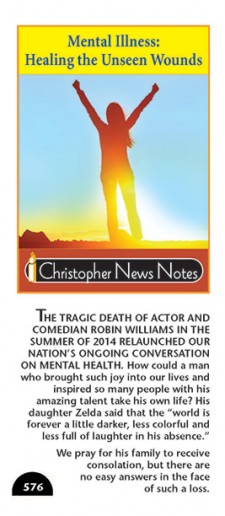 The following is the text of the Christopher News Note “Mental Illness: Healing the Unseen Wounds” (which was written by a freelancer). If you’d like a pdf or hard copy, see the end of this post:
The tragic death of actor and comedian Robin Williams in the summer of 2014 relaunched our nation’s ongoing conversation on mental health. How could a man who brought such joy into our lives and inspired so many people with his amazing talent take his own life?
His daughter Zelda said that the “world is forever a little darker, less colorful and less full of laughter in his absence.” We pray for his family to receive consolation, but there are no easy answers in the face of such a loss.
The pressing questions we are left with as a society are: how do we help each other heal the unseen wounds that threaten to destroy us from within? How do we create an environment where it is normal to seek help for ourselves and offer it to others? And how do we find meaning in the troubles we face while also finding a reason to rise above those troubles for the sake of those we love?
Out of the Shadows
One year after his son took his own life while battling depression, Evangelical Pastor Rick Warren of Saddleback Church in Orange County, California, teamed up with the National Alliance on Mental Illness and Bishop Kevin Vann of the local Roman Catholic Diocese of Orange to host the first ever “Gathering on Mental Health and the Church.”
“We are all broken,” Pastor Warren said on a day devoted to encouraging Christian leaders to more openly and forcefully combat a problem from which many people suffer at various times in their lives.
He gave testimony of his own struggles with depression and anxiety, and others came forward to offer accounts of a wide range of mental health issues. Recalling his battle with schizophrenia, David Mandani — founder and president of Saving Grace Saving Face, an organization dedicated to providing free mental health resources — said: “People often ask, how did God help you through recovery? Well, while I still take medication and have used medical therapies, I am absolutely convinced that God gave me the resilience and bounce-back power to get through my recovery.”
Then he added, “Because I entrusted my life and my disease to Jesus, so many of the predictions people said to me never happened. I was told I would never finish college, but God gave me the grace to complete graduate school. I was told I’d never hold down a job, but God gave me a vision and purposeful ministry. I was told I should never get married or even have kids, but God gave me three big blessings, a loving wife and two incredible kids.”
Throughout the conference, Pastor Warren and Bishop Vann both expressed a commitment to fostering a more open environment for anyone suffering from mental health problems, so they can get the help they need and move forward with their lives free of stigmatization.
Regarding the pain of losing his son and the influence that had on his new ministry, Pastor Warren said, “One of the things I believe is that God never wastes a hurt and that oftentimes your greatest ministry comes out of your deepest pain.”
From Tragedy to Hope
One troubling form of mental distress that has been on the rise in recent years is post traumatic stress disorder, or PTSD, which has been afflicting some of the brave soldiers who lay their lives on the line for our safety. And those from whom we expect such courage are all too susceptible to shame, which causes them to bury these problems rather than seek help.
In an article for Harper’s Magazine, “You Are Not Alone Across Time,” Wyatt Mason chronicles the program Outside the Wire, which utilizes theater— specifically, classical tragedy — to help soldiers confront the difficult realities of war. Mason details a particular performance of Sophocles’ “Ajax,” the story of a warrior suffering from profound mental anguish.
Recounting a poignant moment after the performance, when many of the soldiers came forward to meet the actors, Mason writes, “A retired lieutenant with deeply bagged eyes and a black bristle of mustache was brought to the performance that day by his wife, an active duty colonel. Since he’d gotten back from his tours in Afghanistan, he had refused to get the help his wife said he needed. But he confessed he’d broken down while watching ‘Ajax’ unfold. ‘Because of you guys,’ he told each of the actors afterward in a moment of frankness, ‘I’m going to seek help. I’ve been in denial for three years.’”
Beyond its service to veterans, Outside the Wire performs at hospitals, prisons, and homeless shelters with the goal of reaching people who believe their suffering can’t be understood and therefore must be suppressed.
The arts can play a vital role in breaking down the emotional barriers that stand in the way of healing psychological wounds so often buried and left to grow into complex problems. Once we lower those barriers, it is of paramount importance to have faith that things can improve. We should also remain committed to sharing our troubles with people who can help.
In the Christian mystery, we discover God’s invitation to unite our sufferings and all our mental anguish to Christ on the cross. Our response to His sacrifice enables us to move beyond sorrow to hope in all that is promised to those who persevere. Christ is not only with us in our suffering, He is the architect of Divine Providence and draws us towards the right people and circumstances where healing can be found.
A Reason to Heal
In his book “Stumbling Blocks or Stepping Stones: Spiritual Answers to Psychological Questions,” the late Father Benedict Groeschel explains how the unseen wounds we bear can help us grow closer to God when we open our hearts to His healing ways. Drawing on years of experience in the field of psychology and the wisdom of his Christian faith, he shows the importance of striving to live a morally guided life when it comes to recovering and maintaining mental well-being.
Father Groeschel writes, “If I tried to link the struggle for mental health with the struggle for holiness, I would say it is most clearly seen in the terrible battle against self-hate in the depths of the soul. Once the chain of self-hate is broken, the individual becomes free to love others, to be generous, to escape from his own darkness. This is part of the mystery of God’s love. God has first loved us; let us begin now to love Him.”
Recounting the story of Saint Francis of Assisi, Father Groeschel writes, “His fun loving personality had its melancholy side. Early on there were signs he was trying to cope with self-hate.” But the saint channeled his angst into service to the poor, the sick and the outcast. “It is not at all inappropriate,” observes Father Groeschel, “to look into his psychological make-up to find the sources of energy whereby he responded to the cross. His life powerfully demonstrates how the love of God can transform a weakness into a strength, a pathology into an opportunity for victory.”
Every trial, every torment, every bit of mental anguish we endure is an invitation to achieve the same kind of victory in our own lives. And when we strive for victory through service to others, we take the most important step towards our own sense of well-being.
The most painful part of any illness is that it can force us to turn in on ourselves and away from this mission to love. Every individual must attend to his or her own well-being, but we can never lose sight of the fact that we are constantly trying to make ourselves whole in order to give everything we have away in the spirit of love. This concept can ground us throughout the healing process because it elevates the mind to a higher purpose and enables us to endure the most difficult trials in life.
We all experience varying degrees of distress, but those who suffer from more serious and prolonged forms of mental illness carry a particularly heavy burden. Such extreme suffering prepares us to understand the profound angst at the heart of human existence.
Having experienced sorrow, we can better understand how to cultivate a sense of humor to lift the spirits of those we love. Having experienced anxiety, we can better understand how to calm those who look to us for support. And in this way, we can take all the pain we have overcome or are still working through and use it to bring joy into the world, to create a healing environment that serves the needs of all.
“Jesus, when all is darkness and we feel our weakness and helplessness, give us the sense of Your presence, Your love, and Your strength.”
– St. Ignatius of Loyola
To receive a pdf or mailed copy of “Mental Illness: Healing the Unseen Wounds,” email your request to [email protected]

Browse Our Archives
Select a Category Act One American Idol Andy Griffith Show Audrey Assad Baseball Bible Books Catholic Charities Christmas Christopher Awards Christopher Closeup Christopher News Notes Current Events Down syndrome Education Father Jonathan Morris Father Keller Films Forgiveness Fringe Government Hallmark History Holidays Humor Inspiration Leadership Lost Marriage Media Medical Military Movies Music NY Med Once Upon a Time Once Upon a Time Parenting Patheos Movie Club Person of Interest Politics Pope Francis Prayer Pro Life Saints Senior Citizens Signed Sealed Delivered Special Needs Sports Three Minutes a Day TV Uncategorized Volunteering Women Youth
Select a Month March 2017 February 2017 January 2017 December 2016 November 2016 October 2016 September 2016 August 2016 July 2016 June 2016 May 2016 April 2016 March 2016 February 2016 January 2016 December 2015 November 2015 October 2015 September 2015 August 2015 July 2015 June 2015 May 2015 April 2015 March 2015 February 2015 January 2015 December 2014 November 2014 October 2014 September 2014 August 2014 July 2014 June 2014 May 2014 April 2014 March 2014 February 2014 January 2014 December 2013 November 2013 October 2013 September 2013 August 2013 July 2013 June 2013 May 2013 April 2013 March 2013 February 2013 January 2013 December 2012 November 2012 October 2012 September 2012 August 2012 July 2012 June 2012 May 2012 April 2012 March 2012 February 2012 January 2012
Follow Us!
TAKE THE
Religious Wisdom Quiz
Who does the Bible say is Lord of the Sabbath?
Select your answer to see how you score.
Moses Satan Jesus Man
Related posts from Christopher Closeup

The 2017 Christopher Award winners for TV, Film,...

Mary Tyler Moore Provided Catholic Laughs in Two...
Phillip Phillips Sings His Hit "Home" at Steven...
'We're All Sick Pilgrims Drifting Toward God, Whether...
TRENDING AT PATHEOS Catholic

Rejecting Doom: Christian Hope And Human Action
Christianity is a religion of hope. We are to have hope and...

It’s What Comes From Within Which Matters
One of the most difficult things for us to understand is why...

Why I Choose the Eucharist Over the Sermon
Choose the Eucharist, Not the Sermon What are we supposed to get...

5 Design Elements Found in Spiritually Rooted Homes
Putting Spirituality Into Home Decor Our homes are more than our living...

Credo: A Story of God Told with the...
About 10 years ago, I began to imagine a personal "Credo" that...

The Anatomy of Divine Revelation in Catholic Thought
The claim that God has made Himself known to human beings is...
view all Catholic blogs
Ad-Free & Subscriber Log-In Subscription Support
- About Us
- 2026 Calendar
- Videos
- Podcasts
- Library of World Religions
- Faith In Media Tracker
- Advertise With Us
- Write for Us
- Privacy Policy
- Terms of Service
- Do Not Sell My Data
- Contact Us
- Radiant Digital
- Manage Newsletter Subscriptions
- Unsubscribe From Notifications
- Sitemap
Copyright 2008-2026, Patheos. All rights reserved.
Subscription Support Ad-Free & Subscriber Log-In
Follow Patheos