
BuddhistCatholicContemplativeEvangelicalGeneral ChristianHinduJewishLatter-day SaintMuslimNew VisionsProgressive Christian
Beliefs
- Buddhist
- Catholic
- Contemplative
- Evangelical
- General Christian
- Hindu
- Jewish
- Latter-day Saint
- More Voices
- Muslim
- New Visions
- Pagan
- Progressive Christian
Topics
- Religion News
- Food and Religion
- Sports and Religion
- Religious Art
- Religious Music and Entertainment
- Religious Events
- History and Religion
- Style and Religion
- Politics and Religion
- Women in Religion
- Recreation Outdoors and Religion
- Business Finance and Religion
- Careers Workplace and Religion
- Education and Religion
- Family Parenting and Religion
- Health Fitness and Religion
- Home and Religion
- Relationships and Religion
- Technology and Religion
- Travel and Religion
Columnists
- Buddhist Columnists
- Business Finance and Religion Columnists
- Careers Workplace and Religion Columnists
- Catholic Columnists
- Contemplative Columnists
- Education and Religion Columnists
- Evangelists Columnists
- Family Parenting and Religion Columnists
- General Christian Columnists
- Health Fitness and Religion Columnists
- Hindu Columnists
- History and Religion Columnists
- Home and Religion Columnists
- Jewish Columnists
- More Voices Columnists
- Latter Day Columnists
- Muslim Columnists
- New Visions Columnists
- Nonreligious Columnists
- Pagan Columnists
- Politics and Religion Columnists
- Progressive Columnists
- Recreation Outdoors and Religion Columnists
- Relationships and Religion Columnists
- Religion News Columnists
- Religious Art Columnists
- Religious Events Columnists
- Religious Music and Entertainment Columnists
- Sports and Religion Columnists
- Style and Religion Columnists
- Technology and Religion Columnists
- Travel and Religion Columnists
- Women in Religion Columnists
Resource Library
- 2026 Calendar
- Library of World Religions
- The 100 Most Holy Places on Earth
- Patheos Answers
- Podcasts
- Videos
- Faith Leaders Database
- Anglican Episcopalian
- Bahai
- Baptist
- Buddhism
- Christianity
- Confucianism
- Eastern Orthodoxy
- Hinduism
- Holiness and Pentecostal
- ISKCON
- Islam
- Judaism
- Lutheran
- Methodist
- The Church of Jesus Christ of Latter-day Saints
- New Age
- Paganism
- Presbytarian and Reformed
- Protestantism
- Religion Behind the Scenes
- Roman Catholic
- Scientology
- Shia Islam
- Sikhism
- Sufism
- Sunni Islam
- Taoism
- Zen
- See all religions
Research Tools
 Ad-Free & Subscriber Log-In Subscription Support
Ad-Free & Subscriber Log-In Subscription Support
Follow Patheos 

- Trending:
- Forgiveness
- |
- Marriage
- |
- Consciousness
- |
- Death Penalty
- |
- Election
- |
- Halloween
 Christopher Closeup
- Home
- Catholic
- Religious Music & Entertainment
- Simplifying Your Life and Finding Comfort in an Anxious World
Simplifying Your Life and Finding Comfort in an Anxious World
Last updated on: March 11, 2015 at 9:23 am by Tony Rossi
Simplifying Your Life and Finding Comfort in an Anxious World 2015-03-11T09:23:11-05:00 Tony Rossi
Patheos Explore the world's faith through different perspectives on religion and spirituality! Patheos has the views of the prevalent religions and spiritualities of the world.
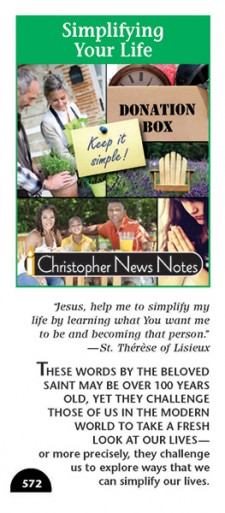 The following is the text of the Christopher News Note “Simplifying Your Life” (which was written by a freelancer). If you’d like a pdf or hard copy, see the end of this post:
“Jesus, help me to simplify my life by learning what You want me to be and becoming that person.”
—St. Thérèse of Lisieux
These words by the beloved saint may be over 100 years old, yet they challenge those of us in the modern world to take a fresh look at our lives – or more precisely, they challenge us to explore ways that we can simplify our lives.
Pursuing simple living is counter-cultural in a society that often seems all too focused on urging us to want more of everything. Yet for spiritual, ecological, and economic reasons, many people hope that cutting back on consumption will help reduce their personal stress levels, improve their relationship with God, and even promote justice in the world at large. Simple living, therefore, is not just a personal project, but a communal effort that embodies the statement by Mahatma Gandhi: “We must live simply that others may simply live.”
Clearing the Clutter
“The ability to simplify means to eliminate the unnecessary so that the necessary may speak.”
—Hans Hofmann
For many, the first step to living simply is to start small. When Susan Vogt decided to clear her home of clutter, she challenged herself to get rid of one item a day during the Lenten season. She hoped to simplify her space by donating unneeded items to those in need. The experiment was fruitful and fulfilling in both a spiritual and practical sense, so she chose to continue the effort for a full year. She described the journey in her book “Blessed by Less: Clearing Your Life of Clutter by Living Lightly.”
Vogt says the process has helped her to obtain a better balance in her life, and to recognize that while she can’t give to the point of destitution, neither can she justify holding on to items that could be useful to someone else: “I have become more attuned to what is really important in life and what things I had been hanging on to or worrying about that I could let go of.” In addition, she says, “It was a reminder of my need to clean out the interior, my inner self, as well. On the outside I will look the same, but it’s important to consider what’s going on inside. It’s about changing one’s attitude. I learned that my worth and importance are not dependent on what I own or even how I look or feel.”
Simplicity and Community
“In character, in manner, in style, in all things, the supreme excellence is simplicity.”
—Henry Wadsworth Longfellow
For some, at least a partial answer to the search for simplicity lies in the formation of community.
Luke Hansen’s first experience with living simply occurred in San Jose, California, when, as a layman, he did a stint with the Jesuit Volunteer Corps, which serves the poor and marginalized. During that time, he and his fellow volunteers ate food mostly from the local food pantry. And though many people in the area used their cars to commute, most of the individuals that Hansen served through his work took the bus—so he took the bus as well. “There is an inconvenience to it,” he says. “But it also creates more space to think, to say, ‘Ok, I have time to pray and I’m sharing life with people that I work with.’”
Hansen’s firsthand experience with simple living stuck with him, so he chose to join the Society of Jesus in order to continue down that road. After becoming a Jesuit priest, Father Hansen was given $75 a month in spending money, which meant making hard choices about what to buy. But in some ways, things got easier. “There were 22 men in the novitiate, we shared everything in common, and we were helped by generous benefactors,” he says. “I had more than enough, even though I couldn’t claim any of it as mine.”
Father Hansen also realized that it was possible to put too much focus on counting every penny, to become obsessed with how little he had rather than how much. Being part of a Jesuit community helped him learn to accept the generosity of others. Yet, he remains conscious of what he buys and how much he spends. “I do try to live frugally; it makes things easier,” Father Hansen says. “In doing less and in spending less, I require less, and it creates more time for prayer and community. It’s humanizing.”
Life Feels More Connected
“What we would like to do is change the world— make it a little simpler for people to feed, clothe, and shelter themselves as God intended them to do.”
—Dorothy Day
Eric Anglada has found a way to disconnect from the technology and distractions of modern life by settling on a Catholic Worker farm in Iowa. He was first drawn to the Catholic Worker movement because of its holistic vision. “It draws on the works of mercy and caring for the poor and the marginalized, and connects that to nonviolence and care for creation,” he says. And simple living is one of the things that holds all of the pieces of the Catholic Worker together. Anglada has lived on the farm for six years.
His community consists of 14 people and three households— eight adults and six children. He shares a house with his wife and another family. While Catholic Worker Houses in inner cities often serve as homes of hospitality for those in need, the farms tend to focus on agriculture and can accommodate families. By growing their own food instead of buying it, the community expresses solidarity with migrant farm workers and a desire to care for creation and trying to live more justly.
Without many of the trappings of modern society, Anglada says he is able to live more intentionally: “It opens up space to not be so frantic and harried and busy.” The community starts the day together with a reading from the Gospel or from a saint, followed by 20 minutes of silence, intercessions and then closing prayer. The common prayer, he says, sets the tone for the day: “We infuse our daily labors with more spiritual meaning. Life feels more connected here.”
Comfort in an Anxious World
“He who possesses God lacks nothing: God alone suffices.” —St. Teresa of Ávila
Paula Huston has been working to connect people with simple living for two decades. She’s written several books on living the good life—and she’s been practicing what she preaches. She and her husband moved from a large home to a 920- square-foot house in southern California, where she can grow and preserve her own food. They also do their own repairs and maintenance.
Her book “Simplifying the Soul” offers spiritual meditations and tips on how one might renew and declutter life in the areas of space, money, the body, the mind, one’s schedule, relationships, and prayer. Her goal in focusing on these areas is to get at the internal sources of want. “These are legitimate human desires,” she says. “These things represent security in the face of uncertainty. They represent status in a society that is competitive and success-oriented. They also represent freedom of choice, which is huge for Americans.”
While some people believe that money is the key to freedom, Huston suggests that we are all actually seeking “comfort in an anxious world.” Instead of trying to find meaning by acquiring possessions, we need to show people other possibilities. “There’s a huge stimulation of desire through advertising and the media in general,” Huston says. “Yet we don’t see many people who are consciously living against the grain.” She hopes to help reintroduce people to the idea of framing the good life within ancient concepts — “not as power-seeking and status-seeking, but as a life of self-control and virtue.”
It’s a concept she learned from a group of monks living as hermits in California. Invited by a friend to join her on a visit to their hermitage, Huston — who was born into a Lutheran family, but was an atheist at this time — found she was fascinated with the order’s alternative lifestyle. “I would feel a new calm and peace,” she said. “And I recognized early on that their lifestyle wasn’t just an escape to a kind of fantasy land. It was something they believed and consciously practiced, and that could be available to a person like me.”
This visit began not only her return to Christianity, but her embrace of the Catholic Church. “There’s a natural connection between simplicity and humility,” Huston says. “Humility means looking at the self realistically. It is the ability to look in the mirror and see who is there and to calm the stormy need for these things that are outside symbols of our own identity.”
Huston adds that possessions don’t take away our anxiety or stress, but can instead add to them: “Simplicity is that path to genuine freedom. You start to think of how little you need, instead of how much. You start to clear mental and physical space on purpose.”
This is something anyone can do, she concludes. The initial effort can be something as small as growing a pot of herbs on a windowsill so you can use them as ingredients in a home-cooked meal. Simplifying allows you to “feel like you have more to say about how your time and money are spent. The business of simplifying has opened up amazing things in my life.”
We cannot have outer simplicity in our homes and schedules without inner simplicity. And, if we are at peace inside, if we lean on and learn to trust God for our needs, our outer lives will reflect that.
We can begin to seek this balance from the outside in or from the inside out. If we clean up our outer clutter, we will become less scattered and chaotic inside. The reverse is also true. If we set aside time for God first thing in the morning as Jesus did, we’ll find more energy for simplifying our environments. We’ll also make better choices about how we spend our time, money, and energy.
– Susan K. Rowland
To receive a pdf or mailed copy of “Simplifying Your Life,” email your request to [email protected]
Previous Post

March 10, 2015
Hire a Veteran Now
Next Post

March 16, 2015 "Person of Interest's" Fusco and Reese Catching Perps on the Corner
Browse Our Archives
Select a Category Act One American Idol Andy Griffith Show Audrey Assad Baseball Bible Books Catholic Charities Christmas Christopher Awards Christopher Closeup Christopher News Notes Current Events Down syndrome Education Father Jonathan Morris Father Keller Films Forgiveness Fringe Government Hallmark History Holidays Humor Inspiration Leadership Lost Marriage Media Medical Military Movies Music NY Med Once Upon a Time Once Upon a Time Parenting Patheos Movie Club Person of Interest Politics Pope Francis Prayer Pro Life Saints Senior Citizens Signed Sealed Delivered Special Needs Sports Three Minutes a Day TV Uncategorized Volunteering Women Youth
Select a Month March 2017 February 2017 January 2017 December 2016 November 2016 October 2016 September 2016 August 2016 July 2016 June 2016 May 2016 April 2016 March 2016 February 2016 January 2016 December 2015 November 2015 October 2015 September 2015 August 2015 July 2015 June 2015 May 2015 April 2015 March 2015 February 2015 January 2015 December 2014 November 2014 October 2014 September 2014 August 2014 July 2014 June 2014 May 2014 April 2014 March 2014 February 2014 January 2014 December 2013 November 2013 October 2013 September 2013 August 2013 July 2013 June 2013 May 2013 April 2013 March 2013 February 2013 January 2013 December 2012 November 2012 October 2012 September 2012 August 2012 July 2012 June 2012 May 2012 April 2012 March 2012 February 2012 January 2012
Follow Us!
TAKE THE
Religious Wisdom Quiz
Who wrote the most letters in the New Testament?
Select your answer to see how you score.
John James Peter Paul
Related posts from Christopher Closeup

The 2017 Christopher Award winners for TV, Film,...

Mary Tyler Moore Provided Catholic Laughs in Two...
Phillip Phillips Sings His Hit "Home" at Steven...

'We're All Sick Pilgrims Drifting Toward God, Whether...
TRENDING AT PATHEOS Catholic

The Parable Of The Sower And The Word...
One of Christ’s most famous parables is that of the sower who...

Rejecting Doom: Christian Hope And Human Action
Christianity is a religion of hope. We are to have hope and...

Why I Choose the Eucharist Over the Sermon
Choose the Eucharist, Not the Sermon What are we supposed to get...

5 Design Elements Found in Spiritually Rooted Homes
Putting Spirituality Into Home Decor Our homes are more than our living...

Credo: A Story of God Told with the...
About 10 years ago, I began to imagine a personal "Credo" that...

The Anatomy of Divine Revelation in Catholic Thought
The claim that God has made Himself known to human beings is...
view all Catholic blogs
Ad-Free & Subscriber Log-In Subscription Support
- About Us
- 2026 Calendar
- Videos
- Podcasts
- Library of World Religions
- Faith In Media Tracker
- Advertise With Us
- Write for Us
- Privacy Policy
- Terms of Service
- Do Not Sell My Data
- Contact Us
- Radiant Digital
- Manage Newsletter Subscriptions
- Unsubscribe From Notifications
- Sitemap
Copyright 2008-2026, Patheos. All rights reserved.
Subscription Support Ad-Free & Subscriber Log-In
Follow Patheos