
BuddhistCatholicContemplativeEvangelicalGeneral ChristianHinduJewishLatter-day SaintMuslimNew VisionsProgressive Christian
Beliefs
- Buddhist
- Catholic
- Contemplative
- Evangelical
- General Christian
- Hindu
- Jewish
- Latter-day Saint
- More Voices
- Muslim
- New Visions
- Pagan
- Progressive Christian
Topics
- Religion News
- Food and Religion
- Sports and Religion
- Religious Art
- Religious Music and Entertainment
- Religious Events
- History and Religion
- Style and Religion
- Politics and Religion
- Women in Religion
- Recreation Outdoors and Religion
- Business Finance and Religion
- Careers Workplace and Religion
- Education and Religion
- Family Parenting and Religion
- Health Fitness and Religion
- Home and Religion
- Relationships and Religion
- Technology and Religion
- Travel and Religion
Columnists
- Buddhist Columnists
- Business Finance and Religion Columnists
- Careers Workplace and Religion Columnists
- Catholic Columnists
- Contemplative Columnists
- Education and Religion Columnists
- Evangelists Columnists
- Family Parenting and Religion Columnists
- General Christian Columnists
- Health Fitness and Religion Columnists
- Hindu Columnists
- History and Religion Columnists
- Home and Religion Columnists
- Jewish Columnists
- More Voices Columnists
- Latter Day Columnists
- Muslim Columnists
- New Visions Columnists
- Nonreligious Columnists
- Pagan Columnists
- Politics and Religion Columnists
- Progressive Columnists
- Recreation Outdoors and Religion Columnists
- Relationships and Religion Columnists
- Religion News Columnists
- Religious Art Columnists
- Religious Events Columnists
- Religious Music and Entertainment Columnists
- Sports and Religion Columnists
- Style and Religion Columnists
- Technology and Religion Columnists
- Travel and Religion Columnists
- Women in Religion Columnists
Resource Library
- 2026 Calendar
- Library of World Religions
- The 100 Most Holy Places on Earth
- Patheos Answers
- Podcasts
- Videos
- Faith Leaders Database
- Anglican Episcopalian
- Bahai
- Baptist
- Buddhism
- Christianity
- Confucianism
- Eastern Orthodoxy
- Hinduism
- Holiness and Pentecostal
- ISKCON
- Islam
- Judaism
- Lutheran
- Methodist
- The Church of Jesus Christ of Latter-day Saints
- New Age
- Paganism
- Presbytarian and Reformed
- Protestantism
- Religion Behind the Scenes
- Roman Catholic
- Scientology
- Shia Islam
- Sikhism
- Sufism
- Sunni Islam
- Taoism
- Zen
- See all religions
Research Tools
 Ad-Free & Subscriber Log-In Subscription Support
Ad-Free & Subscriber Log-In Subscription Support
Follow Patheos 

- Trending:
- Forgiveness
- |
- Marriage
- |
- Consciousness
- |
- Death Penalty
- |
- Election
- |
- Halloween
 Christopher Closeup
- Home
- Catholic
- Religious Music & Entertainment
- Finding Strength in Sticking Together: A Review of “The Good Lie”
Finding Strength in Sticking Together: A Review of “The Good Lie”
Last updated on: December 23, 2014 at 3:02 pm by Tony Rossi
Finding Strength in Sticking Together: A Review of “The Good Lie” 2014-12-23T15:02:03-05:00 Tony Rossi
Patheos Explore the world's faith through different perspectives on religion and spirituality! Patheos has the views of the prevalent religions and spiritualities of the world.
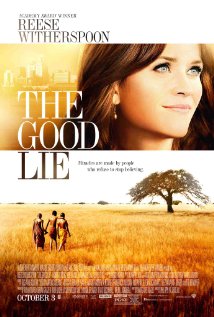 “How long shall it be till the end of these troubles?”
That’s a quote from the Book of Daniel that’s spoken by a refugee from the Sudanese Civil War in the new movie “The Good Lie” – and it accurately reflects the violence and hardship endured by boys and girls there throughout those horrific times.
During the mid-1980s, more than 100,000 children in Sudan were displaced or orphaned because of the civil war that raged for political and religious reasons. Many of these children only escaped death themselves because they were working with cattle out in the fields at the time soldiers arrived in their villages to murder everyone.
Such is the case in “The Good Lie” with the characters Theo, Mamere, their younger sister Abital, and their friends Paul and Jeremiah. Though they’re composite characters, screenwriter Margaret Nagle talked with 1,000 “Lost Boys of Sudan” (as they came to be known) in order to portray their plight realistically.
These five siblings, friends, and others journey a thousand miles by foot, fighting off cougars for food, drinking urine for hydration, and evading soldiers to survive. In the process, they display levels of maturity, resiliency, selflessness, and cohesiveness from which American young people can learn a lot.
By the time they reach a refugee camp in Kenya, they’ve lost several members of their band of brothers, including Theo who gave himself up to some soldiers in order to avoid them finding the other kids. Mamere bears some responsibility for unintentionally creating the situation which led to Theo’s surrender, and the guilt he feels over it never goes away.
Though life in the camp is peaceful and the aid workers are kind, everyone gets by on the bare necessities. They also apply for visas to the United States, where they hope to resettle and build new lives. It takes 13 years, but they finally achieve their goal in the year 2000.
They’re met in Kansas City, Missouri, by Carrie Davis (Reese Witherspoon), whose job it is to find them jobs – though considering their lack of experience, this proves a challenge. Not all is well even in the U.S., though, because Abital is sent to a different state for bureaucratic reasons. The rest of the story follows the former “Lost Boys” and girl as they adjust to life in a land totally different from their own, and even teach Carrie some important lessons about building bonds of genuine friendship.
The first half-hour of “The Good Lie” is focused on the young people’s harrowing experiences in Sudan. Though there are images of death and violence, they’re not portrayed too graphically. These scenes also give witness to the presence of evil in the world because seeing innocent children mercilessly gunned down can’t be called anything but evil.
The tight-knit bonds that form between the kids are also cemented during this time. “We found strength in sticking together,” they say. And when they get word they’re going to America, the actors (Arnold Oceng as Mamere, Ger Duany as Jeremiah, Emmanuel Jal as Paul, and Kuoth Wiel as Abital) bring a palpable joy to the moment, maybe because they are actually Sudanese who experienced the war personally or via family stories.
The film’s tone lightens significantly once they arrive at the refugee camp, and even moreso when they get to the United States. I’d say it even veers into “fish out of water” comedy territory – though I don’t consider that a bad thing. Seeing these young men who have suffered so much being introduced to American staples like McDonald’s and lime green jello reminds us how funny and strange our culture can sometimes be.
But along with American oddities and culture shock, Mamere, Paul, and Jeremiah also discover wastefulness, such as when a supermarket manager would rather throw out his barely-expired food than give it to the homeless.
Reese Witherspoon is the movie’s biggest star and conveys a brash charm and sense of exasperation in her role as Carrie. Thankfully, Carrie is not some whitewashed saint of a figure, but rather a force of nature who’s got her own personality flaws to deal with.
The movie’s title “The Good Lie” refers to a quote from Mark Twain’s “Huckleberry Finn,” in which Huck tells lies in order to save the life of his black friend Jim. Huck’s contention is that these lies are good because they are saving someone. Mamere relates this to the lie his brother Theo told in order to save him from the enemy soldiers. Justifying lying can be a slippery slope and many contend there is no such thing as a “good lie.” In the context of the movie, however, it makes sense to a certain degree – though a later lie is a little more morally problematic. (In order to avoid spoilers, I won’t go into it.)
As the film’s production notes indicate, this story was a labor of love for screenwriter Nagle, who not only talked with refugees, but also interviewed volunteers, pastors, church leaders, and “everybody under the sun” who had been involved with the Lost Boys and bringing them to the States. In addition, producer Molly Smith grew up in a family that took in a Lost Boy, so it was a passion project for her as well.
And producer Brian Grazer said, “Around the time we were making the movie, I brought my kids to an orphanage in Kenya because I wanted them to understand and appreciate the freedoms and privileges they have in their lives. I think that’s one of the things our film speaks to: being grateful and thanking God for what we have. And perhaps to ignite something in us to help where we can, however we can.”
Overall, the makers of “The Good Lie” have done a service by creating an enlightening and entertaining story grounded in a history with which many people are unfamiliar. See the trailer below.
Previous Post

October 1, 2014
VIDEO: Father Jonathan Morris Says Don't Let Family Drama Divide You
Next Post

October 7, 2014 How "Arrow's" Oliver Queen Embraced the Commandment "Thou Shalt Not Kill"
Browse Our Archives
Select a Category Act One American Idol Andy Griffith Show Audrey Assad Baseball Bible Books Catholic Charities Christmas Christopher Awards Christopher Closeup Christopher News Notes Current Events Down syndrome Education Father Jonathan Morris Father Keller Films Forgiveness Fringe Government Hallmark History Holidays Humor Inspiration Leadership Lost Marriage Media Medical Military Movies Music NY Med Once Upon a Time Once Upon a Time Parenting Patheos Movie Club Person of Interest Politics Pope Francis Prayer Pro Life Saints Senior Citizens Signed Sealed Delivered Special Needs Sports Three Minutes a Day TV Uncategorized Volunteering Women Youth
Select a Month March 2017 February 2017 January 2017 December 2016 November 2016 October 2016 September 2016 August 2016 July 2016 June 2016 May 2016 April 2016 March 2016 February 2016 January 2016 December 2015 November 2015 October 2015 September 2015 August 2015 July 2015 June 2015 May 2015 April 2015 March 2015 February 2015 January 2015 December 2014 November 2014 October 2014 September 2014 August 2014 July 2014 June 2014 May 2014 April 2014 March 2014 February 2014 January 2014 December 2013 November 2013 October 2013 September 2013 August 2013 July 2013 June 2013 May 2013 April 2013 March 2013 February 2013 January 2013 December 2012 November 2012 October 2012 September 2012 August 2012 July 2012 June 2012 May 2012 April 2012 March 2012 February 2012 January 2012
Follow Us!
TAKE THE
Religious Wisdom Quiz
What year was the Council of Nicea?
Select your answer to see how you score.
325 AD 500 AD 1517 AD 1054 AD
Related posts from Christopher Closeup

The 2017 Christopher Award winners for TV, Film,...

Jimmy Kimmel Deserves an Emmy For His Job...

Discerning God's Will & Adopting Potatoes in "Signed,...

Bringing the Future to Hope Valley: A Look...
TRENDING AT PATHEOS Catholic

Creation, Preservation, and Teleology in Catholic Theology
As I write this, it is very early Monday morning. Like millions...

The Parable Of The Sower And The Word...
One of Christ’s most famous parables is that of the sower who...

Rejecting Doom: Christian Hope And Human Action
Christianity is a religion of hope. We are to have hope and...

Why I Choose the Eucharist Over the Sermon
Choose the Eucharist, Not the Sermon What are we supposed to get...

5 Design Elements Found in Spiritually Rooted Homes
Putting Spirituality Into Home Decor Our homes are more than our living...

Credo: A Story of God Told with the...
About 10 years ago, I began to imagine a personal "Credo" that...
view all Catholic blogs
Ad-Free & Subscriber Log-In Subscription Support
- About Us
- 2026 Calendar
- Videos
- Podcasts
- Library of World Religions
- Faith In Media Tracker
- Advertise With Us
- Write for Us
- Privacy Policy
- Terms of Service
- Do Not Sell My Data
- Contact Us
- Radiant Digital
- Manage Newsletter Subscriptions
- Unsubscribe From Notifications
- Sitemap
Copyright 2008-2026, Patheos. All rights reserved.
Subscription Support Ad-Free & Subscriber Log-In
Follow Patheos