
BuddhistCatholicContemplativeEvangelicalGeneral ChristianHinduJewishLatter-day SaintMuslimNew VisionsProgressive Christian
Beliefs
- Buddhist
- Catholic
- Contemplative
- Evangelical
- General Christian
- Hindu
- Jewish
- Latter-day Saint
- More Voices
- Muslim
- New Visions
- Pagan
- Progressive Christian
Topics
- Religion News
- Food and Religion
- Sports and Religion
- Religious Art
- Religious Music and Entertainment
- Religious Events
- History and Religion
- Style and Religion
- Politics and Religion
- Women in Religion
- Recreation Outdoors and Religion
- Business Finance and Religion
- Careers Workplace and Religion
- Education and Religion
- Family Parenting and Religion
- Health Fitness and Religion
- Home and Religion
- Relationships and Religion
- Technology and Religion
- Travel and Religion
Columnists
- Buddhist Columnists
- Business Finance and Religion Columnists
- Careers Workplace and Religion Columnists
- Catholic Columnists
- Contemplative Columnists
- Education and Religion Columnists
- Evangelists Columnists
- Family Parenting and Religion Columnists
- General Christian Columnists
- Health Fitness and Religion Columnists
- Hindu Columnists
- History and Religion Columnists
- Home and Religion Columnists
- Jewish Columnists
- More Voices Columnists
- Latter Day Columnists
- Muslim Columnists
- New Visions Columnists
- Nonreligious Columnists
- Pagan Columnists
- Politics and Religion Columnists
- Progressive Columnists
- Recreation Outdoors and Religion Columnists
- Relationships and Religion Columnists
- Religion News Columnists
- Religious Art Columnists
- Religious Events Columnists
- Religious Music and Entertainment Columnists
- Sports and Religion Columnists
- Style and Religion Columnists
- Technology and Religion Columnists
- Travel and Religion Columnists
- Women in Religion Columnists
Resource Library
- 2026 Calendar
- Library of World Religions
- The 100 Most Holy Places on Earth
- Patheos Answers
- Podcasts
- Videos
- Faith Leaders Database
- Anglican Episcopalian
- Bahai
- Baptist
- Buddhism
- Christianity
- Confucianism
- Eastern Orthodoxy
- Hinduism
- Holiness and Pentecostal
- ISKCON
- Islam
- Judaism
- Lutheran
- Methodist
- The Church of Jesus Christ of Latter-day Saints
- New Age
- Paganism
- Presbytarian and Reformed
- Protestantism
- Religion Behind the Scenes
- Roman Catholic
- Scientology
- Shia Islam
- Sikhism
- Sufism
- Sunni Islam
- Taoism
- Zen
- See all religions
Research Tools
 Ad-Free & Subscriber Log-In Subscription Support
Ad-Free & Subscriber Log-In Subscription Support
Follow Patheos 

- Trending:
- Forgiveness
- |
- Marriage
- |
- Consciousness
- |
- Death Penalty
- |
- Election
- |
- Halloween
 Christopher Closeup
- Home
- Catholic
- Religious Music & Entertainment
- How to Build an Active Prayer Life
How to Build an Active Prayer Life
Last updated on: September 3, 2014 at 8:27 am by Tony Rossi
How to Build an Active Prayer Life 2014-09-03T08:27:09-05:00 Tony Rossi
Patheos Explore the world's faith through different perspectives on religion and spirituality! Patheos has the views of the prevalent religions and spiritualities of the world.
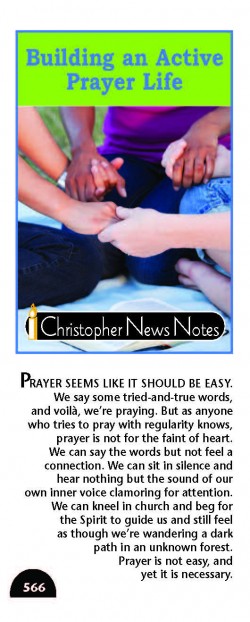 The following is the text of the Christopher News Note “Building an Active Prayer Life.” If you’d like a pdf or hard copy, see the end of this post:
Prayer seems like it should be easy. We say some tried-and-true words, and voilà, we’re praying. But as anyone who tries to pray with regularity knows, prayer is not for the faint of heart. We can say the words but not feel a connection. We can sit in silence and hear nothing but the sound of our own inner voice clamoring for attention. We can kneel in church and beg for the Spirit to guide us and still feel as though we’re wandering a dark path in an unknown forest. Prayer is not easy, and yet it is necessary.
Pope Francis, in one of his morning homilies at Casa Santa Marta, spoke about the necessity of prayer in our lives, and also about the struggle to pray. His words give us comfort, reminding us that both saints and sinners alike have faced the demons of doubt, dryness, and disconnection when they settle down to meet God in prayer.
“How do we pray? Do we pray like this, out of habit, piously but unbothered, or do we put ourselves forward with courage before the Lord to ask for the grace, to ask for what we’re praying for? Courage in prayer: a prayer that is not courageous is not a real prayer,” the pope said. “The courage to trust that the Lord listens to us, the courage to knock on the door…The Lord says: ‘For everyone who asks, receives; and the one who seeks, finds; and to the one who knocks, the door will be opened.’ But you have to ask, seek, and knock.”
How do we muster up the courage to knock, to seek again and again? Where do we find the will and the way?
“Pray inwardly, even if you do not enjoy it. It does good, though you feel nothing; yes, even though you think you are doing nothing.”
– Julian of Norwich, 14th century mystic
Persistence Pays
In the Gospel, Jesus uses the parable of the Persistent Widow to teach us how to pray always and to never weary of praying. In that story, we see the widow return to the judge again and again, annoying him, nagging him, being relentless in her pursuit of justice. And Jesus says, “Will not God then secure the rights of His chosen ones who call out to Him day and night? Will He be slow to answer them? I tell you, He will see to it that justice is done for them speedily. But when the Son of Man comes, will He find faith on earth?” (Luke 18:7-8)
If nothing else, prayer requires perseverance and a willingness to put ourselves before God daily, constantly, relentlessly. There’s something beautiful about a God who begs us to bother Him, to annoy Him, to pursue Him, but we can’t do that if we don’t show up.
So the other thing that prayer requires is our presence. Prayer doesn’t happen without any effort on our part. We shouldn’t just show up every once in a while with a request or demand and expect an immediate answer. We should be diligent in prayer, knowing that this relationship we have with God is built day by day, not once a week or once a month or whenever disaster strikes in our lives.
“Praying is not simply some necessary compartment in the daily schedule of a Christian or a source of support in time of need, nor is it restricted to Sunday morning or mealtimes. Praying is living. It is eating and drinking, action and rest, teaching and learning, playing and working,” writes Henri J.M. Nouwen in “With Open Hands.” “Praying pervades every aspect of our lives. It is the unceasing recognition that God is wherever we are, always inviting us to come closer and to celebrate the divine gift of being alive.”
In other words, we are called to pray without ceasing, as St. Paul challenges all disciples of Christ to do in the First Letter to the Thessalonians. The concept sounds nearly impossible for those of us living already overstretched lives with almost no time to call our own. And yet, what Nouwen and other prayer experts recommend is not making prayer one more thing on your long list of obligations but rather an ever-present part of the whole.
The Divine in the Everyday
In “Everyday Divine: A Catholic Guide to Active Spirituality,” author Mary DeTurris Poust explores ways to make prayer part of normal activities, to “discover the divine in the everyday.”
“When you begin to see prayer not as something that happens outside your everyday actions but as the thread that weaves together the disparate parts of your life tapestry, you soon discover a connection to the divine that never dissipates, never wavers, even when the world outside is pounding on the door to your soul demanding to be let in,” she explains. “You can have it all, despite the seemingly obvious contradictions—a still point while in constant motion, silence in the midst of never-ending noise, sacred vibrations running through the most mundane moments.”
The key is finding a style of prayer that works for you, something you know you’ll stick with because it feels right and it fits into your life. If you can’t get to daily Mass or pray the Liturgy of the Hours, can you say the Jesus Prayer when you’re sitting at a stop light? If you can’t say an entire Rosary before bed each night, can you at least say a few Hail Marys as you chop onions for dinner or pull weeds from your garden? If you can’t sit in silent contemplation for 20 minutes each day, can you take a few minutes to read your Bible, a few minutes when you completely disconnect from email, phone and TV?
Brother Lawrence, the 17th-century French monk who wrote “Practice in the Presence of God,” said: “You must try continually to make all of your actions, without distinction, a sort of little conversation with God—not in a rehearsed way but just as they happen, with purity and simplicity of heart.”
“When you say ‘Jesus,’ the word is already a prayer.”
– Servant of God Catherine Doherty, 20th-century founder of Madonna House
A Dream that Begins with Prayer
Matthew Barnett has seen the power of prayer to transform both the server and the served. The founder of the Dream Center, which ministers to more than 50,000 needy, lost and forgotten people on the streets of Los Angeles each week, stresses that prayer is non-negotiable when it comes to Christian service. He encourages his staff to make time for daily prayer at the Dream Center, which is housed in a former Catholic hospital. Prayer and service must work together, he says, noting that one is not holier or better than the other.
“It’s like two wings of an airplane—evangelism, reaching people that are lost and serving others is one wing—and prayer is the other. You can’t do one without the other. So we’ve set aside this old chapel now where people can come 24 hours a day,” he explained during an interview on the “Christopher Closeup” radio show. “Everyone that goes out on an outreach needs to stop by the chapel for at least five to ten minutes.”
It’s amazing how prayer can shift our focus—away from our own wants and needs and toward God and the needs of others. And prayer begets a desire for more prayer, so even a little bit of time spent in conversation or silence with God has the potential to transform our prayer life and our spiritual journey in substantial ways.
Spiritual Medicine
Pope Francis went so far as to call prayer “spiritual medicine” one recent Sunday during his regular Angelus address.
“I want to recommend some medicine for all of you. It’s a spiritual medicine,” he said, holding up a white box of Rosary beads with a drawing of a human heart on it, adding, “Don’t forget to take it. It’s good for your heart, for your soul, for your whole life.”
If prayer is so good for us, why is it so hard to do? Partly because our fast-moving, multi-tasking world doesn’t see prayer as productive. We can fall into the trap of thinking it’s a luxury, something we do after all our other obligations are met. And partly because prayer—like diet and exercise—can be a tough habit to keep up long-term without some ongoing support.
Look for a prayer partner, a spiritual director, or maybe even a nearby monastery that allows outsiders to come in and pray with the monks or nuns. Find nourishment in weekly or daily Mass, Scripture reading, Adoration, and, if at all possible, an annual retreat, even if only for a day or two.
Spiritual health begins with daily prayer, says Matthew Kelly, author of “The Four Signs of a Dynamic Catholic.”
“The daily habit of prayer is the result of real spiritual work. Different things work for different people. Beginners in prayer struggle because they try one thing and it doesn’t work, and they get discouraged,” he says. “Too many people don’t have someone they can turn to and discuss the intricacies of developing a practical and sustainable prayer life…What is important to recognize is that dynamic Catholics have a time to pray, a place to pray, and a structure to their prayer.”
So begin there. Find a place and a time, whether it’s your parish church for daily Mass or a corner of your bedroom for a nightly Examen or your car for prayers said on the way to work. Commit to that time and place and then begin to explore what prayer style works best for you and your lifestyle.
Find a way to pray that is realistic, and you will be more likely to stick with it and move forward. But do stick with it because prayer is a non-negotiable in a spiritual life.
When asked about how to pray, Blessed Pope John Paul II responded this way: “Pray any way you like, so long as you do pray. You can pray the way your mother taught you; you can use a prayer book. Sometimes it takes courage to pray; but it is possible to pray, and necessary to pray, whether from memory or a book or just in thought, it is all the same.”
“We need not travel to southern France to encounter God’s presence in our lives. God dwells within us already, and just as important as the grotto of Lourdes, where Mary spoke to Bernadette in 1858, is the grotto of our hearts.”
– Father James Martin, S.J., “Lourdes Diary: Seven Days in the Grotto of Massabielle”
To receive a pdf or mailed copy of “Building an Active Prayer Life,” email your request to [email protected]
Previous Post
September 2, 2014
VIDEO: Father Jonathan Morris on Humility, Part One
Browse Our Archives
Select a Category Act One American Idol Andy Griffith Show Audrey Assad Baseball Bible Books Catholic Charities Christmas Christopher Awards Christopher Closeup Christopher News Notes Current Events Down syndrome Education Father Jonathan Morris Father Keller Films Forgiveness Fringe Government Hallmark History Holidays Humor Inspiration Leadership Lost Marriage Media Medical Military Movies Music NY Med Once Upon a Time Once Upon a Time Parenting Patheos Movie Club Person of Interest Politics Pope Francis Prayer Pro Life Saints Senior Citizens Signed Sealed Delivered Special Needs Sports Three Minutes a Day TV Uncategorized Volunteering Women Youth
Select a Month March 2017 February 2017 January 2017 December 2016 November 2016 October 2016 September 2016 August 2016 July 2016 June 2016 May 2016 April 2016 March 2016 February 2016 January 2016 December 2015 November 2015 October 2015 September 2015 August 2015 July 2015 June 2015 May 2015 April 2015 March 2015 February 2015 January 2015 December 2014 November 2014 October 2014 September 2014 August 2014 July 2014 June 2014 May 2014 April 2014 March 2014 February 2014 January 2014 December 2013 November 2013 October 2013 September 2013 August 2013 July 2013 June 2013 May 2013 April 2013 March 2013 February 2013 January 2013 December 2012 November 2012 October 2012 September 2012 August 2012 July 2012 June 2012 May 2012 April 2012 March 2012 February 2012 January 2012
Follow Us!
TAKE THE
Religious Wisdom Quiz
What color is the first horse in Revelation 6?
Select your answer to see how you score.
Black White Pale Red
Related posts from Christopher Closeup

The 2017 Christopher Award winners for TV, Film,...
Mary Tyler Moore Provided Catholic Laughs in Two...
Phillip Phillips Sings His Hit "Home" at Steven...
'We're All Sick Pilgrims Drifting Toward God, Whether...
TRENDING AT PATHEOS Catholic

Rejecting Doom: Christian Hope And Human Action
Christianity is a religion of hope. We are to have hope and...

It’s What Comes From Within Which Matters
One of the most difficult things for us to understand is why...

Why I Choose the Eucharist Over the Sermon
Choose the Eucharist, Not the Sermon What are we supposed to get...

5 Design Elements Found in Spiritually Rooted Homes
Putting Spirituality Into Home Decor Our homes are more than our living...

Credo: A Story of God Told with the...
About 10 years ago, I began to imagine a personal "Credo" that...

The Anatomy of Divine Revelation in Catholic Thought
The claim that God has made Himself known to human beings is...
view all Catholic blogs
Ad-Free & Subscriber Log-In Subscription Support
- About Us
- 2026 Calendar
- Videos
- Podcasts
- Library of World Religions
- Faith In Media Tracker
- Advertise With Us
- Write for Us
- Privacy Policy
- Terms of Service
- Do Not Sell My Data
- Contact Us
- Radiant Digital
- Manage Newsletter Subscriptions
- Unsubscribe From Notifications
- Sitemap
Copyright 2008-2026, Patheos. All rights reserved.
Subscription Support Ad-Free & Subscriber Log-In
Follow Patheos