
BuddhistCatholicContemplativeEvangelicalGeneral ChristianHinduJewishLatter-day SaintMuslimNew VisionsProgressive Christian
Beliefs
- Buddhist
- Catholic
- Contemplative
- Evangelical
- General Christian
- Hindu
- Jewish
- Latter-day Saint
- More Voices
- Muslim
- New Visions
- Pagan
- Progressive Christian
Topics
- Religion News
- Food and Religion
- Sports and Religion
- Religious Art
- Religious Music and Entertainment
- Religious Events
- History and Religion
- Style and Religion
- Politics and Religion
- Women in Religion
- Recreation Outdoors and Religion
- Business Finance and Religion
- Careers Workplace and Religion
- Education and Religion
- Family Parenting and Religion
- Health Fitness and Religion
- Home and Religion
- Relationships and Religion
- Technology and Religion
- Travel and Religion
Columnists
- Buddhist Columnists
- Business Finance and Religion Columnists
- Careers Workplace and Religion Columnists
- Catholic Columnists
- Contemplative Columnists
- Education and Religion Columnists
- Evangelists Columnists
- Family Parenting and Religion Columnists
- General Christian Columnists
- Health Fitness and Religion Columnists
- Hindu Columnists
- History and Religion Columnists
- Home and Religion Columnists
- Jewish Columnists
- More Voices Columnists
- Latter Day Columnists
- Muslim Columnists
- New Visions Columnists
- Nonreligious Columnists
- Pagan Columnists
- Politics and Religion Columnists
- Progressive Columnists
- Recreation Outdoors and Religion Columnists
- Relationships and Religion Columnists
- Religion News Columnists
- Religious Art Columnists
- Religious Events Columnists
- Religious Music and Entertainment Columnists
- Sports and Religion Columnists
- Style and Religion Columnists
- Technology and Religion Columnists
- Travel and Religion Columnists
- Women in Religion Columnists
Resource Library
- 2026 Calendar
- Library of World Religions
- The 100 Most Holy Places on Earth
- Patheos Answers
- Podcasts
- Videos
- Faith Leaders Database
- Anglican Episcopalian
- Bahai
- Baptist
- Buddhism
- Christianity
- Confucianism
- Eastern Orthodoxy
- Hinduism
- Holiness and Pentecostal
- ISKCON
- Islam
- Judaism
- Lutheran
- Methodist
- The Church of Jesus Christ of Latter-day Saints
- New Age
- Paganism
- Presbytarian and Reformed
- Protestantism
- Religion Behind the Scenes
- Roman Catholic
- Scientology
- Shia Islam
- Sikhism
- Sufism
- Sunni Islam
- Taoism
- Zen
- See all religions
Research Tools
 Ad-Free & Subscriber Log-In Subscription Support
Ad-Free & Subscriber Log-In Subscription Support
Follow Patheos 

- Trending:
- Forgiveness
- |
- Marriage
- |
- Consciousness
- |
- Death Penalty
- |
- Election
- |
- Halloween

- Home
- General Christian
- A Life of Love
A Life of Love
Last updated on: November 23, 2021 at 6:46 pm by Guest Contributor
A Life of Love 2021-11-23T18:46:46-05:00 Guest Contributor
Patheos Explore the world's faith through different perspectives on religion and spirituality! Patheos has the views of the prevalent religions and spiritualities of the world.

By Rod Wilson
Many of us have acquired definitions of love through popular music and an oversexualized culture. In those two arenas, love makes us feel good, gives us energy, aids our self-esteem, and makes our world go round.
When you experience that kind of love, you’re ecstatic and emotional, overcome by inner sensations, sexual and otherwise, making you feel great. But therein lies the problem: you.
Biblical love is sacrificial, hard work, others-oriented. Engaging in this kind of love might not make you feel good at all. Think of parenting. Loving children is sometimes one of the most painful forms of love one can experience.
Frequently neither the parents nor the child is happy, but doing what is best for the other isn’t always easy. An attentiveness to the other, an inclination in their direction, is a move away from ourselves. That is why the phrase “falling in love” is such a contradiction. Falling requires no energy or effort. But real love requires all of that and more.
For Christians, a life of love is built on the fact that we are loved. Vertical understanding that God loves me opens up my horizontal world, where all others are recipients of my love. All others. Those who are easy to love, and those who are challenging to love. Even enemies. Even Samaritans. Even those who disagree. Even Republicans. Even Democrats.
Our capacity to love the other reflects our understanding of God’s love for us. A seeming inability or apparent unwillingness to love others may reflect a lack of appreciation for his love. Being good with God and not with others isn’t Christian.
Gratitude, remorse, and care are three ways we can acknowledge the other. When we express gratitude to others, communicating that they have influenced us positively, we value them. When we show remorse to others, conveying that we have affected them negatively, we cherish them.
When we communicate care to others, letting them know we want to hear their story, we respect their dignity. In doing so, we are loving people.
But despite what our leader said, we aren’t always known by our love.
There were many positive influences from the church where I grew up, but one of their significant contributions hasn’t served me well: us and them. This was a long time ago, and is no means typical of most contemporary churches, but many of us have had to wrestle through this particular issue.
This simple distinction expressed itself in various ways. Communion was only for certain people, and they would sit in a circle around a table with bread and wine. Just outside the circle were two sets of chairs. The males sat on one side, while the females sat on the other. All the children and several adults were in those outside locations, meaning that children didn’t sit with their parents, and some spouses and singles weren’t part of the circle on Sunday morning. These two sets of chairs were described in various ways: “Seat of the unlearned.” “Goat pen.” “Back seat.”
The economy of that church on a Sunday morning was transparent. Those in the circle were us. Those outside the circle were them.
I remember with pain the not-infrequent experiences of having one of the leaders invite all those in the back seats to go outside. We would get up without our parents, go down the stairs and out to the church’s front lawn. About ten minutes later, people would come out in tears, with sad faces, because someone had been “read out.”
The following week we’d find out who the person was because they’d be seated in the goat pen with the rest of us. Excommunication in our church meant you moved from us to them because of a particular sin. Moving out of the circle into a “seat of the unlearned” was a loud message.
At youth events, we were warned that we shouldn’t become too friendly with two groups of people—non-Christians and Christians outside our particular church brand. High school was such a weird experience for me because only one fellow student was linked with our churches.
The us comprised two people, and the other twelve hundred students were the them— those who were not following Jesus at all or because they were not following him in the right way. My only way to survive was to disobey church rules and have “too many” friends.
When my wife and I left that church and moved from an us to a them position, it was made very clear that we were moving out from under God’s protection and that any pain we experienced could be traced to this less-than-honorable decision.
Several months after my parents left the same church and my father had a heart attack, my mother received a community leader’s visit. As she was sitting on a chair outside her husband’s hospital room, experiencing anguish over his physical well-being, she was told that now she knew which church she should be attending. Leaving us and becoming them had significant medical consequences.
It would be easy to dismiss these events as strange experiences from a time long ago, but us and them is still alive and well.
Within and between churches and Christian nonprofits, individuals and groups continue to allocate members of our tribe into one box or the other. Relational fractures are extensive as we head to our us and them corners. Conservatives demonize liberals based on their beliefs and offer them a seat in the goat pen. Liberals who find conservatives’ behavior out of touch with contemporary thinking point them to their place in the seat of the unlearned.
Those outside the church observe us as we discuss and debate sexism and racism, homophobia and social justice, immigration and globalization, and they sense the thread of fear and anger that pulls a lot of it together. They react not just to the content of our beliefs but to our attitudes toward others.
When they feel like them, as we elevate us, we don’t endear ourselves to them, and they aren’t interested in what we have to offer. It’s hard to comprehend what’s going on in the circle when you’re on the outside looking in.
Where will we find hope?
As diverse perspectives on beliefs and behaviors create distance within the Christian community and between that community and all others, we need to grasp the importance of belonging.
We are connected to one another. Rooted in the way we were created and emphasized throughout biblical material, it’s the way things are. Our responsibility is to express that link by loving the other. No limitations. No escape clauses because of beliefs. No avoidance because of behavior. All are acknowledged, respected, loved. We belong to each other.
When we express “Thank you,” “I’m sorry,” and “Tell me more” to the other, we strengthen our sense of belonging. We don’t just affirm our understanding of God but also acknowledge the dignity of those he has created. We are all his offspring.
The Human Library, housed in Denmark, is a facility where readers can borrow human beings to serve as open books. Suppose you want to find out about a group that has been subjected to prejudice or discrimination because of their social status, ethnic origin, disability, belief, lifestyle, or diagnosis. In that case, this library will provide human interaction to facilitate your learning. Not simply cognitive learning but a personal education.
Library texts have their place, but there’s something unique about being impacted by another person. Christianity is no different. If all we have to offer are concepts and ideas written on the page, even in our sacred text we call the Bible, we miss our faith’s relational nature. Gratitude, remorse, and care are not disembodied concepts written on the pages of this book. They’re much more than that.
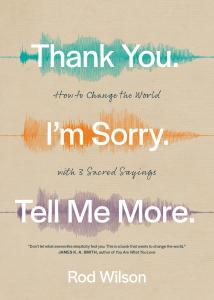 Taken from Thank You. I’m Sorry. Tell Me More.: How to Change the World with 3 Sacred Sayings by Rod Wilson. Copyright ©2022. Used by permission of NavPress. All rights reserved. Represented by Tyndale House Publishers, a Division of Tyndale House Ministries.

About Rod Wilson
Rod Wilson has worked as a psychologist, served as a pastor in three different churches, and held multiple roles in theological education, including President of Regent College in Vancouver, Canada from 2000-2015. Rod currently works with Lumara Grief and Bereavement Care Society, A Rocha, the Society of Christian Schools in BC, and In Trust Center for Theological Schools, and maintains an international teaching and mentoring ministry. His upcoming book, Thank You. I’m Sorry. Tell Me More., releases from NavPress in January 2022. You can read more about the author here.
Previous Post

November 4, 2021
Top 4 Holy Sites Off The Beaten Path
Next Post

November 24, 2021 Clanging Cymbals and a 21st Century Pandemic
Browse Our Archives
Select a Category Uncategorized
Select a Month November 2025 April 2025 March 2025 February 2025 October 2023 July 2022 May 2022 April 2022 March 2022 February 2022 January 2022 December 2021 November 2021 October 2021 September 2021 August 2021 July 2021 May 2021 April 2021 March 2021 February 2021 January 2021 December 2020 November 2020 October 2020 September 2020 August 2020 July 2020 June 2020 May 2020 April 2020 March 2020 February 2020 October 2018 March 2018
TAKE THE
Religious Wisdom Quiz
Which people attacked Israel at Rephidim and were defeated as Moses held up his hands?
Select your answer to see how you score.
Philistines Amalekites Midianites Moabites
Related posts from Christians in General

CEO Crisis: What New Data Reveals About Belief...

6 Trends in Modern Christian Persecution

3 Ways to Keep the Parables Alive

TRENDING AT PATHEOS General Christian

Seventy and Five Years Old: God Still Starts...
There is a small detail tucked into Genesis 12 that I skipped...

A Biblical Vision of Success in Christian Life...
The Concern and Quest Recent trends and tendencies I note around me...

Indigenous Peoples’ Day and the Church
Indigenous' Peoples Day or Columbus Day? Depending on where you live...

When Spiritual Growth Looks Like Losing Ground
Four Passive Spiritual Disciplines: An Introduction When I was a college freshman,...

Faith and Finding Your Current Season
“To everything there is a season,” Ecclesiastes tells us, “and a time...

Did Jesus Fear God's Wrath in Gethsemane?
That Time Jesus Was Terrified Before we begin, let me say at...
view all General Christian blogs
Ad-Free & Subscriber Log-In Subscription Support
- About Us
- 2026 Calendar
- Videos
- Podcasts
- Library of World Religions
- Faith In Media Tracker
- Advertise With Us
- Write for Us
- Privacy Policy
- Terms of Service
- Do Not Sell My Data
- Contact Us
- Radiant Digital
- Manage Newsletter Subscriptions
- Unsubscribe From Notifications
- Sitemap
Copyright 2008-2026, Patheos. All rights reserved.
Subscription Support Ad-Free & Subscriber Log-In
Follow Patheos