
BuddhistCatholicContemplativeEvangelicalGeneral ChristianHinduJewishLatter-day SaintMuslimNew VisionsProgressive Christian
Beliefs
- Buddhist
- Catholic
- Contemplative
- Evangelical
- General Christian
- Hindu
- Jewish
- Latter-day Saint
- More Voices
- Muslim
- New Visions
- Pagan
- Progressive Christian
Topics
- Religion News
- Food and Religion
- Sports and Religion
- Religious Art
- Religious Music and Entertainment
- Religious Events
- History and Religion
- Style and Religion
- Politics and Religion
- Women in Religion
- Recreation Outdoors and Religion
- Business Finance and Religion
- Careers Workplace and Religion
- Education and Religion
- Family Parenting and Religion
- Health Fitness and Religion
- Home and Religion
- Relationships and Religion
- Technology and Religion
- Travel and Religion
Columnists
- Buddhist Columnists
- Business Finance and Religion Columnists
- Careers Workplace and Religion Columnists
- Catholic Columnists
- Contemplative Columnists
- Education and Religion Columnists
- Evangelists Columnists
- Family Parenting and Religion Columnists
- General Christian Columnists
- Health Fitness and Religion Columnists
- Hindu Columnists
- History and Religion Columnists
- Home and Religion Columnists
- Jewish Columnists
- More Voices Columnists
- Latter Day Columnists
- Muslim Columnists
- New Visions Columnists
- Nonreligious Columnists
- Pagan Columnists
- Politics and Religion Columnists
- Progressive Columnists
- Recreation Outdoors and Religion Columnists
- Relationships and Religion Columnists
- Religion News Columnists
- Religious Art Columnists
- Religious Events Columnists
- Religious Music and Entertainment Columnists
- Sports and Religion Columnists
- Style and Religion Columnists
- Technology and Religion Columnists
- Travel and Religion Columnists
- Women in Religion Columnists
Resource Library
- 2026 Calendar
- Library of World Religions
- The 100 Most Holy Places on Earth
- Patheos Answers
- Podcasts
- Videos
- Faith Leaders Database
- Anglican Episcopalian
- Bahai
- Baptist
- Buddhism
- Christianity
- Confucianism
- Eastern Orthodoxy
- Hinduism
- Holiness and Pentecostal
- ISKCON
- Islam
- Judaism
- Lutheran
- Methodist
- The Church of Jesus Christ of Latter-day Saints
- New Age
- Paganism
- Presbytarian and Reformed
- Protestantism
- Religion Behind the Scenes
- Roman Catholic
- Scientology
- Shia Islam
- Sikhism
- Sufism
- Sunni Islam
- Taoism
- Zen
- See all religions
Research Tools
 Ad-Free & Subscriber Log-In Subscription Support
Ad-Free & Subscriber Log-In Subscription Support
Follow Patheos 

- Trending:
- Forgiveness
- |
- Marriage
- |
- Consciousness
- |
- Death Penalty
- |
- Election
- |
- Halloween
 Christian Piatt
- Home
- Progressive Christian
- Titulus Crucis/Title of the Cross (Blood Doctrine, Chapter One)
Titulus Crucis/Title of the Cross (Blood Doctrine, Chapter One)
Last updated on: January 2, 2014 at 6:13 pm by Christian Piatt
Titulus Crucis/Title of the Cross (Blood Doctrine, Chapter One) 2014-01-02T18:13:03+00:00 Christian Piatt
Patheos Explore the world's faith through different perspectives on religion and spirituality! Patheos has the views of the prevalent religions and spiritualities of the world.
In the final days of the campaign to raise the funds to self-publish my novel, Blood Doctrine, I’m sharing early chapters in the manuscript in rough form so folks can get a sense of the story. We’re nearly two-thirds of the way to our goal, with less than six days to go. Thanks for any help you can offer in backing the project and spreading the word!
Click Here to read more about the Kickstarter campaign.
 “Hey Nica,” said Edward, the crusty, stout New Yorker editor twenty years her senior, “what’s a six-letter word for ‘vagabond?’” Nica maintained her gaze, fixed on the screen before her.
“Harlot,” she answered.
“I thought that was a prostitute,” grunted Edward, tossing a handful of sunflower seeds into his mouth. Since his wife put him on a diet, he replaced the M & M’s on his desk with something far more labor-intensive and equally unsatisfying. For a few days, he stuffed the shells in his cheek like a rodent, sucking on them one at a time and cracking them between his molars. Soon he grew weary of the process and began devouring them, shells and all.
“That’s what it means now,” said Nica, pulling her chestnut hair into a ponytail. “It used to mean someone without roots. After that, it referred to a male libertine.”
“You’re making that up,” said Edward, picking at a splintered shell from between his teeth.
“Over time,” she continued, “it became a deprecating word for women.”
“No shit.”
“It’s not that surprising really,” said Nica, pulling out her Oxford Dictionary of English Etymology. “Do you know how many sexually derogatory words there are for women in the English language?”
“No,” sighed Edward, “but I’m afraid you’re about to tell me.”
“A hell of a lot more than there are for men,” she slid the dense volume across the desk toward him, more to emphasize her point than out of an expectation that he would challenge her claim.
“I should know better than to ask a woman with a degree in feminist literature about words,” said Edward. “Yet another testicular power conspiracy revealed.”
“It all comes down to sex and power,” smiled Nica. “Throughout history, men have used power to get sex, and women have used sex to get power.”
“Sadly,” said Edward, grabbing another handful of seeds, “I have no prospect of either.”
“You doing a story?” asked Nica. Edward lifted a folded newspaper he had resting on his lap.
“New York Times crossword,” admitted Edward. “I figured you’d know the answer. Just didn’t expect a lecture.”
“You just got lucky,” said Nica. “I happened to learn plenty about harlots in my graduate class on women in the Bible.”
Nica was fascinated with the genealogy of Jesus, particularly regarding the differences between the lineages outlined in the gospels. While doing research for a college paper, she discovered that many scholars believed the account in Luke actually was referring to the bloodline of Mary, but because maternal lineage was not considered valid, the name ultimately was changed to Joseph. With some further digging, she learned that ancient DNA samples, such as those found occasionally in ancient ossuaries and other Middle Eastern artifacts, generally were traceable only through the maternal bloodline.
“Whereas ancient literature’s legacy is the celebration of the families of our fathers,” Nica once wrote in her weekly newspaper column at the Dallas Morning News, “science confounds such hegemony with hard evidence, left behind by the enduring genetic legacy of women.” Nathan, her managing editor at the News, had dressed her down on two counts for that article. Not only was she stirring up a relative hornet’s nest by spouting feminist ideology in one of the Bible Belt’s most prominent papers, but she did it in a way, using such words as ‘hegemony,’ that simply made the general readership feel ignorant.
“Is it my fault if the average reader has the vocabulary of a seventh-grader, and the critical thinking skills of my niece?” argued Nica.
“No,” said Nathan, “of course not. But it is your fault if those same people stop buying our paper because of what you write.” Despite their occasional clashes, Nathan afforded Nica a relatively wide berth to explore more controversial matters in her Saturday section. Though he often did not agree with her, Nathan respected her, which she deemed was more important. In fact, he had been the one to recommend her for the New Yorker job, for which she was grateful.
Click Here to read more about the Kickstarter campaign.
At the New Yorker, where it was common practice to challenge readers to reach for their thesaurus, and where East Coast principles were more tolerant of her sort of bent, she had sufficient creative room to breathe. Edward, Nica’s boss at the New Yorker, was more of a partner than a supervisor. The egalitarian climate was the perfect environment for a strong personality like hers, and her budget was significantly larger than at the News. Instead of being responsible for several rudimentary pieces a week, Nica was expected to produce more detailed investigative stories about organized religion, generally given four to six weeks to complete an article of several thousand words.
Despite his abrasive, terse mannerisms, Edward rarely shot down Nica’s ideas. In general, it was assumed that if you had the chops to make it onto the New Yorker staff, you no longer needed a mother hen hovering over your shoulder, checking grammar and word counts.
Though the magazine projected an image of austerity and elegance, the inner sanctum of the Lions’ Den, as the main editorial floor was called, was cluttered, noisy and dimly lit. Desks were crammed together in clusters of four around knotted tangles of computer cables and phone lines. Televisions, mounted on support columns, murmured in a hypnotic drone throughout the day on the respective news channels.
Edward, a staple of the Lion’s Den, was the archetypal New York editor. He downplayed his intellectual acuity with a disheveled wardrobe and bowling-league physique. Nica suspected Edward had more than professional feelings for her, though he never did anything to violate her trust or make her uncomfortable. He was more of an adoring father figure than a potential suitor, and though he complained benignly about his marriage, he and his wife had been faithful to one another for three and a half decades.
One of the greatest, and most ironic, drawbacks of her career as a religion writer was that Nica adorned herself with the pessimistic mantle of a journalist so often that her faith meshed clumsily with her fierce pragmatism, which was at the heart of her gifts as a reporter. Though she had expected that life as a religion writer would strengthen her theological resolve, she seemed instead to question her own beliefs more every day.
Despite her cynicism, she had pursued her share of cold leads too far, especially early in her time at the newspaper. Perhaps the most infamous case was when she spent three months investigating a rumored group known only as The Project. Some with whom she spoke believed they were related to the Merovingians, who were the heirs of an ancient French dynasty, mythologized as protectors of the supposed bloodline of Jesus. Others believed they were involved in genetic engineering experiments such as cloning, and still others were confident The Project was a post-apocalyptic survivalist cult. Nica’s travel stipend from the paper ran out in a little over two months, but she used her own money and the balance of her vacation to continue the pursuit. In the end, the quest yielded nothing but more anecdotes and unverifiable conjecture, as well as some hard-earned wisdom for the young reporter.
Nica was just finishing up a story about a botanist in Israel who had nurtured some recently discovered date palm seeds back to life after two thousand years of dormancy when she received an email from Gordon, a colleague in Boston. The heading read, “Essene relic revisited – what do you know?” Gordon was well connected in gossip circles, but as a tabloid reporter, he hardly had the juice to make the real contacts necessary for hard news stories. When he had a lead and wanted to find out more, he usually sent it on to Nica.
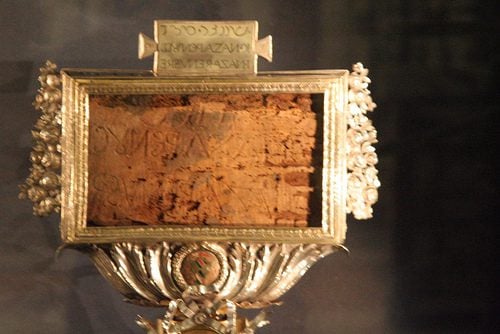
This particular rumor indicated that a name plate from an ancient crucifixion had been discovered in the Qumran caves where the ancient, mysterious Jewish sect known as the Essenes had lived. The find was made in 1948, the year following the discovery of the Dead Sea Scrolls in the same network of caves. The existence of the scrolls led to an intense excavation of the entire area, which led to hundreds of other artifacts being found, each of varying degrees of historical significance. Some offered clues about the enigmatic Essenes, about which the modern world knew very little but speculated greatly.
The name plate was argued to bear remnants of the title bestowed upon Jesus at the time of crucifixion: “King of the Jews.” However nay-sayers were quick to discredit the find on a number of grounds, and there was little enough available at the time to refute the overwhelming arguments against its authenticity. Instead of being further examined, it was placed in the care of the Israeli Antiquities Authority, warehoused along with tens of thousands of other artifacts in a set of enormous storehouses.
Click Here to read more about the Kickstarter campaign.
Gordon’s paper was running a piece in their upcoming edition implying that the relic was indeed authentic. As usual, they had no scientific basis for their claim, but they spun an intriguing story about connections between the name plate and the ossuaries found in the Jesus Tomb, recently popularized by a sensational documentary on the subject. Clearly, Nica mused, they were grasping at anything to cash in on the fervor surrounding the film and subsequent book. However, she determined that doing an investigation piece on the supposed connection might make for an interesting story of her own. If nothing else, she could write a response to the tantalizing claims that surround the tombs and the ossuaries found there, dispelling yet another emerging religious myth.
“Thanks for the tip G-man,” wrote Nica. “I’ll give my guy at the I.A.A. a call and see what he has to say. Will let you know once I have something worth sharing.”
Nica had met Ibrahim at a conference on Biblical artifacts in New York, where he presented a paper on advances in artifact tracking using computer technology. It was not her particular area of interest, but the two struck up a friendship that spanned the continents upon his return to Israel. He had begun his work at the Israel Antiquities Authority as a clerk more than fifteen years prior. Now he was the director of recording and cataloguing. She imagined his daily routine to be dreadfully monotonous and lifeless, although he was always ebullient when she called. Whether it was his normal disposition or if his mood lifted because of her calls, she was not sure.
“Nica, my dear,” said Ibrahim, “it has been too long since we last spoke.”
“I know. It really has. How are you doing?”
“God blesses me every day,” said Ibrahim. “I have two beautiful sons, and my wife is pregnant with our third child.”
“Wow,” exclaimed Nica. “It doesn’t seem like it’s been that long. You work fast.” Ibrahim let forth a raspy, abdominal laugh.
“I have been traveling less,” he said, “which means I have spent more evenings at home.” He laughed again.
“Send me some pictures?”
“Of course,” said Ibrahim. “Now, although I could talk about my family all day long, my guess is you didn’t call from New York to inquire about my children.”
“Actually, I have some questions about something you have in your catalog.” She explained the lead she received from Gordon, and Ibrahim interjected before she could finish her story.
“Ah, yes,” he said. “You’re referring to the titulus crucis.”
“I’m not sure about the Latin,” said Nica, “but that sounds right. Do you know how to get some information on it?”
“Actually,” said Ibrahim, “I have the file on my desk. You’re the fourth person to call about it this week. Every time I start to put the file back, someone else asks about it.” Nica grimaced.
“I know I shouldn’t ask, but–”
“No, no reporters,” he assured her. “You’re the first. Only a couple of academics and one of the administrators at the Vatican.”
“Thanks Ibrahim,” she said. “I’m curious about any records of samples taken from the–”
“Tilulus crucis,” said Ibrahim. “It means ‘Title of the Cross.’”
“Any chance you can tell me who has taken samples from the titulus crucis?” There was silence on the other end of the line, followed by a muffled voice. After several seconds, Ibrahim removed his hand from the receiver.
“Give me your fax number,” he said in a subdued voice, “and a couple of hours.”
“Ibrahim,” said Nica, leaning back in her chair, “you’re a prince.”
“One thing,” warned Ibrahim, “you never got anything from me. Understand?” His voice was uncharacteristically grave.
“I understand,” Nica assured Ibrahim, “I won’t forget it, seriously.” She gave him her fax number and hung up the phone.
“What the hell’s the matter with you?” asked Edward, dumping the rest of the sunflower seeds from his desk into the trash. “Somebody die or something?”
“I’m not sure,” said Nica, “I think I just need to eat something. You hungry?”
“That goes down as one of the top five dumbest things anyone’s ever asked me,” said Edward. “What do you think?”
When Nica got back from lunch, the fax was sitting on her desk. The source number was blocked, and there was no cover letter. There was no reference to the titulus crucis on the page: only her name scribbled at the top, followed by three more names, professional affiliations and dates. The first sample was taken in 1981, the year the titulus was discovered. The recipient was Dr. Binyamin Abijah from PaleoTech Labs, a contractor for the I.A.A. They were commissioned with authenticating newly found artifacts. The most recent date was a month prior, registered by a man named Dr. Vaughan Pavel from the Max Planck Institute in Leipzig. The third, registered to Dr. Damian Armitage from Pennsylvania State University, was taken in June, 1985.
“I’ll be damned,” said Nica.
“Something wrong?” said Edward, glancing up from his crossword.
“I don’t know for sure,” she said, turning toward a nearby window, yellowed with years of Manhattan pollution. “I think I need to take a trip to Pennsylvania.”
Click Here to read more about the Kickstarter campaign.
Previous Post

January 2, 2014
Rivers in the Desert: Why New Years Day Is a Christian Holiday
Next Post
January 2, 2014 Five Things That Will Shock Our Grandkids About Us
Browse Our Archives
Select a Category atonement belief bible Bill O'Reilly Buddhism CCM children christian piatt christianity Contemporary Christian Music current events derek flood Easter education Everyday Sunday faith faith and culture Frank Schaeffer great commission Haaz Sleiman Hobby Lobby Homebrewed Culture humor ISIS Jesus John Paul Lederach Killing Jesus LGBTQ marc driscoll Mission Year Music My Jesus Project Nat Geo parenting politics popular culture postChristian prison reform Ray rice religion republicans sacrifice sexuality theology Uncategorized video violence wild goose festival World Vision young adults
Select a Month December 2017 November 2017 October 2017 September 2017 August 2017 July 2017 June 2017 May 2017 April 2017 March 2017 February 2017 January 2017 November 2016 October 2016 September 2016 August 2016 July 2016 June 2016 May 2016 April 2016 March 2016 February 2016 January 2016 December 2015 November 2015 October 2015 September 2015 August 2015 July 2015 June 2015 May 2015 April 2015 March 2015 February 2015 January 2015 December 2014 November 2014 October 2014 September 2014 August 2014 July 2014 June 2014 May 2014 April 2014 March 2014 February 2014 January 2014 December 2013 November 2013 October 2013 September 2013 August 2013 July 2013 June 2013 May 2013 April 2013 March 2013 February 2013 January 2013 December 2012 November 2012 October 2012 September 2012 August 2012 July 2012 June 2012 May 2012 April 2012 March 2012 February 2012 January 2012 December 2011 November 2011 October 2011 September 2011 August 2011 July 2011 June 2011 May 2011 April 2011 March 2011 February 2011 January 2011 December 2010 November 2010 October 2010 September 2010 August 2010 July 2010 June 2010 May 2010 April 2010 March 2010 February 2010 January 2010 December 2009 November 2009 October 2009 September 2009 August 2009 July 2009 June 2009 May 2009 April 2009 March 2009 February 2009 January 2009 December 2008 November 2008 October 2008 September 2008 August 2008 July 2008 June 2008 May 2008 April 2008 March 2008 February 2008 January 2008 December 2007 November 2007 October 2007 September 2007 August 2007 July 2007 June 2007 May 2007 April 2007 March 2007 February 2007 January 2007 December 2006 November 2006 October 2006 September 2006 August 2006
Follow Us!
TAKE THE
Religious Wisdom Quiz
What does "Amen" originally mean?
Select your answer to see how you score.
Let it happen So be it Praise God Be true
Related posts from Christian Piatt

More Than Jezebel (Third Week Advent Devotional)

Are We There Yet? (Second Week in Advent...

Look, Shiny! (First Week of Advent Study)

TRENDING AT PATHEOS Progressive Christian

What Being a Modern-Day Apostle Means to Me
In my last column, I discussed the ins and outs of modern-day...

Did Ancient China Once Worship the God of...
Across human history, a common thread weaves through the origins of the...

Love Your Neighbor – Including Earth-Kin: Lev. 19,...
God’s command to love your neighbor means acting in an ethical and...

Lead a Church Study of “Jesus and Lao...
Guest writer Jack Thomas (The Irreverent Reverend) reflects on leading his church...

Pastoral Wisdom for Responding to Sermon Pushback
Getting sermon pushback on your social justice sermon? Learn practical, Proverbs-based strategies...

Principles for Understanding the Apostolic Ministry Today
Whenever people discover that my formal ministry title is "apostle," as in...
view all Progressive Christian blogs
Ad-Free & Subscriber Log-In Subscription Support
- About Us
- 2026 Calendar
- Videos
- Podcasts
- Library of World Religions
- Faith In Media Tracker
- Advertise With Us
- Write for Us
- Privacy Policy
- Terms of Service
- Do Not Sell My Data
- Contact Us
- Radiant Digital
- Manage Newsletter Subscriptions
- Unsubscribe From Notifications
- Sitemap
Copyright 2008-2026, Patheos. All rights reserved.
Subscription Support Ad-Free & Subscriber Log-In
Follow Patheos