
BuddhistCatholicContemplativeEvangelicalGeneral ChristianHinduJewishLatter-day SaintMuslimNew VisionsProgressive Christian
Beliefs
- Buddhist
- Catholic
- Contemplative
- Evangelical
- General Christian
- Hindu
- Jewish
- Latter-day Saint
- More Voices
- Muslim
- New Visions
- Pagan
- Progressive Christian
Topics
- Religion News
- Food and Religion
- Sports and Religion
- Religious Art
- Religious Music and Entertainment
- Religious Events
- History and Religion
- Style and Religion
- Politics and Religion
- Women in Religion
- Recreation Outdoors and Religion
- Business Finance and Religion
- Careers Workplace and Religion
- Education and Religion
- Family Parenting and Religion
- Health Fitness and Religion
- Home and Religion
- Relationships and Religion
- Technology and Religion
- Travel and Religion
Columnists
- Buddhist Columnists
- Business Finance and Religion Columnists
- Careers Workplace and Religion Columnists
- Catholic Columnists
- Contemplative Columnists
- Education and Religion Columnists
- Evangelists Columnists
- Family Parenting and Religion Columnists
- General Christian Columnists
- Health Fitness and Religion Columnists
- Hindu Columnists
- History and Religion Columnists
- Home and Religion Columnists
- Jewish Columnists
- More Voices Columnists
- Latter Day Columnists
- Muslim Columnists
- New Visions Columnists
- Nonreligious Columnists
- Pagan Columnists
- Politics and Religion Columnists
- Progressive Columnists
- Recreation Outdoors and Religion Columnists
- Relationships and Religion Columnists
- Religion News Columnists
- Religious Art Columnists
- Religious Events Columnists
- Religious Music and Entertainment Columnists
- Sports and Religion Columnists
- Style and Religion Columnists
- Technology and Religion Columnists
- Travel and Religion Columnists
- Women in Religion Columnists
Resource Library
- 2026 Calendar
- Library of World Religions
- The 100 Most Holy Places on Earth
- Patheos Answers
- Podcasts
- Videos
- Faith Leaders Database
- Anglican Episcopalian
- Bahai
- Baptist
- Buddhism
- Christianity
- Confucianism
- Eastern Orthodoxy
- Hinduism
- Holiness and Pentecostal
- ISKCON
- Islam
- Judaism
- Lutheran
- Methodist
- The Church of Jesus Christ of Latter-day Saints
- New Age
- Paganism
- Presbytarian and Reformed
- Protestantism
- Religion Behind the Scenes
- Roman Catholic
- Scientology
- Shia Islam
- Sikhism
- Sufism
- Sunni Islam
- Taoism
- Zen
- See all religions
Research Tools
 Ad-Free & Subscriber Log-In Subscription Support
Ad-Free & Subscriber Log-In Subscription Support
Follow Patheos 

- Trending:
- Forgiveness
- |
- Marriage
- |
- Consciousness
- |
- Death Penalty
- |
- Election
- |
- Halloween
 Christian Piatt
- Home
- Progressive Christian
- Emergent Christian Cliches to Avoid
Emergent Christian Cliches to Avoid
Last updated on: September 18, 2015 at 5:48 pm by Christian Piatt
Emergent Christian Cliches to Avoid 2015-09-18T17:48:20+00:00 Christian Piatt
Patheos Explore the world's faith through different perspectives on religion and spirituality! Patheos has the views of the prevalent religions and spiritualities of the world.

To learn about Christian Piatt’s new project, “A**hole Christian Survival Guide,” and to pre-order your copy, CLICK HERE. The humorous illustrated book will include these and other Christian cliches, games and a lot more.
Following the creation of my first five articles in this ongoing series about Christian cliches (links below), I was alerted to the fact that my lists were notably absent of particular cliches often employed by emergent Christians. While the emergent Christians are endeavoring to re-imagine the way we engage faith, one another and the world differently, the movement still is dependent on human beings. As such, we tend to screw it up.
So in the spirit of fairness, I offer you a list of things emergent Christians can and should strike from our daily lexicon…
We Don’t Use Gender-Exclusive Language for God. There has been plenty of pushback against speaking of God only as a “he,” and this has been addressed with new worship music, updated translations of the Bible and from the pulpit. And while it can be affirming to speak of God in broader terms, while also recognizing the baggage some people carry with regard to certain terminology for God, it’s unfair to suggest that any gender-specific descriptions of God are somehow inaccurate or inferior. If some people find comfort in thinking of God as father, mother or even both, it’s not our place to take that away from them. engaging in substantive discussions about why we all use the words and imagery we do to describe God can be a good thing, but not if we’re starting from a position of having some kind of theological high ground.
Is this (fill in the blank) fair trade/organic/locally grown/humanely raised? I think it’s great that part of the ecological and social stewardship at the heart of the emergent Christian movement is to know more about where all of the goods we consume come from, and at what cost. But making a big scene about such values in public serves to draw attention to ourselves more than the cause we value if not done with some discretion. And as the text in Proverbs says, to everything there is a season. There are times to ask where your chicken came from, but probably not when you’re a guest at someone’s dinner table. Trying to make others feel bad because they don’t share your values only serves to buttress the stereotype of Christians as morally superior, arrogant and insensitive.
I’ve kind of moved beyond the whole (fill in the blank) Christian doctrine. I bristle as much as anyone in emergent Christianity when someone tries to pin me down with a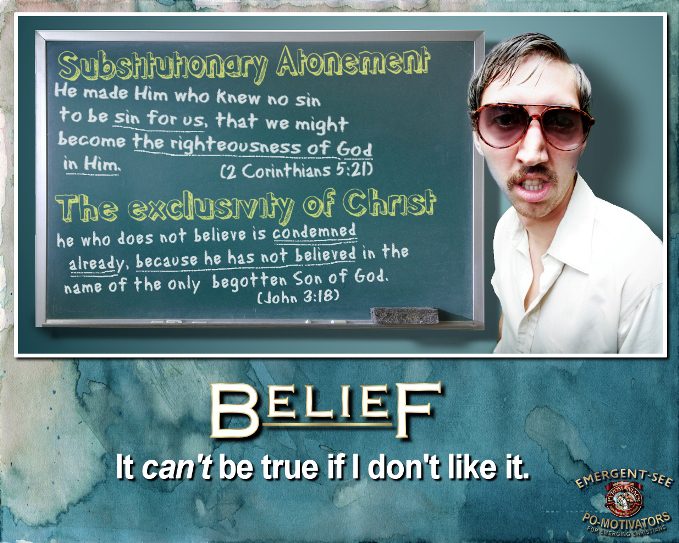 certain Christian doctrine like my position on the trinity or my doctrine of salvation. But to reject these traditions outright is both a potential affront to those who still embrace them as well as a rebuff of our religious history. It’s healthy to have a reason for embracing or setting aside doctrines of our faith, but if we talk about getting over them or moving past them, it implies those who don’t agree with us are, well…dumb.
That is a very colonial/imperial attitude. Most people would agree that plenty of harm has been done in the name of the Christian faith, or faith in general, for that matter. And while some call for the dissolution of religion all together, others believe that it is the marriage of faith to the power of a political empire that creates the real abomination of an otherwise peaceful and affirming faith. But while it is a worthwhile endeavor to seek to separate Christianity from its history of Christendom, casting knee-jerk judgments on sentiments or perspectives held by others only deepens the divide between two already deeply-entrenched camps. Yes, Jesus spoke truth, but he did it in love. And if we’re not coming yet from s place of love, it’s probably best not to speak at all.
I love Jesus but not religion/the Church. Though this kind of began as an emergent Christian mantra, it’s actually begun to be embraced even by some evangelicals. But can we really cast such a broad net over the whole of organized religion and the entire history of the church? Has nothing good at all come from our two thousand years of history? Can we take nothing forward with us, despite our resistance to the established norms of institution? The whole “I love this but hate that,” attitude reeks of modernist duality, which seems to work directly against what emergents claim to value. So be bold in critiquing the institutions of power in our midst, religion included, but don’t throw our entire collective history under the proverbial bus because the phrase trends well on Twitter.
We don’t do traditional worship. Emergents tend to define ourselves as much or more by what we’re not than by what we are. And like the cliche above, we have a bad habit (bordering on tradition?) of kicking everything that smacks of traditionalism to the curb. Yes, some traditions become false idols that should be challenged, if not completely toppled. But tradition also is part of how we continue to create and pass on our collective story. Plus, while many emergents reject the very idea of tradition, we’re already in the process of creating some new traditions of our own. I wonder how we’ll react when a future cohort of Christians calls us on our own dusty, rigid ways?
BONUS CLICHE:
This last one isn’t necessarily limited to emergents at all, but it came to mind as I was wrapping up the list I’ve created so far. Plus, after compiling the list of emergent cliches above, I realized I had thirty-nine, so I squeezed out one more to make for a nice, round number.
I don’t (insert activity here); I’m a Christian. It’s fine that you choose to live differently because of your faith. In fact, one’s faith should inform much about their daily life. But by making public announcements about what you do and don’t do because of your religious beliefs, you’re not only implicitly casting judgment on those who think or act differently than you; you’re also exalting yourself, which I’m pretty sure is something Christians aren’t supposed to do. Yes, I know we can find a Biblical basis for “boasting in Christ,” but if what you’re doing makes you look like a self-righteous tool, you’re probably doing more harm than good.
Read article one in the series here: Ten Cliches Christians Should Never Use
Read article two in the series here: Ten More Cliches Christians Should Avoid
Read article three in the series here: Nine (Final) Christian Cliches to Avoid
Read article four in the series here: Ten Antidotes to Christian Cliches
Read article five in the series here: Five New Christian Cliches to Avoid
Previous Post

November 6, 2012
The Presidential & VP Debates: A Bad Lip Reading Recap
Next Post
November 9, 2012 Homebrewed CultureCast Post-Election Special with Jim Wallis
Browse Our Archives
Select a Category atonement belief bible Bill O'Reilly Buddhism CCM children christian piatt christianity Contemporary Christian Music current events derek flood Easter education Everyday Sunday faith faith and culture Frank Schaeffer great commission Haaz Sleiman Hobby Lobby Homebrewed Culture humor ISIS Jesus John Paul Lederach Killing Jesus LGBTQ marc driscoll Mission Year Music My Jesus Project Nat Geo parenting politics popular culture postChristian prison reform Ray rice religion republicans sacrifice sexuality theology Uncategorized video violence wild goose festival World Vision young adults
Select a Month December 2017 November 2017 October 2017 September 2017 August 2017 July 2017 June 2017 May 2017 April 2017 March 2017 February 2017 January 2017 November 2016 October 2016 September 2016 August 2016 July 2016 June 2016 May 2016 April 2016 March 2016 February 2016 January 2016 December 2015 November 2015 October 2015 September 2015 August 2015 July 2015 June 2015 May 2015 April 2015 March 2015 February 2015 January 2015 December 2014 November 2014 October 2014 September 2014 August 2014 July 2014 June 2014 May 2014 April 2014 March 2014 February 2014 January 2014 December 2013 November 2013 October 2013 September 2013 August 2013 July 2013 June 2013 May 2013 April 2013 March 2013 February 2013 January 2013 December 2012 November 2012 October 2012 September 2012 August 2012 July 2012 June 2012 May 2012 April 2012 March 2012 February 2012 January 2012 December 2011 November 2011 October 2011 September 2011 August 2011 July 2011 June 2011 May 2011 April 2011 March 2011 February 2011 January 2011 December 2010 November 2010 October 2010 September 2010 August 2010 July 2010 June 2010 May 2010 April 2010 March 2010 February 2010 January 2010 December 2009 November 2009 October 2009 September 2009 August 2009 July 2009 June 2009 May 2009 April 2009 March 2009 February 2009 January 2009 December 2008 November 2008 October 2008 September 2008 August 2008 July 2008 June 2008 May 2008 April 2008 March 2008 February 2008 January 2008 December 2007 November 2007 October 2007 September 2007 August 2007 July 2007 June 2007 May 2007 April 2007 March 2007 February 2007 January 2007 December 2006 November 2006 October 2006 September 2006 August 2006
Follow Us!
TAKE THE
Religious Wisdom Quiz
What bird did Noah release second from the ark?
Select your answer to see how you score.
A raven An eagle A sparrow A dove
Related posts from Christian Piatt

More Than Jezebel (Third Week Advent Devotional)

Are We There Yet? (Second Week in Advent...

Look, Shiny! (First Week of Advent Study)

TRENDING AT PATHEOS Progressive Christian

What Being a Modern-Day Apostle Means to Me
In my last column, I discussed the ins and outs of modern-day...

Did Ancient China Once Worship the God of...
Across human history, a common thread weaves through the origins of the...

Love Your Neighbor – Including Earth-Kin: Lev. 19,...
God’s command to love your neighbor means acting in an ethical and...

Lead a Church Study of “Jesus and Lao...
Guest writer Jack Thomas (The Irreverent Reverend) reflects on leading his church...

Pastoral Wisdom for Responding to Sermon Pushback
Getting sermon pushback on your social justice sermon? Learn practical, Proverbs-based strategies...

Principles for Understanding the Apostolic Ministry Today
Whenever people discover that my formal ministry title is "apostle," as in...
view all Progressive Christian blogs
Ad-Free & Subscriber Log-In Subscription Support
- About Us
- 2026 Calendar
- Videos
- Podcasts
- Library of World Religions
- Faith In Media Tracker
- Advertise With Us
- Write for Us
- Privacy Policy
- Terms of Service
- Do Not Sell My Data
- Contact Us
- Radiant Digital
- Manage Newsletter Subscriptions
- Unsubscribe From Notifications
- Sitemap
Copyright 2008-2026, Patheos. All rights reserved.
Subscription Support Ad-Free & Subscriber Log-In
Follow Patheos